Rapid Prototyping Methods: How to Pick One, Costs and Lead Times
Compare rapid prototyping methods by the question each answers - fit, function, appearance or durability - with real costs and lead times.
February 13, 20226 min read

Written by Ralph Hill, Mechanical & electrical systems, 3D manufacturing
Prototyping Engineer
Published February 13, 2022Updated September 2, 2026
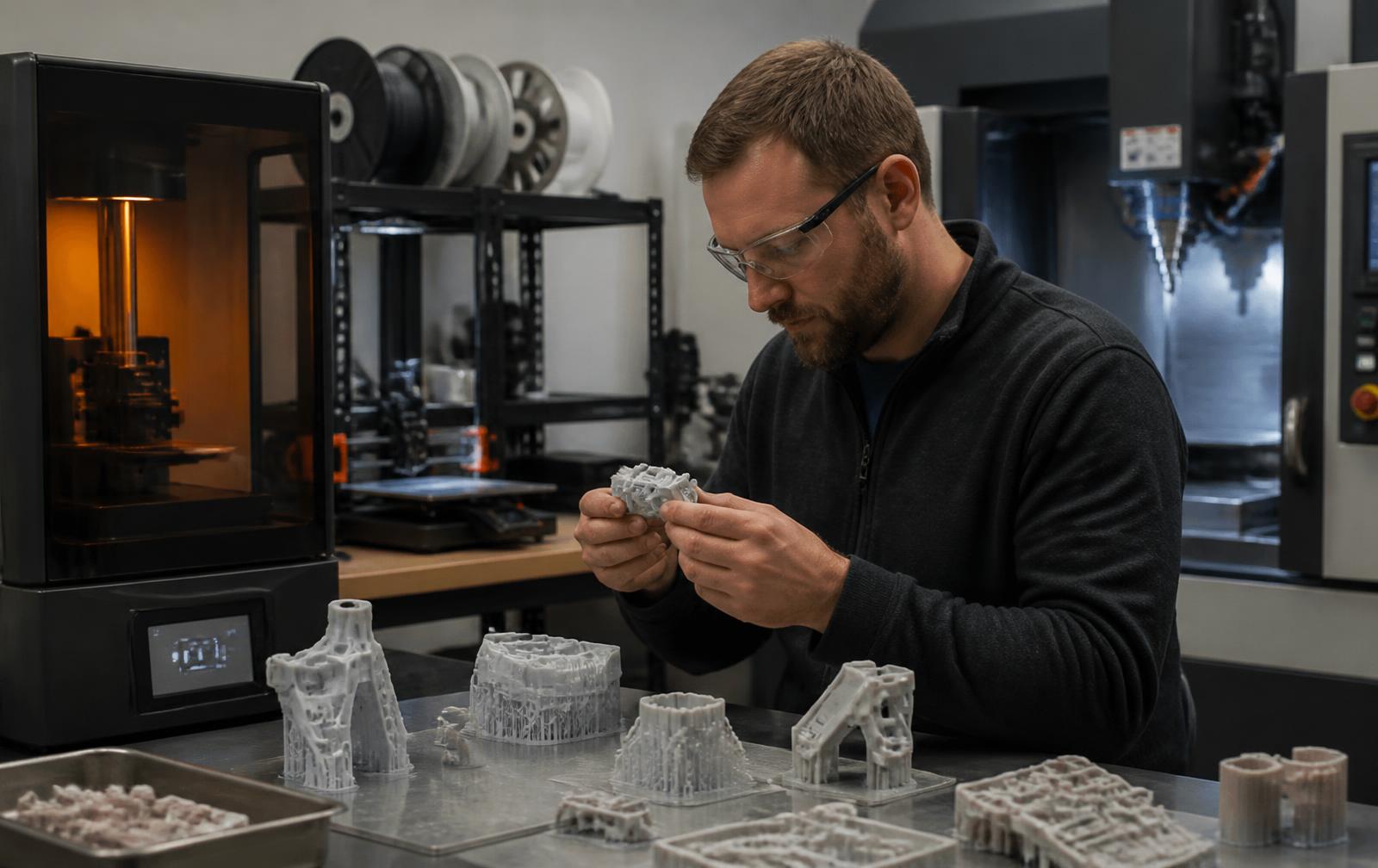
A prototype is a question you ask in physical form. The right rapid prototyping service depends entirely on which question you are asking - does it fit, does it work, does it look right, or will it survive a customer. Our Shreveport prototyping floor runs FDM, resin, powder-bed printing, CNC machining and short-run production under one roof so a design can move between methods without changing suppliers.
Which rapid prototyping method should you use?
Match the method to the decision. Fit checks and early form studies belong on FDM because the parts are cheap and you will print several revisions in a day. Anything with fine detail, clear windows or a cosmetic surface goes to resin. Functional parts that must snap, flex or take a load are best in SLS nylon. When the prototype has to behave like the production part in the production material, machine it or cast it.
Method | Typical tolerance | Materials | Lead time | Typical part cost |
|---|---|---|---|---|
FDM | +/-0.20-0.50 mm | PLA, ABS, PETG, ASA, nylon | 1-3 days | $20-$150 |
SLA / DLP resin | +/-0.05-0.15 mm | Rigid, tough, clear, high-temp resins | 1-3 days | $40-$300 |
SLS nylon | +/-0.10-0.30 mm | PA12, PA11, glass-filled nylon | 2-5 days | $60-$400 |
Cast urethane | +/-0.15-0.30 mm | Rubber-like and ABS-like urethanes | 7-12 days | $60-$250 per part, 15-50 parts |
CNC machining | +/-0.01-0.05 mm | Aluminum, steel, POM, PC, PEEK | 3-7 days | $150-$1,200 |
How much do rapid prototyping services cost?
Per-part pricing is only half the picture. A realistic prototyping budget covers CAD preparation, the build itself, finishing and the iteration you know is coming. Most hardware programs run three prototype rounds before design freeze, and each round is faster and more expensive than the last as the parts get closer to production intent.
Round | Purpose | Duration | Typical cost |
|---|---|---|---|
Round 1 - looks-like | Form, ergonomics, stakeholder review | 1-2 weeks | $1,500-$5,000 |
Round 2 - works-like | Mechanism, electronics integration, bench test | 2-4 weeks | $5,000-$18,000 |
Round 3 - production intent | Real materials, real process, user or field test | 4-6 weeks | $12,000-$45,000 |
How fast can you get a prototype?
- Same day to 3 days - printed fit checks and appearance models from clean CAD.
- 3-7 days - machined metal parts and multi-part printed assemblies with basic finishing.
- 1-2 weeks - assembled works-like prototypes with electronics, wiring and firmware loaded.
- 2-4 weeks - cast urethane or short-run bridge parts in production-like materials.
- Lead times start when the CAD is manufacturable, not when the purchase order arrives - unresolved wall thicknesses and missing tolerances are the most common delay.
Designing parts that prototype well
- Hold 1.5-2.0 mm nominal walls so printed and molded versions behave alike.
- Add draft early - a prototype that ignores draft hides the tooling problems you will pay for later.
- Design snap fits and living hinges in the material you intend to mold, not in whatever prints fastest.
- Split large parts at seams that will exist in production, not at the edge of the build volume.
- Model fastener bosses, ribs and clearances now; re-adding them after user testing restarts validation.
From prototype to short-run production
Our Shreveport facility was built so a program does not have to change hands between prototyping and first production. The same engineers who print round one run the bridge builds, the fixtures and the inspection plan, which means tolerances and assembly steps carry forward instead of being rediscovered by a new supplier. Related reading: our rapid prototyping service and injection molding cost and break-even.
Choosing a method by the question you need answered
Prototyping methods are not ranked from worst to best; they answer different questions. A foam block answers ergonomics. A printed shell answers proportion and fit.
A CNC-machined part answers stiffness and tolerance. A vacuum-cast batch answers whether twenty reviewers can hold something that looks like the product. Picking the cheapest process for the question, rather than the most impressive process available, is what keeps a prototyping budget under control across a program.
Question | Method | Typical lead time | Typical cost |
|---|---|---|---|
Does it feel right in the hand? | Foam or clay model | 2-4 days | $300-$2,000 |
Do the parts fit together? | FDM or SLA print | 1-3 days | $50-$500 |
Will it survive load? | CNC machined part | 5-10 days | $200-$1,500 |
Can twenty people evaluate it? | Vacuum casting batch | 10-15 days | $2,500-$9,000 |
Does the production process work? | Bridge tool short run | 3-5 weeks | $6,000-$18,000 |
Running a prototype cycle that stays on budget
- Write the question the prototype must answer before choosing a process.
- Batch several open questions into one build to share setup cost.
- Keep a prototype log: revision, purpose, result, decision made.
- Prototype the riskiest subsystem first, not the most visible one.
- Reuse fixtures and test rigs across revisions.
- Stop iterating once the question is answered; polish belongs to a later phase.
Sequencing prototypes across a program
Programs run smoothly when prototype builds are sequenced against decision gates rather than produced on demand.
A typical hardware program uses four builds: a proof-of-principle build that answers the core technical risk, an alpha build that integrates subsystems, a beta build made with production-intent materials and processes, and a pilot run from production tooling.
Each build has a defined exit criterion, and a build that does not answer a question should not be scheduled.
The discipline pays off in supplier conversations too. Manufacturers quote confidently against a beta build with production-intent parts and hesitantly against a bag of printed models. Getting to production-intent earlier, even in small quantities, is usually what unlocks accurate quotes and realistic lead times.
Build | Purpose | Quantity | Exit criterion |
|---|---|---|---|
Proof of principle | Retire the core technical risk | 1-3 | Function demonstrated |
Alpha | Integrate subsystems | 5-15 | Subsystems work together |
Beta | Production-intent materials | 20-50 | Passes pre-compliance testing |
Pilot | Validate tooling and process | 100-500 | First-article approval |
Choosing a prototyping method by what it must prove
The method should follow the question. A prototype that proves fit does not need production material; a prototype that proves a snap-fit will survive 500 cycles absolutely does. Picking on price alone is how teams end up with a beautiful model that answers nothing.
Method | Proves | Lead time | Cost per part | Material fidelity |
|---|---|---|---|---|
FDM | Size, layout, basic fit | 1–3 days | $15–$120 | Low |
SLA / DLP | Surface, detail, appearance | 2–4 days | $30–$300 | Low (brittle) |
SLS (nylon) | Functional fit, living hinges, snaps | 3–6 days | $40–$400 | Medium-high |
MJF | Functional parts, small batches | 3–6 days | $35–$350 | High |
CNC machining | Tolerance, stiffness, real material | 5–12 days | $120–$1,200 | High |
Urethane casting | 20–200 near-production parts | 10–20 days | $25–$90 | Medium-high |
Bridge tooling | Real process, real material, pilot run | 3–6 weeks | $3–$18 | Production |
Cost drivers worth knowing before you quote
- Machining cost tracks setups, not size — a part needing five orientations costs more than a bigger part needing two.
- SLA cost tracks Z-height, so laying a tall part down can halve the price.
- Powder processes charge for the packed build volume; nesting several parts in one build is nearly free capacity.
- Tight tolerance callouts on non-functional surfaces are the most common avoidable cost on machined prototypes.
- Cosmetic finishing (sanding, primer, paint to a color standard) often exceeds the printing cost itself.
Iteration cadence that actually converges
Effective teams run tight loops: build, test against a written question, change one class of thing, rebuild. Three fast loops in three weeks beat one perfect build in six. Keep a prototype log listing each build, the question it answered and the resulting design change — it becomes the evidence trail for the design freeze and stops the team relitigating decisions made two months earlier.
When to stop prototyping
- The remaining open risks can only be answered by production tooling or certified testing.
- Two consecutive builds produced no design change.
- Fit, function and cost estimates are all inside their target bands.
- A manufacturer has reviewed the CAD and returned a DFM report with no blocking items.
We run this loop for clients out of our own shop — see rapid prototyping services.
Frequently asked questions
What are rapid prototyping services?
Rapid prototyping services turn CAD into physical parts in days using additive manufacturing, CNC machining and urethane casting, so a design can be evaluated for fit, function and appearance before tooling is committed.
How much does a prototype cost?
Individual printed or machined parts run roughly $20 to $1,200 depending on process and size. A complete prototype round for a small device - parts, assembly and finishing - typically costs $1,500 to $18,000, with production-intent rounds reaching $45,000.
How long does rapid prototyping take?
Printed parts ship in one to three days and machined parts in three to seven. A fully assembled working prototype with electronics usually takes one to two weeks from released CAD.
Key takeaways
- Every prototype should answer one written question.
- Prototype the riskiest subsystem before the most visible one.
- Keep a prototype log so decisions are traceable.
- Stop iterating once the question is answered.
Send us your CAD and the decision you are trying to make. We will recommend the cheapest method that answers it and quote the build.
Choosing a prototyping shop you can actually build with
The cheapest quote rarely produces the cheapest program. A prototyping partner earns its keep when the parts it makes answer a specific question — fit, function, appearance, or manufacturability — and when the process it chooses maps onto how the product will eventually be made.
Ask any shop three questions before you send a purchase order: which process they recommend and why, what tolerance they will hold on the features you flag as critical, and what they would change in the CAD to make the part cheaper in production.
A shop that answers all three is doing engineering; a shop that answers none is selling machine time.
Location matters more than most teams expect. Same-day pickup on an appearance model, a walk-through when a fixture does not seat correctly, and a hands-on review of a wall thickness problem all compress days out of a development schedule. That is why regional shops in places like Shreveport and Ruston remain useful even when an online quoting portal is a browser tab away — the value is the conversation, not just the part.
What to ask before the first order
- Which process fits the question this prototype must answer, and what the closest production analogue is.
- Achievable tolerance on your critical-to-function dimensions, stated in numbers rather than adjectives.
- Material substitutions the shop recommends, and how the substitute differs from the production resin or alloy in stiffness and heat resistance.
- Turnaround for a first article versus a revision, so you can plan iteration loops rather than single builds.
- Whether the shop will provide a written DFM note with the parts — the most valuable deliverable you can get for free.
Work with LA NPDT: if you are moving from here to execution, start with our rapid prototyping services or talk to us about prototype design.
Filed under:Uncategorized
Services related to this guide
- Is a local firm the right call?When proximity matters, which regions do what, and how to vet a remote team.
- Product development in LouisianaWhere to take an idea in-state, plus the free programs most inventors miss.
- Best product development companiesHow the leading US firms compare, and which one fits your stage and budget.
- Product development examplesReal projects we designed, prototyped and shipped.