Inventing a Product: A 7-Step Guide From Idea to Shelf
Inventing a product in seven steps - validation, prior art, prototyping, protection, costing, manufacturing and the licensing decision.
July 4, 20198 min read

Written by Konstantin Dolgan, Ph.D., NPDP
Founder & CEO, Product Development Engineer
Published July 4, 2019Updated September 2, 2026
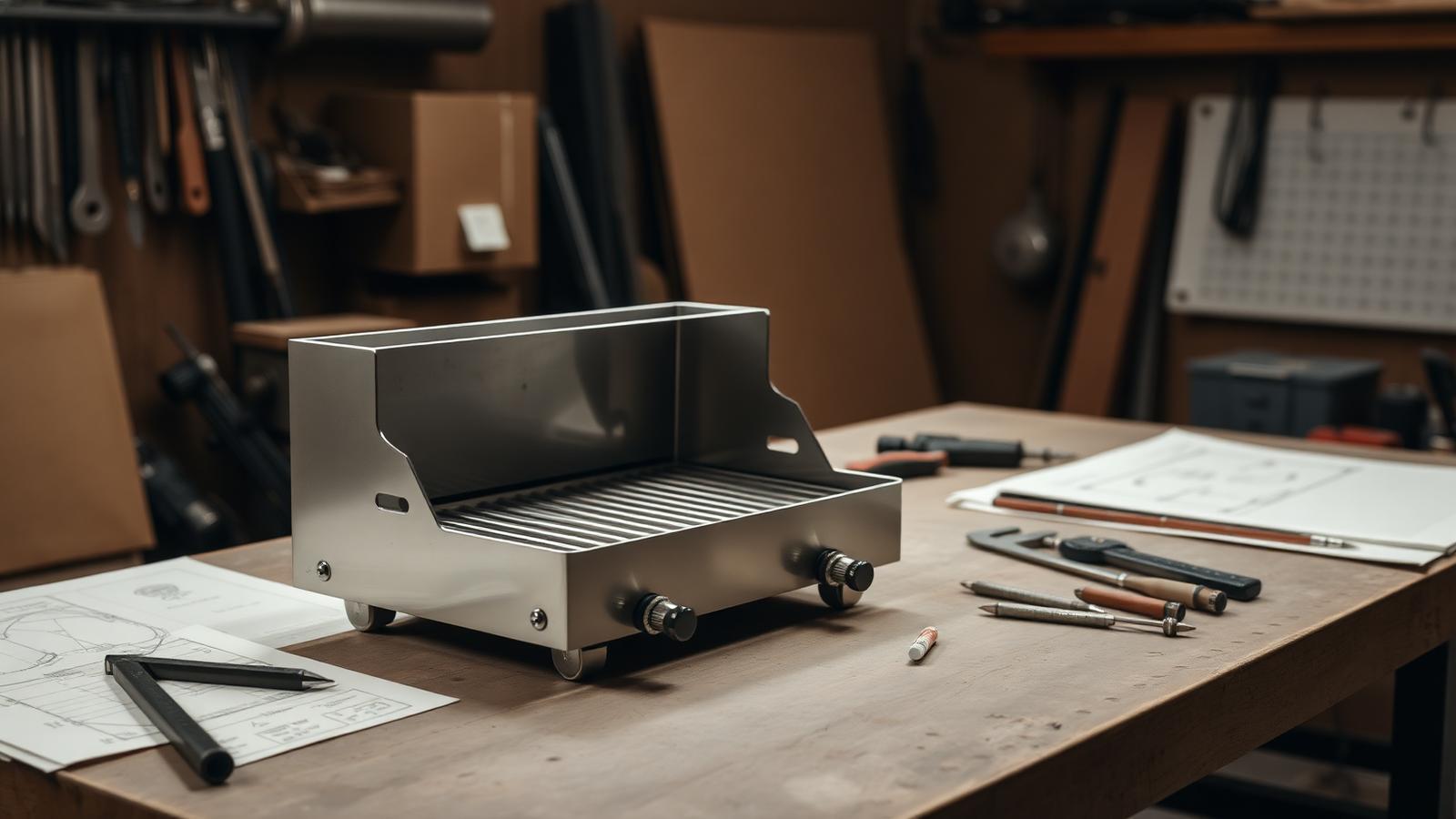
Inventing something is a sequence, not an event: define a problem, sketch solutions, check what already exists, prototype the risky part, test it with real users, protect it, then make it. George Stephen did exactly this in 1952 when he cut a marine buoy in half because open brick grills could not control heat or keep ash off food - the kettle grill that resulted still sells today. The steps below are the modern version of that path, with realistic durations and costs.
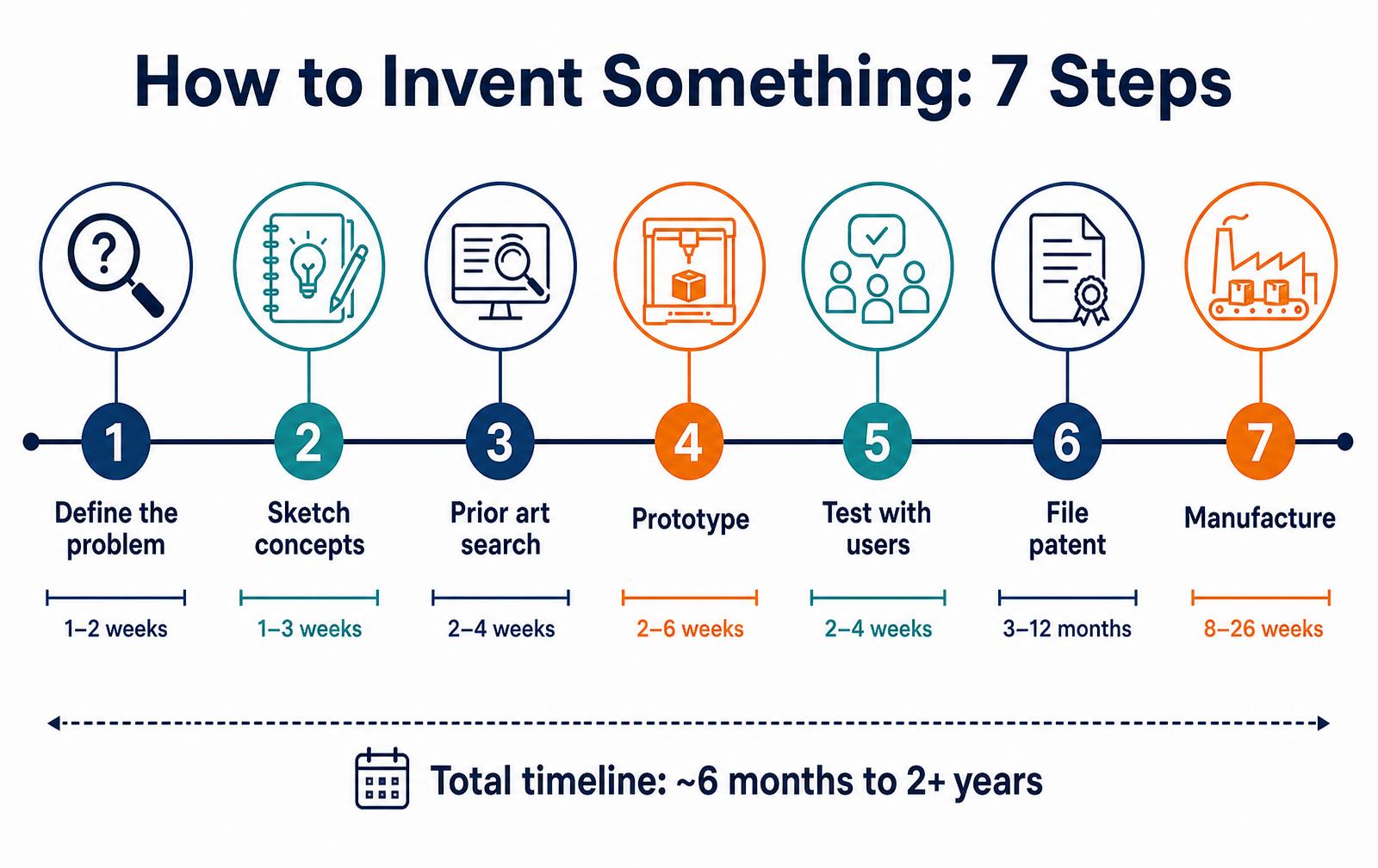
The seven steps at a glance
Step | What you produce | Duration | Typical cost |
|---|---|---|---|
1. Define the problem | One-sentence problem statement and target user | 1-2 weeks | $0 |
2. Sketch concepts | 5-10 concepts, one chosen | 1-3 weeks | $0-$5,000 |
3. Prior-art search | Search report and freedom-to-operate view | 2-4 weeks | $500-$3,000 |
4. Prototype | Working model of the risky function | 2-6 weeks | $1,500-$25,000 |
5. Test with users | Feedback log and design changes | 2-4 weeks | $0-$8,000 |
6. File a patent | Provisional, then utility | 3-12 months | $2,000-$20,000 |
7. Manufacture | Tooling, first article, production | 8-26 weeks | $8,000-$150,000+ |
Step 1-2: Define the problem, then sketch
Write the problem as who, when and what it costs them: "Backyard cooks cannot hold 225F for six hours without babysitting vents." A problem statement that survives contact with ten strangers is worth designing against. Then sketch broadly before narrowing - the first idea is rarely the cheapest one to build.
Step 3: Search prior art before you spend
- Search Google Patents and USPTO by function, using at least three phrasings.
- Check live marketplaces and crowdfunding - commercial prior art matters as much as filings.
- Note expired patents: free to use, impossible to own.
- Decide early whether your edge is a patent, a cost structure or a brand.
Step 4-5: Prototype the risky part and test it
Prototype the single function most likely to fail, not the whole product. A looks-like model answers appeal; a works-like model answers physics. Test with eight to twelve target users, watch rather than ask, and log every change. Two cheap iterations beat one expensive first attempt.
Step 6: Protect what is worth protecting
- Provisional patent - twelve months of priority for $2,000-$5,000 with counsel.
- Utility patent - protects function; $8,000-$20,000 and two to four years to grant.
- Design patent - protects appearance; $1,500-$3,500 and often the better fit for consumer goods.
- Trade secret - right choice when the advantage is a process nobody can reverse-engineer.
Step 7: Make it
Design for manufacture before quoting: consolidate parts, standardise fasteners, remove undercuts and set tolerances only where they matter. Quote with two or three factories, run a first article inspection and a pilot batch before mass production. Aim for a landed cost at or below one third of your intended retail price.
Frequently asked questions
How do I invent something with no money?
The first four steps cost almost nothing: define the problem, sketch, search prior art yourself through Google Patents and a Patent and Trademark Resource Center, and build a cardboard or 3D-printed prototype at a library or university maker space. Spend money only after a real user has tried the prototype.
How long does it take to invent something?
Six months to two years for most physical products. Design and prototyping take three to six months, patent prosecution runs in parallel, and tooling plus first production adds four to six months.
Do I need a prototype to file a patent?
No - patents require an enabling written description, not a physical unit. In practice a prototype makes the description far stronger and reveals claims you would otherwise miss.
What makes an invention successful?
A frequent problem, a buyer who names a price, a cost structure that leaves margin, and a channel you can actually reach. Novelty alone has never sold a product.
Related reading: finding and validating invention ideas, preparing an invention for production and our rapid prototyping services.
Inventing a product is a sequence, not a moment
The story of an invention is usually told as a flash of insight followed by success. The reality is a sequence of small, cheap decisions that each remove a way the idea can fail. Independent inventors who succeed are rarely the ones with the best idea; they are the ones who spent the least money reaching the point where they knew whether the idea was worth funding.
The order matters. Money spent on tooling before evidence of demand is money spent proving nothing. Money spent on a patent before a novelty search is often money spent protecting something that already exists.
Stage gates for an independent inventor
Stage | Question it answers | Typical spend | Gate to pass |
|---|---|---|---|
Problem evidence | Does anyone else have this problem? | $0-500 | 15+ unprompted confirmations |
Prior art search | Has it been done? | $0-2,500 | No blocking claim found |
Provisional filing | Can I speak about it safely? | $1,500-4,000 | Application on file |
Looks-like prototype | Do people want it when they see it? | $500-4,000 | Pre-orders or letters of intent |
Works-like prototype | Does the mechanism work? | $3,000-20,000 | Function proven under real load |
Cost and manufacturability | Can it be made at a viable price? | $2,000-10,000 | Quoted landed cost under target |
Route decision | Licence or manufacture? | - | Signed term sheet or funded first run |
Evidence before spend
The cheapest validation available is a conversation in which you do not describe your solution. Ask people how they currently handle the problem, what it costs them, and what they have already tried and abandoned. When someone has already spent money on a workaround, you have found a real market. When everyone agrees it is a nice idea but nobody has tried anything, you have found a hobby.
- Talk to twenty people who have the problem before building anything.
- Ask what they bought last time they tried to solve it, and what happened to that purchase.
- Count how many describe the problem before you name it — unprompted mentions are the signal.
- Test willingness to pay with a real price, not a hypothetical one.
- Search marketplaces for near-substitutes; read the one-star reviews, which are your feature list.
Protection: what to file and when
Instrument | What it protects | Cost range | When to use |
|---|---|---|---|
Provisional application | A filing date for 12 months | $1,500-4,000 | Before any public disclosure |
Utility patent | How it works | $8,000-20,000 | After market evidence exists |
Design patent | How it looks | $1,500-4,000 | Distinctive appearance products |
Trademark | The brand name | $1,000-2,500 | Before packaging and listings |
Trade secret | Process know-how | Internal cost | Manufacturing methods not visible in product |
A provisional application is the right first step for most inventors because it is cheap, fast, and buys a year in which to test demand before committing to the far larger utility expense. It is not a patent, and it only covers what it actually describes — a two-page sketch will not support broad claims later.
The prototype ladder
Rung | Purpose | Method | Cost |
|---|---|---|---|
Sketch and cardboard | Size, layout, ergonomics | Hand-built | Under $100 |
Looks-like model | Reaction and pre-orders | 3D print, painted | $300-3,000 |
Works-like rig | Prove the mechanism | Machined or off-the-shelf parts | $1,000-10,000 |
Integrated prototype | Both, for demonstration | Combination build | $5,000-25,000 |
Production-intent | Real materials and process | Soft tooling or short run | $10,000-60,000 |
Do not skip rungs to impress someone. A licensee needs to believe the mechanism works and that the product will sell; both are provable with a works-like rig and a looks-like model, at a fraction of the cost of a production-intent unit.
Honest cost math for a physical product
Line | Rule of thumb | Example at $79 retail |
|---|---|---|
Landed manufacturing cost | 20-25% of retail | $16-20 |
Packaging and fulfilment | 5-8% of retail | $4-6 |
Retail or marketplace margin | 40-50% of retail | $32-40 |
Marketing and acquisition | 10-20% of retail | $8-16 |
Returns and warranty reserve | 2-5% of retail | $2-4 |
Remaining to inventor and overhead | Whatever is left | $0-17 |
This table is why the four-times-cost pricing rule exists. An inventor who costs a product at half of retail has no business, regardless of how good the invention is.
Licence or manufacture
Factor | Licensing | Manufacturing yourself |
|---|---|---|
Capital needed | Low, mostly IP and prototypes | High, tooling and inventory |
Return per unit | 2-6% royalty on wholesale | Full margin, minus all costs |
Speed to market | Depends on the licensee's calendar | Your calendar |
Control | Minimal after signature | Complete |
Risk | Mostly time and opportunity cost | Financial and operational |
Best when | Category has strong incumbents | Niche the incumbents ignore |
How to recognise an invention-promotion trap
- Unsolicited enthusiasm about your idea before anyone has evaluated it technically.
- A large up-front fee for a 'market evaluation' or 'submission package'.
- Refusal to give success statistics, or vague claims about 'connections' with manufacturers.
- Pressure to file quickly through their in-house agent rather than an attorney you chose.
- Deliverables that are documents rather than working hardware, quotes or signed interest.
- A legitimate partner tells you what could go wrong and quotes specific engineering work with defined outputs.
More questions teams ask
How much does it cost to invent a product and bring it to market?
For a moderately complex consumer product, plan on $20,000-$60,000 through validated prototypes and quotes, plus $15,000-$80,000 for injection tooling and a first production run. Simple products can be far less; anything with electronics or regulatory exposure is substantially more.
Do I need a patent to sell my invention?
No, but you need one to stop someone else copying it, and licensees generally will not sign without at least a filed application. If the plan is to manufacture in a niche the large players ignore, speed and brand may protect you better than a patent would.
What is the biggest mistake first-time inventors make?
Spending the largest sums first — tooling and full patents — before proving anyone will buy. The correct order inverts the spend curve: cheap evidence first, expensive commitments only once demand and cost are known.
Can I show my invention at a trade show before filing?
Not safely. Public disclosure starts a twelve-month clock in the United States and immediately forfeits rights in most other countries. File a provisional application first; it is inexpensive relative to what disclosure can cost you.
How long does it take to go from idea to shelf?
Twelve to twenty-four months is typical for a mechanical consumer product with no regulatory burden. The variable is rarely engineering — it is the time spent finding funding, a licensee, or a manufacturer willing to work at first-run volumes.

Costing the product before you commit to tooling
Most first-time inventors price backwards: they add up what the parts cost and put a margin on top. Retail works the other way.
Start from the shelf price a shopper will accept, subtract retailer margin, distributor margin, freight, duty, returns and your own overhead, and whatever survives is the landed unit cost you must design toward.
If the number that comes back is $4.10 and your prototype costs $11 to build, the fix is a design change - fewer parts, a cheaper process, less finishing - not a hopeful volume assumption.
Line item | Share of $29.99 shelf price | Notes |
|---|---|---|
Retailer margin | $12.00 (40%) | Higher for specialty retail |
Distributor / broker | $3.00 (10%) | Skip only if selling direct |
Freight, duty, warehousing | $1.80 | Ocean freight, 20-25 units per carton |
Returns and damage allowance | $0.90 (3%) | Budget it before it happens |
Your gross margin target | $8.20 | Funds marketing, tooling payback, support |
Landed unit cost ceiling | $4.09 | Design target for BOM plus assembly |
Choosing a manufacturer without losing a year
- Send the same drawing package to three suppliers - unequal packages produce unquotable quotes.
- Ask for tooling cost, per-part cost at three volumes, lead time and first-article date as separate line items.
- Require a named process and material spec; substitution is where quality quietly leaves.
- Ask what they would change about the part to reduce cost - the answer reveals how much they actually read.
- Pay for a T1 sample run before releasing the full tooling balance.
Common ways the seven steps go wrong
Mistake | When it shows up | Cost to unwind |
|---|---|---|
Filing a patent before user testing | Step 6 | $8k-$20k on claims that no longer match the product |
Prototyping the easy part first | Step 4 | Weeks lost, real risk untouched |
Skipping the prior-art search | Step 3 | Redesign or licensing fees after launch |
Tooling before the price ceiling is known | Step 7 | $15k-$60k of steel for an unsellable cost |
One supplier quote | Step 7 | 20-40 percent overpayment on tooling |
The kettle grill worked because Stephen tested the shape in his own backyard before anyone tooled it. The order of operations has not changed: prove the risky function cheaply, learn the price the market will bear, then spend the money that is hard to get back.
How long each step really takes for a first-time inventor
Published timelines assume a full-time team. A solo inventor working evenings should roughly double every duration in the table above, and should expect the prototype stage to loop two or three times before the risky function behaves. That is not failure - it is the cheapest place in the whole programme to be wrong. A $2,000 printed part that fails a drop test has saved you a $40,000 tool that would have failed the same test in steel.
Budget calendar time for the parts you do not control: prior-art search reports come back in two to four weeks, patent examiners respond in months, and overseas tooling adds two weeks of shipping on each sample cycle. Plan the dependent tasks - packaging artwork, compliance testing, retail line reviews - to run alongside those waits rather than after them.
Protecting the idea without overspending
A provisional application costs a few hundred dollars in fees and buys twelve months of priority while you test the market.
Use that year to answer the questions that decide claim scope: which feature customers actually pay for, which geometry survives manufacturing, and whether a design patent on the visible shape is worth more than a utility claim on the mechanism.
Filing a full utility application before those answers exist usually means paying an attorney twice - once to write claims, once to rewrite them.
- File a provisional only after a working prototype demonstrates the claimed function.
- Keep a dated build log with photographs; it supports inventorship and later disputes.
- Use NDAs with suppliers, but assume the real protection is speed and tooling ownership.
- Search design patents as well as utility patents - shape claims block products too.
- Decide on international filing before the 12-month deadline; extensions are expensive and rare.
Every step in this guide exists to make the next one cheaper to reverse. Follow the sequence and the worst case is a well-documented decision to stop; skip it and the worst case is a garage full of inventory the shelf never wanted.
Work with LA NPDT: if you are moving from here to execution, start with our product discovery for inventors or talk to us about prior art search.
Filed under:EducationInspiration
Services related to this guide
- Product design servicesIndustrial design and CAD taken all the way to manufacturable files.
- Rapid prototypingWorking prototypes in days, from 3D printing to vacuum casting.
- Electronic design servicesSchematic, PCB layout, firmware and bring-up, through to production handoff.
- Product development examplesReal projects we designed, prototyped and shipped.