Smart Security Solutions for your Business
A Security IoT system is ideal for small and developing businesses, thanks to the advent of IoT, you can do all remotely with a few taps on your smartphone.
February 9, 20228 min read

Written by Ashok Chintagunta, MS Computer Science, Louisiana Tech University
CTO & Software Engineer, AI and Automation
Published February 9, 2022Updated September 2, 2026
Smart Security IoT System Solutions for your Business
Keeping business properties secure is simple:
Let the right people in and keep the unauthorized ones out. Impregnability, however, often requires a tough negotiation between the quality of services and the cost. Much of the total cost for security systems is due to monitoring or the ability to track down any unauthorized activity. But, thanks to smart security systems, you can crush out large sums off of your business budget for monitoring and consider it affordably covered.
What is a Smart Security System?
The smart security system isn’t called so to imply that the older business security models are “non-smart.” Before smart security systems, the legacy security facility was effective too.
The “smart” in smart security system has something to do with IoT services,short for the Internet of Things.
Smart security essentially takes the monitors in facility systems and hooks them up with the internet and cellular phone systems to enable alerts and other notifications.
Such technology, enabled by an IoT system,allows you to keep track of your business properties via your smartphone. As a small business owner, you will be able to save up from expenses for a 24-hour monitoring service by security companies. With smart do-it-yourself and purpose-driven security solutions, the start-up costs are relatively lower and there are no monthly fees too.
What Makes Up a Smart Security System?
Whether you intend to hire somebody to install an IoT system or choose to assemble a smart security system yourself, it pays to know its composite parts. A smart security system can range from an extensive monitoring facility with video cameras and sensors or just one or two smart cameras.
You can also set up other IoT services such as smoke and motion detection or sound and temperature tracking. But, the rudimentary components of a smart security system include:
- Hub
The heart of a smart security system, the hub, is connected to your router, either via a cable or WiFi. The hub is what allows you to control the individual system devices using an app on your smartphone, iPad, or tablet. It communicates with all the devices that make up your smart security system through wireless protocols. Some systems use a simple WiFi connection, an open system such as Z-Wave, or other proprietary systems.
- Sensors
Sensors that detect motion, smoke, changes in temperature, or when entry points are breached. They can be set to trigger an alert, alarm, or automate a video activation for you to be able to monitor unauthorized activity.
- Access control
These are mechanisms that allow the entry of authorized personnel. It can be set up using an access code, a swipe of an employee identification card, or a biometric recognition. The access control system can be hooked to an alarm or alert system on your app to manage unauthorized entry.
- Security cameras
Cameras are, of course, an essential part of a security system as it provides footages of daily activities within your business. With an IoT system, you can remotely access the surveillance cameras using an app. There are systems that allow you to use cloud storage for the footages as well.
Which Smart Security System Fits Your Business?
There are mainly two categories of smart security systems that are suitable even for small business settings.
- All-in-one solutions
Security systems basically composed of smart cameras with built-in sensors. They can monitor motion, temperature, humidity, and other custom IoT services.
Notifications coming from data picked up by sensors can be sent to your smartphone, tablet, or computer. Services that notify third parties when you are unable to respond to the alerts are also available. There are companies that offer all-in-one solutions with costs ranging from $50-200 depending on the complexity of the services.
- Expandable systems
Expandable systems refer to customizable solutions. Generally, expandable systems have one hub or central device that controls the sensors, cameras, and other security devices. Such systems usually cost around $150 to as much as $1,500.
Smart security systems are ideal for small and developing businesses wherein changes are fast-paced. Thanks to the advent of IoT, there is much more room to wiggle around in terms of features and costs of security devices. The good thing is you can take ownership in monitoring your business and cut costs. Plus, you can do all these remotely and with a few taps on your smartphone.
Smart Security System Categories
Category | Description | Cost Range |
|---|---|---|
All-in-one solutions | Composed of smart cameras with built-in sensors. Monitor motion, temperature, humidity. | $50-$200 |
Expandable systems | Customizable solutions with a central hub controlling sensors, cameras, and other devices. | $150-$1,500 |
Sources and standards
- USPTO — patent basics — Official filing guidance from the US Patent and Trademark Office.
- WIPO PCT system — International patent filing route for products sold abroad.
- NIST Manufacturing Extension Partnership — Federal program supporting US small and mid-size manufacturers.
What a business-grade IoT security system actually requires
Most connected security deployments fail their first serious review not because the sensors are bad but because the system was assembled as a collection of devices rather than designed as a system.
A camera, a door controller and a motion sensor each secured in isolation still leave the network, the cloud account, the update mechanism and the installer credentials as open doors. An IoT security system is only as strong as its weakest link, and the weakest link is almost never the hardware.
Start with the threat model, in plain language: who would want in, what would they gain, and what would it cost you. A warehouse protecting inventory has a different model from a clinic protecting patient data or a manufacturer protecting process know-how. The model determines what you spend on, and without it, budget flows to whatever the vendor demonstrates most convincingly rather than to the risk that actually matters.
From there, the requirements are consistent regardless of vertical. Every device must have a unique identity rather than a shared default credential. Communication must be encrypted in transit and authenticated in both directions, so a spoofed gateway cannot harvest data or issue commands.
Firmware must be signed and updatable in the field, because a device you cannot patch is a device with a fixed expiry date. And the whole estate needs an inventory, because you cannot secure what nobody has listed.
Where the real risk sits
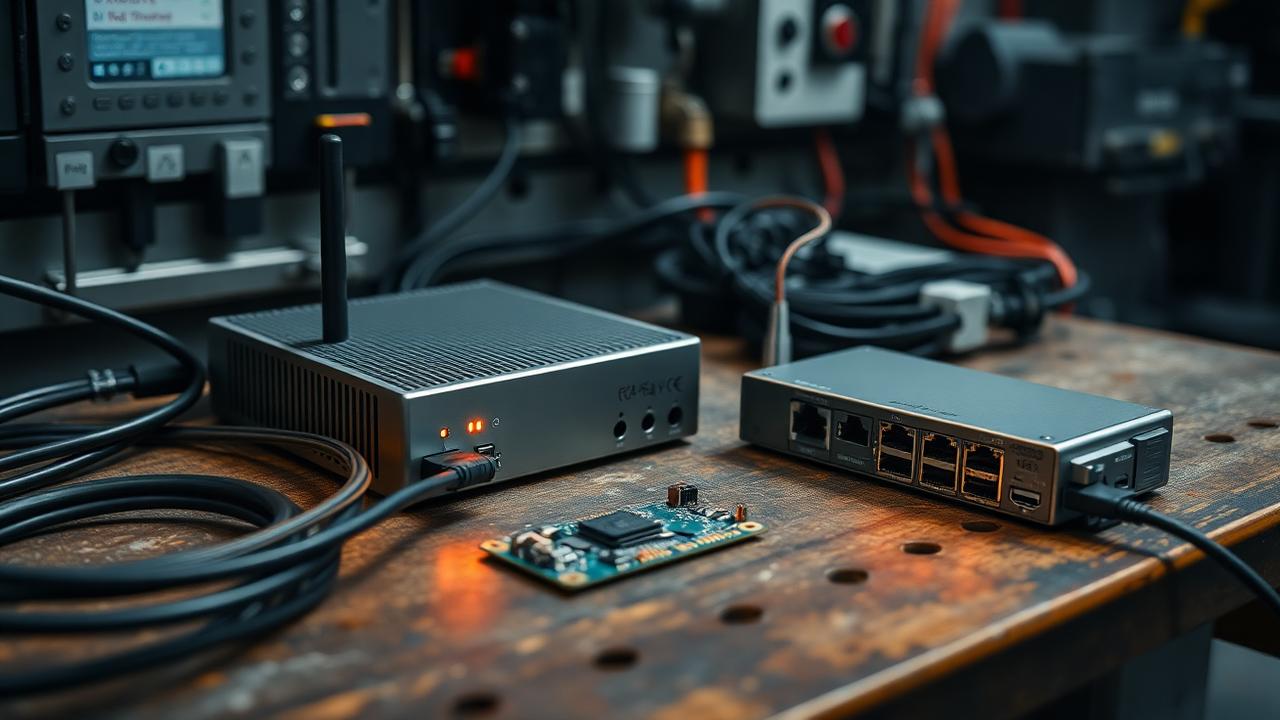
Segment the network before you buy anything else. Connected security devices belong on their own VLAN, with firewall rules that permit only the traffic they need and deny lateral movement to business systems.
The most common serious breach pattern in commercial buildings is not an attacker defeating a camera. It is an attacker reaching a flat network through a poorly secured device and moving sideways into finance or operations systems.
Segmentation turns a device compromise into a device problem instead of a company problem.
Then treat cloud accounts as part of the physical security perimeter. Multi-factor authentication on the management console, individual accounts rather than a shared installer login, and prompt revocation when a contractor leaves. A surprising share of incidents involve credentials that belonged to an integrator who finished the job two years earlier and never had access removed.
Finally, plan for degradation. Ask what the system does when the internet connection drops, when the cloud service has an outage, and when a battery sensor dies quietly. A security system that silently stops recording is worse than no system, because it produces confidence without coverage. Local recording buffers, heartbeat monitoring and alerting on absence of data all address the same failure class.
IoT security controls by risk and effort
Control | Risk it removes | Effort | Typical cost | When to do it |
|---|---|---|---|---|
Change default credentials, unique per device | Automated botnet compromise | Low | $0 | Day one, before devices go online |
Dedicated VLAN and firewall rules | Lateral movement into business systems | Low-medium | $0-$3,000 | At installation |
MFA on all management consoles | Credential theft and stale contractor access | Low | $0 | Day one |
Signed firmware and a patch schedule | Known exploited vulnerabilities | Medium | Vendor dependent | Procurement requirement |
Device inventory with end-of-support dates | Unpatchable orphan devices | Medium | $0-$2,000 | Before scaling past 20 devices |
Encrypted transport with mutual authentication | Traffic interception and spoofed commands | Medium | Vendor dependent | Procurement requirement |
Local recording buffer and heartbeat alerts | Silent outages and coverage gaps | Medium | $1,000-$8,000 | At installation |
Annual penetration test of the deployment | Configuration drift and unknown exposure | High | $8,000-$25,000 | Once the estate is business critical |
Procurement checklist for connected security devices
- Ask for the security support end date in writing. A device with no committed patch window is a liability with a warranty.
- Require unique per-device credentials or certificates, not a shared default password documented in a public manual.
- Confirm firmware is cryptographically signed and that updates can be applied without a site visit.
- Verify data residency and retention if video or access logs leave your premises, particularly for regulated environments.
- Demand an export path. If footage and logs can only be read in the vendor's app, you are locked in and evidentially exposed.
- Check integration protocols such as ONVIF, MQTT or standard REST APIs, so a vendor failure does not strand the installation.
- Include the installer's access removal in the acceptance checklist, with a named owner responsible for revoking it.
If you are building the devices rather than buying them, security has to be designed in at the architecture stage. Our IoT product development and electronic design services cover secure boot, provisioning and certification, and embedded software development handles the signed-update pipeline that keeps a fielded product patchable.
Frequently asked questions
What is an IoT security system?
It is a set of connected sensors, cameras, controllers and gateways that report to a central platform, together with the network, identity and update infrastructure that keeps them trustworthy. The connected part is what makes it useful, because events reach you anywhere, and it is also what makes it a target. Judged properly, the system includes the cloud account and the network design, not just the hardware on the wall.
How much does a business IoT security system cost?
For a small commercial site, hardware and installation typically land between eight and thirty thousand dollars, with recurring platform and storage fees of fifty to two hundred dollars per device per year. The costs people forget are network segmentation work, ongoing patch management and eventual device replacement when support ends, which together often exceed the original hardware spend over a seven-year life.
What is the biggest IoT security risk for a business?
Unpatched devices on a flat network, reached through default or shared credentials. That combination is behind the majority of real incidents, and all three parts are fixable cheaply: unique credentials cost nothing, segmentation is a configuration exercise, and patching is a procurement requirement you can write into the purchase order before anything is installed.
Should IoT security devices be on the main business network?
No. Put them on a dedicated VLAN with explicit firewall rules that allow only the outbound connections the platform requires and block everything toward internal business systems. This single change converts the most damaging failure mode, a compromised camera used as a foothold into finance or operations, into a contained problem affecting only the security estate.
Designing an IoT Security System That Holds Up
An IoT security system fails in predictable places: default credentials, an unencrypted local link, a cloud account nobody rotates, and a camera nobody checks until an incident. Treat the deployment as a set of controls tied to threats, rather than a shopping list of devices.
Threat | Where it happens | Control | Verification |
|---|---|---|---|
Default or shared credentials | Cameras, NVRs, gateways | Unique per-device passwords in a manager | Quarterly credential audit |
Unencrypted local traffic | Sensor to gateway link | TLS or an encrypted radio profile | Packet capture on install day |
Stale firmware | Every node | Signed OTA updates with rollback | Firmware version report monthly |
Flat network | Whole site | VLAN for devices, no route to business LAN | Segmentation test after changes |
Cloud account sprawl | Vendor portals | SSO plus named accounts, no shared logins | Offboarding checklist |
Physical tampering | Exterior nodes | Tamper switch plus alert routing | Trigger test per node |
Silent failure | Battery devices | Heartbeat and low-battery alerts | Weekly device health report |
Cost Model for a Single-Site Deployment
Item | Small site (5-10 nodes) | Mid site (25-40 nodes) |
|---|---|---|
Hardware | $1,500-4,000 | $8,000-20,000 |
Installation labor | $800-2,500 | $4,000-12,000 |
Network and segmentation work | $500-1,500 | $2,000-6,000 |
Monitoring and storage per year | $300-900 | $1,800-6,000 |
Maintenance per year | $400-1,000 | $2,000-5,000 |
Device Hardening Checklist
- Change every default credential during commissioning, not after.
- Disable UPnP, telnet and any unused ports on cameras and recorders.
- Put devices on their own VLAN with outbound rules only to the vendor cloud.
- Turn on automatic signed firmware updates where the vendor supports rollback.
- Record who owns each vendor portal account and remove access at offboarding.
- Test one alert path per month end to end, including the phone that should ring.
- Keep a written retention policy for footage; storing more than you need is a liability, not a feature.
For businesses developing their own connected products rather than buying them, the same list becomes a design requirement set. Secure provisioning, signed updates and a documented decommission path are far cheaper to build in during electronics design than to retrofit after the first field incident.
Work with LA NPDT: if you are moving from here to execution, start with our product discovery for inventors or talk to us about prior art search.
Services related to this guide
- Electronic design servicesSchematic, PCB layout, firmware and bring-up, through to production handoff.
- Rapid prototypingWorking prototypes in days, from 3D printing to vacuum casting.
- Product design servicesIndustrial design and CAD taken all the way to manufacturable files.
- Product development examplesReal projects we designed, prototyped and shipped.