Aerospace Component Manufacturing: Supply Tiers, Processes and Qualification
The structure of the aerospace supply chain, the processes behind flight hardware, and what AS9100, NADCAP and first article inspection cost in time and money.
August 25, 20168 min read

Written by Konstantin Dolgan, Ph.D., NPDP
Founder & CEO, Product Development Engineer
Published August 25, 2016Updated September 2, 2026
Aerospace manufacturing is a documentation business that happens to produce metal. The machining, forming and layup are demanding but well understood. What separates a supplier that wins aerospace work from one that quotes it and loses money is the quality system wrapped around the process - traceability, first article inspection, special-process accreditation and the discipline to change nothing without approval.
How the aerospace supply chain is structured
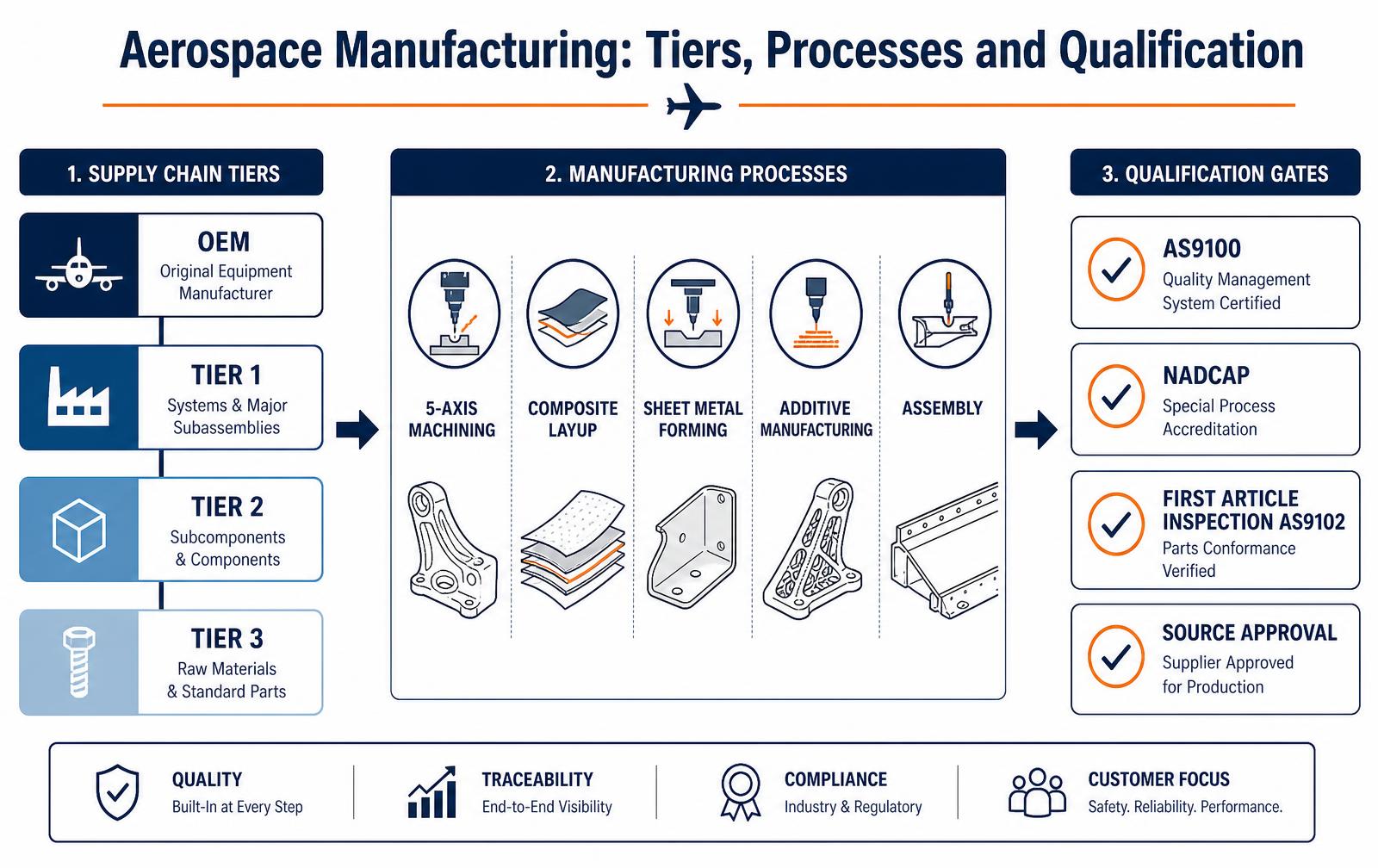
Work flows down four levels. The OEM integrates the aircraft or spacecraft. Tier 1 delivers systems and major structures - wings, landing gear, avionics suites. Tier 2 makes subassemblies and machined components. Tier 3 supplies raw material, fasteners and standard parts. Every level inherits the flow-down requirements of the one above it, which is why a small machine shop can find itself holding an aerospace-grade quality manual to sell a bracket.
Tier | Typical scope | Certifications expected | Typical order horizon |
|---|---|---|---|
OEM | Aircraft or spacecraft integration | AS9100, design authority | 5-20 years |
Tier 1 | Systems and major structures | AS9100, NADCAP, design and build | 5-15 years |
Tier 2 | Subassemblies and machined parts | AS9100, NADCAP for special processes | 2-7 years |
Tier 3 | Raw material, fasteners, standard hardware | AS9100 or AS9120 for distributors | 1-5 years |
Core aerospace manufacturing processes
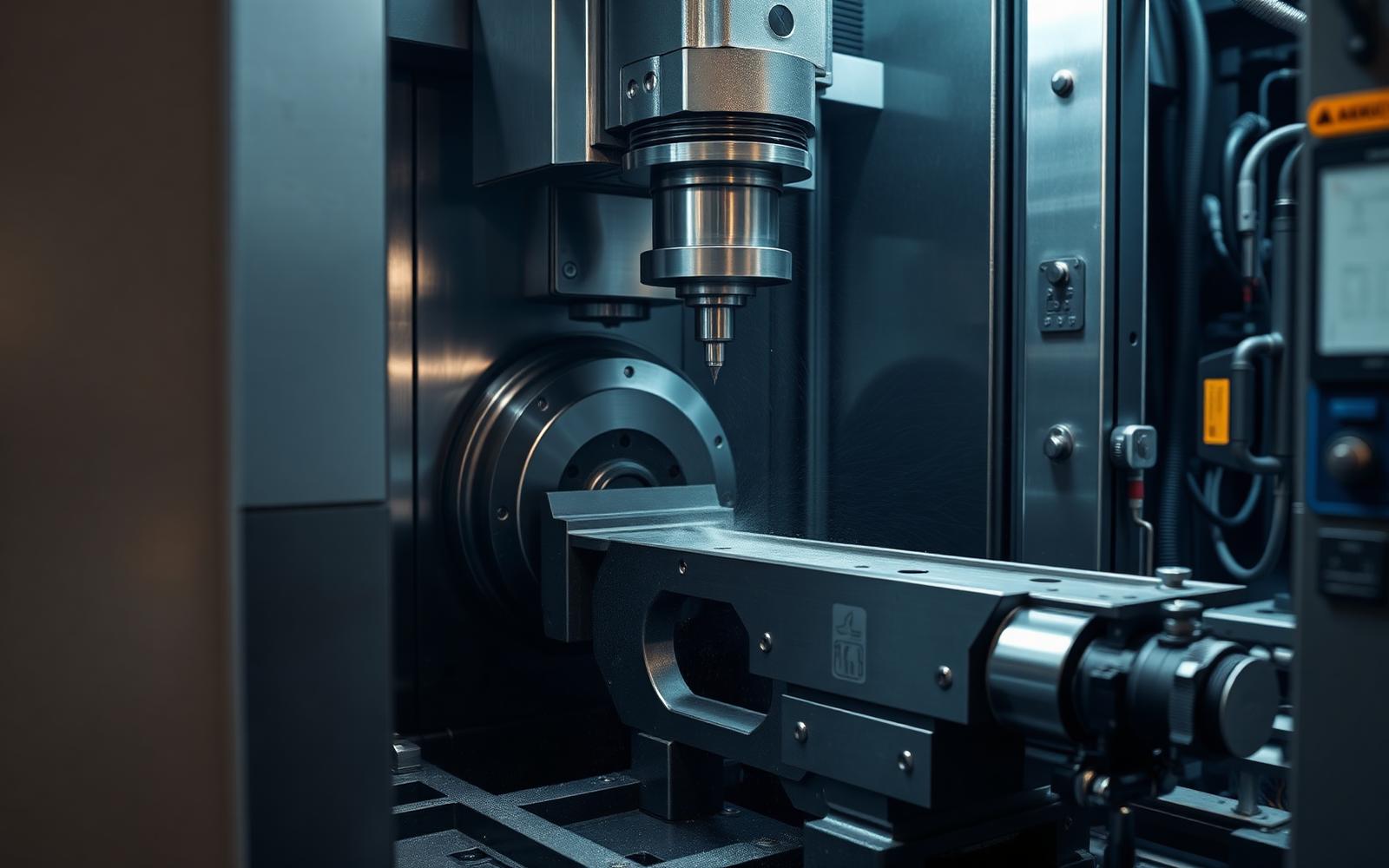
- Five-axis machining - monolithic structural parts machined from billet, often removing 90 percent of the material to hit weight targets.
- Composite layup and cure - hand or automated fiber placement of carbon prepreg, autoclave cured to controlled ramp and dwell profiles.
- Sheet metal forming - stretch forming, hydroforming and joggling for skins, ribs and clips.
- Additive manufacturing - laser powder bed fusion for complex ducting, brackets and heat exchangers, increasingly flight qualified.
- Special processes - anodizing, chem film, shot peening, heat treat, NDT and painting, all requiring NADCAP accreditation.
- Assembly - drilling to tolerance, fastener installation, shimming and sealing, with torque and traceability recorded per fastener on critical joints.
Qualification: the gates that actually gate you
A shop can machine a perfect part and still fail the audit. AS9100 covers the quality management system and is table stakes. NADCAP accredits individual special processes such as heat treat, welding and NDT - and it is process by process, not company wide.
AS9102 first article inspection documents every characteristic on the drawing against the actual part, ballooned and reported. Source approval from the OEM or Tier 1 is the final gate, and it can take six to eighteen months after the quality system is in place.
Gate | What it proves | Typical time to achieve | Typical cost |
|---|---|---|---|
AS9100 certification | Quality management system meets aerospace requirements | 9-18 months | $25,000-$90,000 including consulting and audit |
NADCAP accreditation | One special process meets industry-controlled requirements | 6-12 months per process | $15,000-$40,000 per process |
AS9102 FAI | This specific part matches the drawing | 1-3 weeks per part number | $1,500-$6,000 per part number |
Source approval | Supplier approved to ship to a specific customer | 6-18 months | Audit and sample build costs |
What makes aerospace parts expensive
- Material certification and full lot traceability from mill to finished part.
- Tight tolerances, frequently plus or minus 0.001 inch on interfaces, with the inspection time to prove it.
- Low volumes - hundreds per year is common, so setup and programming amortize poorly.
- Frozen processes: once qualified, any change to tooling, material or sequence may require re-qualification.
- Documentation labor, which routinely adds 15 to 30 percent to the cost of a part.
Breaking into aerospace work
The realistic path is to start as a Tier 3 or Tier 2 supplier of non-flight-critical hardware - tooling, ground support equipment, brackets - while building the quality system with real parts flowing through it. Then add one NADCAP process at a time in the order your target customers actually need. Related reading: our manufacturing services and engineering support.
Materials and the processes they demand
Material choice in aerospace drives process choice, tooling cost and qualification burden simultaneously. A change from aluminum to titanium is not a substitution; it is a different shop, different tooling, different cycle time and often a different NADCAP scope.
Material | Typical application | Dominant process | Manufacturing note |
|---|---|---|---|
Aluminum 7075 / 2024 | Airframe structure, brackets, housings | Five-axis machining | High material removal rates; watch residual stress and distortion |
Titanium Ti-6Al-4V | Engine pylons, fasteners, landing gear fittings | Machining, forging, additive | Slow cutting speeds, high tool wear, cost per pound is 5-10x aluminum |
Inconel 718 / 625 | Hot section, exhaust, turbine hardware | Forging, EDM, additive | Work-hardens quickly; grinding and EDM often required |
Carbon fiber composite | Fuselage panels, control surfaces, fairings | Layup and autoclave cure | Tooling and cure cycle dominate cost; NDT inspection is mandatory |
Stainless 15-5PH / 17-4PH | Fittings, actuators, hydraulic components | Machining plus heat treat | Heat treat certification is a separate NADCAP scope |
First article inspection: the gate most shops underestimate

First article inspection under AS9102 is where new suppliers most often stumble. Every dimension on the drawing must be ballooned, measured and reported, with material and process certifications attached. A single missing certificate voids the package, and the supplier quality engineer on the customer side will not chase it for you.
- Balloon every characteristic on the drawing, including notes, finishes and general tolerances.
- Report actual measured values, not pass or fail; the customer wants the data, not your conclusion.
- Attach raw material certification traceable to the mill heat lot.
- Attach certificates for every special process, each from a NADCAP-accredited source.
- Document the exact machines, fixtures, programs and operators used - the FAI is a snapshot of a repeatable process, not one good part.
- Re-run the FAI after any change to material, process, tooling location or a lapse in production of more than two years.
What qualification actually costs a small shop
Investment | Typical cost | Typical timeline | Payback consideration |
|---|---|---|---|
AS9100 certification | $25,000-$60,000 including consulting | 9-18 months | Non-negotiable for Tier 2 work |
NADCAP per special process | $15,000-$40,000 each | 6-12 months | Only pursue processes you will run repeatedly |
CMM and metrology capability | $80,000-$300,000 | 3-6 months to deploy | Required for FAI credibility |
Document and traceability system | $10,000-$50,000 | 2-4 months | Audit failures are usually record failures |
Trained quality staff | $70,000-$120,000 per year | Ongoing | One capable quality engineer prevents most nonconformances |
Key takeaways
- Aerospace suppliers are qualified on documentation and repeatability, not on their best part.
- Material selection determines process, cost and which NADCAP scopes you need.
- AS9102 first article inspection is the most common early rejection point; over-document it.
- Enter through non-flight-critical Tier 3 work, prove delivery and paperwork, then move up the tiers.
Special processes and the approvals behind them
Most of the delay in aerospace component manufacturing comes from special processes — operations whose results cannot be fully verified by inspecting the finished part. Heat treatment, welding, plating and non-destructive testing all fall into this category, and each needs its own accreditation held by whoever performs it. Sourcing them late is the classic reason a first article slips a quarter.
Special processes and approval routes
Process | Why it is special | Typical approval | Lead time to source |
|---|---|---|---|
Heat treatment | Properties not visible in the part | Nadcap heat treating | 4-10 weeks |
Welding / brazing | Joint integrity is internal | Qualified procedures and welders | 4-12 weeks |
Chemical processing and plating | Coating quality is subsurface | Nadcap chemical processing | 6-12 weeks |
Non-destructive testing | Inspection itself needs qualification | Nadcap NDT, certified Level II/III | 4-8 weeks |
Shot peening | Residual stress is not measurable in situ | Nadcap surface enhancement | 4-8 weeks |
Composite bonding | Bond line hidden after cure | Customer-specific approval | 8-16 weeks |
Every one of these must also appear on the customer's approved supplier list for that specific commodity — a shop's general accreditation is not enough if the prime has not approved it for your part. Confirm the pairing of process, supplier and customer approval before quoting a delivery date.
Sourcing checklist for special processes
- Identify every special process on the drawing at quoting time, not at routing.
- Verify the processor's accreditation scope covers your exact specification.
- Confirm the prime's approved supplier list includes that processor.
- Build the transit time between operations into the schedule; it is often weeks.
- Keep certifications with the traveler so the first article package is complete.
Key takeaways
- Special processes drive aerospace lead time more than machining does.
- Accreditation scope and customer approval are two separate hurdles.
- Source and schedule outside processing before promising a delivery date.
Frequently asked questions
What is aerospace manufacturing?
Aerospace manufacturing is the production of aircraft and spacecraft structures, systems and components under controlled, traceable processes governed by AS9100 quality requirements and customer-specific approvals.
What certifications do aerospace suppliers need?
AS9100 for the quality management system, NADCAP accreditation for each special process performed in house such as heat treat or NDT, AS9102 first article inspection reporting per part number, and source approval from the specific OEM or Tier 1 customer.
How long does it take to become an aerospace supplier?
Plan on nine to eighteen months to achieve AS9100, six to twelve months per NADCAP special process, and a further six to eighteen months for source approval with a given customer - often two to three years in total from a standing start.
Why are aerospace components so expensive?
Low production volumes, tight tolerances, certified materials with full traceability, frozen qualified processes and extensive documentation combine to add substantial cost that commercial manufacturing does not carry.
What Qualification Actually Costs in Time and Money
The part price quoted by an aerospace supplier is rarely the number that decides a program. Qualification is the real gate.
Before a component ships against a production purchase order it has to survive a first article inspection, a set of special process approvals, and in most cases a source inspection by the customer or a delegated representative.
Teams that budget only for tooling and unit cost are the ones that miss their first delivery date by two quarters. The table below reflects the ranges we see on structural and mechanical components moving from a machined prototype into a qualified Tier 2 or Tier 3 supply position.
AS9100 supplier audit and onboarding | 8-16 weeks | $15k-$60k internal effort | Supplier quality |
|---|---|---|---|
AS9102 first article inspection report | 2-6 weeks per part number | $2k-$12k per part | Supplier + customer SQE |
NADCAP special process approval (heat treat, NDT, coating) | 6-12 months if not already held | $40k-$150k plus audit fees | Process house |
Material traceability and DFARS-compliant sourcing | 4-10 weeks | Material premium of 10-40% | Purchasing |
Production readiness review and rate qualification | 4-8 weeks | $10k-$35k | Program management |
Two of those rows dominate schedule risk.
NADCAP approval for a special process you do not already hold is almost never worth chasing for a single program. The practical answer is to route heat treat, penetrant inspection, anodize and chem film through an approved process house and design the part so it needs the shortest possible chain of them.
Every additional special process adds a queue, a transport leg, and a certificate that must be reconciled before the part can be accepted.
Design Decisions That Move Aerospace Part Cost
Aerospace components carry a cost structure that behaves differently from consumer hardware. Volumes are low, material is expensive, and inspection can exceed cutting time. That inverts several habits engineers bring from other industries. Buy-to-fly ratio, tolerance discipline and datum strategy usually matter more than clever geometry.
- Buy-to-fly ratio: Machining a 12 kg titanium bracket down to 1.4 kg means paying for 12 kg of certified material and the cycle time to remove the rest. Near-net forgings, plate-to-size purchasing, or a welded and stress-relieved assembly frequently cut landed cost by 30-50% at rates above a few hundred units per year.
- Tolerance banding: Apply tight tolerances only to interfaces that carry load or locate mating hardware. A blanket profile tolerance across every surface can double inspection time because each toleranced feature must be measured and reported on the AS9102 form.
- Datum strategy: A datum scheme that matches how the part is fixtured lets the machinist, the CMM programmer and the customer inspector all read the same story. Mismatched datums are the single most common source of first article rejection.
- Finish and marking: Specify a finish that an approved process house near the machine shop already runs. An exotic coating with one qualified supplier in the country adds weeks of freight and single-source risk.
- Fastener and insert selection: Standard qualified hardware from an approved parts list avoids a separate qualification path for a nonstandard fastener that saves $2 per unit and costs six months.
Choosing Between Tier 1, Tier 2 and Direct-to-OEM Positioning
Where a component supplier sits in the supply chain changes the engineering burden more than most teams expect.
Selling a detail part to a Tier 1 integrator means the integrator owns the interface control, the qualification evidence and the customer relationship, and the detail supplier competes largely on price, on-time delivery and quality escape rate.
Moving up to an assembly or subsystem position means owning integration testing, configuration control and often obsolescence management for a program life measured in decades. The higher position carries better margin and much heavier documentation.
A shop that is excellent at holding tolerance but has no configuration management discipline will lose money at the subsystem tier even with a strong quoted price.
A pragmatic path for a regional manufacturer entering aerospace is to qualify on a small family of similar detail parts, prove a year of on-time delivery and zero escapes, then bid a bracket assembly that reuses those same details. Qualification evidence compounds. The second part number in a family costs a fraction of the first because material certifications, process routings and inspection methods carry across.
A Practical Entry Checklist
- Confirm the quality system requirement in the purchase order text before quoting, not after award.
- Map every special process on the drawing to a named approved supplier with current certification dates.
- Model the buy-to-fly ratio and material lead time as separate line items in the quote.
- Build the AS9102 balloon drawing during process planning so inspection is designed in rather than reconstructed.
- Agree the source inspection plan and acceptance authority in writing before the first article is cut.
- Hold a capacity reserve of at least 20% before accepting a rate increase; aerospace penalties for late delivery are contractual, not conversational.
Developing a component for an aerospace program?
Work with LA NPDT: if you are moving from here to execution, start with our our product development process or talk to us about end-to-end product development.
Filed under:Media
Tagged:Advanced MaterialsBossierConductive CoatingEmi ShieldingGrapheneGraphenohigh-techInnovationLouisianaMaterialsNorth West LouisianaProduct DevelopmentShreveportStartupTechnologyTechnology Commercialization
Services related to this guide
- Is a local firm the right call?When proximity matters, which regions do what, and how to vet a remote team.
- Product development in LouisianaWhere to take an idea in-state, plus the free programs most inventors miss.
- Best product development companiesHow the leading US firms compare, and which one fits your stage and budget.
- Product development examplesReal projects we designed, prototyped and shipped.