Electronics Contract Manufacturing: Models, Costs and Choosing a Partner
Engagement models, what NRE and unit pricing really cover, MOQs by process, and a vetting checklist for choosing an electronics contract manufacturer.
August 3, 20166 min read

Written by Konstantin Dolgan, Ph.D., NPDP
Founder & CEO, Product Development Engineer
Published August 3, 2016Updated September 2, 2026
Electronics contract manufacturing means outsourcing production of your product to a factory that builds it under your brand. The label covers everything from a machine shop cutting parts to your drawings, to an EMS partner who sources components, assembles boards, tests, packs and ships to your fulfilment centre. What you pay, how fast you launch and how much control you keep all depend on which model you choose.
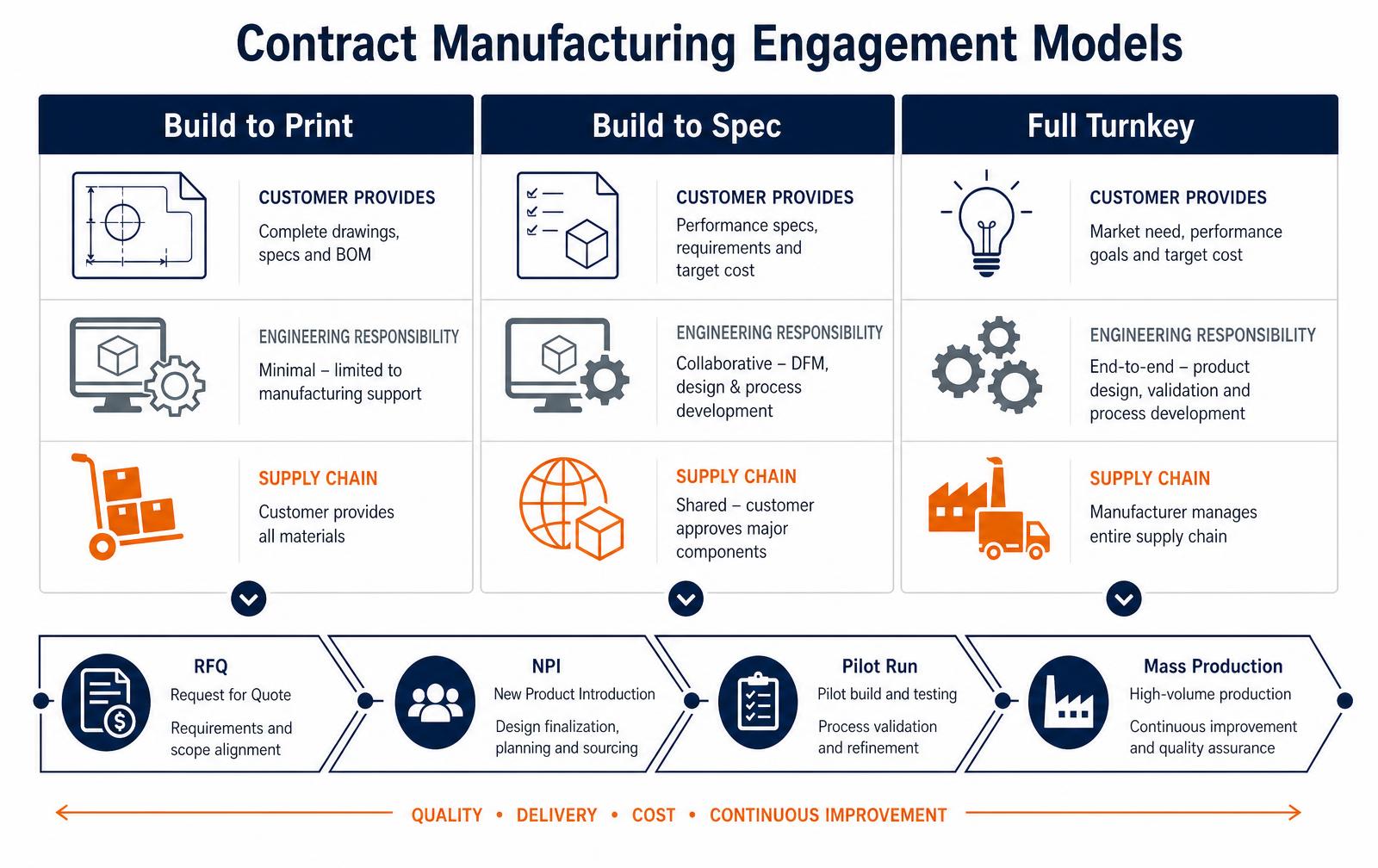
The three engagement models
Model | You provide | Factory provides | Best when |
|---|---|---|---|
Build to print | Complete drawings, BOM, specs | Production only | Design is frozen and validated |
Build to spec | Requirements and target cost | DFM, process design, some engineering | Design needs manufacturing input |
Full turnkey | Market need and target cost | Design, sourcing, build, test, logistics | You have no in-house engineering or supply chain |
What contract manufacturing actually costs
Cost element | Typical range | Notes |
|---|---|---|
NRE / engineering | $5k-$60k | DFM review, process design, test development |
Tooling | $4k-$180k | Depends on process and cavitation |
Test fixtures | $3k-$25k | Per station; needed for any electronics |
First article + pilot run | $5k-$30k | 50-500 units, often at 2-4x unit cost |
Unit price | BOM x 1.15-1.4 + assembly | Assembly at $12-$45/hr burdened depending on region |
Minimum order quantities by process
- CNC machining and sheet metal - MOQ 1-50. No tooling, higher unit cost, ideal below 2,000 units/yr.
- Injection molding - MOQ typically 1,000-5,000 per run once tooling exists; soft tools lower this to a few hundred.
- PCBA - MOQ 25-100 boards; component reels and MOQs on ICs usually set the real floor.
- Cast, extruded or die-cast metal - MOQ 2,000+ and 8-14 week tooling lead times.
- Textiles and soft goods - MOQ 300-1,000 per colourway, driven by fabric minimums.
How to vet a contract manufacturer
- Ask for a customer in your product category and volume band - not their largest logo.
- Confirm the quality system that matches your market: ISO 9001 baseline, ISO 13485 for medical, IATF 16949 for automotive, AS9100 for aerospace.
- Audit the actual line that will build your product, not the showroom cell.
- Get the quote broken into materials, labour, overhead, tooling and NRE - a lump price cannot be negotiated.
- Check engineering change control: how are ECOs priced, and how long does a change take to reach the line?
- Confirm who owns the tooling and where it physically lives. Get it in the contract.
- Ask about second-source strategy for single-sourced components before you commit.
Contracts: the clauses that matter
- IP ownership - designs, tooling, fixtures and test software should be yours on payment.
- Exit terms - can you take tools to another factory, and at what notice?
- Yield and scrap responsibility - who pays for material lost to process defects.
- Price validity and material escalation - how often unit prices are re-opened.
- Liability and recall - caps, insurance and defect definitions.
- Capacity commitment - guaranteed monthly slots so you are not bumped by a bigger customer.
From lab material to specified component
Advanced materials only reach revenue after they become specifiable. Buyers cannot purchase a promising material; they purchase a component with a datasheet, a tolerance range, a lead time, and a failure mode they can design around.
The path runs through four documents: a characterization report with repeatable test methods, a processing window that a contract manufacturer can hold, a qualification plan naming the standards the end product must pass, and a supply statement covering capacity and second-source risk.
Plan the schedule honestly. Lab-scale consistency to pilot-scale consistency commonly takes nine to eighteen months, and the loss point is batch-to-batch variation rather than peak performance.
Qualify one flagship application first, ideally one where the incumbent material has a specific, measurable weakness, and publish comparative data against it.
Price against the total system cost, not against the incumbent material cost per kilogram, since advanced materials usually win by removing assembly steps, weight, or warranty claims rather than by being cheaper per unit mass.
Frequently asked questions
What is contract manufacturing?
Contract manufacturing is an arrangement where a company hires an outside factory to produce its product. The brand owns the design and the product; the contract manufacturer owns the equipment, labour and process capability.
What is the difference between contract manufacturing and OEM?
A contract manufacturer builds to your design and your brand. An OEM designs and sells a product that another company rebrands. Full turnkey contract manufacturing sits between the two because the factory contributes design work while you still own the product.
How long does it take to go from RFQ to first production run?
Plan 12-20 weeks for a plastic-and-electronics product: 2-4 weeks quoting and DFM, 6-10 weeks tooling, 2-3 weeks first article and pilot, then mass production. Machined or sheet-metal products can compress to 4-6 weeks because there is no hard tooling.
Do I need a US contract manufacturer or an offshore one?
Domestic manufacturing wins on lead time, IP control, travel cost and low-to-mid volumes. Offshore wins on unit cost above roughly 10,000 units per year, when the design is stable and the landed-cost gap survives freight, duty and inventory carrying cost.
Related reading: our manufacturing services, the total manufacturing cost formula and design for manufacturing principles.
What a real electronics manufacturing quote contains
A quote that is one number per unit is not a quote, it is a placeholder. Electronics contract manufacturing pricing is assembled from a stack of separate costs, and every one of them moves independently with volume, component choice and test strategy. Ask for the stack broken out — factories that will not break it out are protecting margin you could otherwise design away.
Line item | Typical share of unit cost | How to reduce it |
|---|---|---|
Components (BOM) | 55-75% | Consolidate part numbers, design out sole-source parts, negotiate annual volume pricing |
PCB fabrication | 5-12% | Panelise better, relax layer count and via technology where signal integrity allows |
SMT assembly labour | 6-15% | Single-sided placement, fewer odd-form and hand-solder operations |
Test and inspection | 5-15% | Design a boundary-scan and ICT-friendly board; avoid manual functional test rigs |
Box build and packaging | 4-10% | Reduce fastener count, design for snap assembly |
Yield loss and rework | 1-6% | DFM review before tooling; the cheapest yield fix is a layout change |
Test strategy is a cost decision, not a QA afterthought
Test stage | Catches | Fixture cost | When it is worth it |
|---|---|---|---|
Automated optical inspection (AOI) | Solder defects, missing or skewed parts | Included by most CMs | Always |
X-ray inspection | BGA and QFN solder voids | Per-hour charge | Any board with BGAs |
In-circuit test (ICT) | Shorts, opens, wrong values | $8k-$30k bed of nails | Above ~5k units/yr |
Flying probe | Same as ICT, no fixture | $0, slower per board | Prototype and low volume |
Functional test (FCT) | Does the product actually work | $5k-$60k custom rig | Always for a shipped product |
Burn-in / HASS | Infant mortality | $10k+ chamber time | Safety-critical, medical, long-warranty products |
Writing the functional test specification is your job, not the factory's. If you leave it to them, the definition of a passing unit becomes whatever is easy to measure on their line, and field returns become a debate rather than a warranty claim.
Component sourcing risk to settle before the first build
- Sole-source parts. Every single-source component is a schedule bomb. Approve a second source at design time or accept the risk in writing.
- Lifecycle status. Run the BOM through a lifecycle check; parts already flagged NRND should not enter a product you plan to ship for three years.
- Consigned vs turnkey. Turnkey lets the CM buy; consigned means you buy and ship. Turnkey is simpler, costs 5-12% more, and hides the real component price from you.
- Counterfeit exposure. Require franchised-distributor sourcing in writing, with broker purchases needing your prior approval and incoming test.
- Buffer stock. Agree who holds safety stock on long-lead parts and who pays for it — the answer decides whether a shortage costs you two weeks or two quarters.
Onshore, nearshore and offshore, honestly
Factor | US / Canada | Mexico / Eastern Europe | China / SE Asia |
|---|---|---|---|
Unit cost at 10k/yr | Baseline | 10-25% lower | 25-45% lower |
NRE and tooling | Highest | Moderate | Lowest |
Prototype turn time | 1-2 weeks | 2-3 weeks | 3-5 weeks plus freight |
Travel to fix a problem | Same week | Same week | Multi-day, visa dependent |
IP posture | Strongest | Strong | Requires active management |
Best volume band | Under 25k/yr | 25k-250k/yr | Above 100k/yr |
The crossover is rarely where founders expect. Below roughly 25,000 units per year, freight, duty, travel, inventory carrying cost and the cost of slow problem-solving usually erase the offshore unit-price advantage entirely.
An audit checklist for the factory visit
- Walk the line for your product class specifically — a plant that excels at automotive harnesses may be mediocre at fine-pitch consumer boards.
- Ask to see the last three corrective action reports and what changed as a result.
- Check ESD compliance in practice: wrist straps in use, floor mats grounded, verified daily.
- Review the traceability system — can they tell you which reel of capacitors went into a specific serial number?
- Look at the rework bench. A large, busy rework area is a yield problem being managed manually.
- Meet the person who would be your programme manager, and ask how many other accounts they carry.
More questions teams ask
Frequently asked questions
What does electronics contract manufacturing cost?
NRE and DFM engineering typically runs $5k-$60k, functional test fixtures $5k-$60k, and unit assembly cost is usually 20-45% on top of the BOM at low volume, falling toward 10-18% at scale. Components dominate — usually 55-75% of unit cost.
What is the difference between turnkey and consigned manufacturing?
In turnkey the CM procures all components and quotes a finished-unit price, adding roughly 5-12% for purchasing and carrying risk. In consigned, you buy and supply parts and pay only for assembly, which gives you price visibility and control but transfers shortage risk entirely to you.
How do I stop a contract manufacturer copying my product?
Own the design files and firmware, keep test software and calibration data under your control, register IP in the manufacturing country, split assemblies across suppliers where feasible, and use serialised firmware provisioning so unauthorised units cannot be activated.
What minimum volume does a contract manufacturer accept?
Prototype and pilot runs of 25-250 boards are widely available. Most CMs want 1,000+ units per year to prioritise an account, and the best pricing tiers usually begin around 10,000 units per year.
How long from RFQ to first production units?
Two to four weeks for quoting and DFM, four to eight weeks for long-lead components, one to two weeks for first article and pilot build, then production. Twelve to twenty weeks total is normal for an electromechanical product with new tooling. Work with LA NPDT: if you are moving from here to execution, start with our low-volume manufacturing or talk to us about design for manufacturing .
Filed under:Media
Services related to this guide
- Product design servicesIndustrial design and CAD taken all the way to manufacturable files.
- Rapid prototypingWorking prototypes in days, from 3D printing to vacuum casting.
- Electronic design servicesSchematic, PCB layout, firmware and bring-up, through to production handoff.
- Product development examplesReal projects we designed, prototyped and shipped.