
Grants for Small Business Startups: Where the Money Actually Is
Most startup grant lists are link dumps. This one groups grants for small business startups by who funds them, what they pay, how long they take and what a winning application has to prove.
June 21, 20188 min read

Written by Konstantin Dolgan, Ph.D., NPDP
Founder & CEO, Product Development Engineer
Published June 21, 2018Updated September 2, 2026
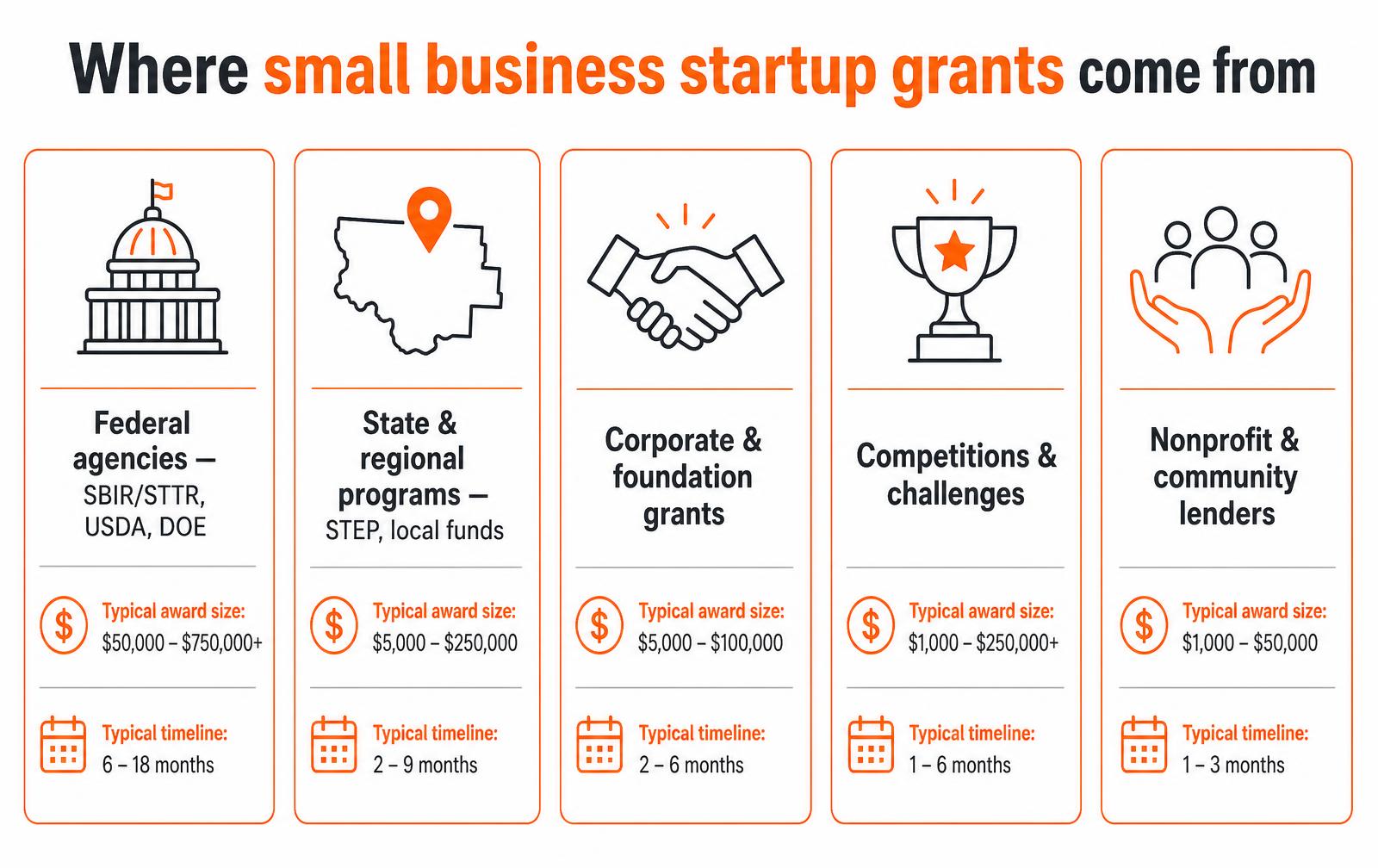
Grants for small business startups come from five distinct places — federal agencies, state and regional programs, corporate and foundation funds, competitions, and nonprofit lenders — and they behave very differently on award size, timeline and what they will pay for. Knowing which bucket you are in matters more than the length of your list of links, because it decides whether you are writing a two-page form or a forty-page technical proposal.
What a grant is, and is not
A grant is non-dilutive money given for a purpose the funder cares about. You keep your equity; you do not keep your freedom. Every grant carries a scope of work, a reporting obligation and rules about allowable costs.
Federal awards in particular will not reimburse marketing, general overhead beyond a negotiated rate, or work performed before the award date. Read the allowable-cost section before you read the award amount — a $250,000 award that cannot pay for tooling is not tooling money.
The five sources, compared
Source | Examples | Typical award | Time to money | Best fit |
|---|---|---|---|---|
Federal agencies | SBIR / STTR (NIH, NSF, DOE, DOD), USDA rural programs | $50k phase I to $750k+ phase II | 6-18 months | Technical risk, R&D, novel engineering |
State & regional | STEP export grants, state innovation and matching funds | $5k-$250k | 2-9 months | Export costs, hiring, equipment, matching a federal award |
Corporate & foundation | Bank and retailer small-business funds, industry foundations | $5k-$100k | 2-6 months | Early operating costs, underrepresented founders |
Competitions & challenges | Agency prize challenges, university and accelerator pitch prizes | $1k-$250k+ | 1-6 months | Fast cash plus credibility and press |
Nonprofit & community | CDFIs, chambers, economic development organizations | $1k-$50k | 1-3 months | Micro-grants, local businesses, first prototype |
Amounts and cycles vary by program and change every year; treat the table as a way to choose which door to knock on, then verify the current numbers on the funder solicitation itself. Grants.gov and SAM.gov are the authoritative sources for federal opportunities, and your state economic development office is the authoritative source for the rest.
federal: SBIR and Sttr are the Serious Money
If your startup has real technical risk — a mechanism nobody has proven, a material behaving in a new way, a manufacturing process that may not scale — the Small Business Innovation Research and Small Business Technology Transfer programs are the largest non-dilutive pool available to a US company.
Eleven federal agencies participate. Phase I funds feasibility, phase II funds development, and a phase III commercialization path exists without further competition.
- Register early. SAM.gov, a UEI number and agency portals take weeks. Start before you have a proposal, not after.
- Match the agency, not the deadline. NSF funds broad innovation, NIH funds health outcomes, DOE funds energy, DOD funds a defined defense need. A good proposal to the wrong agency loses to a mediocre one aimed correctly.
- Talk to the program officer. For most agencies this is allowed and expected before submission. It is the single highest-return hour in the process.
- Write the risk, not the vision. Reviewers are technical. They fund a hypothesis with a test plan, milestones and quantitative success criteria — not enthusiasm.
- Budget honestly. Include the indirect rate, subcontractor limits and equipment rules from the solicitation. Budget errors sink otherwise fundable proposals.
State, regional and local programs
State programs are smaller, faster and far less competitive than federal ones, and almost nobody applies to them because they are hard to find.
Three categories are worth a morning of research: State Trade Expansion Program funds that reimburse export costs such as trade shows and international marketing. State matching grants that add money on top of a federal phase I award. And rural or opportunity-zone programs tied to where you operate.
Your local Small Business Development Center will name the live ones in a single free appointment.
Corporate, foundation and competition money
Corporate and foundation grants are marketing programs with a philanthropic wrapper, and that is not a criticism — it tells you how to write the application. The funder wants a story it can publish: a named founder, a community, a measurable outcome.
Competitions work the same way and add a second payoff, because the press and the judging panel are often worth more than the check. Both categories move in months rather than years, so they fit the gap between a working prototype and a first production run.
What every winning application has
- Alignment in the first paragraph. Name the funder priority you serve, in their words, before you describe your product.
- A specific problem with a number attached. Not a market that is worth billions, but a cost, defect rate or delay a defined buyer pays today.
- Evidence you can execute. Prior builds, test data, a named team with relevant credentials, and a manufacturing plan that exists.
- Milestones with dates and criteria. Each deliverable needs a pass or fail measurement, not a verb.
- A budget that matches the narrative. Every line item should be traceable to a task in the work plan.
- A life after the grant. Reviewers are scored on commercialization. Show the next customer, the next funding step or the revenue model.
The parts founders underestimate
Applications take real time — a federal proposal is commonly a month of work with technical writing, letters of support, budget justification and compliance forms. Awards are usually reimbursement-based, so you need working capital to spend first and get paid later. Reporting continues for the life of the award.
And a grant funds the work described, which means scope drift after you win becomes a modification request, not a decision you can make alone. Plan for all four before you apply, and skip programs where the administrative load exceeds the money.
One practical sequencing note for hardware: grant reviewers respond to evidence, and the cheapest evidence is a working prototype with test data. A modest rapid prototyping spend before you apply routinely does more for the score than another revision of the narrative.
A 60-day plan
- Days 1-7. Register on SAM.gov, obtain a UEI, and book a free session with your local Small Business Development Center.
- Days 8-20. Build a shortlist of six programs across at least three of the five sources. Record deadline, award size, match requirement and allowable costs for each.
- Days 21-30. Contact two program officers. Adjust the shortlist based on what they say.
- Days 31-50. Write one strong federal or state proposal and two short corporate or competition applications in parallel.
- Days 51-60. Internal review by someone outside the project, budget check against the solicitation, then submit at least 48 hours before the deadline.
Frequently asked questions
Are there federal grants to simply start a business?
Not in the general sense. Federal money funds specific outcomes — research, exporting, rural development, energy or health goals — rather than the act of starting a company. Anyone promising a general free-money startup grant for a fee is selling a list you can get free on Grants.gov.
How long does it take to receive grant money?
Community and competition awards commonly pay within one to three months. State programs run two to nine months. Federal SBIR awards typically run six to eighteen months from submission to first disbursement, and most reimburse costs after they are incurred, so budget working capital accordingly.
Do grants require giving up equity or repaying money?
No equity and no repayment when you use the funds as agreed and report on time. Misusing funds or failing to perform the scope can trigger clawback, so treat the scope of work as a contract, because that is exactly what it is.
Can a pre-revenue hardware startup win a grant?
Yes, and pre-revenue is normal for SBIR phase I, which exists precisely to fund feasibility. What reviewers require instead of revenue is technical credibility: a defined hypothesis, a test plan, evidence you can build, and a plausible path to a paying customer.
What happens after you win: budgets, reporting and audits
The application is the visible part of grant funding; compliance is the part that consumes staff time for the next two years. Federal awards in particular come with cost principles that decide which expenses are allowable, an indirect cost rate that determines how much overhead you can recover, and reporting deadlines that affect future eligibility. Price this administrative load into your plan before accepting an award.
Typical post-award obligations
Obligation | Typical frequency | Effort | Consequence of slipping |
|---|---|---|---|
Financial reports | Quarterly | 2-6 hours each | Payments withheld |
Technical progress reports | Quarterly or at milestones | 4-12 hours each | Milestone payment delayed |
Time and effort records | Continuous | Payroll system setup | Disallowed labor costs |
Procurement documentation | Per purchase over threshold | 1-3 hours each | Cost disallowed on audit |
Single audit (over federal threshold) | Annual | $10k-$25k in fees | Findings affect future awards |
Final technical and property report | At close-out | 1-3 days | Blocks future eligibility |
Set up accounting to segregate grant funds from day one. Retrofitting a general ledger to show which dollars paid for which line item is the single most common reason small companies fail an audit on an otherwise successful project.
Before you accept an award
- Read the cost principles and confirm your major expenses are allowable.
- Negotiate or elect an indirect cost rate rather than absorbing overhead.
- Assign one named person as the compliance owner, with time budgeted.
- Confirm whether the award requires cost share, and where that money comes from.
- Check IP and data-rights clauses, especially government purpose rights.
Key takeaways
- Compliance work, not the application, is the bigger long-term cost of a grant.
- Segregate grant accounting from the first transaction.
- Check IP and data rights before signing; some awards change what you can license.
From the archive
Need engineering support to make your grant application credible?
Where grant money actually comes from
Source | Typical award | Best fit | Effort to apply |
|---|---|---|---|
Federal SBIR/STTR | $50k-$300k phase I | Technical R&D with a research risk | High - 4-8 weeks |
State economic development | $5k-$50k | Job creation, equipment, local hiring | Moderate |
Local and municipal | $1k-$15k | Storefronts, small manufacturers | Low |
Corporate and foundation | $5k-$25k | Community impact, underrepresented founders | Low to moderate |
Industry and trade association | $2k-$20k | Sector-specific innovation | Low |
Non-dilutive competitions | $5k-$100k | Demonstrable prototype and a pitch | Moderate |
Grants are not free money; they are paid for in documentation, reporting and scope discipline. The right way to evaluate one is to divide the award by the hours it will take to win and administer it. A $10,000 local grant that costs eight hours is excellent. A $50,000 award that requires a research partner, quarterly reports and a matched contribution may be worse than a customer deposit.
What reviewers actually score
- Fit to the stated purpose. Most rejections are applications aimed at the wrong programme, not weak businesses.
- Specific use of funds. Line items with quotes attached score far higher than a lump sum labelled “development”.
- Evidence of traction. Letters of intent, pilot customers, pre-orders and prior spend all count.
- Team credibility. Who is doing the work and what they have shipped before.
- Measurable outcomes. Jobs, units, revenue or completed milestones by a stated date.
- Ability to report. Reviewers avoid applicants who look unlikely to file the required paperwork.
A reusable application kit
Asset | Why it saves time | Refresh interval |
|---|---|---|
One-page company summary | Reused in nearly every application | Quarterly |
Problem and solution narrative, 300 and 800 word versions | Fits most word limits with light editing | Quarterly |
Itemised budget template with vendor quotes | Turns a lump sum into a scoreable plan | Per application |
Milestone table with dates and owners | Answers the outcomes section directly | Quarterly |
Founder bios and prior results | Team scoring | Twice yearly |
Letters of support and pilot commitments | Traction evidence | As obtained |
Financial statements and entity documents | Eligibility screening | Annually |
Build the kit once and each subsequent application takes hours instead of days. Track every submission in a simple sheet with the programme, the deadline, the amount, the decision date and the outcome - within a year that record tells you which categories of funder actually respond to your kind of business, and you can stop spending time on the rest.
Common disqualifiers to check before you write a word
- Entity type, registration state or business age outside the eligibility window.
- Revenue or headcount above the programme ceiling.
- Matched-funding requirement you cannot cover.
- Costs already incurred - most grants do not fund retroactive spending.
- Overlapping awards that the programme treats as duplicate funding.
- Reporting obligations extending past the life of your current plan.
Writing the budget section
The budget is the section reviewers read most carefully, because it is the only part of the application that cannot be written vaguely.
Break the request into line items that map to the milestones you promised, attach a real quote or a documented rate to each, and state what happens to the project if only part of the request is funded.
Partial awards are common, and applicants who show a credible reduced-scope plan get them far more often than applicants who present an all-or-nothing number.
Line item | How to evidence it | Common mistake |
|---|---|---|
Engineering labour | Hourly rate times estimated hours, by task | One lump figure with no basis |
Prototype and tooling | Supplier quote attached | Estimating from memory |
Testing and certification | Lab quote with the standard named | Omitting retest contingency |
Equipment | Vendor quote plus a justification of need | Buying capability the project does not use |
Marketing | Channel-level plan with expected cost per acquisition | Undefined brand spend |
Contingency | 5-10 percent, stated openly | Hiding it inside other lines |
After the award: keeping it
- Read the reporting schedule the day you accept and put every date in a calendar with a reminder.
- Keep grant spend in a separate ledger or account so reconciliation takes minutes, not days.
- Save invoices and proof of payment for every funded line item; most programmes audit a sample.
- Report scope changes before you make them - retroactive approval is rarely granted.
- Record outcome metrics as you go; reconstructing them at the final report is painful and inaccurate.
- Ask the programme officer questions early; they are usually helpful and they remember applicants who communicate.
Funders repeat with people who deliver and report cleanly. A modest first award administered well is often the route to a larger second one, and the administrative habits it forces - itemised budgets, milestone tracking, documented outcomes - make the business easier to run whether or not more grant money arrives.
Work with LA NPDT: if you are moving from here to execution, start with our product development consulting or talk to us about end-to-end product development.
Filed under:InspirationNews
Services related to this guide
- Best product development companiesHow the leading US firms compare, and which one fits your stage and budget.
- Best product design companiesDesign studios compared by scope, industry and what they hand off.
- Product engineering companiesEngineering firms for physical products compared by discipline, rigor and budget.
- Consultant vs firm vs freelancerWhat each option costs, what it delivers and where to find them.