Social Media Strategy: How to Promote a New Product
Are you looking for a social media strategy for your new product? In this article, we will share a few simple steps to get you started.
May 4, 20189 min read

Written by Konstantin Dolgan, Ph.D., NPDP
Founder & CEO, Product Development Engineer
Published May 4, 2018Updated September 2, 2026
Congratulations you thought about an invention and you already have your new idea or product ready to go. Are you also ready for the next step to bring this product to the masses? Now you ask yourself, what is the Social Media Strategy?
How to Promote a New Product. What do I need to become a success in the digital world? Some recent studies claim that an average person spends around two hours a day in social media and also in messaging apps. It may be hard to admit but some of us spend even more time!
There are a lot of social networks at the moment that let you create natural content that the average user can see in their newsfeeds and also make them attracted to your product.
To begin the Social Media Strategically, the most efficient social networks at the moment are Facebook, Twitter, LinkedIn, and Instagram. These networks have the most active users, also letting you reach more people at the same time with one click.
Step 1
The first step is to set up all the profiles in these networks. It is also important to use the same name on each and every one of them so that it is easier for the clients to find you if they switch from one online marketing company to the other. The profiles created should also have fan pages with pictures and content of your invention or idea.
It is stated that a picture can express a thousand words, meaning that the adequate picture can also explain to your customer what you want to express. Another good idea after you have created your profile is to also create a Google+, YouTube and Pinterest account. Even though these are less popular online marketing company at the moment they continue to grow every day and if you don’t keep up you will also end up losing customers.
Step 2
The second step would be to create content about your background, invention history and also other related information you want the consumer to know about you. If you don’t know how to create content you can take online courses on Copywriting or pay an online marketing company to manage this area. Each content should also be accompanied by beautiful pictures of the product or idea.
Try not to bombard your page with a lot of information as the followers can get bored with your intentions and end up unfollowing you. I would also suggest posting three times a day for Social Media Strategy, maybe once with every meal you take. This way you can target morning people, people on their lunch breaks, and also people getting off work and wanting to relax for a while.
Step 3
The third basic step you must take is not only finding but also engaging your audience. You may begin by asking family and friends to like and share your pages with their friends. There are also many tools you can download to find customers on the different online marketing company.
Even a simple google search can help you find extensions or programs that can ease you in Social Media Strategy. If you have time available, then do take simple marketing courses on the web on how each online marketing company works. It will also help you target more audience. An example of this is Twitter if you follow someone eventually they will follow you back.
On the other hand in Facebook, you also need to have people like your page if you want to engage and keep those clicking on your posts and liking them if not they will not see your posts again. After you have a small fan club you may also begin asking questions, sending samples, creating polls to have the user engage and continue following your page.
Now you have a basic understanding of Social Media Strategy
Stay tuned to learn about marketing new products!
Ready to Start!
Our experts are happy to help!
A Social Media Product Launch Calendar That Works
A social media product launch is won in the eight weeks before availability, when there is still time to build proof. Content published after the listing goes live only converts demand that already exists; content published before it creates the demand.
Phase | Weeks before launch | Content that performs | Metric to watch |
|---|---|---|---|
Problem framing | 8-7 | Short clips of the failure the product removes | Save and share rate |
Build in public | 6-5 | Prototype iterations, test rigs, honest failures | Comment depth |
Proof | 4-3 | Side-by-side tests, durability abuse, teardown | Watch-through rate |
Faces | 3-2 | Founder and engineer explaining a tradeoff | Follower growth |
Seeding | 2-1 | Creator units shipped, unscripted first reactions | Referral clicks |
Availability | 0 | Simple demo plus a clear price and link | Conversion rate |
Retention | +1 to +4 | Setup tips, use cases, review responses | Return rate |
Content Assets to Capture During Development
- Every prototype generation photographed against the same background for a progression reel.
- Test rig footage - drops, cycles, water, heat - which outperforms polished renders by a wide margin.
- One unscripted two-minute engineer explanation of the hardest design decision.
- Macro shots of the parts that justify the price, such as bearing, seal or weld.
- Factory floor B-roll gathered during the pilot build, which is otherwise impossible to reshoot.
- A short answer to the three objections your pre-orders raised most often.
The practical constraint is that most of this footage can only be captured while the work is happening. Teams that decide to make content after tooling is finished are left with renders and stock imagery, which is exactly the material the algorithm and the buyer both discount.
Key Social Media Strategy Steps for New Product Promotion
Frequently asked questions
What are the initial steps for promoting a new product using social media?
Step | Action | Goal |
|---|---|---|
1 | Set up profiles on Facebook, Twitter, LinkedIn, Instagram (also Google+, YouTube, Pinterest). | Establish online presence; ensure consistent naming; use pictures/content. |
2 | Create content about background, invention history, and product details. | Inform consumers; accompany posts with pictures; post regularly without overwhelming. |
3 | Engage audience by asking family/friends to share, using tools to find customers, asking questions, sending samples, creating polls. | Grow followers; encourage interaction; maintain interest. |
The initial steps involve setting up profiles on efficient social networks like Facebook, Twitter, LinkedIn, and Instagram. Use the same name across all platforms for client discoverability. Create fan pages with pictures and content about your product. Consider adding Google+, YouTube, and Pinterest accounts as these platforms continue to grow daily.
Frequently asked questions
How should content be created for social media promotion?
Which social media platforms are most effective for promoting a new product initially?
Content should focus on your background, product history, and other relevant information for consumers. If content creation is challenging, online courses on copywriting or hiring an online marketing company are options. Each piece of content should include relevant pictures of the product or idea. Avoid overwhelming followers with too much information at once.
Facebook, Twitter, LinkedIn, and Instagram are currently the most efficient social networks. These platforms have the most active users. Using them allows you to reach more people at the same time with one click. Setting up profiles on these networks is the first step in a social media strategy for new products.
What is an effective posting schedule for social media content?
What information should I include in my social media profiles for a new product?
An effective posting schedule for social media strategy could involve posting three times a day. This approach allows you to target different audiences throughout the day, such as morning people, individuals on lunch breaks, and those relaxing after work. This varied timing helps reach a broader audience segment.
Your social media profiles should use the same name across all platforms for easier client discovery. Create fan pages with pictures and content related to your invention or idea. Pictures can effectively explain your product to customers. Consider creating Google+, YouTube, and Pinterest accounts as well, as they continue to grow.
How can I engage my audience on social media platforms?
How often should I post new content on social media for product promotion?
Engaging your audience can begin by asking family and friends to like and share your pages. Tools and simple Google searches can help find customers. On platforms like Facebook, you need likes to ensure posts are seen. Once a small following is established, you can ask questions, send samples, and create polls to encourage user interaction and continued engagement.
You could post three times a day for your social media strategy. This schedule allows you to target different audiences throughout the day, such as morning people, those on lunch breaks, and people relaxing after work. Avoid overwhelming your page with too much information, which can cause followers to disengage.
How can I engage my audience on social media for a new product?
Engage your audience by asking family and friends to share your pages initially. Use tools or simple Google searches to find customers on different platforms. Once you have a small following, ask questions, send samples, and create polls to encourage user engagement and continued interest in your page.
What kind of content should I create for social media product promotion?
Create content about your background, the invention's history, and other relevant information for consumers. Each content piece should include quality pictures of your product or idea. If content creation is challenging, consider online copywriting courses or hiring an online marketing company. Avoid overwhelming followers with too much information.
Building a social media strategy for a new product launch
Social media does not launch a hardware product on its own; it compresses the time between someone hearing about a product and believing it works. For physical goods that belief comes from footage — the product being used, assembled, dropped, cleaned, repaired. A launch strategy is therefore mostly a production plan: decide what has to be filmed, film it while the prototypes are in hand, and then distribute it on a schedule.
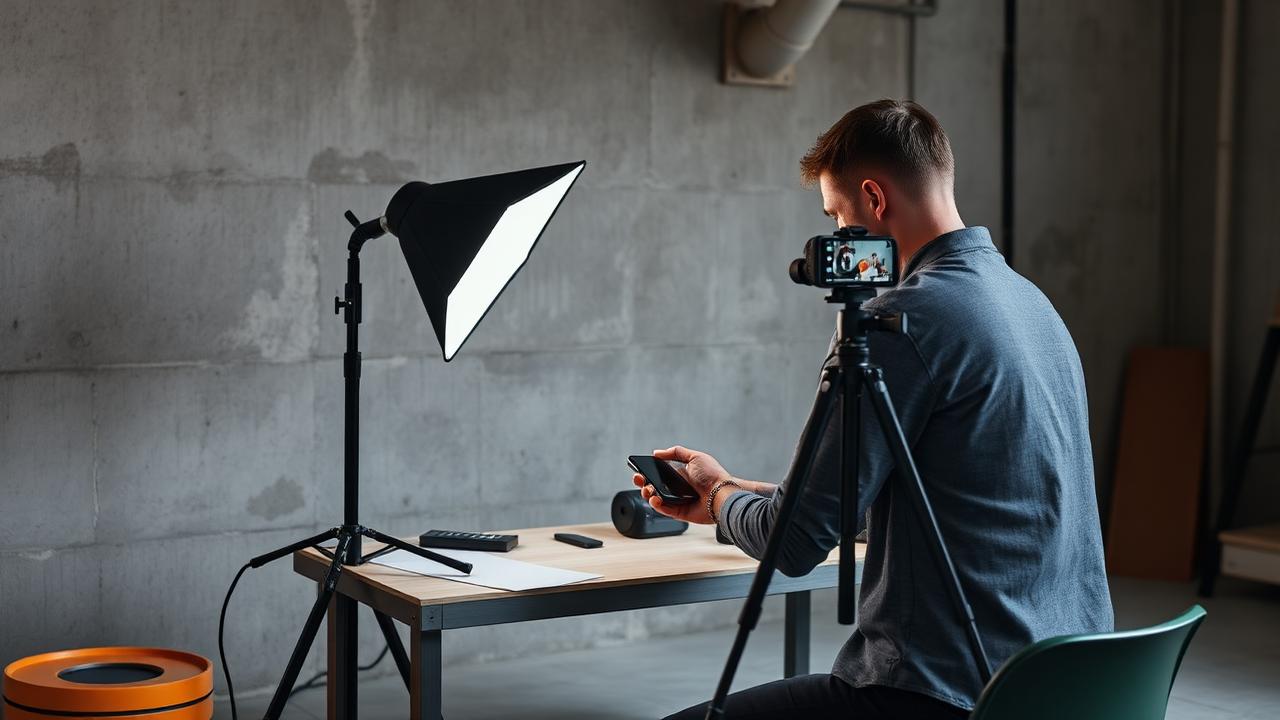
The most common and most expensive mistake is leaving content capture until after tooling, when the prototypes have been shipped to the factory and nobody has usable footage. Shoot during prototype design and the pilot build, when parts are on the bench and engineers can explain what they are doing. That material carries the entire pre-launch phase and costs almost nothing to collect at the time.
A 90-day launch calendar
Phase | Weeks | Goal | Content that works | Cadence | Primary metric |
|---|---|---|---|---|---|
Pre-launch / build in public | -12 to -5 | Assemble an audience before there is a product | Prototype iterations, failed tests, factory visits, founder explanations | 3-4 posts/week | Email signups per 1,000 views |
Waitlist push | -4 to -1 | Convert followers to an email list | Feature reveals, price teaser, behind-the-scenes of packaging | 4-5 posts/week | Waitlist conversion rate |
Launch week | 0 | Concentrate demand in 72 hours | Demo video, unboxing, comparison against the old way, creator posts | 1-2 posts/day | Click-to-order conversion |
Social proof | +1 to +6 | Replace your voice with customers' | User footage, reviews, question answers, use-case variations | 3-4 posts/week | Ratio of UGC to brand posts |
Sustain | +7 onward | Keep the catalog working | Maintenance tips, accessory reveals, seasonal use cases | 2-3 posts/week | Cost per acquisition trend |
Platform fit for physical products
- Short-form video (TikTok, Reels, Shorts): best for demonstrating a mechanism in under 15 seconds. Lead with the problem in frame one, not with your logo.
- YouTube: the only platform where a 6-12 minute build or teardown compounds for years; also the format reviewers borrow from.
- Instagram: product photography and carousels for spec detail; strongest for consumer and lifestyle categories.
- LinkedIn: industrial, B2B and component products — the audience is the buyer, and manufacturing content performs better than marketing content.
- Reddit and forums: the fastest way to find hostile, useful feedback pre-launch; post as a builder asking questions, never as an advertiser.
- Pinterest: long-tail discovery for home, kitchen and organization products, with a much longer content half-life than feeds.
Pick two platforms and cover them properly rather than posting everywhere at half strength. The choice follows the buyer, not the founder's comfort: a $19 kitchen accessory and a $9,000 machine do not share an audience or a proof format. That decision should already exist in the requirement work done during the product development process, where the target customer and price point were defined.
What to measure
Follower count predicts almost nothing about revenue for hardware. The metrics that correlate with launch outcome are email signups per thousand views, waitlist-to-order conversion, and the share of content produced by customers rather than by the brand.
Track those weekly, and treat any post that produced signups as a template to repeat rather than a one-off success. When paid budget is added, start it only against organic content that already converted — amplifying weak creative just buys reach for a message that did not work.
One practical budget note: for a first hardware launch, $3,000-8,000 covers photography, a demo video and a small creator seeding program, which is usually more than enough at pre-launch volumes. Save the larger spend for after reviews exist.
If you need the physical assets — appearance models, packaging, renders — before production units exist, that work sits alongside product development consulting and is worth scheduling into the program plan rather than improvising at launch.
Frequently asked questions
Filed under:Education
Services related to this guide
- Product design servicesIndustrial design and CAD taken all the way to manufacturable files.
- Rapid prototypingWorking prototypes in days, from 3D printing to vacuum casting.
- Electronic design servicesSchematic, PCB layout, firmware and bring-up, through to production handoff.
- Product development examplesReal projects we designed, prototyped and shipped.