Product Concept Design Examples: 7 Cases and What They Teach
Seven product concept design examples, what each one got right, and a repeatable framework for turning an idea into a concept that survives engineering and sells.
May 9, 202312 min read

Written by Konstantin Dolgan, Ph.D., NPDP
Founder & CEO, Product Development Engineer
Published May 9, 2023Updated September 2, 2026
A product concept is not a sketch — it is a testable promise: who the product is for, what problem it removes, how it will be recognised, and whether it can actually be built at a price the buyer accepts. The concepts below survived because all four parts held together, not because the drawing was beautiful.
This guide walks through seven well-documented product concept examples, pulls out the decision that made each one work, and then turns those decisions into a framework you can apply to your own concept design work. Two of the examples are more than a century old and two are from the last twenty years; the pattern behind them is identical.
What a product concept actually is
In new product development, the concept sits between the raw idea and the engineered design. The idea is "a bottle people can recognise"; the concept is "a contoured glass bottle whose silhouette is identifiable by touch in the dark and in a photograph of a broken shard, producible on existing bottling lines". The second version can be tested, costed and rejected. The first cannot.
A concept is complete when a stranger can read it and predict what the finished product does, who buys it and roughly what it costs to make. Anything less and you are still holding an idea — see concept design vs. detailed design for where the boundary sits.
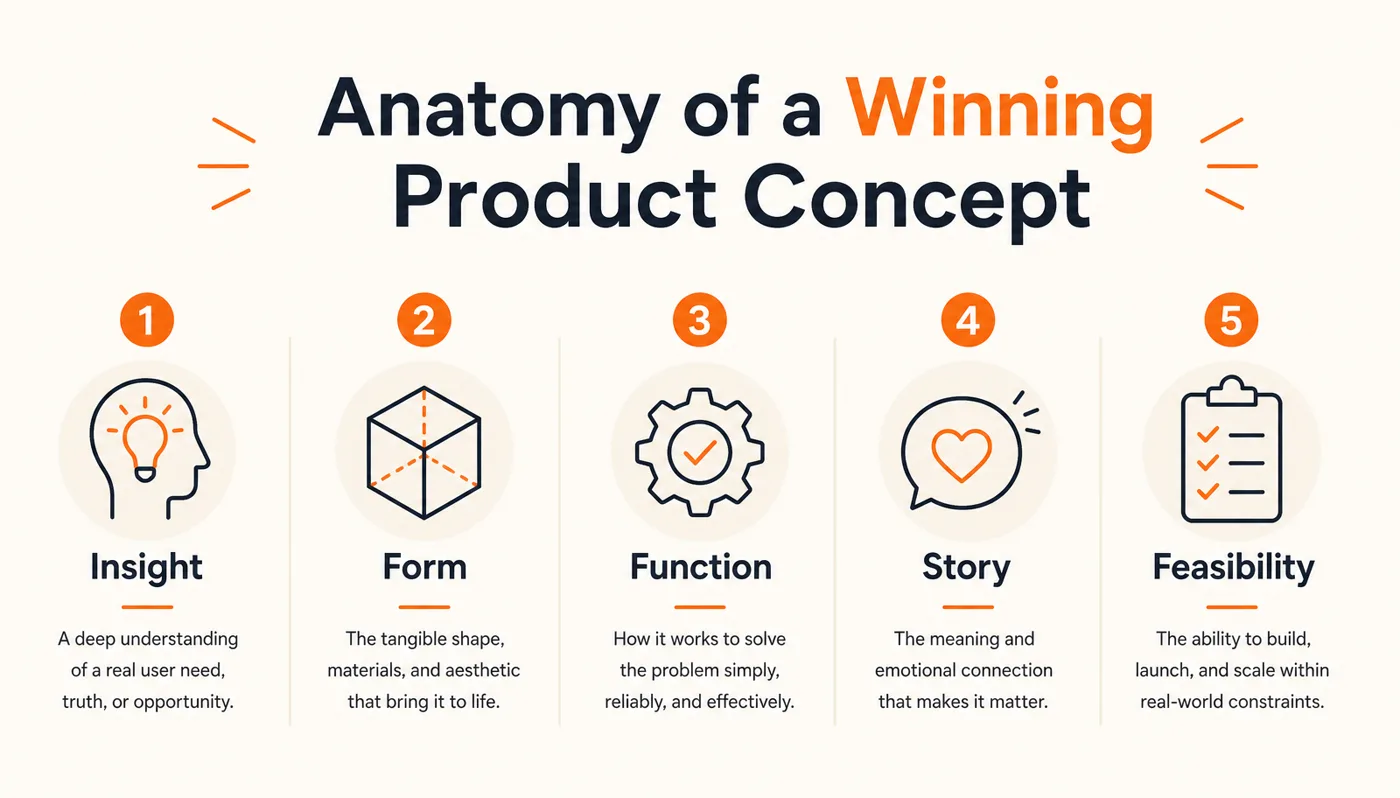
Layer | Question it answers | Evidence you need |
|---|---|---|
Insight | Whose problem is this, and how badly does it hurt? | User interviews, support tickets, search demand |
Form | What does it look and feel like? | Sketches, CMF studies, foam or printed models |
Function | What must it do, and how well? | Requirement list with numbers and limits |
Story | Why would someone choose this over the incumbent? | Positioning statement, concept test results |
Feasibility | Can it be made, certified and sold profitably? | Process route, rough BOM, target landed cost |
A concept that cannot be manufactured is a mood board. A concept nobody wants is an engineering exercise. You need both halves.
Example 1: The Coca-Cola contour bottle
The brief given to bottle makers in 1915 is the cleanest concept statement in industrial design history: a bottle recognisable by touch in the dark, and identifiable even when smashed on the ground. The Root Glass Company of Indiana answered it with the contour shape, approved in 1915 and introduced in 1916. Coca-Cola documents the background of the bottle concept on its official website.
What makes this a textbook product concept example is the constraint. The brief did not ask for beauty; it asked for a measurable outcome — brand identification under two hostile conditions — and it had to run on the bottling equipment of the day. The distinctiveness was a by-product of solving a counterfeiting problem, which is why it never went out of style.

- Lesson: write the brief as a test the finished product must pass, not as an adjective.
- Lesson: a manufacturing constraint that is fixed early is a design asset, not a limitation.
Example 2: The ballpoint pen
John J. Loud patented a rolling-ball marker in 1888; it worked on leather and hides but tore paper. Fifty years later László Bíró, a journalist, noticed that newspaper ink dried almost instantly and paired that ink chemistry with a ball-and-socket tip, patenting the writing instrument in 1938. Over two billion ballpoints are now produced in the U.S. each year.
The concept did not change between Loud and Bíró — a ball that rolls ink onto a surface. What changed was the system: viscosity, ball tolerance and capillary feed had to be designed together. Most failed concepts are like Loud's: the mechanism is right and one supporting variable makes it unusable.

Example 3: Oreo
Two chocolate wafers with a crème filling was not a novel format in 1912 — Sunshine Biscuits had launched Hydrox four years earlier. Nabisco won anyway, and Oreo has been America's best-selling cookie for over a century. The differentiators were the embossed wafer pattern (an identity you can see on a single crumb), the name, and relentless line extension into seasonal and regional variants.
This is the example that founders resist most: being second with a better concept is a winning position. The concept work happened at the level of branding, ritual and distribution rather than mechanism.

Example 4: The iPhone
In 2006 the leading phones — BlackBerry, Nokia, Sony Ericsson — combined a small screen with a fixed hardware keyboard. The iPhone concept removed the keyboard so the screen could become the whole device and the interface could change per application. Contemporary accounts describe how many engineers considered it technically impossible at the time.
The instructive part for a product team is the trade-off discipline: the concept accepted worse typing to gain a reconfigurable interface, and refused to compromise on that. Concepts die when a team tries to keep the advantage of the new idea and the safety of the old one.

Example 5: The Anglepoise lamp
George Carwardine designed vehicle suspension systems. In 1932, working from his own garage, he applied constant-tension spring theory to a task light so it could be repositioned with one finger and stay where it was put; Herbert Terry & Sons produced the first lamps in 1934. The heavy base was not styling — it was the counterweight the mechanism required.
Carwardine's move — transplanting a solved mechanism from one industry into an unsolved problem in another — remains the highest-yield concept technique available to small teams. You are not inventing physics; you are relocating it.

Example 6: Dyson's cyclonic vacuum
James Dyson's concept came from an industrial cyclone separator used in a sawmill: remove the bag, and suction no longer degrades as the machine fills. The company reports the design took years and thousands of prototypes before it was viable, and the clear bin — showing the dirt collected — turned an engineering property into the product's marketing argument.
That last detail is worth copying. The strongest concepts make their advantage visible without explanation. If you have to write a paragraph to explain why your product is better, the concept is not finished.
Example 7: The Nest Learning Thermostat
Programmable thermostats existed for decades and were widely disliked because programming them was tedious. Nest's concept did not add features; it removed the programming step by learning from adjustments, and it treated the wall-mounted object as a consumer product rather than a piece of building equipment. Google acquired the company in 2014 for a reported $3.2 billion.
Nest is the modern proof that a category with entrenched incumbents can be opened with a concept that subtracts work from the user. When you evaluate ideas, score them on how much user effort they remove, not on how many features they add.
Product | Designer / company | Introduced | Concept move that mattered |
|---|---|---|---|
Coca-Cola contour bottle | Root Glass Company | 1916 | Brief written as a recognition test |
Ballpoint pen | László Bíró | 1938 | Ink chemistry and tip designed as one system |
Oreo | Nabisco | 1912 | Identity and ritual over mechanism |
Anglepoise lamp | George Carwardine | 1934 | Suspension engineering moved into lighting |
Dyson cyclonic vacuum | James Dyson | 1993 | Made the technical advantage visible |
iPhone | Apple | 2007 | Accepted a clear trade-off and held it |
Nest thermostat | Nest Labs | 2011 | Removed user effort instead of adding features |
The pattern behind all seven
Read the seven together and the same four moves keep appearing. None of them require a large budget; all of them require deciding something specific before CAD begins.
- Write the brief as a pass/fail test. "Recognisable in the dark" beats "iconic".
- Borrow a solved mechanism. Suspension springs, cyclone separators, newspaper ink — the physics already worked elsewhere.
- Choose one trade-off and defend it. Every strong concept is worse at something on purpose.
- Make the advantage visible. A clear bin, an embossed wafer, a glass silhouette — proof the buyer can see in a second.
How to develop your own product concept
Concept development is a short, cheap phase that decides how expensive everything after it will be. In our own work, teams that spend three to six weeks here typically avoid at least one full tooling revision later. The sequence we use with clients is deliberately compressed:
- Frame the problem. One sentence: who, in what situation, currently does what, and what it costs them. Anything you cannot state this way is not yet a product opportunity.
- Generate widely, then cut hard. Twenty rough directions, sketched at low fidelity — see our tips for developing new product ideas for structured generation methods.
- Write concept statements. For the best three or four: a paragraph, a sketch, the primary trade-off and a rough cost target.
- Test on strangers. Show the statements to people in the target group without explaining them; ask what the product does and what they would pay.
- Check feasibility early. A rough bill of materials and a process route filter out concepts that cannot hit the price, before you fall in love with them.
- Build the cheapest honest model. Foam, cardboard or a printed shell answers proportion and ergonomics questions long before functional prototyping — see how to make a prototype.
Formal concept testing methods — monadic tests, purchase-intent scales, conjoint studies — are well documented by practitioners such as the Product Development and Management Association. For most early-stage teams, twelve honest conversations beat a statistically clean survey run too late.
Where product concepts usually fail
- The concept is a feature list. No trade-off, no priority, nothing to test.
- Aesthetics arrive before requirements. Renders are approved, then engineering discovers the geometry cannot be moulded.
- Cost is checked after tooling. By then the concept is expensive to change; run a rough BOM at concept stage instead — prototype and product cost drivers are largely set here.
- The team tests with friends. Enthusiasm from people who like you is not demand.
- Regulation is discovered late. Skin, food, children's or medical contact changes materials and testing — decide it at concept stage, not at launch.
Frequently asked questions about product concept design
What is a product concept example?
A product concept example is a documented case where an idea was turned into a specific, testable proposition before engineering began — the Coca-Cola contour bottle brief ("recognisable in the dark"), Bíró's ball-and-ink system, or Nest's decision to remove thermostat programming. In each case the concept named the user, the problem, the form and the trade-off clearly enough that it could be evaluated before money was spent on tooling.
What are the elements of product design?
The four commonly cited elements are features, aesthetics, interaction and novelty. Features deliver the functional outcome, aesthetics create desirability, interaction determines whether people can use the product without instructions, and novelty establishes why it deserves attention. A concept that scores well on all four but fails feasibility is still not viable, which is why manufacturability is treated as a fifth element in practice.
What makes a product design successful?
Two conditions: it meets a real user requirement, and it delivers value beyond that minimum requirement at a cost the market accepts. A product can satisfy a need and still fail commercially if the landed cost forces a price the buyer rejects, so successful design is always measured against the target cost as well as the user's brief.
What are the three product design strategies?
Understand the problem, define the product, and visualise the product. Understanding means researching the user's situation rather than your assumption about it. Defining converts that research into requirements and constraints with numbers attached. Visualising turns the definition into sketches, models and concept statements that other people can react to.
How long should concept design take?
For most consumer and light industrial products, three to six weeks — long enough to generate and test several directions, short enough that the team does not over-invest in one. Regulated, electromechanical or highly engineered products commonly run eight to twelve weeks because feasibility checks involve component sourcing and early compliance review.
How many concepts should you generate before choosing one?
Generate fifteen to twenty rough directions, develop three or four into written concept statements with sketches, and take one or two into prototyping. Teams that develop only one concept almost always discover its weakness after tooling, when changing it is most expensive.
Turn your concept into a product
LA NPDT runs concept design as a decision-making phase, not a rendering exercise: we frame the brief as testable requirements, generate and screen directions, check manufacturability and cost early, and hand engineering a concept that survives contact with tooling. Explore our concept design, product design and rapid prototyping services, or read how we run product discovery before design begins.
Have an idea that needs to become a real concept?
How to read product development examples without copying the wrong thing
Case studies are usually told backwards, so the winning decision looks obvious. It was not. Each example below is stated as the constraint the team faced, the decision they made under uncertainty, and the specific practice you can transfer to your own program.
Example | Domain | Core constraint | Transferable lesson |
|---|---|---|---|
Contoured beverage container | Consumer packaging | Brand recognition without a label | Shape can carry identity and be protected |
Cordless power tool platform | Consumer/pro tools | Battery cost across a product family | Standardise the expensive shared subsystem |
Single-use insulin pen | Medical device | Untrained users, zero tolerance for error | Design the error out, not the warning in |
Flat-pack furniture system | Home goods | Freight and warehouse cost per unit | Optimise for the box, not just the product |
Ruggedized field tablet | Industrial | Drop, dust and glove operation | Environment defines the spec, not the roadmap |
Modular kitchen appliance | Small appliance | Shelf price versus feature creep | Cost target as a hard design requirement |
Wearable activity sensor | Connected consumer | Battery life versus size | Fix the non-negotiable, trade everything else |
1. Shape as brand: the contoured container
The constraint was recognition in the dark and on a crowded shelf, using no printed elements. The decision was to invest in a form that could be protected as trade dress, accepting higher mold complexity and a heavier unit than a straight-wall alternative. The lesson: when differentiation must survive being wet, unlit or partially obscured, geometry outperforms graphics — and the extra tooling cost is a marketing budget line, not an engineering overrun.
2. Platform thinking: the cordless tool family
The expensive subsystem in a cordless tool is the battery and charger, not the motor housing. Standardising one pack across dozens of tools converted a per-product cost into a shared platform cost and created a switching barrier for customers who owned three packs. The lesson: identify the highest-cost shared subsystem early and design the family around it rather than designing products individually and rationalising later.
Approach | Tooling investment | Unit cost at scale | Customer lock-in |
|---|---|---|---|
Product-by-product design | Lower per launch | Higher | None |
Shared battery platform | Higher up front | Lower | Strong |
3. Designing the error out: the injection pen
Users were untrained, often elderly, sometimes impaired, and a dosing mistake had clinical consequences. Instead of adding instructions, the team made incorrect operation physically difficult: audible and tactile dose clicks, a mechanically limited maximum dose, and a needle shield that cannot be re-exposed.
The lesson: in any product where misuse is costly, ranked mitigation is design-out, then guard, then warn — a label is the weakest control and regulators treat it that way.
4. Optimising for the box: flat-pack furniture
Metric | Assembled shipping | Flat-pack design |
|---|---|---|
Units per 40ft container | Baseline | 4–8x baseline |
Freight cost per unit | High | Low |
Damage rate in transit | Higher | Lower |
Customer assembly time | None | 15–60 minutes |
The decision was to accept customer assembly time as a product feature to be designed — numbered parts, a single tool, unambiguous orientation — in exchange for a structurally lower cost base. The lesson: logistics constraints belong in the design brief from day one, because they often dominate unit economics more than BOM cost does.
5. Environment as specification: the field tablet
- Drop spec derived from observed use (waist height onto concrete), not from a marketing number.
- Touchscreen tuned for gloved operation, which changed the digitizer and the minimum touch target size.
- Sealed to IP65, which drove connector selection, gasket geometry and thermal design simultaneously.
- Serviceability designed in, because field replacement beats RMA logistics for industrial customers.
The lesson: write the environmental specification before the feature list. Retrofitting sealing and impact resistance onto a consumer-derived design is one of the most expensive rework paths in hardware.
6. Cost target as a hard requirement: the kitchen appliance
The team set a landed cost ceiling derived backwards from the target shelf price and channel margin, then treated it exactly like a safety requirement — no feature could be added without removing equivalent cost. Features were held in a ranked backlog and admitted only when a cost reduction elsewhere paid for them.
Shelf price target | Retail margin | Distributor margin | Landed cost ceiling |
|---|---|---|---|
$99 | 40% | 15% | ~$50 |
$149 | 40% | 15% | ~$76 |
$249 | 45% | 15% | ~$116 |
7. Fix the non-negotiable: the wearable sensor
Battery life below seven days killed adoption in user testing, so seven days became immovable. Everything else — display resolution, sampling rate, housing material, sensor count — became a trade variable against that constraint. The lesson: identify the one attribute that determines adoption, make it a fixed constraint, and force every other decision to negotiate around it. Teams that leave every attribute negotiable end up mediocre at all of them.
What the seven examples have in common
- The binding constraint was named explicitly and early, and it did not move.
- Cost, logistics or regulation was treated as a design input rather than a downstream problem.
- Each team invested in the expensive shared element (tool, platform, battery) instead of spreading spend evenly.
- User error and user environment were designed for directly, not documented around.
- Trade-offs were made deliberately and recorded, so later decisions did not silently reverse earlier ones.
Applying this to your own program
- Write one sentence naming the binding constraint for your product, and get the whole team to agree on it.
- Derive a landed cost ceiling from the target price and channel structure before engineering begins.
- List the top three misuse scenarios and assign each a design-out, guard or warn mitigation.
- Identify the highest-cost shared subsystem and decide now whether it is a platform.
- Put freight, packaging and certification into the requirements document, not the launch checklist.
Frequently asked questions
What are good product development examples to learn from?
The most instructive examples are ones where a single hard constraint — cost ceiling, environment, user error, freight — shaped the whole design. Cordless tool battery platforms, flat-pack furniture and single-use medical injectors are all clean illustrations of that pattern.
What do successful product development projects have in common?
A named binding constraint, a cost ceiling derived from the market rather than from the BOM, early treatment of logistics and regulation as design inputs, and deliberate recorded trade-offs.
How many prototypes do these programs typically build?
Three or more rounds is normal: an early concept build, an integrated beta, and a production-intent unit used for certification and first article inspection.
Can a small team apply these lessons?
Yes. None of these practices require scale — naming the constraint, deriving a cost ceiling and ranking misuse mitigations are all zero-cost decisions that happen before money is committed.
What is the most common reason products fail after a good concept?
Cost and constraint discipline erode during detailed design. Features get added, the cost ceiling drifts, tooling is committed late, and the product arrives at market priced above what the original demand assumed. Work with LA NPDT: if you are moving from here to execution, start with our product design services or talk to us about industrial design and development .
Filed under:EducationInspirationWords
Services related to this guide
- Product design servicesIndustrial design and CAD taken all the way to manufacturable files.
- Best industrial design firmsWhich studios take an idea from form to manufacturable hardware, and what they charge.
- Prototype designLooks-like, works-like or pre-production: what each proves and what it costs.
- Product development examplesReal projects we designed, prototyped and shipped.