Robotic Process Automation in Manufacturing: Use Cases and ROI
RPA automates the paperwork around production, not the production itself. Here are the use cases that pay back, what bots cost, and where RPA fails.
October 24, 20196 min read

Written by Ashok Chintagunta, MS Computer Science, Louisiana Tech University
CTO & Software Engineer, AI and Automation
Published October 24, 2019Updated September 2, 2026
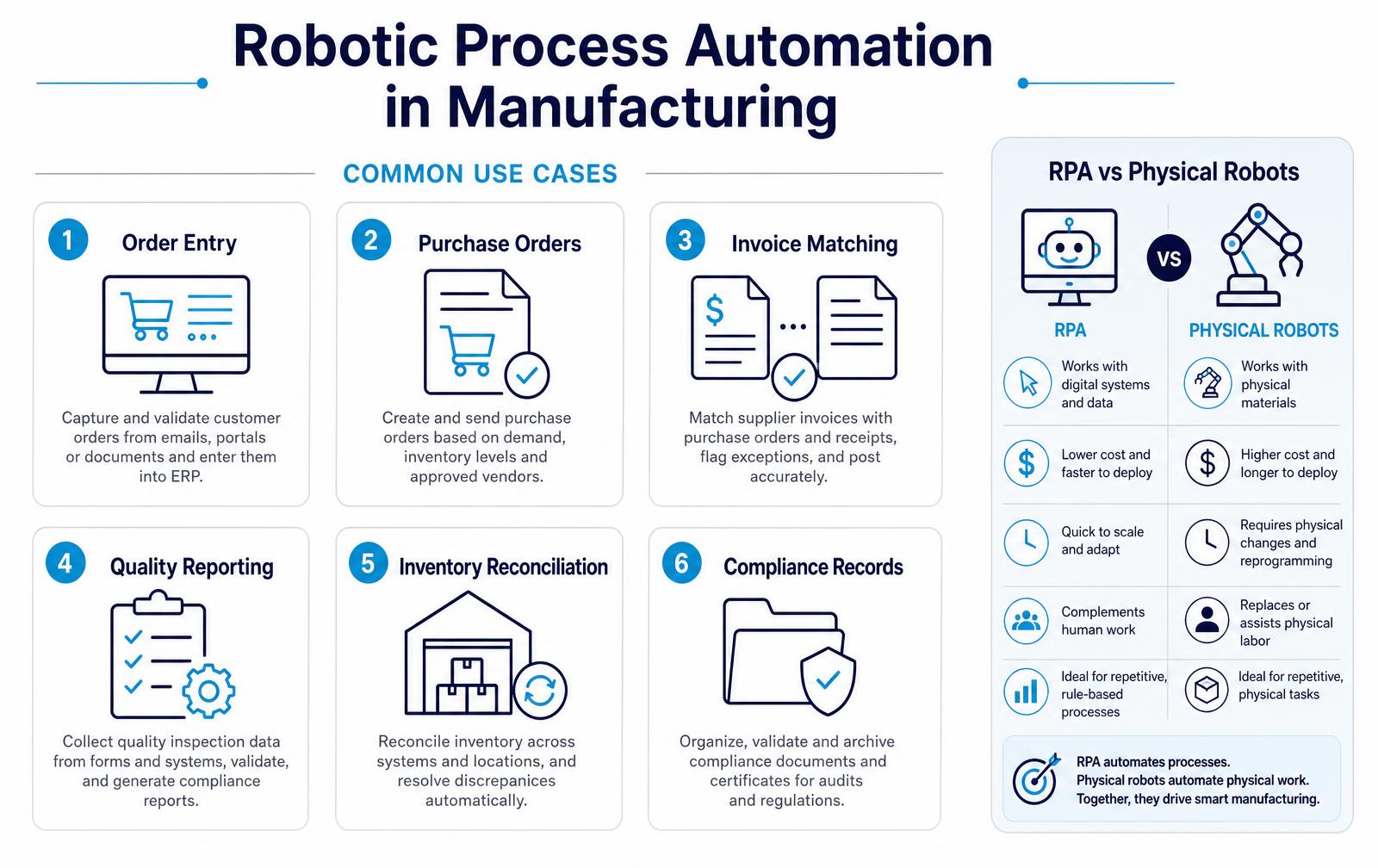
RPA does not touch the product. It automates the clerical work that surrounds production — rekeying orders, matching invoices, assembling compliance packets. That distinction matters, because the plants that get value from robotic process automation in manufacturing target well-defined, rule-based transactions, not judgement calls.
Use cases, effort and payback
Process | Build effort | Hours saved per week | Typical payback |
|---|---|---|---|
Order entry from email or portal into ERP | 3-6 weeks | 10-30 | 6-12 months |
Purchase order creation and follow-up | 2-4 weeks | 5-15 | 6-14 months |
Three-way invoice matching | 4-8 weeks | 15-40 | 5-10 months |
Quality and SPC reporting | 2-5 weeks | 5-12 | 9-18 months |
Inventory and cycle-count reconciliation | 3-6 weeks | 8-20 | 8-15 months |
Compliance and audit record assembly | 3-6 weeks | 4-10 | 12-24 months |
what Rpa Costs to Run
- Licences. Roughly $5,000 to $15,000 per attended or unattended bot per year, plus orchestration.
- Build. $10,000 to $60,000 per process when using an integrator; less if built in-house.
- Maintenance. Budget 15 to 25 percent of build cost annually — bots break when a screen or form changes.
- Governance. Bot credentials, access reviews and audit logging, especially in regulated plants.
- Process redesign. Fixing the process first often removes half the steps you were going to automate.
when Rpa is the Wrong Tool
If a proper API or ERP integration exists, use it — a bot driving a user interface is a fragile substitute for a supported interface. RPA also struggles with unstructured input, frequent exceptions and processes that change every quarter. Treat it as a bridge over gaps between systems you cannot integrate, and retire bots as real integrations arrive.
Related reading: robotics in manufacturing and collaborative robots in manufacturing.
A 90-day pilot plan
Phase | Weeks | Work | Exit criteria |
|---|---|---|---|
Process discovery | 1-2 | Shadow the task, record clicks and exceptions | Documented process map with exception rates |
Feasibility scoring | 3 | Rank by volume, rule stability and system access | One process picked with a signed ROI estimate |
Build | 4-8 | Bot development in a sandbox with test data | Bot completes the happy path plus top three exceptions |
Shadow run | 9-11 | Bot runs alongside the human, outputs compared | Under 2% variance across a full cycle |
Cutover and monitoring | 12-13 | Production run with exception alerts | Handling time and error rate measured against baseline |
What makes a process a good candidate
- High volume, low judgment. Hundreds of repetitions a week with rules you can write down.
- Stable inputs. Structured files or screens that do not change layout every quarter.
- Digital end to end. Any paper step forces a human handoff and erodes the savings.
- Measurable baseline. You know today what the task costs in hours and errors.
- Low exception rate. Above roughly 20% exceptions, a workflow or integration fix beats a bot.
Where the savings actually come from
The pitch for robotic process automation is labour hours, but in a manufacturing business the durable savings usually sit somewhere else: rework caused by transcription errors, expedite freight caused by a purchase order that sat in an inbox, and inventory carried because nobody trusted the system of record.
A bot that copies order data from a customer portal into the ERP saves perhaps six hours a week of clerical time. The same bot removes a class of typos that used to generate one wrong shipment a month.
Price the second effect and the payback case stops depending on headcount reduction, which is the assumption most plant managers refuse to sign anyway.
Cost and payback by process type
Process | Build effort | Annual run cost | Typical annual saving | Payback |
|---|---|---|---|---|
Order entry from PDF or portal | 3-6 weeks | $3k-$8k | $25k-$60k | 3-6 months |
Supplier invoice matching | 4-8 weeks | $4k-$10k | $30k-$90k | 4-8 months |
Quality record compilation | 3-5 weeks | $2k-$6k | $15k-$40k | 5-10 months |
Shipping document generation | 2-4 weeks | $2k-$5k | $12k-$35k | 4-9 months |
Inventory reconciliation across systems | 6-10 weeks | $5k-$12k | $40k-$120k | 5-9 months |
Why bots break, and how to keep them alive
- Prefer APIs to screen scraping. A documented endpoint survives a vendor UI refresh; a coordinate-based click does not.
- Give every bot an owner. Unowned automation quietly stops and nobody notices until the month-end close.
- Log every transaction the bot touches so an auditor can reconstruct what happened without watching a recording.
- Build an exception path first. Decide what the bot does with the 5% of documents it cannot read before you automate the other 95%.
- Version the bot like software. Source control, a test environment and a rollback beat editing a live workflow.
- Review the process before automating it. Automating a broken approval chain just makes the wrong answer arrive faster.
Governance keeps a bot fleet from becoming shadow IT
The second year of an automation program is harder than the first. A dozen bots now touch the ERP, the quality system and a supplier portal, each holding credentials somebody issued informally, and nobody has a list.
When an auditor asks who approved a change to the invoice matching rule, the honest answer is often nobody. Treat bots as systems: a register with owner, purpose, systems touched and last review date; service accounts with scoped permissions rather than a shared human login; and a change log.
The overhead is a few hours a month and it is the difference between an automation portfolio and an unmapped dependency that fails during the one week your controller is on leave.
- Keep a bot register with owner, business process, systems and criticality.
- Use dedicated service accounts with the minimum permissions each task needs.
- Alert on failure, not just on success, and route alerts to a person who can act.
- Review each bot quarterly against the process it automates; processes drift.
- Document the manual fallback so the work continues when a bot is down.
- Retire bots deliberately when the underlying system gains native functionality.
Where robotic process automation pays back on a factory floor
Robotic process automation in manufacturing covers two overlapping things: software bots that move data between ERP, MES and supplier portals, and the scripted handling cells that feed machines. The payback math is different for each, and mixing them in one business case is the fastest way to get a project rejected. Software automation is cheap, fast and reversible; physical automation is capital, and it locks in a process.
Automation target | Typical setup cost | Payback period | Best fit |
|---|---|---|---|
Order entry / invoice matching bots | $8k–$35k | 3–9 months | High transaction volume, stable formats |
Production reporting and traceability | $15k–$60k | 6–14 months | Audited or regulated output |
Machine tending cobot cell | $45k–$120k | 12–24 months | Repetitive load/unload, 2+ shifts |
Vision inspection station | $30k–$90k | 9–18 months | Defect escape cost is high |
Palletizing / end-of-line | $80k–$220k | 18–30 months | Heavy, high-cycle packaging |
The most common mistake is automating a process that should be eliminated. Before scoping a bot, run the task through the standard sequence: eliminate, simplify, standardize, then automate. Automating an unstandardized process just makes the exceptions someone else's problem, and exception handling is where RPA projects quietly lose their savings.
A readiness checklist before you scope the first bot
- Is the input digital and consistent? Scanned PDFs with varying layouts need document AI, not rule-based RPA — a different budget entirely.
- How many exceptions per hundred transactions? Above roughly fifteen percent, a human still touches most of the work and savings collapse.
- Who owns the bot when the ERP updates? Screen-scraping bots break on every UI change; API-based integrations do not.
- Is the cycle time actually the constraint? Automating a non-bottleneck station adds WIP, not throughput.
- What is the safety scope for a physical cell? A risk assessment to ISO 10218 and ISO/TS 15066 comes before the quote, not after.
- Can the cell be re-tasked? A cobot that only ever runs one part number is a fixed machine at a flexible-machine price.
If you are weighing an automated cell against a redesigned part that needs less handling, our consulting engagements compare both before capital is committed.
where Rpa Pays Back Fastest on the Plant Floor
Manufacturers that get returns from robotic process automation in manufacturing start with the boring, high-volume clerical work that sits between systems — not with the flashiest process. Payback below nine months almost always comes from the top three rows here.
Process | Hours/month recovered | Build effort | Typical payback | Failure mode |
|---|---|---|---|---|
Order entry from PDF/email to ERP | 60-160 | 4-6 weeks | 3-6 months | Layout variation, needs document AI |
Supplier invoice matching | 40-120 | 3-5 weeks | 4-8 months | Exception handling not designed |
Shipment status and ASN updates | 30-90 | 2-4 weeks | 5-9 months | Carrier portal changes break the bot |
Quality record transcription | 20-60 | 4-8 weeks | 9-14 months | Regulated records need validation |
Production scheduling data pulls | 15-50 | 2-3 weeks | 8-12 months | Better solved by a real integration |
The total cost nobody quotes
Line item | Year 1 | Ongoing/year | Comment |
|---|---|---|---|
Bot licenses | $5,000-$15,000 | $5,000-$15,000 | Per attended/unattended bot |
Orchestrator / platform | $8,000-$30,000 | $8,000-$30,000 | Often overlooked in pilots |
Build and testing | $10,000-$60,000 | — | Per automation, varies with exceptions |
Maintenance | — | 20-30% of build | UI changes are the main driver |
Internal process owner | 0.25-0.5 FTE | 0.25-0.5 FTE | Without this, bots rot |
Go / no-go screen for a candidate process
- Volume above 200 transactions per month — below that, the maintenance eats the savings.
- Rule-based decisions — if a human judgement call happens more than 10% of the time, redesign first.
- Stable source systems — an ERP migration in the next 12 months kills the business case.
- Digital, consistent inputs — scanned faxes need document AI layered on top.
- Named owner — someone whose job includes fixing the bot when it breaks.
- Measured baseline — you cannot prove savings you never timed.
If two or more screens fail, fix the process before you automate it. Automating a broken process just makes it fail faster and more consistently.
Frequently asked questions
Key takeaways
The manufacturers getting durable value from automation are not the ones that bought the most software. They picked processes with high volume and stable rules, measured the before state honestly, automated a narrow slice, and only expanded once the first slice ran unattended for a month.
That sequence produces a payback number you can defend and a team that trusts the tools. The opposite sequence, a platform purchase followed by a search for processes to justify it, is how automation budgets get cut in year two.
Frequently asked questions
What is robotic process automation in manufacturing?
It is software that performs rule-based digital tasks across existing systems — reading an order email, keying it into the ERP, matching an invoice to a purchase order, compiling a quality report. Unlike industrial robots, RPA never touches physical material; it automates the administrative layer around production.
How is Rpa Different from Industrial Robots?
Industrial robots automate physical work — welding, handling, assembly — and need safety engineering, tooling and floor space. RPA automates digital transactions, deploys in weeks rather than months, and costs thousands rather than hundreds of thousands. Many plants run both, addressing different bottlenecks.
What Does an Rpa Bot Cost?
Licensing typically runs $5,000 to $15,000 per bot per year, with $10,000 to $60,000 of build effort per automated process and 15 to 25 percent of that build cost each year in maintenance. Well-chosen processes usually pay back within six to eighteen months. Work with LA NPDT: if you are moving from here to execution, start with our low-volume manufacturing or talk to us about design for manufacturing .
Filed under:Tech Talk Podcast
Tagged:AIArtificial IntelligenceDesignDevelopmentLatestNewsProduct DesignProduct DevelopmentTechTechnologyUpdates
Services related to this guide
- Product design servicesIndustrial design and CAD taken all the way to manufacturable files.
- Rapid prototypingWorking prototypes in days, from 3D printing to vacuum casting.
- Electronic design servicesSchematic, PCB layout, firmware and bring-up, through to production handoff.
- Product development examplesReal projects we designed, prototyped and shipped.