Consumer Packaged Goods Manufacturing: Costs, Timelines and Partners
What consumer packaged goods manufacturing actually involves, how co-manufacturers price work, and where first-time CPG brands lose money.
October 24, 20197 min read

Written by Ralph Hill, Mechanical & electrical systems, 3D manufacturing
Prototyping Engineer
Published October 24, 2019Updated September 2, 2026
In CPG, the margin is decided before the first production run. Formulation, pack format and co-manufacturer minimums set your landed cost, and none of them are easy to change once tooling exists and a retailer has a planogram. This guide walks the sequence, the money and the mistakes that repeat.
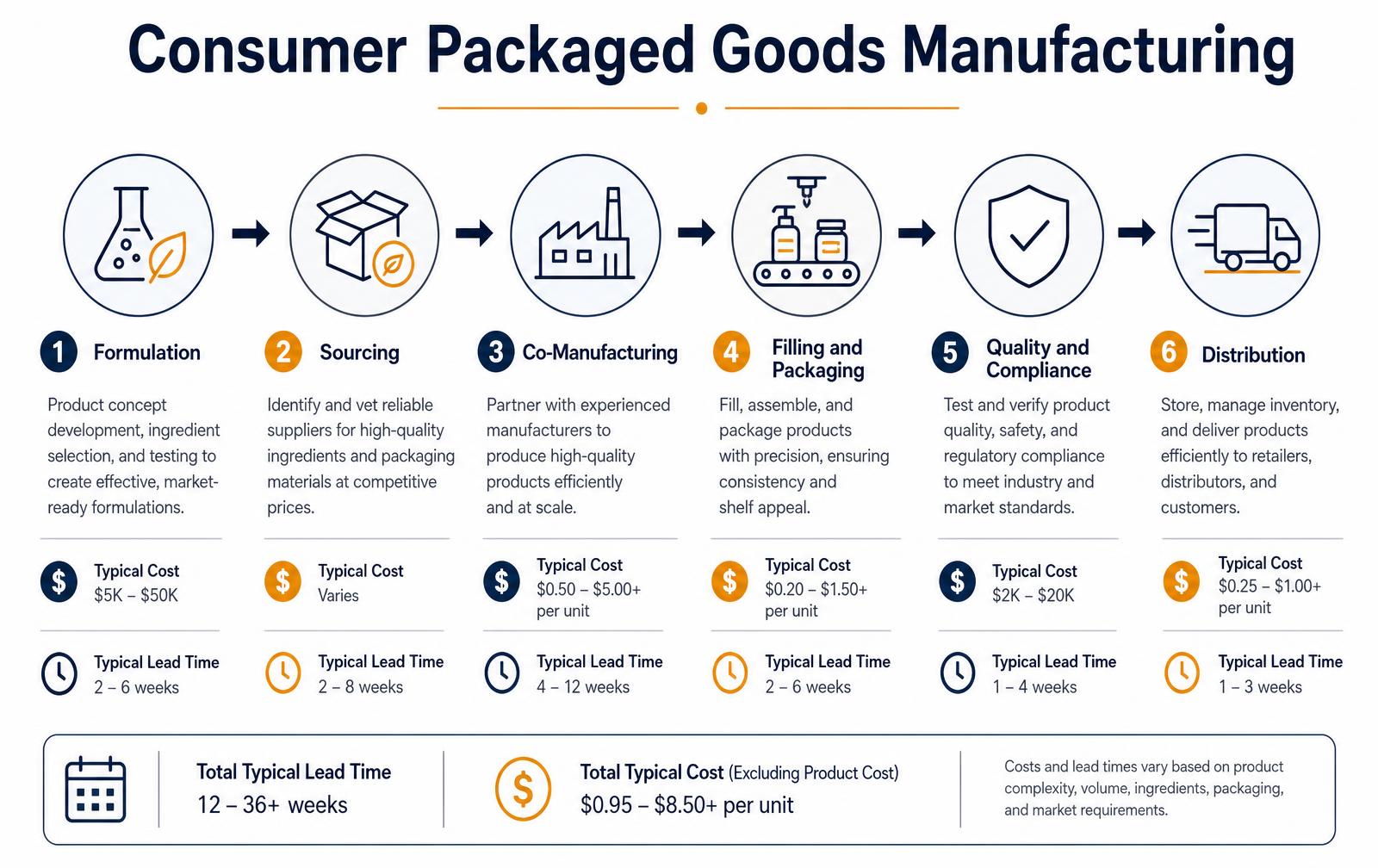
Stage costs and lead times
Stage | Typical cost | Lead time | Main risk |
|---|---|---|---|
Formulation and bench work | $5k-$50k | 2-6 weeks | Formula does not scale on plant equipment |
Sourcing and supplier qualification | Varies | 2-8 weeks | Single-sourced ingredient or component |
Co-manufacturing setup | $3k-$25k setup | 4-12 weeks | MOQ far above your launch forecast |
Filling and packaging | $0.20-$1.50/unit | 2-6 weeks | Changeover fees eat small runs |
Quality and compliance | $2k-$20k | 1-4 weeks | Label claims not substantiated |
Distribution and 3PL | $0.25-$1.00/unit | 1-3 weeks | Retailer chargebacks for case spec errors |
Co-manufacturer or in-house?
Almost every emerging CPG brand should start with a co-manufacturer. You buy access to qualified equipment, audited food safety systems and existing supplier relationships instead of capital equipment. The trade-off is control: you fit their schedule, their minimums and their changeover economics. Bringing production in-house becomes rational when annual volume covers a line's installed cost in roughly two years and the process itself is a differentiator.
Where first launches lose money
- Ordering to MOQ instead of demand. Cash and shelf life both expire in the warehouse.
- Ignoring changeover fees. Short runs on a shared line can double effective unit cost.
- Designing packaging the line cannot run. Validate pack format against the filler before art is finalised.
- Skipping a second supplier. One ingredient outage stops every SKU that uses it.
- Underpricing trade spend. Slotting, promotions and chargebacks routinely consume 15 to 30 percent of revenue.
Related reading: food packaging manufacturers and custom industrial equipment manufacturing.
A realistic first-run cost model
Cost line | Per unit at 5,000 | Per unit at 50,000 | Notes |
|---|---|---|---|
Ingredients / formulation | $1.40 | $1.05 | Volume pricing kicks in at pallet quantities |
Primary packaging | $0.85 | $0.42 | Plate and tooling amortization dominates at low volume |
Co-manufacturing tolling | $0.90 | $0.35 | Setup and changeover spread across the run |
Secondary packaging and labor | $0.25 | $0.15 | Cartoning, case packing, palletizing |
Freight and warehousing | $0.30 | $0.18 | LTL versus full truckload |
Landed cost | $3.70 | $2.15 | Before trade spend, slotting and returns |
Questions to ask a co-manufacturer
- What is the true MOQ per SKU, and per flavor or variant? Variants multiply changeovers and minimums.
- Who owns the formula and the specifications? Get ownership and portability in writing before trials.
- What certifications are current? SQF or BRCGS, organic, kosher, allergen control program - with audit dates.
- How are trial runs billed and how many are included? Two to three trials is normal before a clean production run.
- What is the scheduling lead time in peak season? Ten to sixteen weeks is common and will define your reorder cadence.
Minimum order quantities and what drives them
Format | Typical co-man MOQ | Driver of the minimum | Ways to reduce it |
|---|---|---|---|
Beverage, canned | 30,000-100,000 units | Line changeover and can pallet quantities | Shared runs, smaller can supplier, tolling |
Sauce or liquid, glass or PET | 5,000-20,000 units | Kettle batch size and fill line setup | Match batch to kettle, accept a shorter shelf test |
Dry blend, pouch | 3,000-15,000 units | Film print minimums, not the blend | Digital-print film for launch quantities |
Supplement, capsule | 10,000-50,000 units | Encapsulation setup and testing | Contract with a smaller specialist facility |
Personal care, cream | 2,500-10,000 units | Mixing vessel and component MOQs | Stock components, custom label only |
Compliance work that runs in parallel
Formula and packaging get all the attention, but the regulatory track has its own critical path and it does not compress.
Nutrition analysis takes two to four weeks per SKU, shelf-life and stability testing can take three to twelve months depending on the claim, and label review for allergens, net contents and claim language should happen before print plates are cut.
Any facility making food in the United States needs a written food safety plan under FSMA, and retail buyers increasingly require a GFSI-recognised audit such as SQF or BRC before they will list a product. Start these the same week the formula is locked, not after the first successful production run.
Launch readiness checklist
- Formula locked and scaled on the co-manufacturer equipment, not a benchtop version.
- Nutrition panel and allergen statement generated from the production formula.
- Shelf-life data covering the claimed date, with the storage conditions distribution will actually deliver.
- Packaging components qualified on the fill line, including cap torque and seal integrity.
- Barcodes registered and verified on printed material, not on a proof.
- Liability insurance and facility audit certificates ready for the retail buyer packet.
- Landed cost model including freight, slotting, distributor margin and expected promotional spend.
Margin math before you sign a co-man agreement
Retail arithmetic is unforgiving and it works backwards from the shelf.
A product priced at $4.99 typically leaves the distributor at around $3.00 and the brand at roughly $2.40, so a cost of goods above about $1.20 makes the business unworkable once you add freight, damages, slotting and promotional support that routinely consumes 10-20% of revenue.
Run that model before locking a formula, because the levers that fix it are all upstream: pack size, ingredient substitution, cavity count on the mold, run length.
Discovering the gap after the first production run means either a price increase the buyer will not accept or a reformulation that restarts shelf-life testing.
- Start from the shelf price and work back through every margin in the chain.
- Include trade spend: slotting, promotions, free fills and demo costs are not optional in retail.
- Model two volumes, launch and steady state, since per-unit cost moves sharply with run length.
- Ask for the tolling breakdown so you can see ingredient cost separately from conversion.
- Negotiate a volume ladder up front instead of renegotiating after growth.
- Keep a second co-man qualified on paper; single-source production ends brands.
what Cpg Manufacturers Need Before They Will Quote
Consumer packaged goods manufacturing runs on co-packers and contract fillers, and they quote from a specification package rather than a conversation. Arriving with the package below turns a three-week back-and-forth into a same-week number.
Document | Why the co-packer needs it | Who usually writes it |
|---|---|---|
Formula or bill of materials | Ingredient sourcing and allergen handling | Formulator or brand |
Batch size target | Line scheduling and minimum runs | Brand |
Primary packaging spec | Fill line compatibility | Packaging engineer |
Label artwork with claims | Regulatory review and print plates | Brand plus regulatory |
Shelf-life and stability data | Storage, distribution and code dating | Lab or co-packer |
Target retail price | Whether the cost structure closes | Brand |
Margin math that decides whether the product survives retail
CPG failures are usually arithmetic, not marketing. A product that lands at 45 percent gross margin after slotting, freight and returns has no room for trade spend, and trade spend is how shelf position is bought. Work the number backwards from the shelf price before committing to a formula.
- Retail price to wholesale: most grocery and specialty channels expect 35–50% retailer margin.
- Distributor cut: another 20–30% when you are not selling direct to the chain.
- Cost of goods target: aim for 25–30% of your wholesale price, not of retail.
- Freight and warehousing: 4–8% of wholesale for ambient goods, far more for refrigerated.
- Trade and promotion: budget 10–20% of gross sales for a launch year in retail.
- Shrink and returns: 1–3% for shelf-stable; higher for anything with a short code date.
If the numbers do not close, the fixes are structural: a larger batch size, a lighter package, a simplified formula, or a direct channel where you keep the retailer's share. Trying to make it up in volume with a broken margin only accelerates the loss.
Frequently asked questions
Key takeaways
Getting a food or beverage product onto a shelf is a manufacturing and margin problem long before it is a marketing one. Lock the formula against the equipment that will actually make it, run the retail arithmetic before you commit to a package, and start the compliance track the same week you start the co-manufacturer search. Brands that do those three things arrive at their first purchase order with a product they can produce profitably and repeatedly.
What is consumer packaged goods manufacturing?
It is the end-to-end production of fast-moving retail goods — food, beverage, personal care, household products — covering formulation, ingredient and packaging sourcing, co-manufacturing or in-house production, filling and packing, quality and regulatory compliance, and distribution to retailers.
How Long Does it Take to Launch a Cpg Product?
Twelve to thirty-six weeks is typical from formulation to first shipment, depending on packaging tooling, co-manufacturer scheduling and any regulatory testing. Packaging tooling and co-man queue time, not the formula, are usually the critical path.
How much does a co-manufacturer cost?
Expect $3,000 to $25,000 in setup and trial-run fees, then a per-unit tolling charge that commonly lands between $0.50 and $5.00 depending on format and complexity. Short runs carry changeover fees that can exceed the tolling charge itself.
Launching a CPG product?
We design products and packaging around real co-manufacturing constraints.
Co-packer scorecard: how to compare three quotes fairly
Three co-manufacturer quotes almost never arrive in the same format. One prices per case, one per unit, one bundles packaging and one excludes it.
Before you compare anything, normalize every quote to a landed cost per selling unit that includes ingredients, packaging components, co-man tolling, changeover amortization, inbound freight of components, outbound freight to your 3PL, and expected yield loss.
A quote that looks eight cents cheaper per unit routinely turns out to be twenty cents more expensive once a 4 percent scrap rate and a two-pallet minimum shipment are added back.
Scoring dimension | Weight | What a strong answer looks like | Red flag |
|---|---|---|---|
Category experience | 25% | Has run your exact format and pH/water activity class at commercial scale | Wants to "learn on your run" |
Certifications | 20% | Current SQF or BRCGS, third-party audit report shared without friction | Certificate expired or "in progress" |
Capacity headroom | 15% | Can absorb a 3x reorder inside eight weeks | Line is booked twelve months out |
Changeover economics | 15% | Charges a defined changeover fee, not a hidden MOQ | MOQ quoted with no explanation |
R&D and scale-up support | 10% | Has a pilot line and a formulation tech assigned to you | Scale-up is entirely your problem |
Transparency on yield | 10% | States expected first-run yield and who eats the loss | Silent on scrap |
Financial stability | 5% | Willing to share bank or trade references | Requires 100% prepay on first run |
Shelf life, stability and the testing calendar
Shelf life is not a marketing number; it is a claim you have to substantiate, and it is often the longest-lead item in the whole launch. Real-time stability on a twelve-month claim takes twelve months.
Accelerated stability at elevated temperature and humidity can support a provisional claim in eight to twelve weeks, but most retailers and any co-manufacturer worth using will want real-time data running in parallel.
Start stability on production-representative packaging, not on lab jars: closure torque, headspace oxygen and light transmission through the actual bottle change results more than any ingredient tweak.
- Week 0: pull retains from the pilot run in final packaging, three lots minimum, and place them at 25C/60RH and 40C/75RH.
- Week 4-12: accelerated pulls for microbial, pH, water activity, viscosity, color and sensory. Any drift here is a formula problem, not a storage problem.
- Month 3, 6, 9, 12: real-time pulls against the same panel; this is the data that defends the printed date.
- Ongoing: one production lot per quarter enters the stability program so the claim stays live as suppliers and seasons change.
Reorder cadence and the working capital trap
The second production run breaks more CPG brands than the first. The first run is funded by enthusiasm and a raise. The second has to be funded by cash that is still sitting in receivables from a distributor on net-60 terms while the co-manufacturer wants a deposit on ingredients with a ten-week lead time.
Model this before you sign: if your cash conversion cycle is 120 days and your co-man requires a 50 percent deposit at PO, you need roughly two full production runs of working capital available at all times to keep the shelf full.
Plan the reorder trigger off weeks-of-supply remaining, not off a calendar date, and set it at the ingredient lead time plus production plus transit plus four weeks of safety.
Work with LA NPDT: if you are moving from here to execution, start with our low-volume manufacturing or talk to us about design for manufacturing.
Filed under:Tech Talk Podcast
Tagged:3D Printer3D PrintingBatteriesDronesLatestLatest TechnologyNew TechNewsPhonesTechTechnologyUpdates
Services related to this guide
- Product design servicesIndustrial design and CAD taken all the way to manufacturable files.
- Rapid prototypingWorking prototypes in days, from 3D printing to vacuum casting.
- Electronic design servicesSchematic, PCB layout, firmware and bring-up, through to production handoff.
- Product development examplesReal projects we designed, prototyped and shipped.