Phone Case Manufacturers: How to Choose, Tooling and Costs
Comparing phone case manufacturing routes, tooling costs, minimum order quantities and the drop-test data buyers should ask for.
November 1, 20196 min read

Written by Ashok Chintagunta, MS Computer Science, Louisiana Tech University
CTO & Software Engineer, AI and Automation
Published November 1, 2019Updated September 2, 2026
Phone cases look like the easiest product in consumer electronics accessories and price like the hardest. Margins are thin, model cycles are short, and a mold that arrives two months late is a mold for a phone nobody is buying any more. Choosing between phone case manufacturers is mostly about matching the process to your volume and your launch window.
Comparing the three routes
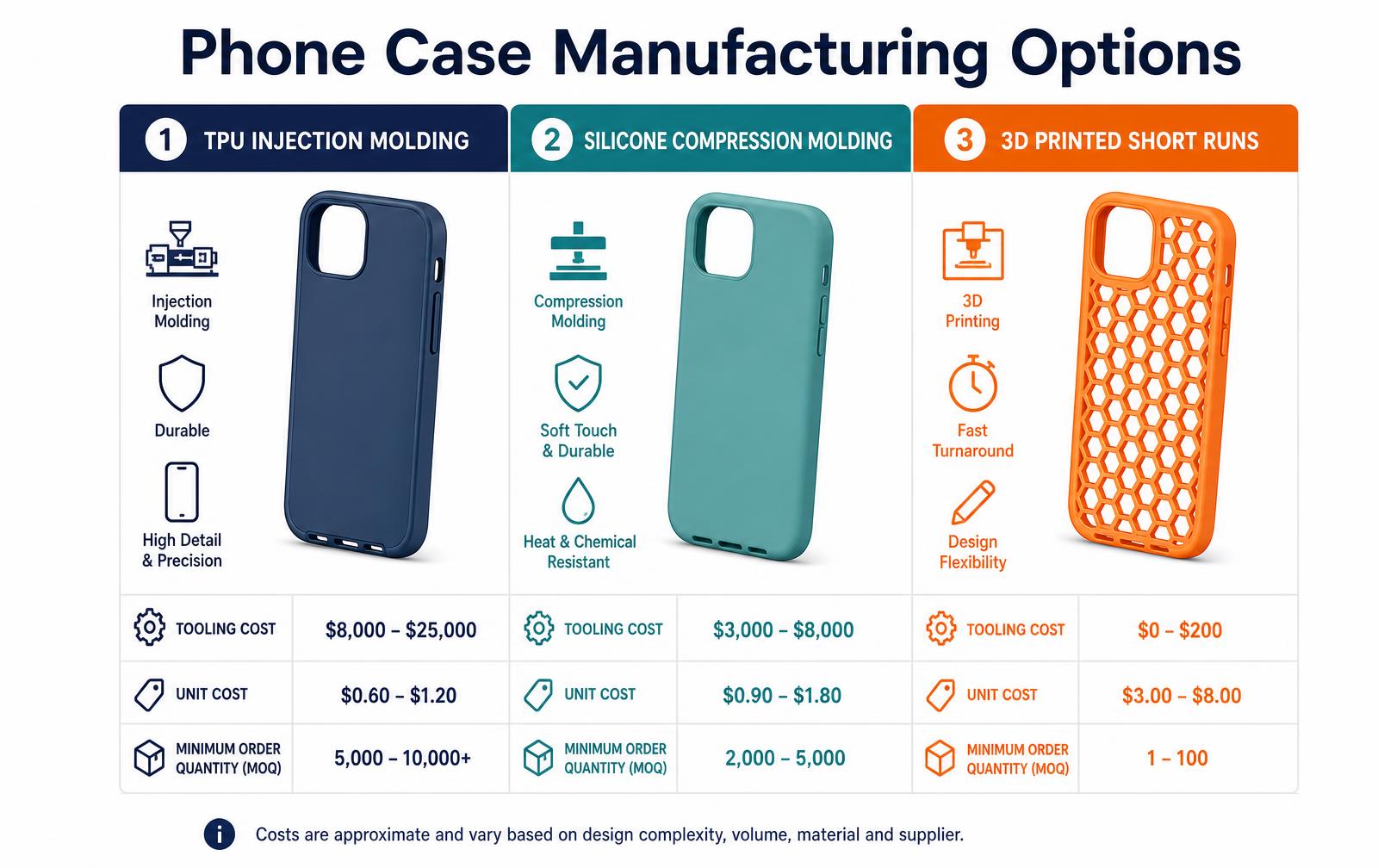
Process | Tooling | Unit cost | Typical MOQ | Best for |
|---|---|---|---|---|
TPU injection molding | $8k-$25k | $0.60-$1.20 | 5,000-10,000 | Mainstream launches with a proven model |
Silicone compression molding | $3k-$8k | $0.90-$1.80 | 2,000-5,000 | Soft-touch cases, smaller runs |
3D printed short runs | $0-$200 | $3.00-$8.00 | 1-100 | Fit checks, samples, niche or custom cases |
Two-shot TPU + PC | $25k-$60k | $1.40-$3.00 | 10,000+ | Rugged and drop-rated cases |
What to ask a supplier before you commit
- Whose CAD is the phone model? Scanned handset data varies. Ask which device revision the cavity was cut from and insist on a printed fit check before steel is cut.
- Drop-test evidence. If you plan to advertise a drop rating, ask for MIL-STD-810G test reports on your geometry, not a generic certificate.
- Tool ownership. Confirm in writing that you own the mold and can move it. Unstated tool ownership is the most common way accessory brands get locked to one factory.
- Colour and finish control. Yellowing is the top complaint on clear TPU; ask for anti-yellowing additive specification and UV-exposure data.
- Lead time to first shipment. Tooling plus sampling plus production is usually eight to fourteen weeks; a launch tied to a phone release date has to start earlier than that.
Getting to a sellable case
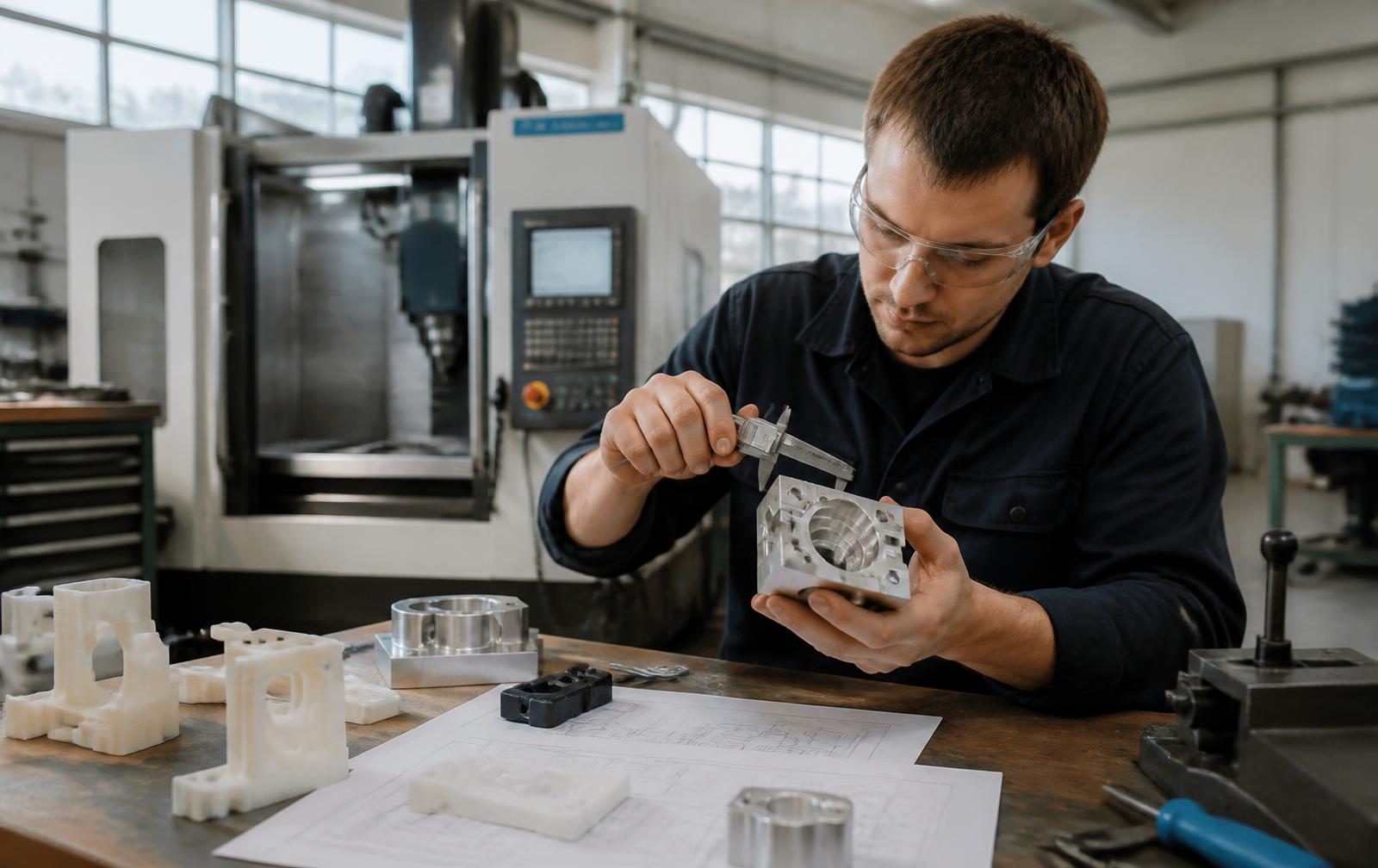
The design work that pays for itself is the boring part: button feel, port clearances, camera-bump lip height, wall thickness for grip and the exact interference that keeps the case on without making it painful to remove. Those dimensions come from printed iterations on real handsets, which is why we prototype in short runs before releasing any tool.
Related reading: 3D printing for prototyping and choosing manufacturers as a first-time inventor.
What a phone case program actually costs
Line item | TPU injection | Silicone compression | 3D printed short run |
|---|---|---|---|
Tooling | $3,500-$9,000 per model | $2,000-$5,000 per model | $0 |
Unit cost at 1,000 | $1.10-$2.20 | $1.40-$2.80 | $6-$14 |
Unit cost at 10,000 | $0.55-$1.20 | $0.80-$1.60 | Not viable |
Lead time to first shipment | 5-7 weeks | 4-6 weeks | 5-10 days |
Breakeven vs printing | ~600 units | ~450 units | - |
How to vet a case manufacturer
- Ask who owns the tool. Get it in writing that the steel is yours and can be shipped if you change suppliers.
- Check model-cycle turnaround. A supplier who cannot cut a new cavity within four weeks of a phone launch will cost you the season.
- Require drop-test data. MIL-STD-810G 1.2 m onto concrete, six faces plus corners, is the accepted floor for a protective claim.
- Confirm material certs. RoHS, REACH and a Prop 65 statement for US retail; yellowing resistance for clear TPU.
- Price the whole landed unit. Insert card, retail hanger, poly bag and freight often add more than the molded part itself.
Frequently asked questions
How much does it cost to manufacture a phone case?
Unit cost is typically $0.60 to $1.80 for molded TPU or silicone at volume, plus $3,000 to $25,000 of tooling per phone model. Short-run 3D printed cases avoid tooling but cost $3 to $8 each.
What is the minimum order quantity for phone cases?
Most injection molding suppliers set 5,000 to 10,000 units per colour, silicone compression molders often accept 2,000, and 3D printing has no practical minimum for samples or niche models.
How long does it take to bring a phone case to market?
Plan on eight to fourteen weeks: two to four weeks of design and printed fit checks, four to six weeks of tooling, one to two weeks of sampling and approval, then production and freight.
The unit economics that decide whether this is a business
Phone cases are a volume game played on thin absolute margins. The design work is straightforward; the arithmetic is unforgiving. Before choosing between phone case manufacturers, build the landed-cost model, because the difference between a viable programme and an expensive lesson is usually four or five cents per unit and one missed handset launch.
Cost line | Per unit at 10k | Per unit at 50k | Note |
|---|---|---|---|
Molded case (TPU) | $0.95 | $0.68 | Two-colour or IML adds $0.15-$0.40 |
Tooling amortisation | $1.40 | $0.28 | $14k tool spread across the run |
Retail packaging | $0.35 | $0.24 | Insert card, hanger, polybag |
Inbound freight and duty | $0.22 | $0.18 | Sea freight; air freight multiplies this 4-6x |
Warehousing and fulfilment | $1.80 | $1.65 | Pick, pack, parcel for DTC |
Returns and damage allowance | $0.30 | $0.26 | 3-5% typical for accessories |
Total landed | $5.02 | $3.29 | Before marketing or channel margin |
At a $24.99 retail price with a 50% wholesale discount, the wholesale take is $12.50 against a $3.29 landed cost at 50,000 units. That looks healthy until customer acquisition cost enters the model — direct-to-consumer accessory CACs of $8-$16 routinely consume the entire contribution margin.
Handset timing is the real constraint
Milestone | Timing relative to phone launch | Risk |
|---|---|---|
Dimensional data or leaked CAD available | 8-14 weeks before | Data may be wrong; verify against a second source |
Tool cut on speculative data | 6-10 weeks before | A camera-bump change scraps or reworks the cavity |
First shots and fit check on a real handset | 0-2 weeks after launch | The only true fit verification |
Retail-ready inventory | 3-6 weeks after launch | Peak sell-through is the first 8 weeks |
Sell-through window closes | 16-24 weeks after | Leftover inventory discounts to near cost |
This is why speculative tooling exists in this category and why case programmes fail. Cutting a tool from leaked dimensions buys weeks of shelf presence and risks a rework charge of $1,500-$4,000 per cavity — a bet most established suppliers price into their quotes and most first-timers discover after the fact.
Material choices, in practice
Material | Feel and look | Cost index | Weakness |
|---|---|---|---|
TPU | Flexible, grippy, clear or coloured | 1.0 | Clear grades yellow with UV over 6-12 months |
Polycarbonate | Hard, glossy, printable | 1.1 | Cracks on impact without a TPU bumper |
PC + TPU dual-shot | Premium hybrid protection | 1.8-2.4 | Two-shot tooling cost, longer cycle |
Liquid silicone rubber (LSR) | Soft-touch premium feel | 1.6-2.2 | Attracts lint; needs a lined interior |
Bio-based / recycled blends | Marketing advantage | 1.3-1.9 | Colour consistency and certification paperwork |
Aramid fibre composite | Ultra-thin, high perceived value | 4-8 | Minimal drop protection; niche pricing |
Qualification tests worth paying for
- Drop testing to MIL-STD-810G 516.6 — 26 drops from 1.2 m onto each face, edge and corner, if you intend to make any protection claim in marketing.
- Wireless charging pass-through — verify at the actual case thickness with a Qi2 charger; magnets need alignment testing, not just presence.
- Button actuation force — measure it; a case that adds 40% to the click force generates returns even though nothing is broken.
- UV and yellowing — accelerated exposure on clear grades, because yellowing is the single most common review complaint for clear cases.
- Chemical resistance — sunscreen, hand sanitiser and insect repellent destroy some soft-touch coatings within weeks.
- Colour and finish consistency — approved physical master samples per colour, not a Pantone number in an email.
Contract terms that protect a small brand
- Tool ownership stated in writing, with the right to have the steel shipped to another supplier on payment.
- A defined tool life in shots, and who pays for maintenance and refurbishment.
- First-article approval before mass production, with your signature required on physical samples.
- AQL inspection level agreed up front (2.5 major / 4.0 minor is common for accessories) and who pays for a failed lot.
- Cavity change and rework pricing pre-agreed, since handset revisions are a matter of when, not if.
- No production of your design for other customers, and no use of your tool for their orders.
More questions teams ask
Drop testing: what the certification actually proves
"Military grade" on a phone case listing usually refers to MIL-STD-810G Method 516.6, which specifies 26 drops from 48 inches onto plywood over concrete, across faces, edges and corners.
It is a real protocol, but it is self-declared unless a third-party lab runs it, and the standard was written for equipment durability, not for whether a screen survives.
If drop protection is your differentiator, pay a lab such as an ISO 17025 accredited facility for a witnessed run on production-tooled parts with a real handset or a mass-and-stiffness-matched dummy inside. Budget $2,500 to $8,000 per configuration and expect to iterate at least once.
Test | Typical protocol | Cost per configuration | What it tells a buyer |
|---|---|---|---|
Drop, MIL-STD-810G 516.6 | 26 drops from 48 in onto plywood over concrete | $2,500-$6,000 | Structural survivability claim |
Tumble | Drum tumble, 100-500 cycles from 1 m | $800-$2,000 | Finish and hinge durability |
Yellowing / UV | QUV or xenon arc, 200-500 h | $1,200-$3,000 | Whether clear TPU stays clear |
Chemical resistance | Sunscreen, DEET, hand sanitizer wipe cycles | $600-$1,500 | Real-world surface failure |
Wireless charging | Qi throughput and thermal at case thickness | $500-$1,500 | Whether the case blocks charging |
RF / antenna | Free-space and head-hand SAR-adjacent screening | $3,000-$10,000 | Signal degradation from metal accents |
Packaging, retail readiness and the hidden cost of a hook
Case unit economics are decided at retail, and retail packaging is where first-time brands lose their margin. A blister or clamshell with a printed insert runs $0.35 to $0.90 per unit at modest volumes, before the artwork, before the UPC, and before the corrugated shipper.
Add a peg hook, and you have to prove the hang tab survives a pull test. Add a retailer-specific planogram, and you may need three SKUs of the same case in different pack formats.
Decide early whether you are a direct-to-consumer brand shipping in a compostable mailer at $0.18 per unit or a retail brand carrying the full pack cost, because the two lead to different tooling, different MOQs and different price ladders.
- Lock the UPC and country-of-origin marking before tooling text is engraved, not after.
- Confirm the handset model list printed on the pack matches the exact cavity you tooled.
- Order packaging on a shorter lead time than cases so artwork errors do not strand finished goods.
- Get a retail pull test on the hang tab if a single peg hook failure can pull your SKU off shelf.
Work with LA NPDT: if you are moving from here to execution, start with our design optimization or talk to us about low-volume manufacturing.
Frequently asked questions
How much does it cost to start a phone case brand?
Realistically $18,000-$45,000 for a first handset model: $8,000-$25,000 in tooling, $6,000-$15,000 for a first production run, plus packaging, photography and compliance. Landed cost at 50,000 units runs about $3.30 per unit for a standard TPU case with retail packaging.
Which phone case material is best?
TPU for mainstream flexible cases, polycarbonate with a TPU bumper for rugged protection, dual-shot PC+TPU for premium hybrids, and liquid silicone for soft-touch premium lines. Clear TPU is the most popular and the most prone to yellowing, so specify a UV-stabilised grade.
How do manufacturers get phone dimensions before launch?
From leaked CAD, supply-chain dimensional data, or purchased scans of early units. All of it can be wrong. Serious suppliers cut a cavity on that data to hit the launch window and budget for a rework charge once a real handset is measured.
What is the minimum order quantity for phone cases?
Injection molders typically require 5,000-10,000 units per colour, silicone compression molders often accept 2,000, and 3D printed short runs let you test demand at 50-500 units at a much higher unit cost.
How long does a phone case programme take?
Eight to fourteen weeks: two to four weeks of design and printed fit checks, four to six weeks of tooling, one to two weeks of first shots and approval, then two to three weeks of production plus freight.
Filed under:Tech Talk Podcast
Tagged:AIArtificial IntelligenceHealthcareTechTechnologyUpdates
Services related to this guide
- Product design servicesIndustrial design and CAD taken all the way to manufacturable files.
- Rapid prototypingWorking prototypes in days, from 3D printing to vacuum casting.
- Electronic design servicesSchematic, PCB layout, firmware and bring-up, through to production handoff.
- Product development examplesReal projects we designed, prototyped and shipped.