Food Packaging Manufacturers: How to Choose and What It Costs
A practical guide to selecting food packaging manufacturers, from barrier specification and food-safe certification to tooling costs, MOQs and shelf-life validation.
November 5, 20195 min read

Written by Konstantin Dolgan, Ph.D., NPDP
Founder & CEO, Product Development Engineer
Published November 5, 2019Updated September 2, 2026
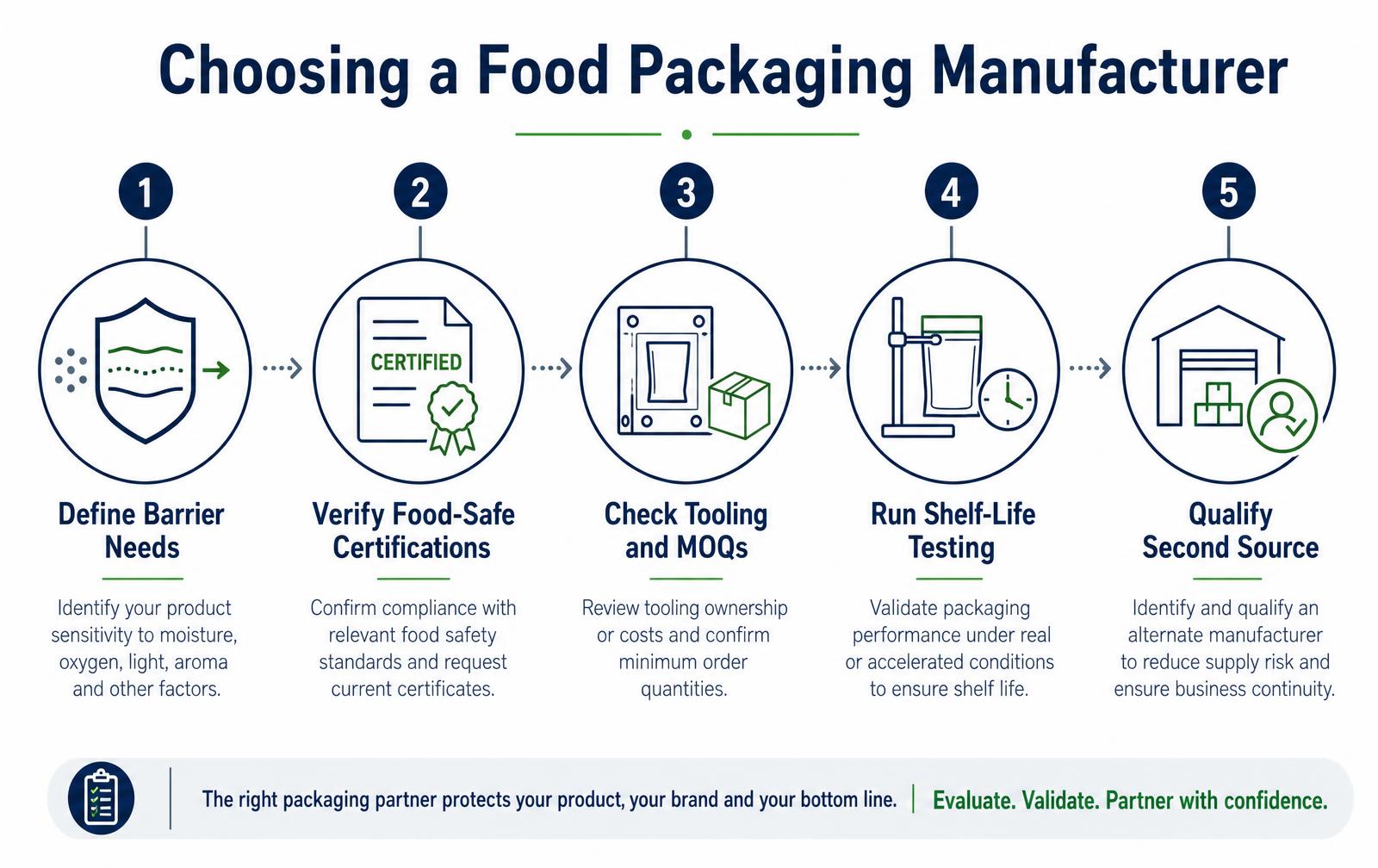
Food packaging fails quietly. A pouch that looks perfect on the shelf can lose seal integrity at week six, and by then you have a recall, not a design problem. Choosing a manufacturer is mostly about proving barrier performance and food-contact compliance before you commit to tooling.
Format costs, tooling and minimums
Format | Tooling / plates | Typical MOQ | Unit cost at volume |
|---|---|---|---|
Stand-up pouch (flexible) | $1,500-$8,000 plates | 10,000-25,000 | $0.08-$0.35 |
Folding carton | $800-$4,000 die + plates | 5,000-20,000 | $0.10-$0.60 |
Thermoformed tray | $4,000-$25,000 tool | 20,000-50,000 | $0.05-$0.30 |
Injection-moulded tub and lid | $12,000-$80,000 tool | 25,000-100,000 | $0.12-$0.70 |
Glass or metal with label | Label plates only | 5,000-15,000 | $0.30-$1.50 |
What to verify before signing
- Food-contact compliance. FDA 21 CFR food-contact statements or EU 10/2011 declarations for every layer and ink.
- Audited food safety scheme. BRCGS Packaging, SQF or FSSC 22000 certification, current and in scope for your format.
- Barrier data. Measured OTR and MVTR for the exact structure, not the resin supplier's datasheet.
- Tooling ownership. Get it in writing that you own the tool and can move it.
- Run tolerance. Overrun and underrun allowances of plus or minus 10 percent are normal — budget for them.
Validate shelf life before scaling
Run real-time and accelerated studies on production-intent material from the actual line, not hand-sealed samples. Seal strength, drop and transit testing, and sensory checks at intervals give you evidence that survives a retailer audit. Most avoidable packaging failures trace back to a structure qualified on lab samples and then produced on faster equipment with different seal parameters.
Related reading: flexible packaging manufacturers and consumer packaged goods manufacturing.
Matching barrier to product
Product type | Main spoilage driver | Barrier needed | Common structure |
|---|---|---|---|
Dry snacks | Oxygen and moisture | High OTR and MVTR barrier | PET / met-PET / LLDPE |
Coffee | Oxygen, aroma loss | High oxygen barrier plus degassing valve | PET / foil / LLDPE |
Fresh produce | Respiration | Breathable, controlled permeability | Perforated OPP |
Sauces and liquids | Oxygen, light | Foil or EVOH barrier, hot-fill capable | PET / EVOH / PP |
Frozen foods | Moisture, cold cracking | Low-temperature seal integrity | PE-heavy laminate |
Line trials: what actually goes wrong
- Seal contamination. Powder or oil in the seal zone causes leakers that hand-sealed samples never show.
- Registration drift. Print creeps against the seal on long runs; check the last cases, not the first.
- Film slip and stiffness. A structure that runs on the converter equipment may jam on your filler.
- Zipper and valve placement. Verify on production tooling; retrofits after plates are cut are expensive.
- Case and pallet fit. Confirm final pack dimensions against retailer planogram and pallet pattern before scaling.
Frequently asked questions
How do you choose a food packaging manufacturer?
Start from the barrier and shelf-life requirement, then shortlist manufacturers holding a current BRCGS, SQF or FSSC 22000 certificate for your format. Compare tooling cost and ownership, MOQs, run tolerance and lead time, and require measured barrier data plus a production-intent shelf-life study before you scale.
What certifications should food packaging suppliers hold?
Expect a GFSI-recognised scheme such as BRCGS Packaging Materials, SQF or FSSC 22000, plus food-contact declarations under FDA 21 CFR or EU Regulation 10/2011 covering substrates, adhesives and inks. Ask for certificates with the scope and expiry visible.
What are typical minimum order quantities?
Flexible pouches usually start around 10,000 to 25,000 units per SKU, folding cartons around 5,000, and thermoformed or injection-moulded formats 20,000 or more because tooling has to be amortised. Digital printing lowers the entry point but raises the per-unit cost.
Bringing a food product to shelf?
We design packaging that passes shelf-life testing and retailer audits.
Start from the format, not the vendor list
Food packaging manufacturers specialise by format, and the format decides which shortlist is even relevant. A flexible film converter, a folding carton printer, a rigid thermoformer and a glass or can filler are four different industries with different tooling, minimums and lead times. Picking a vendor before settling the format is the most common way early-stage food brands waste a tooling budget.
Format | Best for | Typical MOQ | Tooling / setup | Lead time |
|---|---|---|---|---|
Stand-up pouch (flexible) | Snacks, coffee, powders, pet treats | 5,000-10,000 units | Printing plates $1.5k-5k per SKU | 6-10 weeks |
Folding carton | Secondary packaging, dry goods | 2,000-5,000 | Cutting die $500-2k plus plates | 4-6 weeks |
Thermoformed tray | Fresh, chilled, ready meals | 10,000+ | Tooling $5k-25k | 8-14 weeks |
Rigid jar or bottle | Sauces, spreads, beverages | Stock available; custom 25,000+ | Stock: none; custom mould $15k-60k | Stock 2-4 weeks; custom 12-20 |
Labels only, stock container | Launch and market testing | 250-1,000 | Digital print, no plates | 1-3 weeks |
For a first production run, stock containers plus digitally printed labels almost always beat custom tooling. You keep the option to change the format after real sell-through data, at the cost of a higher unit price you will not miss at 1,000 units.
Food-contact compliance is a supplier obligation you must verify
- Ask for documentation that every food-contact layer complies with FDA 21 CFR requirements, or EU Regulation 1935/2004 and 10/2011 for plastics if you sell in Europe.
- Request a declaration of compliance and, for plastics, migration testing data relevant to your food type and storage temperature.
- Confirm the facility's food safety certification — SQF, BRCGS Packaging Materials or FSSC 22000 — rather than a generic ISO 9001 certificate.
- For sealed products, verify seal integrity testing capability and get the seal specification in writing.
- Check allergen and cross-contamination controls if the plant also runs non-food substrates.
- Confirm recyclability claims against real local streams before printing a recycling claim; mixed-material films rarely qualify.
What drives your unit cost
Cost driver | Effect | Lever available to you |
|---|---|---|
Run length | Largest single factor; setup amortises | Consolidate SKUs onto shared film or carton stock |
Number of colours | Each colour is a plate and a station | Design within four colours; use substrate colour |
Substrate structure | Barrier layers multiply cost | Match barrier to real shelf-life need, not maximum |
SKU count | Each SKU carries its own plates and minimums | Common base film, variable digital label |
Finishing | Zippers, spouts, matte varnish, windows | Add after product-market fit is proven |
Questions that reveal the real fit
Question | Good answer | Warning sign |
|---|---|---|
What is your minimum for a repeat order, not a first order? | A specific, lower number | Same minimum forever |
Who owns the plates and dies? | Customer owns, we store | Vendor owns and will not release |
What is your standard over/under run tolerance? | ±5-10%, billed accordingly | No stated tolerance |
How do you handle a colour mismatch on delivery? | Documented tolerance and remake terms | Case-by-case goodwill |
Can you provide production samples before the full run? | Yes, press check or first-article | Only after the full run |
What is your shelf-life testing support? | Barrier data plus references to test labs | Guesswork on barrier claims |
Validate shelf life before you commit tooling
Barrier requirements set your material structure and therefore your cost. Establish the target shelf life first, then choose the lowest-cost structure that meets it with margin. Oxygen transmission rate and water vapour transmission rate are the two numbers to specify; a converter that cannot quote them for a proposed structure is quoting a guess.
- Define target shelf life and the storage conditions it applies to, including worst-case retail temperature.
- Run accelerated stability studies on the candidate structure, then confirm with a real-time study in parallel.
- Test the actual sealed package, not film coupons — seals and headspace dominate real failures.
- Include drop, compression and transit vibration testing before signing off on the format.
- Re-validate after any material substitution, including apparently equivalent film from a second source.
Frequently asked questions
What minimum order quantity should I expect from food packaging manufacturers?
Flexible pouches typically start at 5,000-10,000 units per SKU, folding cartons at 2,000-5,000, and custom moulded rigid containers well above 25,000. Stock containers with printed labels are available in the hundreds.
Do I need a certified facility for a small food brand?
If you sell through grocery or club retail, buyers will ask for the packaging supplier's food safety certification during onboarding. Choosing a certified converter from the start avoids re-sourcing at exactly the moment you scale.
How much does packaging tooling cost?
Printing plates run roughly $1,500-5,000 per flexible SKU, cutting dies $500-2,000, thermoform tooling $5,000-25,000, and custom blow or injection moulds $15,000-60,000.
Should I use one supplier for everything?
Consolidating primary and secondary packaging with one converter simplifies scheduling but concentrates risk. Qualify a second source for your highest-volume component once annual volume passes the point where a stockout would be material.
Format and material fit
Format | Typical MOQ | Tooling / plate cost | Best for | Watch out for |
|---|---|---|---|---|
Flexible pouch (stand-up) | 10k-25k units | $1.5k-$6k cylinders/plates | Snacks, powders, pet food | Barrier film choice drives shelf life |
Folding carton | 5k-20k units | $500-$3k die and plates | Dry goods, secondary packaging | Not a barrier — needs an inner liner |
Rigid injection-moulded tub | 25k-100k units | $15k-$60k tool | Spreads, deli, reheatable | Tool cost dominates at low volume |
Glass jar with closure | 10k-50k units | $0 stock, $20k+ custom | Sauces, preserves, premium positioning | Freight and breakage costs |
Can / retort pouch | 50k+ units | $5k-$40k | Shelf-stable wet food | Retort validation is a separate program |
Compliance questions to ask before a quote
- Which food-contact regulations do your materials comply with, and can you supply declarations of compliance and migration test data?
- Are you certified to a GFSI-recognised scheme such as BRCGS Packaging or SQF, and when was your last audit?
- What is your allergen and cross-contamination control if you also run non-food substrates?
- Can you support the shelf-life testing protocol our product needs, or do we contract that separately?
- How do you handle traceability and recall — lot coding, retained samples, mock recall frequency?
- Which recyclability or extended producer responsibility claims can you substantiate in our target markets?
Cost drivers beyond the unit price
Driver | Effect on landed cost | Mitigation |
|---|---|---|
Barrier film structure | 10-40% of pouch cost | Test whether a lower-barrier structure meets real shelf life |
Number of print colours | $300-$1,200 per colour in plates | Design for 4-6 colours; reuse plates across SKUs |
Minimum order quantity | Cash tied up in inventory | Negotiate blanket orders with scheduled releases |
Freight and cube | Up to 20% on rigid formats | Nest, lightweight, or ship flat and form locally |
Changeover fees | Per-SKU surcharge | Batch SKUs into a single run window |
Scrap and setup waste | 2-8% of run | Ask for measured setup waste in the quote |
A practical vetting sequence
- Shortlist three manufacturers who already run your format and volume band.
- Request certification packs and two references in your category.
- Send a specification, not a picture — substrate, dimensions, barrier target, fill method, closure, print process.
- Compare quotes on landed cost per unit at three volumes, not on unit price at one.
- Order a pre-production run and put it through your real filling line before committing.
- Run a shelf-life study on packaging from that run, not from a sample sent by the sales team.
Frequently asked questions
Can we start below the MOQ? Often yes through a converter or digital printing partner at a higher unit cost. Treat it as market-validation spend, and switch to a conventional run once weekly volume justifies plates.
How long does a first order take? Typically 8-16 weeks from artwork approval for flexible formats, longer where a mould or a retort validation is involved.
Who owns the print plates and tooling? Whoever paid for them, if the contract says so. Get it in writing along with the right to transfer them, or a supplier change becomes a full re-tooling cost.
Work with LA NPDT: if you are moving from here to execution, start with our packaging design services or talk to us about new product marketing.
Filed under:Tech Talk Podcast
Tagged:FitbitGoogleLatest TechnologyTechTech NewsTech UpdatesTechnology News
Services related to this guide
- Product design servicesIndustrial design and CAD taken all the way to manufacturable files.
- Rapid prototypingWorking prototypes in days, from 3D printing to vacuum casting.
- Electronic design servicesSchematic, PCB layout, firmware and bring-up, through to production handoff.
- Product development examplesReal projects we designed, prototyped and shipped.