Medical Equipment Manufacturing Industry Challenges in 2026
What is actually constraining medical equipment manufacturers in 2026, and the design and sourcing decisions that reduce exposure.
November 13, 20196 min read

Written by Konstantin Dolgan, Ph.D., NPDP
Founder & CEO, Product Development Engineer
Published November 13, 2019Updated September 2, 2026
Most pressure on medical device firms in 2026 is structural, not cyclical. Parts supply, rules, and sterile needs are tight limits. Your design choices either fix or worsen these issues. The best firms treat these as design tasks instead of buying problems.
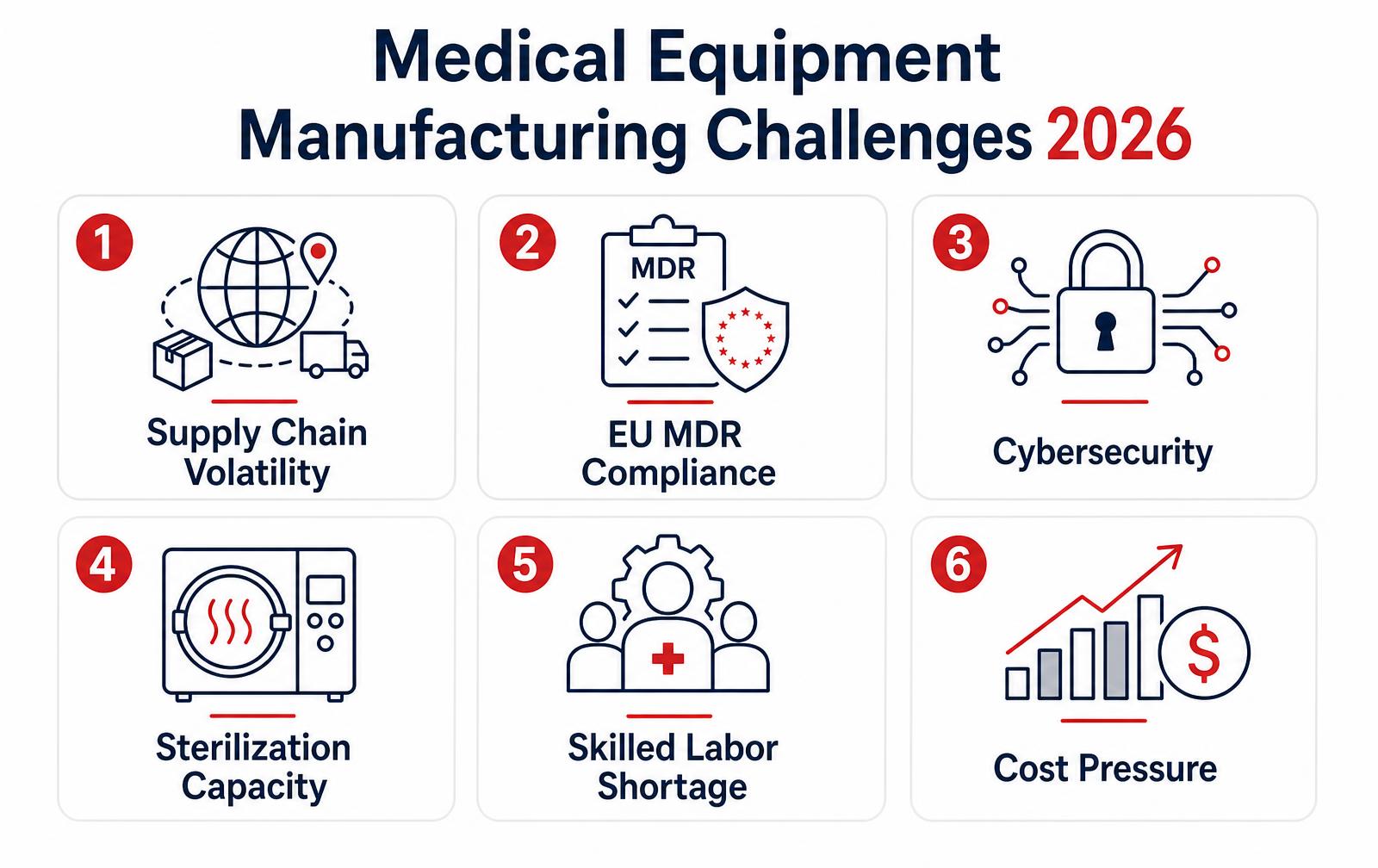
The six pressures and what they cost
Challenge | Where it hits | Practical mitigation |
|---|---|---|
Supply chain volatility | Semiconductors, sensors, medical-grade polymers | Second-source critical parts at design freeze, not after shortage |
EU MDR compliance | Clinical evidence, technical files, notified body queues | Budget 12-24 months and start the evidence plan pre-design-freeze |
Device cybersecurity | Connected equipment, FDA premarket expectations | SBOM, threat model and update path designed in from the start |
Sterilization capacity | EtO facility constraints and emissions rules | Qualify gamma, e-beam or X-ray as an alternate route |
Skilled labour shortage | Assembly, quality engineering, validation | Design for fewer manual steps; document work instructions visually |
Cost pressure | Hospital capital budgets and GPO pricing | Design-to-cost reviews before tooling, not after launch |
Design choices that reduce exposure
- Component abstraction. Specify to function and footprint so an alternate part does not trigger a design change.
- Material selection with sterilization in mind. Polymers that survive both EtO and gamma keep a second route open.
- Modularity. Isolating the connected subsystem limits the cybersecurity and regulatory blast radius of an update.
- Reduced part count. Fewer fasteners and sub-assemblies directly offsets scarce assembly labour.
- Documentation discipline. A clean technical file shortens notified body cycles more than any expedite fee.
Related reading: medical device design process and documentation and medical device manufacturing software.
Where medical equipment programs slip in practice
Program stage | Typical slip | Root cause | What prevents it |
|---|---|---|---|
Design freeze | 6-12 weeks | Late human factors findings | Formative usability at concept, not at verification |
Supplier qualification | 8-16 weeks | Single-sourced sensor or connector | Second source specified at schematic stage |
Verification testing | 4-10 weeks | Test protocols written after the build | Protocols drafted with the requirements |
Sterilization validation | 6-14 weeks | Material fails a second modality | Material screening against EO and gamma up front |
Notified body review | 3-9 months | Clinical evidence gaps | Gap assessment before technical file submission |
What compliance costs to budget
- Quality system. $40k-$120k to stand up ISO 13485 with an external consultant, plus annual surveillance audits.
- Technical file and clinical evaluation. $30k-$150k depending on device class and how much literature support exists.
- Notified body fees. $25k-$90k for initial certification under EU MDR, with queue times still measured in quarters.
- Verification and validation testing. $50k-$250k for electrical safety, EMC, biocompatibility and sterilization.
- Post-market surveillance. Budget an ongoing headcount fraction; PMCF reporting is not a one-time cost.
The pressures reshaping medical equipment manufacturing
Three forces squeeze device makers now. Rules keep getting harder to follow. The European MDR makes you re-test products sold for years. Any connected device must now have cyber proof. One old chip can force a full redesign and new tests. Also, hospitals now buy based on total cost, not just features. You must plan for these issues during the design phase.
Challenge, impact and practical response
Challenge | Typical impact | Practical response |
|---|---|---|
Regulatory re-certification | 6-18 months and significant cost per legacy product | Rationalise the portfolio; retire low-volume SKUs rather than re-certify |
Component obsolescence | Design change plus re-verification | Second-source critical parts at design time; abstract the hardware layer |
Cybersecurity requirements | Submission delays for connected devices | Threat model and SBOM produced during development, not at filing |
Supplier quality | Nonconformances and field actions | Audit and qualify suppliers before first article, not after a failure |
Hospital cost pressure | Margin erosion and longer sales cycles | Design for serviceability and prove total cost of ownership |
Design-phase decisions that pay off later
- Second-source every critical component, especially semiconductors and sensors.
- Isolate hardware-dependent firmware so a part swap does not rewrite the application.
- Build the risk file and traceability as you go, so a change is an update rather than an archaeology project.
- Produce a software bill of materials from the first build for any connected device.
- Design for field service: modular replacement, diagnostics, documented calibration.
- Qualify suppliers with an audit, and keep the qualification current.
Post-market surveillance is part of the product
Getting clearance is just the start. You must collect field data and report bad events fast. You must use what you learn to manage risk. The EU now asks for regular safety reports on high-risk tools. Bad complaint handling is a top cause for audit failure. You need a path that puts device feedback into the quality system. This creates a record before you need it.
- Route every device-related contact into the complaint system, including calls to sales.
- Triage within a defined window and document the reportability decision either way.
- Trend complaints against the risk file, not just against a service backlog.
- Keep field service records traceable to serial numbers and firmware versions.
- Rehearse a recall before you need one; distribution records are the bottleneck.
- Feed field data into the next design revision as a formal input.
Key takeaways
Hard manufacturing tasks are really rule, supply, and service issues. These often look like engineering emergencies. Good teams use two sources for parts and keep quality files current. They treat cyber safety as a design input to lower costs. Teams that wait until after a field event pay much more for the same result.
Sterilization and packaging: the constraint designers discover last
Sterile choices look like small details but act as big limits. Your method picks which plastics, glues, and parts you can use. Validating a second method late takes months. ETO gas capacity is low due to new rules and plant closures. Relying on one route is now a major risk to your supply chain.
Modality | Suited to | Material limits | Typical validation time |
|---|---|---|---|
Ethylene oxide (EtO) | Electronics, long lumens, heat-sensitive assemblies | Requires aeration; residual limits per ISO 10993-7 | 8-16 weeks |
Gamma irradiation | High-volume polymer disposables | Embrittles polypropylene and PTFE; discolours some resins | 6-12 weeks |
E-beam / X-ray | Dense or shielded assemblies | Dose mapping is geometry-sensitive | 8-14 weeks |
Steam autoclave | Reusable metal and high-temp polymer instruments | 134°C excludes most electronics and many adhesives | 4-10 weeks |
Vaporized hydrogen peroxide | Heat-sensitive reusable devices | Poor lumen penetration; cellulose incompatible | 8-14 weeks |
Pick materials that work with at least two sterile routes. Test the second route before you need it. Packaging is part of this choice. The barrier must survive the sterile process and shipping tests. It must also last through shelf-life studies. These tests are vital for your launch date.
Service, spares and the cost of a fielded fleet
Capital equipment earns money for a decade. The best design choices affect the tenth year, not just the first. Makers who ignore service costs pay later. They face field labor costs, downtime credits, and parts buys that no one planned for.
- Define field-replaceable units early. A technician swapping a module in twenty minutes is a different economic model from returning a system to depot.
- Design for a ten-year spares horizon. Semiconductor lifecycles are shorter than device lifecycles; identify the parts that will require a lifetime buy and price it into the program.
- Instrument the product for diagnostics. Error logs and usage counters cut the no-fault-found return rate, typically the largest single service cost.
- Keep the cybersecurity posture maintainable. Connected devices need a documented patch path and an SBOM; a device that cannot be updated in the field becomes uncertifiable well before it wears out.
- Cost the service contract into the product decision, including calibration intervals, consumables and technician travel.
Plan for annual service costs to be 8 to 15 percent of the bill of materials. Treat every cut in that cost as profit. Related reading: medical device design controls.
Frequently asked questions
What are the biggest medical equipment manufacturing challenges in 2026?
Supply chains for chips and polymers remain shaky. New EU MDR rules and busy notified bodies create delays. Connected devices face new cyber rules. Sterilization capacity is low. Firms also face staff shortages and low hospital budgets.
How Long Does EU Mdr Certification Take?
Plan for twelve to twenty-four months to get a certificate for Class IIa and IIb devices. This time depends on notified body queues and clinical reviews. Start the clinical plan before design freeze to save time.
How can manufacturers reduce sterilization risk?
Choose materials and packs that work with many methods. Validate a second route like gamma, e-beam, or X-ray with ethylene oxide. Dual tests cost more now. They stop a single point of failure from halting your shipments later.
Building medical equipment?
We design for sourcing, sterilization and documentation constraints from the first concept.
component Obsolescence and the Eol Response Plan
Medical gear stays on the market for seven to fifteen years. The chip inside it lasts only five years. This gap drives most unplanned redesign costs. Every part change notice from a supplier needs a review. A new part costs money for tests, code, and filing. Good teams pick sole-sourced parts at the start. They budget for updates instead of treating changes as emergencies.
Obsolescence event | Typical response | Cost range | Lead time |
|---|---|---|---|
Drop-in equivalent available | Component qualification, limited verification | $15k-$60k | 8-16 weeks |
Pin-compatible, different silicon | Firmware port plus full verification | $60k-$200k | 4-8 months |
No equivalent, board respin | PCBA redesign, EMC retest, letter-to-file | $150k-$500k | 6-12 months |
Display or sensor discontinued | Mechanical and UI rework, human factors review | $200k-$700k | 9-18 months |
Last-time buy | Working capital tied up in inventory, storage and shelf-life risk | Varies | Immediate |
Cybersecurity as a manufacturing requirement
Connected medical tools now face cybersecurity rules that start in the factory. The software bill of materials must be correct at shipping. Do not use the old version from the last design review.
Secure boot keys must be set up on the line. Keep these keys safe from operators. You must sign and track firmware in the device history record.
Field updates must work for six-year-old units on private hospital networks. Treat key setup and SBOM creation as validated processes. Write clear work instructions because auditors will ask to see them.
- Generate the SBOM from the build pipeline, not from a spreadsheet maintained by hand.
- Provision keys in a controlled station with access logging and no operator-visible secrets.
- Record firmware hash and version in the DHR for every serialized unit.
- Validate the field update path including the rollback case, on real hospital network conditions.
- Define a coordinated vulnerability disclosure route before a researcher finds one for you.
Installed base economics: why the fleet outlives the program
New medical devices bring quick revenue, but costs last for years. Each unit adds a decade of spare parts and software upkeep. You must track calibration needs and handle all complaints.
Model the fleet as a debt with a yearly cost per unit. This change shifts your design choices. A power supply that costs eleven dollars more can save a four-hundred-dollar service call.
Service data is your cheapest design tool. Make sure to code complaint records well enough to show clear trends.
Work with LA NPDT: if you are moving from here to execution, start with our medical device development or talk to us about medical device prototyping.
Filed under:Tech Talk Podcast
Tagged:GoogleLatestMicrosoftNewsPaypalTech NewsTechnologyUpdates
Services related to this guide
- Product design servicesIndustrial design and CAD taken all the way to manufacturable files.
- Rapid prototypingWorking prototypes in days, from 3D printing to vacuum casting.
- Electronic design servicesSchematic, PCB layout, firmware and bring-up, through to production handoff.
- Product development examplesReal projects we designed, prototyped and shipped.