Robotic Machine Tending: When a Cobot Pays for Itself
Where collaborative robots in manufacturing beat caged industrial arms, where they do not, and what a cobot cell really costs to deploy.
November 22, 20196 min read

Written by Konstantin Dolgan, Ph.D., NPDP
Founder & CEO, Product Development Engineer
Published November 22, 2019Updated September 2, 2026
Robotic machine tending is the job most shops should automate first, and a cobot is not simply a cheaper industrial robot. You give up speed and payload and get back floor space, fast redeployment and the ability to sit a robot next to a person without building a cage. For low-volume, high-mix loading and unloading, that trade usually decides the payback period.
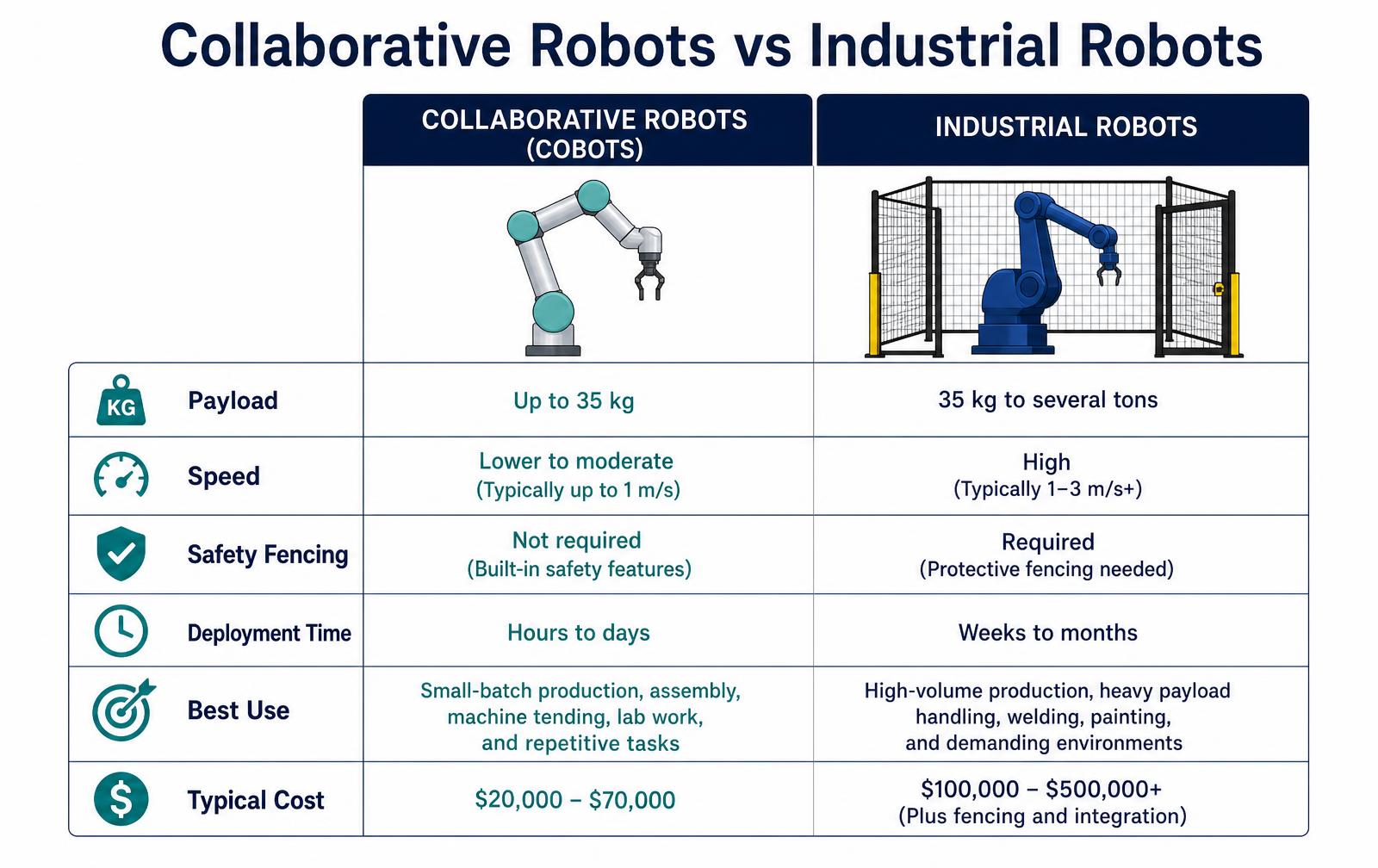
Cobot versus industrial robot
Criterion | Collaborative robot | Industrial robot |
|---|---|---|
Payload | Up to about 35 kg | 35 kg to several tons |
Speed | Reduced near people, roughly 1 m/s | 1-3 m/s and higher |
Safety | Risk assessment per ISO/TS 15066, often fenceless | Fencing, interlocks and light curtains required |
Deployment | Hours to days, hand-guided teaching | Weeks to months with an integrator |
Best fit | High-mix, low-volume, frequent changeover | High-volume, fixed, heavy or fast work |
Typical cost | $20k-$70k plus tooling | $100k-$500k installed |
Tasks where cobots pay back fastest
- CNC and injection moulding machine tending, where an operator is otherwise waiting on cycle time.
- Screwdriving and small-part assembly with consistent fixtures and torque verification.
- Benchtop inspection with a camera and a pass/fail criterion.
- Carton packing and light palletising at rates a person can match but not sustain all shift.
- Lab and short-run production, where the same arm moves between three or four jobs each week.
The safety point people get wrong
Cobots are not inherently safe; the application is what gets assessed. A force-limited arm holding a sharp blade or a hot part is a hazardous machine, and a risk assessment will require guarding, speed limits or presence sensing anyway. Plan for a documented assessment of the whole cell — robot, tool, workpiece and the human tasks around it — rather than assuming the collaborative rating removes the obligation.
Related reading: our guide to robotics in manufacturing and designing for manufacturability.
Payback math for a tending cell
Line item | One-shift cell | Two-shift cell |
|---|---|---|
Cobot and controller | $35,000 | $35,000 |
Gripper, fixturing, table | $12,000 | $14,000 |
Integration and programming | $18,000 | $22,000 |
Safety assessment and guarding | $6,000 | $8,000 |
Total installed | $71,000 | $79,000 |
Labor displaced per year | $52,000 | $104,000 |
Simple payback | ~17 months | ~9 months |
Preparing the machine and the part flow
- Machine interface. The CNC needs an M-code handshake or robot-ready package; retrofits add $3k-$10k.
- Door automation. Auto door and auto chuck or vise are mandatory for unattended cycles.
- Part presentation. Trays, bins or conveyors with repeatable location beat vision systems on cost and uptime.
- Chip and coolant management. An air blast or wash step keeps locating surfaces clean between loads.
- Cycle time fit. Machining cycles above about 90 seconds give the robot enough slack to serve two machines.
Frequently asked questions
What are collaborative robots in manufacturing?
Collaborative robots, or cobots, are force and speed limited robot arms designed to work in the same space as people. They are taught by hand-guiding rather than traditional programming, and after a risk assessment they can often run without full safety fencing, which makes them practical for high-mix, low-volume production.
How much does a cobot cost?
The arm typically costs $20,000 to $70,000 depending on payload and reach. A deployed cell including gripper, fixtures, vision if needed and integration usually totals $45,000 to $120,000, which is well under a comparable caged industrial cell.
Do collaborative robots need safety fencing?
Not automatically. The requirement comes from a risk assessment of the whole application under ISO 10218 and ISO/TS 15066. A cobot handling blunt, light, room-temperature parts often runs fenceless; the same arm carrying a blade, a hot part or a heavy tool usually needs guarding or presence sensing.
Machine tending is the easiest robot job and still gets scoped wrong
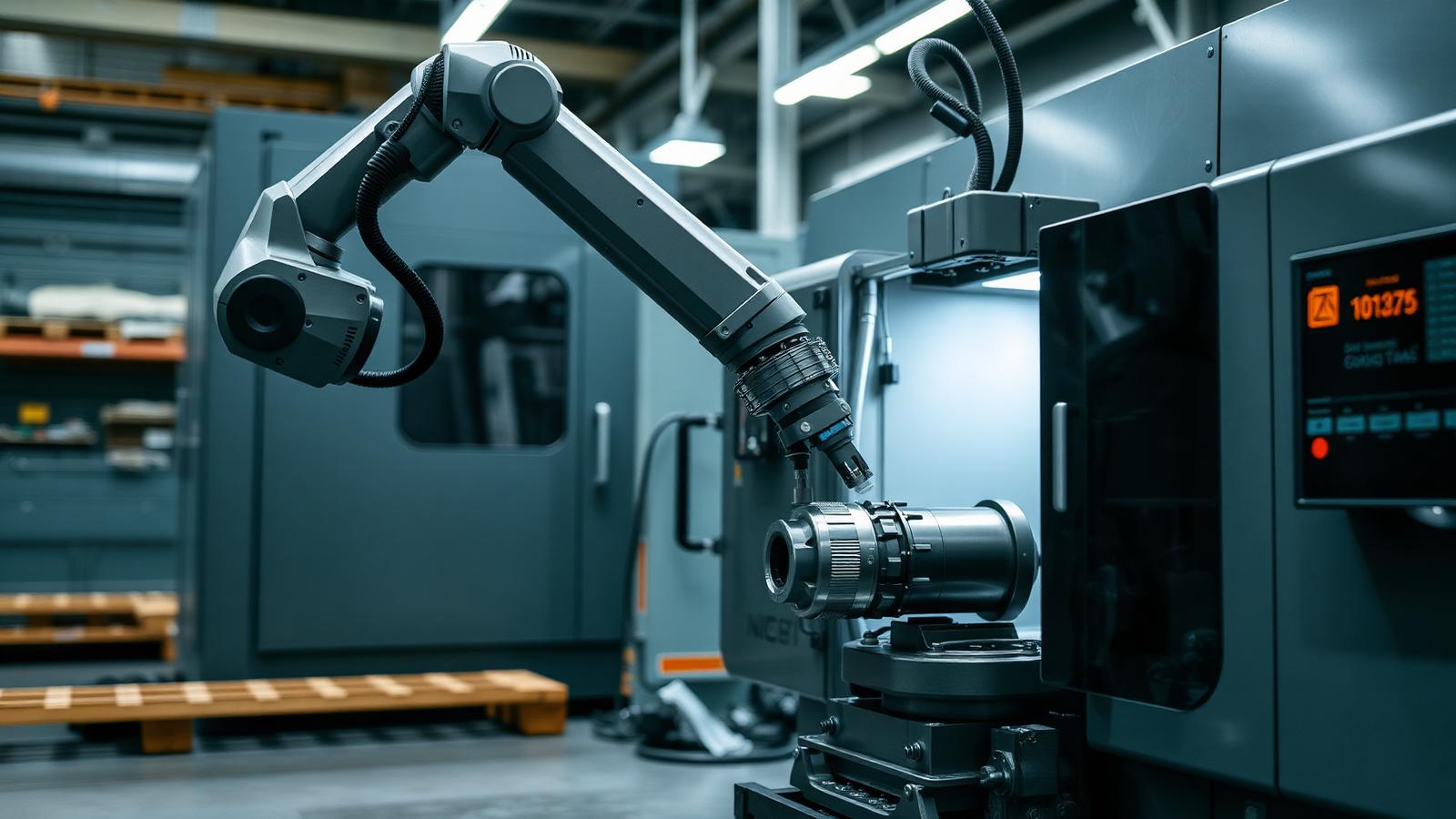
Robotic machine tending — loading raw stock into a CNC, lathe or press and unloading the finished part — is the highest-success-rate industrial automation task available. The motion is repetitive, the environment is controlled, and the return is measurable in spindle hours.
Yet a large share of cells end up idle within a year, almost always for the same reasons: the part mix was too varied, the fixturing was never redesigned, or nobody on the shop floor owned the programme changeover.
The robot is rarely the constraint. Everything around it — how parts arrive, how they are located, how the machine door and chuck are signalled, and who reprograms it on a Tuesday — determines whether the cell runs.
Which parts justify a cell
Attribute | Good candidate | Poor candidate |
|---|---|---|
Cycle time | Over 90 seconds machine time | Under 30 seconds |
Batch size | 200+ pieces per setup | Under 25 pieces |
Part variety | Family with shared gripping features | Every job a new geometry |
Weight | Under 15 kg including gripper | Heavy parts needing hoists |
Presentation | Stackable, orientable in trays | Loose bin of tangled parts |
Machine interface | Automatic door and chuck available | Manual clamping only |
Run pattern | Repeats monthly or runs lights-out | One-off prototype work |
The single strongest predictor is machine cycle time. Below about 30 seconds, the robot spends most of its life waiting or becomes the bottleneck itself, and an operator with two machines is cheaper. Above 90 seconds, one person can supervise three or four robot-tended machines and the economics turn quickly.
Cobot or industrial robot
Factor | Collaborative robot | Industrial robot with guarding |
|---|---|---|
Payload typical | 3-20 kg | 10-200 kg |
Speed | Reduced when a person is near | Full speed always |
Cell footprint | Small, often no fence | Fence and light curtains add 30-60% |
Installed cost | $45k-90k | $90k-220k |
Redeployment | Hours, on a cart | Days, fixed installation |
Programming | Hand-guide and teach pendant | Specialist programming |
Best fit | High-mix, frequent changeover | High volume, stable parts |
Cobots win in job shops because redeployment is cheap and floor space is scarce. Industrial arms win where a single part family runs continuously and the speed penalty of collaborative operation costs real throughput. The awkward truth is that many cobot cells end up fenced anyway once the risk assessment considers the sharp chips and cutting fluid the arm is now carrying.
Grippers and fixturing decide changeover time
- Two-jaw parallel grippers with soft jaws handle most turned and prismatic parts; machine one jaw set per part family, not per part.
- Dual grippers halve cycle time by carrying the raw blank while removing the finished part in a single door opening.
- Vacuum works for flat sheet and moulded parts but fails on oily surfaces and chips — expect it to be the first thing to be replaced.
- Blow-off and chip clearing must be automated; a chip under a locating face scraps the part and can crash the chuck.
- Part presentation is the real engineering task: trays, drawers or servo conveyors give repeatable location without vision.
- Add vision only when part presentation cannot be controlled — it adds cost, lighting sensitivity and one more thing to calibrate.
Payback math that survives a finance review
Line | Example figure | Notes |
|---|---|---|
Cell capital (robot, gripper, fixturing, integration) | $115,000 | Integration is typically 40-60% of total |
Annual labour offset (0.7 operator, two shifts) | $62,000 | Redeployment, not headcount cut, in most shops |
Added spindle hours from unattended running | $38,000 | Third shift at 60% utilisation |
Scrap reduction from consistent loading | $7,000 | Fewer crash and mislocation events |
Annual running cost (maintenance, tooling, energy) | -$9,000 | Includes annual service |
Net annual benefit | $98,000 | - |
Simple payback | 14 months | Under 24 months is the usual approval bar |
The line that is most often overstated is labour offset and most often understated is added spindle hours. Automation rarely removes a person from a job shop; it lets the same person supervise more machines and adds an unattended shift that did not exist. Build the case on machine hours and the numbers hold up under scrutiny.
Safety work that gates go-live
Step | What it produces | Who signs |
|---|---|---|
Task and hazard identification | List of interactions and hazards per task | Cell owner and safety lead |
Risk assessment (ISO 12100) | Scored risks with mitigation plan | Safety lead |
Collaborative force testing | Measured force and pressure values | Integrator with instrumented tests |
Safeguard validation | Verified stop times and distances | Integrator |
Residual risk documentation | Operator instructions and training record | Production supervisor |
Sign-off and lockout procedure | Written safe-access method | Plant management |
Collaborative rating belongs to the application, never to the robot alone. A cobot holding a sharp billet or a hot part is not collaborative, and the force-and-pressure measurements are what prove that — not the datasheet.
A phased deployment that avoids the idle-cell outcome
Phase | Scope | Duration | Exit criterion |
|---|---|---|---|
1 | Part family selection and time study | 2 weeks | Three parts with shared gripping strategy |
2 | Fixturing and presentation redesign | 3-5 weeks | Repeatable location without operator judgement |
3 | Cell build and machine interfacing | 4-8 weeks | Door, chuck and alarm signals proven |
4 | Supervised production | 2-4 weeks | Eight-hour unattended run with no intervention |
5 | Changeover training | 2 weeks | Two operators change parts unaided in under 30 minutes |
6 | Expansion | Ongoing | Second machine or new part family added |
More questions teams ask
How much does a robotic machine tending cell cost?
A cobot-based cell for a single CNC typically lands between $75,000 and $130,000 installed, including gripper, fixturing, machine interfacing and integration. Industrial arms with guarding and higher payload run $130,000 to $250,000. Integration and fixturing usually cost more than the robot itself.
What batch size makes machine tending worthwhile?
As a rule of thumb, 200 or more pieces per setup with a machine cycle over 90 seconds. Below that, changeover time consumes the gain unless the shop invests in quick-change jaws and standardised part presentation across a family.
Do we need to fence a collaborative robot?
Only if the risk assessment says so — but sharp workpieces, cutting fluid and pinch points frequently push a machine tending cell out of true collaborative operation. Plan for light curtains or a partial fence in the budget rather than discovering the need at validation.
Who programs the cell after the integrator leaves?
Someone on your payroll, or the cell will stop when the part changes. Name that person during phase one and put them in the integrator's build for training; shops that skip this consistently end up with an expensive idle cart.
How long from order to production?
Twelve to twenty weeks is realistic for a first cell — robot lead time is the smaller part, and fixturing design, machine interfacing and safety validation take the rest. A second, similar cell typically installs in half the time.
Evaluating a cobot cell?
We design the parts, fixtures and tooling that make automation work.
End-of-arm tooling is where the budget quietly goes
Quotes for machine tending cells are usually written around the robot, and the robot is rarely the expensive part. The gripper, the tool changer, the part presentation and the guarding routinely add fifty to eighty percent on top of the arm.
A cell quoted at $45,000 for a UR10e with a simple two-finger gripper becomes $80,000 once you add a dual gripper for load-unload in one cycle, a compliant device for chuck insertion, a bowl feeder or tray system, and a light curtain at the operator aisle.
Tooling approach | Typical cost | Changeover | Best fit |
|---|---|---|---|
Single two-finger gripper | $3,000-$6,000 | Manual jaw swap, 10-20 min | One part family, long runs |
Dual gripper (load and unload) | $8,000-$14,000 | Manual jaw swap | Cycle time critical, 30-40% faster door-open time |
Magnetic or vacuum end effector | $2,500-$7,000 | Near zero | Flat ferrous or sealed surfaces |
Tool changer plus two EOAT sets | $12,000-$22,000 | Under 2 min | Mixed part families, weekly changeover |
Custom compliant nest and gripper | $15,000-$35,000 | Engineered per part | Tight-tolerance chuck loading |
The right question is not which gripper is cheapest but how many minutes of changeover the shop can absorb per week. A cell that needs twenty minutes of retooling three times a day loses an hour of spindle time daily, which is often more value than the gripper upgrade costs over a year.
Integrator, distributor or in-house build
Route | Cost premium | Time to production | Risk carried by |
|---|---|---|---|
Full-service integrator | 25-40% over hardware | 8-14 weeks | Integrator, with acceptance criteria |
Distributor starter package | 10-15% | 4-8 weeks | Shared; you own the part presentation |
In-house build with vendor training | 0-5% plus internal hours | 12-24 weeks | You, entirely |
In-house builds look cheapest on the quote sheet and are the most common source of the idle-cell outcome. They work when one maintenance technician is given protected hours and formal training, and they fail when the build is somebody’s fifth priority. If nobody on staff can write and debug a program six months after go-live, buy the integration and buy the training with it.
Key takeaways
- Budget the cell, not the arm — tooling, presentation and guarding usually add 50-80%.
- Dual grippers pay for themselves whenever door-open time gates the machine.
- Price changeover in minutes per week before choosing an EOAT strategy.
- Assign a named in-house owner before go-live or the cell stalls.
- Write acceptance criteria — parts per hour at a stated scrap rate — into the purchase order.
Work with LA NPDT: if you are moving from here to execution, start with our low-volume manufacturing or talk to us about design for manufacturing.
Filed under:Tech Talk Podcast
Services related to this guide
- Product design servicesIndustrial design and CAD taken all the way to manufacturable files.
- Rapid prototypingWorking prototypes in days, from 3D printing to vacuum casting.
- Electronic design servicesSchematic, PCB layout, firmware and bring-up, through to production handoff.
- Product development examplesReal projects we designed, prototyped and shipped.