Industrial Robot Integration: Cell Design, Costs and ROI
A practical look at industrial robot integration: which tasks automate well, what a robot cell actually costs, and how to calculate payback before you buy.
November 25, 20195 min read

Written by Konstantin Dolgan, Ph.D., NPDP
Founder & CEO, Product Development Engineer
Published November 25, 2019Updated September 2, 2026
Robots do not fix a process. They scale whatever process you already have. The plants that get a fast return from industrial robot integration automate a task that is repetitive, well defined and already stable. The ones that struggle try to automate a job that changes every week. This guide covers where robot cells work, what one costs once integration and tooling are counted, and how to run the payback maths before committing.
Where robots earn their keep
Application | Typical robot | Installed cell cost | Payback |
|---|---|---|---|
Material handling and palletising | 4-axis palletiser or 6-axis arm | $85k-$200k | 12-24 months |
Welding | 6-axis arm with positioner | $120k-$350k | 12-30 months |
Assembly and screwdriving | Cobot or SCARA | $60k-$180k | 18-36 months |
Machine tending (CNC, moulding) | Cobot or compact 6-axis | $70k-$180k | 9-24 months |
Inspection and packaging | Vision-guided arm or delta | $90k-$250k | 18-30 months |
What the sticker price leaves out
- End-of-arm tooling. Grippers, quick-change plates and part-specific fingers commonly add $8,000 to $60,000.
- Part presentation. Feeders, conveyors and fixtures are often more expensive than the robot itself.
- Safety. Risk assessment, light curtains, fencing and interlocks per ISO 10218 and ISO/TS 15066.
- Integration and programming. Typically 50 to 100 percent of hardware cost for a first cell.
- Training and spares. Uptime depends on your own technicians being able to recover a fault at 2am.
Design the part for the robot, not the other way round
Automation amplifies product design decisions. Parts that nest unpredictably, need two hands to align, or rely on a human noticing a burr will jam a cell repeatedly.
Small changes made during design — a flat gripping surface, a chamfered lead-in, a consistent datum feature, fasteners from a single direction — routinely cut cycle time and remove entire fixtures.
If automation is on the roadmap, review the product for robot handling before tooling is cut, not after the cell is quoted.
Related reading: designing for manufacturability and robotics and computer-integrated manufacturing.
Cost breakdown of a typical cell
Component | Share of installed cost | Typical spend |
|---|---|---|
Robot arm and controller | 30-40% | $40k-$90k |
End effector and tooling | 10-20% | $12k-$40k |
Fixtures and part presentation | 10-15% | $10k-$30k |
Safety guarding and scanners | 8-12% | $8k-$25k |
Controls, integration, programming | 25-35% | $35k-$80k |
Commissioning and training | 5-8% | $6k-$15k |
Choosing your first application
- Pick a stable, repetitive process. If the part or process changes monthly, fix that first.
- Prefer rigid, consistent parts. Floppy or highly variable parts push you into vision and force control.
- Target a two-shift bottleneck. Utilization is what shortens payback, not robot speed.
- Keep the first cell single-purpose. Flexibility multiplies fixtures, programming and debug time.
- Assign an internal owner before kickoff. Cells without a trained champion quietly go idle.
Frequently asked questions
Where the money actually goes in a robot cell
What is robotics in manufacturing used for?
The robot arm is rarely more than a third of an integrated cell. End-of-arm tooling, safety hardware, fixturing, controls integration and the commissioning labour together dominate the capital line. Budgeting from the arm price alone is the single most common reason integration projects blow their approved capex.
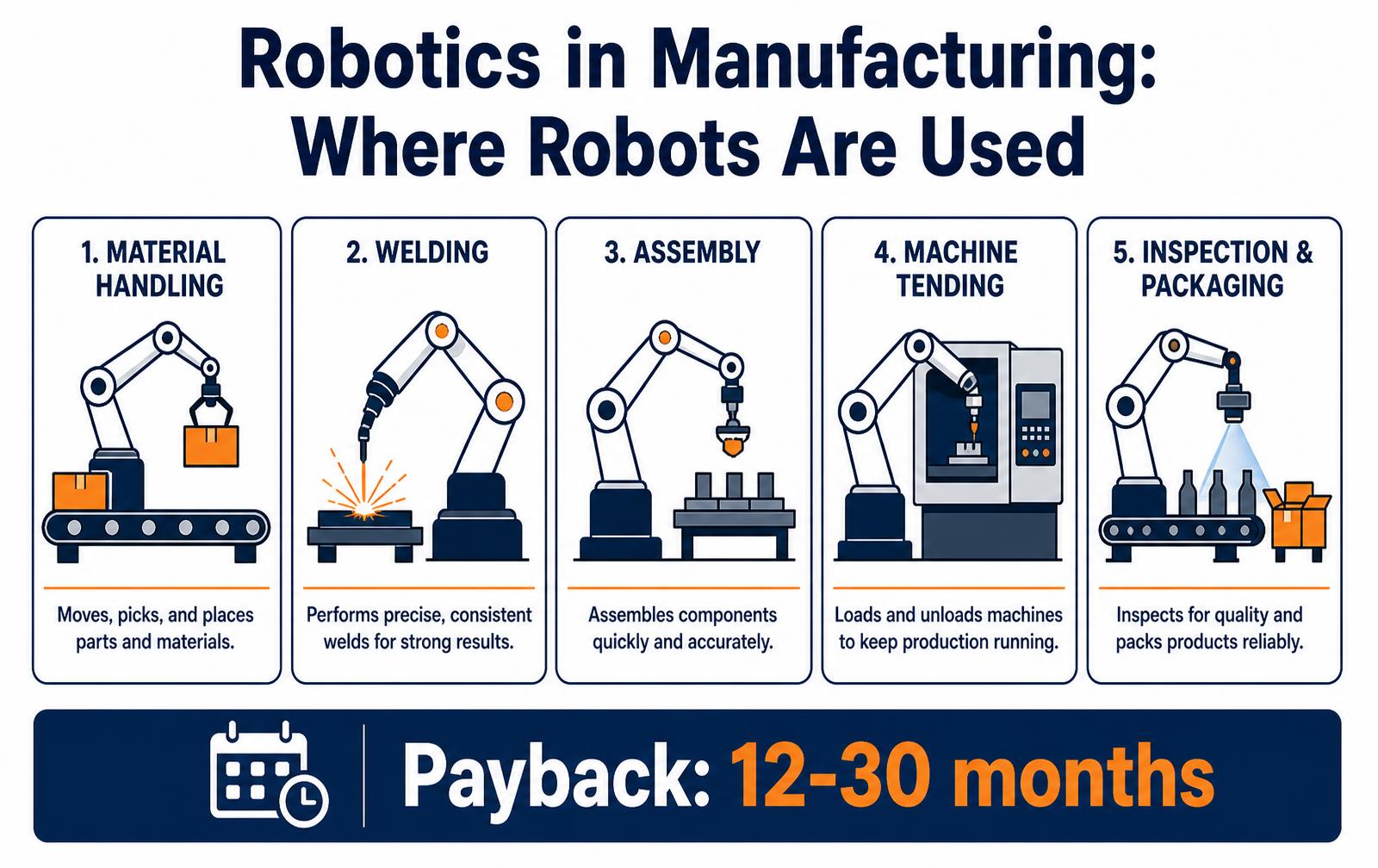
Most installed manufacturing robots perform material handling and palletising, welding, assembly and screwdriving, machine tending for CNC and injection moulding, and vision-based inspection or packaging. These tasks share the same traits: repetitive motion, consistent part presentation and measurable quality criteria.
Line item | Share of cell cost | Typical spend | Notes |
|---|---|---|---|
Robot arm and controller | 25-35% | $35,000-$90,000 | Payload and reach drive price more than brand |
End-of-arm tooling | 10-20% | $8,000-$45,000 | Multi-part grippers and tool changers add fast |
Fixturing and part presentation | 10-20% | $10,000-$50,000 | Bowl feeders and vision are the usual surprise |
Safety (fencing, scanners, e-stops) | 8-15% | $7,000-$35,000 | Risk assessment first, hardware second |
Controls, PLC and HMI integration | 10-15% | $12,000-$40,000 | Includes MES or line data hooks |
Installation and commissioning | 15-20% | $18,000-$60,000 | Debug and run-off dominate the schedule |
How much does an industrial robot cell cost?
Payback math and the numbers to defend
The arm alone is usually $25,000 to $100,000, but an installed cell including tooling, part presentation, safety equipment and integration typically runs $60,000 to $350,000. Integration commonly costs as much as the hardware on a first deployment.
Payback equals installed cell cost divided by annual savings. Count labour displaced (fully loaded, not wage), scrap reduction, rework hours avoided, and throughput gained at contribution margin - not revenue.
A $210,000 cell that removes 1.6 operators at $58,000 fully loaded and cuts scrap by $22,000 a year returns roughly $115,000 annually and pays back in about 22 months. Anything under 30 months usually clears a manufacturing capital committee; beyond 36 months you need a quality or ergonomics argument as well.
How do you calculate robot payback?
Design for automation: rules that decide feasibility
Divide the installed cell cost by annual savings: labour hours displaced, scrap and rework avoided, and throughput gained on a constrained line. Most justified cells land between twelve and thirty months. If the calculation depends on running three shifts you do not currently run, treat the result as optimistic.
- Give every part one stable orientation and a datum the gripper can find without vision.
- Eliminate parts that tangle, nest or flex - springs, wire harnesses and thin films are the classic automation killers.
- Standardise fastener types and head sizes so one driver covers the cycle.
- Design for top-down assembly; every reorientation adds cycle time and a failure mode.
- Specify cycle-time budget per station up front and hold 15% headroom for drift and maintenance stops.
An integration project is 20% robot and 80% everything else
Acceptance and run-off terms to write into the PO
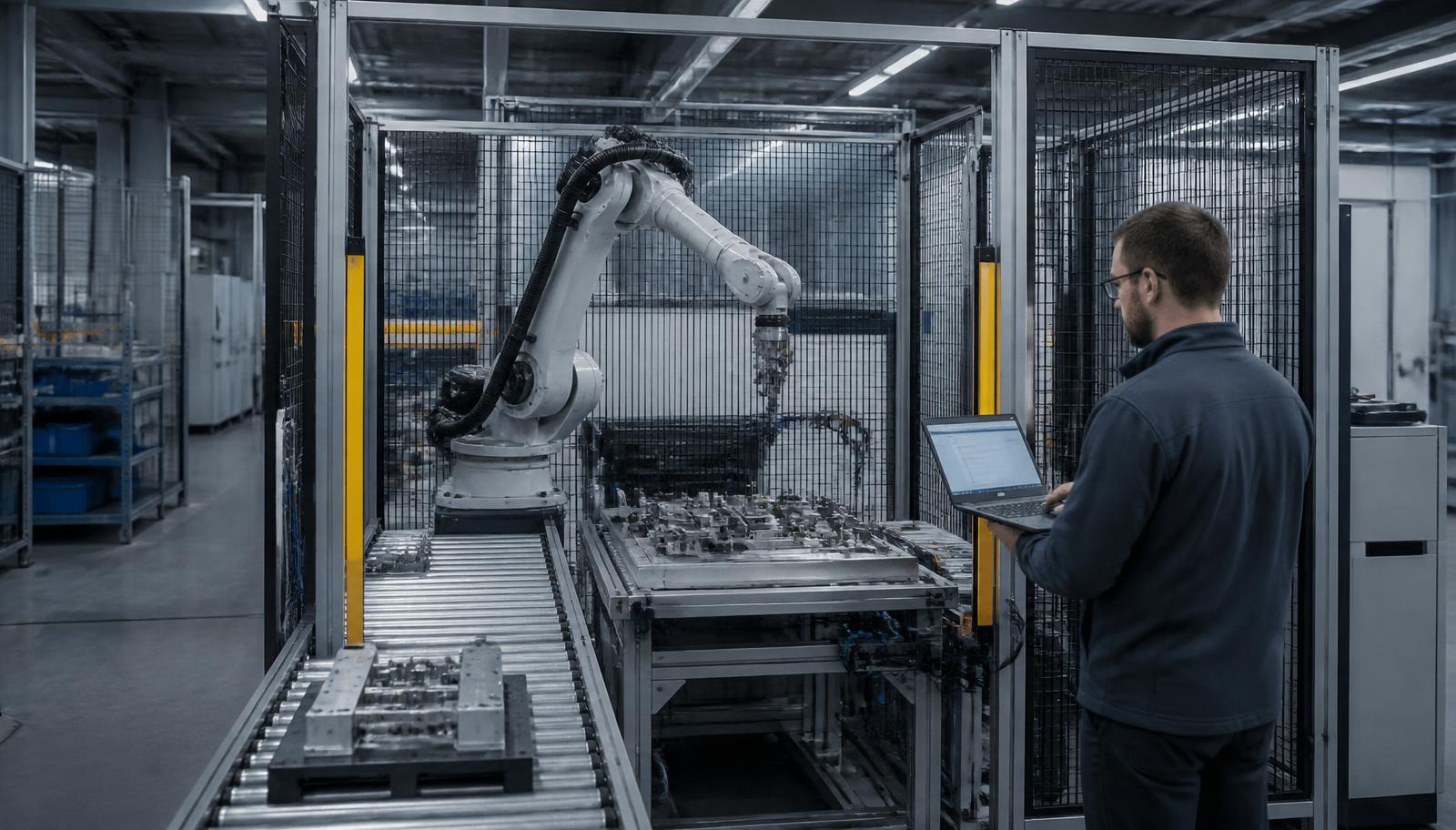
The arm is a commodity. What determines whether an industrial robot integration succeeds is the work around it: how parts are presented, how the cell talks to upstream and downstream equipment, how the safety assessment is closed out, and who on your payroll can change a programme at 2am when the schedule shifts. Plants that treat integration as a purchase rather than a project end up with an expensive fenced-off sculpture.
Milestone | Payment | Acceptance test |
|---|---|---|
Design approval | 20-30% | Cell layout, risk assessment, cycle-time simulation signed off |
Factory acceptance test | 30-40% | Cell runs your parts at the integrator, cycle time within 5% of quote |
Site acceptance test | 20-30% | 8-hour continuous run at target rate on your floor |
Final acceptance | 10-20% | 30-day availability above 95%, documentation and spares delivered |
Project phases and who owns them
Phase | Duration | Integrator owns | You own |
|---|---|---|---|
Concept and simulation | 2-4 weeks | Cycle-time study, reach and collision analysis | Part data, volumes, takt time |
Detailed design | 3-6 weeks | Cell layout, EOAT, controls architecture | Utilities, floor space, IT policy |
Procurement | 6-14 weeks | Ordering robot, safety, vision, drives | Approving substitutions promptly |
Build and FAT | 4-8 weeks | Assembly, programming, witnessed run | Supplying real production parts |
Install and SAT | 1-3 weeks | Rigging, commissioning, tuning | Downtime window, utilities live |
Ramp and training | 2-6 weeks | Operator and maintenance training | Naming and freeing the internal owner |
The most commonly skipped input is real production parts for the factory acceptance test. Cells validated on clean, hand-selected samples fail on the floor when they meet oily, burred, slightly-out-of-spec reality.
Simulation earns its fee before steel is ordered
- Cycle-time proof: whether the cell actually hits takt with the chosen robot, or needs a faster model or a second arm.
- Reach and singularity checks that stop you discovering a 40 mm shortfall after the fence is bolted down.
- Collision detection between EOAT, fixtures, guarding and the machine door.
- Operator ergonomics for load and unload stations, before anyone builds a bench at the wrong height.
- Offline programme generation, which cuts on-site commissioning time by days on complex paths.
Safety work is a deliverable with a document trail
Step | Standard | Output |
|---|---|---|
Hazard identification and risk assessment | ISO 12100 | Documented hazard list with severity and exposure |
Robot system safety requirements | ISO 10218-1/-2 | Safeguarding scheme for the cell |
Collaborative operation validation | ISO/TS 15066 | Force and pressure measurements if fenceless |
Safety function design and rating | ISO 13849-1 | Required and achieved performance level per function |
Lockout/tagout and energy control | OSHA 1910.147 | Written procedure, trained staff |
Residual risk communication | ISO 12100 | Operator manual, signage, training record |
Ask which party signs the risk assessment before you sign the purchase order. Integrators vary widely on this, and an unsigned assessment discovered during an insurance audit is a very expensive surprise.
ROI math that survives scrutiny
Input | Example value | Note |
|---|---|---|
Labour displaced | 1.5 shifts of one operator | Use fully burdened cost, not wage |
Fully burdened labour cost | $52,000 per shift-year | Wage plus benefits, PPE, turnover, supervision |
Annual labour saving | $78,000 | 1.5 x $52,000 |
Scrap reduction | $14,000 | From 2.1% to 0.6% on $930k of material |
Throughput gain value | $26,000 | Only count it if you can sell the extra output |
Added annual cost | -$11,000 | Maintenance, spares, energy, programming support |
Net annual benefit | $107,000 | Sum of the above |
Installed cell cost | $245,000 | Robot, EOAT, safety, integration, install |
Simple payback | 2.3 years | Under 3 years clears most capital committees |
Two honesty tests separate real business cases from wishful ones. First, count throughput gains only when demand exists to absorb them. Second, subtract the ongoing cost of supporting the cell — the maintenance technician's time is not free just because it is already on payroll.
What to build internally before go-live
- One named cell owner with authority and time — not a volunteer with a full workload already.
- Two maintenance technicians trained to recover from faults and change grippers, so a jam does not require a service call.
- One person trained to edit and create programmes, or the cell will only ever run the parts it shipped with.
- A spares kit on the shelf: gripper fingers, sensors, cables, a spare safety relay. Air-freighting a $90 sensor costs a shift.
- A written recovery procedure taped to the cell for the five most likely faults.
More questions teams ask
Frequently asked questions
How much does industrial robot integration cost?
An installed cell typically runs $120k-$450k depending on application. The arm itself is usually only 25-35% of that; end-of-arm tooling, safety equipment, controls integration, fixturing and commissioning make up the rest.
How long does a robot integration project take?
Twenty to thirty-three weeks is typical from purchase order to production ramp, with component procurement — not engineering — most often on the critical path. Simple pick-and-place cells can be done in twelve to sixteen weeks.
What payback period should I expect?
Two to three years is the common target and clears most capital committees. Sub-eighteen-month paybacks usually indicate multi-shift operation or a significant scrap reduction; anything over four years generally needs a non-financial justification such as ergonomics or hiring difficulty.
Do I need a fence around an industrial robot?
Unless the system is validated for collaborative operation under ISO/TS 15066 with measured force and pressure limits, yes. Even nominally collaborative arms often need guarding once the payload is sharp, hot or carrying cutting fluid.
What most often makes an integration fail?
Inconsistent part presentation, no internal owner, and acceptance testing on unrepresentative parts. All three are cheap to fix before the project starts and expensive to fix after installation. Work with LA NPDT: if you are moving from here to execution, start with our low-volume manufacturing or talk to us about design for manufacturing .
Filed under:Tech Talk Podcast
Services related to this guide
- Product design servicesIndustrial design and CAD taken all the way to manufacturable files.
- Rapid prototypingWorking prototypes in days, from 3D printing to vacuum casting.
- Electronic design servicesSchematic, PCB layout, firmware and bring-up, through to production handoff.
- Product development examplesReal projects we designed, prototyped and shipped.