Industrial Manufacturing Equipment: Types, Costs and Selection
What industrial manufacturing equipment actually costs, how long it takes to install, and how to choose between buying, leasing and outsourcing.
November 26, 20197 min read

Written by Konstantin Dolgan, Ph.D., NPDP
Founder & CEO, Product Development Engineer
Published November 26, 2019Updated September 2, 2026
Equipment decisions lock in your cost structure for a decade. A machine bought for one product family becomes the constraint every future product is designed around. Before capital is committed, it is worth being precise about volume, tolerance and changeover expectations — and honest about whether outsourcing the operation is cheaper for the first two years.
Equipment categories, costs and lead times
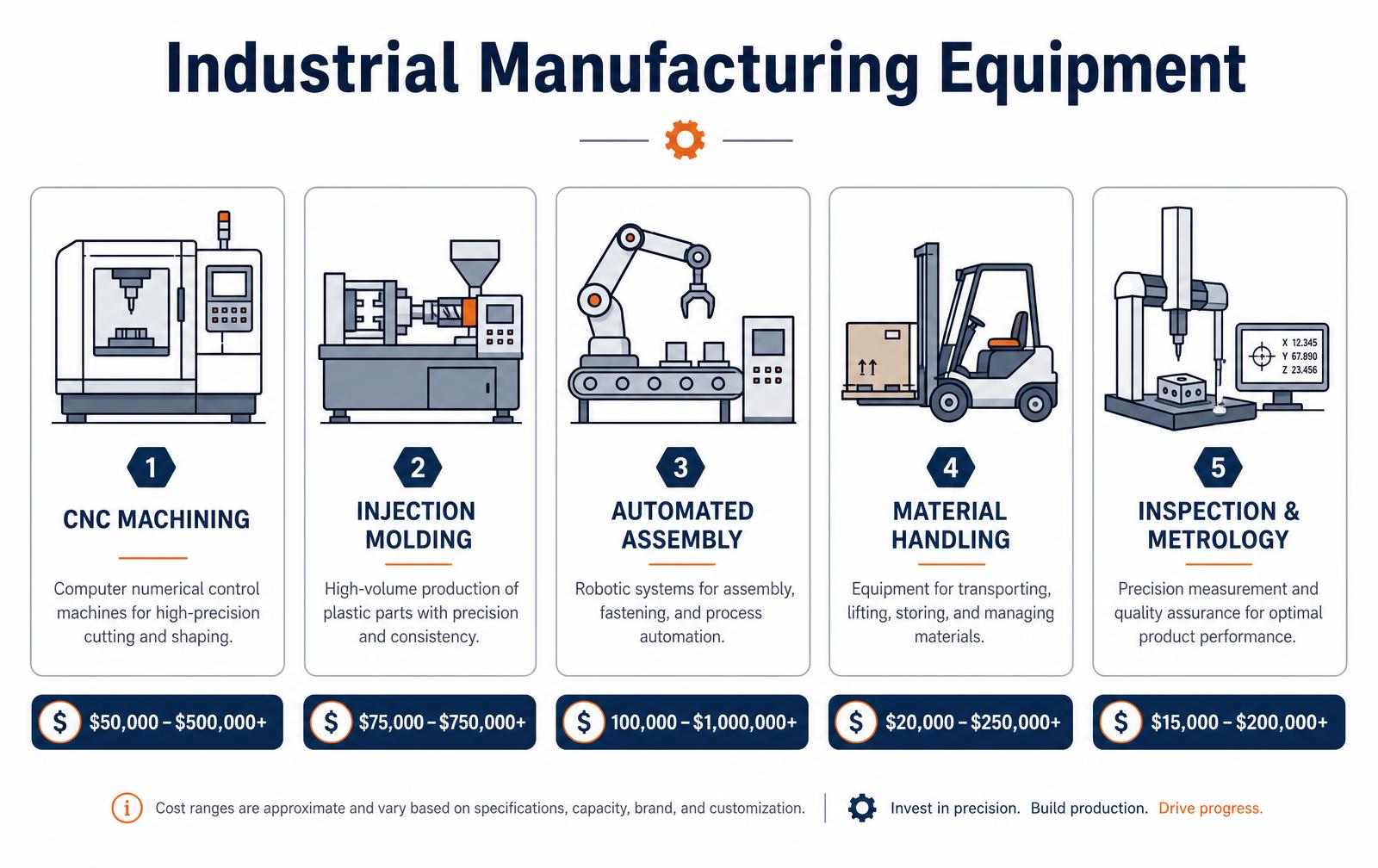
Category | Typical capital cost | Install lead time | Best fit |
|---|---|---|---|
CNC machining centre | $50k-$500k | 8-20 weeks | Metal parts, tight tolerance, low to mid volume |
Injection moulding press + tool | $75k-$400k press, $8k-$120k tool | 12-24 weeks | Plastic parts above roughly 10,000 units/year |
Automated assembly cell | $100k-$1M | 16-40 weeks | Stable, high-volume assembly sequences |
Material handling / conveyance | $20k-$250k | 6-16 weeks | Line balancing, palletising, WIP movement |
Inspection and metrology (CMM, vision) | $15k-$200k | 6-14 weeks | Regulated products and SPC-driven quality |
What the quote leaves out
- Tooling and fixtures. Often 20 to 60 percent of the machine price and product-specific.
- Facilities. Three-phase power, compressed air, chilled water, floor loading and rigging.
- Installation and qualification. IQ/OQ/PQ documentation if you supply regulated markets.
- Training and spares. Two operators and a maintenance technician, plus a critical spares kit.
- Software licences. CAM, controller options and MES connectivity are rarely in the base price.
Buy, lease or outsource
Outsourcing is usually right until the process becomes a core competency or the contract manufacturer's margin exceeds the annual cost of owning the asset. A simple test: divide the installed equipment cost by the annual outsourced spend on that operation. Under two years and rising demand argues for buying.
Over four years, or a product still changing shape, argues for staying variable. Leasing splits the difference when the technology may be superseded within five years.
Related reading: custom industrial equipment manufacturing and designing for manufacturability.
Buy new, buy used, or outsource?
Option | Upfront cost | Lead time | Best when |
|---|---|---|---|
New machine | 100% | 16-40 weeks | Volume is proven and uptime is critical |
Used / refurbished | 35-60% | 2-8 weeks | Proven process, tolerant tolerances, in-house maintenance |
Lease | 10-15% per year | 4-12 weeks | Cash preservation or uncertain demand |
Outsource to a job shop | $0 capital | 1-4 weeks per job | Under roughly 20 hours of machine time per week |
Installation costs people forget
- Rigging and placement. $2k-$25k depending on weight, door width and floor level.
- Foundation and leveling. Precision machines may need an isolated pad, not just a slab.
- Power and air. Three-phase drops, transformers and compressor capacity routinely add $5k-$40k.
- Chip, coolant and dust handling. Extraction and filtration are compliance items, not accessories.
- Training and first-article support. Two weeks of ramp is normal; unbudgeted downtime is the real cost.
- Spares and tooling. Budget 5-15% of machine price for workholding, tooling and critical spares.
Specifying industrial equipment you will still like in year five
Capital equipment decisions are usually made on price and cycle time and regretted for reasons that appear later: spare parts on a twelve-week lead time, a controller nobody local can program, a footprint that blocks the aisle you needed for the next line.
Purchase price is typically only a third of the ten-year cost of a machine. Energy, maintenance, tooling, spares and the labour to operate it make up the rest, and downtime dominates all of them in any plant running near capacity.
Write the specification around uptime and serviceability, then compare quotes on total cost of ownership rather than on the invoice.
Ten-year cost profile of a typical machine
Cost element | Share of 10-year cost | Notes |
|---|---|---|
Purchase and installation | 30-40% | Includes rigging, utilities and commissioning |
Maintenance and spares | 20-30% | Rises sharply once a machine passes its service interval design |
Energy | 10-20% | Compressed air and heating dominate in most plants |
Tooling and consumables | 10-20% | Often the largest surprise on cutting and forming equipment |
Downtime | Highly variable | Can exceed every other line item on a constrained process |
Questions to put in the RFQ
- What is the guaranteed throughput on our part, run on our material, witnessed before payment?
- Which controller and drives, and can our team or a local integrator support them?
- What is the spare parts lead time for the five items most likely to fail?
- What data does it expose, over what protocol, and is that access included?
- What are the utility requirements, including air, power quality and ventilation?
- What training and commissioning support is included, and for how long?
- What is the changeover time between our two most common products?
Installation and commissioning: the part nobody budgets
The gap between machine delivery and stable production routinely runs six to twelve weeks, and it consumes plant resources that were already committed elsewhere.
Foundations, three-phase power, compressed air capacity, fume extraction and floor loading all have to be ready before the rigger arrives, and each has a lead time of its own. Then comes commissioning: operator training, program development for your parts, fixture fabrication, and the run-off that proves capability.
Building this into the project plan and the capital request avoids the familiar situation where a paid-for machine sits idle for a quarter waiting on an electrical contractor.
- Confirm utilities and floor loading against the machine drawing months before delivery.
- Schedule the electrical and mechanical contractors at order time, not at delivery.
- Include operator and maintenance training in the purchase agreement with named hours.
- Plan fixture and tooling design in parallel with the machine build.
- Define an acceptance run-off with pass criteria tied to final payment.
- Stock the critical spares before go-live, not after the first failure.
Key takeaways
Industrial equipment should be bought on uptime, serviceability and total cost of ownership rather than on purchase price and quoted cycle time. Demand a witnessed run on your own parts, confirm spare parts and controller support before signing, and make data access an explicit requirement so the machine can join whatever monitoring system you adopt next.
Facility readiness: utilities, foundations and the costs after the quote
Capital equipment quotes cover the machine. They rarely cover getting your building ready to run it, and that gap routinely adds 20 to 50 percent to the project.
Requirement | Typical scope | Cost range | Lead time |
|---|---|---|---|
Electrical service | 480V 3-phase drop, disconnect, transformer | $6k-$60k | 4-16 weeks |
Compressed air | Dryer, receiver, piping to point of use | $4k-$30k | 3-8 weeks |
Foundation / isolation | Reinforced pad or isolation pit for presses and grinders | $8k-$120k | 6-14 weeks |
Chilled water / process cooling | Chiller, loop, glycol | $10k-$75k | 6-12 weeks |
Ventilation and fume extraction | Capture hood, filtration, make-up air | $5k-$50k | 4-10 weeks |
Rigging and installation | Crane, skates, leveling, anchoring | $2k-$25k | Scheduled with delivery |
Ask the vendor for the utility requirement sheet before you sign, and have an electrician and a millwright walk the space. The most common schedule slip in equipment installation is a transformer or switchgear lead time discovered after the machine is already on the dock.
Maintenance, spares and the ten-year cost of ownership
A machine that runs 6,000 hours a year consumes far more in maintenance and downtime than in purchase price. Build the maintenance plan into the purchase decision, and negotiate spares while you still have leverage.
- Stock the failure-driven spares, not the catalog. Servo drives, controller boards, proximity sensors, seals, and belts cover most unplanned stops.
- Get the maintenance manual and PLC source. Locked controllers force you back to the OEM for every change at OEM rates.
- Negotiate training in the purchase order. Two operators and one maintenance tech, on site, at commissioning.
- Set a preventive maintenance interval by run hours, not by calendar. Log hours from day one so the intervals are defensible.
- Track OEE from commissioning. Availability, performance, and quality separately; a single uptime number hides the cause.
- Plan for the control obsolescence date. The mechanical base outlives the electronics by a decade; know the retrofit path before the drive goes end of life.
When you compare two quotes, put ten years of consumables, spares, service contract, and expected downtime into the same table as the purchase price. The cheaper machine loses that comparison more often than not.
Frequently asked questions
What counts as industrial manufacturing equipment?
It covers the capital machinery used to convert raw material into finished goods: machining centres, presses and moulding machines, automated assembly and robotic cells, material handling and conveyance, and inspection or metrology systems. Support infrastructure such as compressors, chillers and dust collection is normally budgeted alongside it.
How much does industrial manufacturing equipment cost?
Single machines commonly run $15,000 to $500,000, and fully automated assembly cells can exceed $1 million. Budget an extra 20 to 60 percent for tooling, fixtures, facilities work, installation and training before the asset produces a saleable part.
When should a company buy equipment instead of outsourcing?
Buy when volumes are stable, the process is a core competency or quality differentiator, and the installed cost is recovered against outsourced spend in roughly two years. Keep the operation outsourced while the design is still changing or demand is unproven.
Planning a production line?
We design products and processes around the equipment you actually have.
Total cost of ownership over ten years
Purchase price is typically 30 to 50 percent of what a machine costs across a ten-year life. Power, tooling, consumables, preventive maintenance contracts, operator training, spare parts inventory and the floor space itself carry the rest.
A machine that is 15 percent cheaper but runs proprietary consumables and a service contract priced per call will lose the comparison in year three. Build the model before the quote comparison, and require every vendor to fill in the same lines.
Cost line | Share of 10-year TCO | Notes |
|---|---|---|
Acquisition and installation | 30-50% | Includes rigging, foundation, utilities hookup |
Energy | 8-20% | Spindle load and compressed air are the usual surprises |
Tooling and consumables | 10-25% | Proprietary consumables are the biggest lock-in risk |
Preventive maintenance | 8-15% | Contract vs time-and-materials changes this sharply |
Unplanned downtime | 5-20% | Model at your real hourly contribution margin |
Operator training and turnover | 3-8% | Higher for five-axis and automation cells |
Spares inventory | 2-6% | Critical spares held on site vs 48-hour vendor SLA |
Disposal or resale | Negative 5-15% | Well-supported brands hold residual value |
Commissioning, acceptance testing and the payment schedule
The leverage you have over an equipment vendor disappears the moment final payment clears, so tie payment to acceptance criteria you defined, not to a shipping date.
A workable structure is 30 percent at order, 40 percent at factory acceptance test, 20 percent at site acceptance, and 10 percent held for thirty days of production at rate. Factory acceptance should run your parts on your material to your tolerances, with a capability study rather than a single good sample.
Site acceptance repeats the same run after installation, because a machine that made capable parts on a vendor floor will not necessarily do it on your slab, your air supply and your operators.
- Define the acceptance part and its critical dimensions in the purchase order, with a Cpk target.
- Require a documented run at rate, typically four to eight hours at planned cycle time.
- Confirm utilities early: amperage, phase, compressed air CFM at pressure, chilled water, exhaust.
- Get the maintenance and electrical schematics as a deliverable, not as a later request.
- Agree on spare parts and training days before the deposit, when they are still free to add.
Buy, lease or outsource: the decision that precedes the spec
Owning equipment makes sense when utilization is high, the process is core to your differentiation, and demand is predictable enough to keep the asset loaded. Below roughly 40 percent utilization, an outside supplier is almost always cheaper once you carry maintenance, labor and floor space.
Leasing sits between the two and is most defensible when the technology is moving quickly or when the contract that justifies the machine is shorter than its depreciation life. Run the arithmetic on utilization first; the machine specification conversation is much easier once the ownership question is settled.
Work with LA NPDT: if you are moving from here to execution, start with our low-volume manufacturing or talk to us about design for manufacturing.
Filed under:Tech Talk Podcast
Services related to this guide
- Product design servicesIndustrial design and CAD taken all the way to manufacturable files.
- Rapid prototypingWorking prototypes in days, from 3D printing to vacuum casting.
- Electronic design servicesSchematic, PCB layout, firmware and bring-up, through to production handoff.
- Product development examplesReal projects we designed, prototyped and shipped.