Contract Electronics Manufacturer: How to Choose the Right Partner
How to vet a contract electronics manufacturer - scope, quoting red flags, NPI support and test coverage - before you commit a build.
November 27, 20197 min read

Written by Ralph Hill, Mechanical & electrical systems, 3D manufacturing
Prototyping Engineer
Published November 27, 2019Updated September 2, 2026
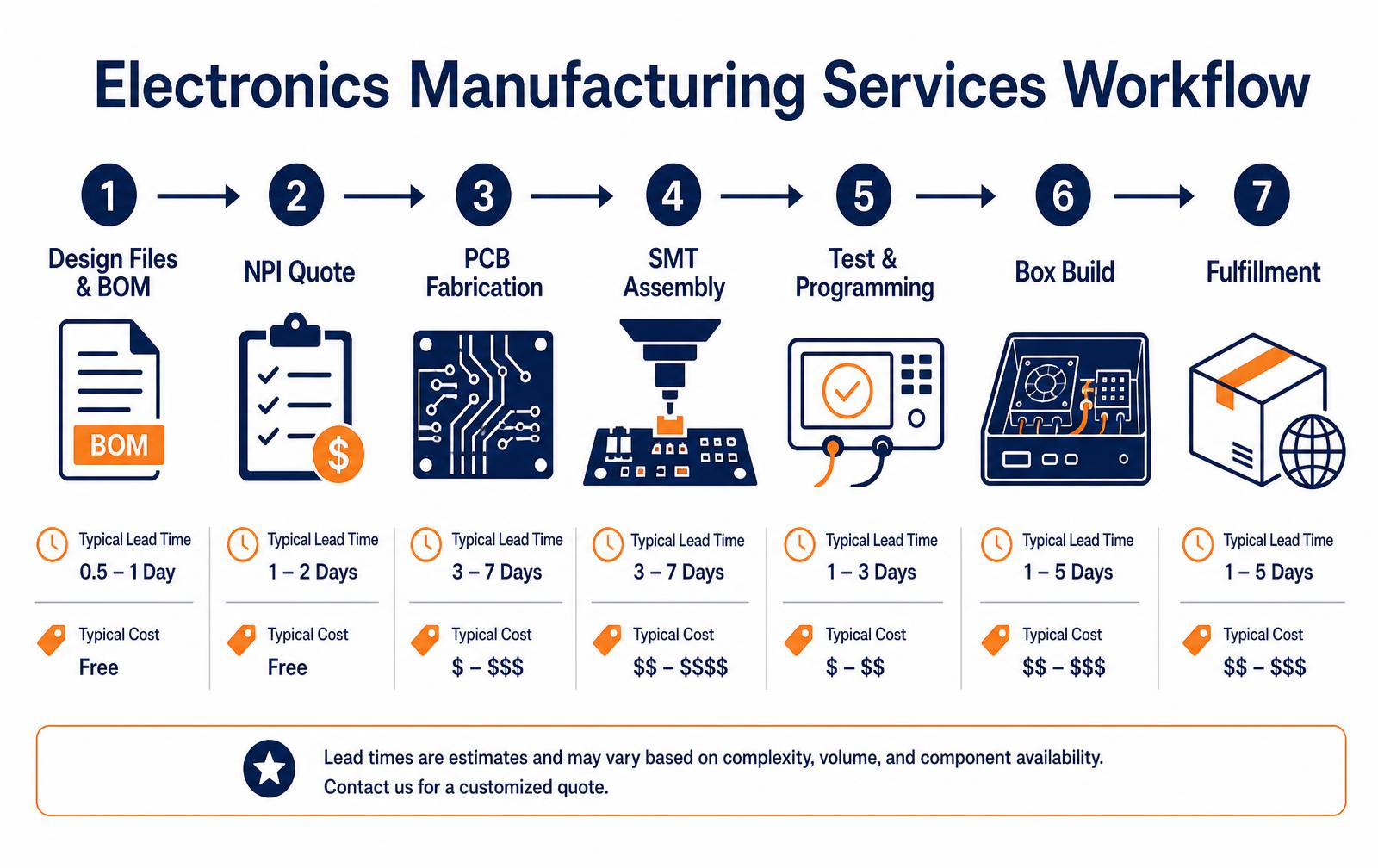
Electronics manufacturing services (EMS) providers build the electronics you designed. The scope runs from bare PCB fabrication and SMT assembly through firmware loading, functional test, box build and drop-ship fulfillment. Choosing the wrong partner rarely shows up in the first quote - it shows up six months later in yield, change-order pricing and a schedule you cannot control.
What do electronics manufacturing services include?
- Design for manufacturing review - panelization, fiducials, testpoints, component availability.
- Procurement - component sourcing, franchised distribution, lifecycle and counterfeit screening.
- PCB fabrication - usually subcontracted to a board house the EMS qualifies.
- SMT and through-hole assembly - stencil printing, pick and place, reflow, selective solder.
- Test - AOI, X-ray for BGAs, in-circuit test, functional test fixtures, burn-in.
- Box build - cabling, enclosure assembly, firmware loading, serialization, labeling.
- Logistics - packaging, kitting, warehousing and direct fulfillment.
What does PCB assembly cost?
An EMS quote is built from three stacks: non-recurring engineering, materials and labor. NRE covers the stencil, programming, and any test fixture. Materials are your BOM at the volumes you commit to. Labor is placements per hour plus hand-work for connectors and odd-form parts. The single biggest lever is annual volume commitment, because it changes component pricing tiers far more than it changes assembly time.
Cost element | Prototype (10 pcs) | Pilot (250 pcs) | Production (5,000 pcs) |
|---|---|---|---|
NRE / stencil / setup | $400-$1,200 | $400-$1,200 | $400-$1,200 |
Functional test fixture | Often skipped | $3k-$15k | $3k-$25k |
Bare PCB, each | $25-$60 | $8-$18 | $3-$7 |
Components, each | BOM + 20-40% | BOM + 5-15% | BOM at tier price |
Assembly labor, each | $40-$120 | $12-$30 | $4-$12 |
Typical lead time | 2-3 weeks | 4-6 weeks | 6-10 weeks |
How do you evaluate an EMS provider?
- Does your volume fit their line? A shop running million-unit programs will not prioritize your 2,000-unit build.
- Which certifications apply - IPC-A-610 Class 2 or 3, ISO 13485 for medical, AS9100 for aerospace, ITAR if applicable?
- Who owns component shortages: do they carry buffer stock, and how are alternates approved?
- What test coverage is included, and who designs and pays for the fixtures?
- How are engineering changes priced mid-program, and what is the scrap liability for obsolete kits?
- Can you get first-pass yield data and defect Pareto charts per build, not just a pass/fail?
- Where does the board physically get built, and can you audit it?
- What are payment terms, and does the price hold if copper, freight or currency moves?
What documentation does an EMS need from you?
A complete manufacturing data package prevents the two-week email loop that most quotes start with: Gerber or ODB++ data, an IPC-2581 or drill file set, a costed bill of materials with manufacturer part numbers and approved alternates, centroid and pick-and-place files, assembly drawings showing polarity and hand-assembly notes, the test specification, and the firmware image with programming instructions.
Incomplete BOMs - especially lines with only a distributor number - are the most common cause of quote delay.
Should you use one EMS or split the work?
For most hardware startups, one partner through pilot production is the right answer: the learning stays in one place and the finger-pointing between board house, assembler and integrator disappears.
Split sourcing makes sense once volumes justify it, once the design is frozen, and once your documentation is good enough that a second supplier can build from it without a phone call. Plan for the second source at design freeze, not after the first quality escape.
What separates a good contract electronics manufacturer from a cheap quote
Quotes from three shops for the same board can differ by 40 percent, and the cheapest is frequently the most expensive by the time you ship. The gap is rarely in placement cost per part. It is in what the shop absorbs versus what it bills back: engineering queries, stencil revisions, component substitutions, rework on your design errors, and the yield they achieve on the first run.
Judge a contract electronics manufacturer on how they behave before the purchase order — the depth of their DFM feedback on your first data package is the single most predictive signal you will get.
Signal during quoting | Low-risk partner | High-risk partner |
|---|---|---|
DFM feedback | Marked-up report within days, specific and technical | "Files received, we can build it" |
Component risk | Flags long-lead and EOL parts, proposes alternates with datasheets | Silence until the build stalls |
Test strategy | Proposes AOI, ICT or flying probe with coverage estimates | Visual inspection only |
Quote structure | NRE, materials and labour itemised | One lump sum |
Change handling | Written ECO process with cost and schedule impact | Verbal agreement on email |
Reading an EMS quote without getting surprised
Materials usually dominate, and materials pricing is where quotes quietly diverge. Ask whether the quote assumes your exact approved parts or shop-selected equivalents, whether it is based on live stock or lead-time pricing, and how long the quote is valid — in volatile component markets a 30-day quote is a real constraint, not a formality.
Line item | What it covers | Question to ask | Common surprise |
|---|---|---|---|
NRE | Stencil, programming, fixtures, first-article setup | Is NRE reusable on the next run? | New stencil billed after a minor revision |
Materials | BOM parts plus attrition | Live stock or lead-time pricing? | Price valid 30 days only |
Attrition | Reels, setup waste, spares | What attrition percentage is assumed? | 3-5% billed on expensive parts |
Assembly labour | Placement, reflow, hand solder | How many hand-solder operations remain? | Connectors and shields billed per unit |
Test | AOI, ICT, functional, programming | What coverage does this buy? | Functional test fixture as separate NRE |
Box build | Cables, enclosure, labelling, packing | Who owns mechanical parts sourcing? | Kitting fees on customer-supplied parts |
The audit questions that actually predict quality
- What is your first-pass yield on boards of similar complexity, and how do you measure it?
- Which IPC class do you build to by default, and what changes when we specify Class 3?
- What is your process for a component substitution — who approves, and what documentation do we receive?
- How is moisture-sensitive device handling controlled, and what happens to a reel that exceeded floor life?
- Can you show traceability from a finished serial number back to reels and reflow profiles?
- What is the escalation path when a build stops, and what response time is contractual?
- Who owns test fixtures and programming files if we move production elsewhere?
Test strategy: pay for coverage, not for inspection theatre
Every defect caught at the panel costs a fraction of the same defect caught in the field. Choose test methods against your volume and failure consequences rather than buying the most impressive-sounding option. AOI is nearly always worth it; in-circuit test earns its fixture cost somewhere in the low thousands of units; functional test is mandatory whenever firmware, RF or safety are involved.
Method | Catches | Typical setup cost | Worth it from |
|---|---|---|---|
AOI | Placement, polarity, solder shorts and opens | Included or low | First prototype run |
Flying probe | Shorts, opens, component values | Low NRE, slow per board | 10-500 units |
In-circuit test | Same plus powered checks, high coverage | $3k-$15k fixture | 1,000+ units |
Functional test | The product actually working | $5k-$40k rig | Any product with firmware or safety claims |
Burn-in / HASS | Infant mortality | Chamber time | Medical, industrial, automotive |
Component risk is now a design decision
Since the shortages of the early 2020s, component availability has become a design constraint rather than a purchasing problem. Design in alternates from the start: footprints that accept two package options, passive values from standard series, and microcontrollers with pin-compatible siblings across memory sizes. A board with three single-sourced parts is a board that will be redesigned at least once.
- Mark every part in the BOM as single-source, dual-source or commodity, and drive the single-source count down before layout freeze.
- Design alternate footprints for connectors and power components where board area allows.
- Keep at least one memory and one package step of headroom on the main processor.
- Ask the EMS to run a lifecycle check on the BOM: any part in NRND status should be replaced before pilot.
- Hold buffer stock of the two longest-lead parts rather than the two most expensive ones.
Contract terms that matter more than price
The commercial terms decide what happens when something goes wrong, which is the only time contracts get read. Negotiate them before the first build, when you still have leverage: IP ownership of design files and test fixtures, liability for scrap caused by shop error versus design error, buffer stock ownership, and the exit terms if you need to move production.
Term | Reasonable position | Red flag |
|---|---|---|
Design file ownership | You own all design and test artefacts | Shop claims rights to fixtures or firmware images |
Scrap liability | Shop pays for process error, you pay for design error, both documented | All scrap billed to customer |
Excess material | You buy remaining kitted stock at cost | Automatic invoice for full reel quantities |
Lead time commitment | Written, with penalty or credit for misses | "Typical" lead time only |
Exit | Files, fixtures and remaining stock released within 30 days | Files held pending final settlement |
More questions teams ask
How many EMS partners should we quote for a first production run?
Three is the practical number: enough to reveal how much of the price spread is real, few enough that you can give each a complete data package and evaluate their DFM feedback properly. Sending an incomplete package to eight shops produces eight meaningless numbers.
Should prototypes be built at the same shop that will run production?
Where possible, yes. The learning from the prototype build — panelisation, profile, fixture design, awkward hand-solder steps — is worth more than the small saving from using a quick-turn prototype house, and it removes an entire transfer step before pilot.
What does a complete manufacturing data package contain?
Gerbers or ODB++, NC drill, pick-and-place centroid file, a BOM with manufacturer part numbers and approved alternates, assembly drawings with polarity markings, an IPC class specification, test requirements, and firmware programming instructions with a versioned image.
Is offshore assembly still cheaper once logistics are included?
At low volume, usually not. Below a few thousand units, freight, duties, longer feedback loops and travel typically erase the labour saving. The crossover depends on board complexity and on how much engineering support the build still needs.
We run DFM reviews, build manufacturing data packages and manage EMS selection and transfer for hardware teams.
Auditing a contract electronics manufacturer before you commit
Choosing a contract electronics manufacturer is mostly an exercise in checking whether their normal operating volume matches yours. A plant tuned for hundreds of thousands of units will accept your five-thousand-unit order and then schedule it around larger customers; a plant tuned for prototypes will struggle when you scale. Volume fit predicts satisfaction better than price, certification list or geography.
The second predictor is who owns the bill of materials. If the CEM sources components against your approved-vendor list with documented substitution rules, you keep control of quality and of obsolescence exposure. If they source freely against a target cost, you will eventually find an unapproved part in your product and discover it during a field failure rather than during incoming inspection.

Annual volume | Best-fit partner | Typical NRE | Main risk |
|---|---|---|---|
Under 1,000 | Prototype / NPI house | $2k–$10k | High per-unit cost; limited test capability |
1,000–25,000 | Regional mid-size CEM | $8k–$35k | Component sourcing leverage is limited |
25,000–250,000 | Established CEM with test engineering | $25k–$90k | You are a small account; scheduling priority |
Above 250,000 | Offshore high-volume CEM | $60k+ | Change control and travel overhead |
The audit checklist
- Confirm certifications that apply to you specifically — ISO 9001 broadly, ISO 13485 for medical, IATF 16949 for automotive, AS9100 for aerospace
- Ask what percentage of their revenue comes from customers at your volume
- Require a written component substitution policy with an approval step on your side
- Ask to see the incoming inspection procedure and the last three months of supplier defect data
- Confirm inspection capability: automated optical inspection at minimum, X-ray if you have BGAs
- Require a documented test strategy: in-circuit test, functional test fixture, and who pays to build it
- Ask how engineering change orders are handled and what the lead time and cost are
- Confirm who owns tooling, stencils and test fixtures if you leave
- Agree on excess and obsolete inventory liability in writing before the first order
- Visit the floor, or send someone — a video tour hides the parts of a plant worth seeing
Design decisions made before you engage a CEM determine how much of this is negotiable. A board designed with accessible test points, generous panelization and a conservative component footprint quotes lower everywhere. We build these constraints into electronic design work and into manufacturing planning so the transfer to production does not require a redesign.
Frequently asked questions about contract electronics manufacturers
Should I use a domestic or offshore CEM? Domestic for the first two production runs, because the iteration loop is short and travel is cheap. Move offshore when the design is stable and volume justifies the change-control overhead.
Who should own the component sourcing? You should own the approved-vendor list; the CEM executes purchasing against it. Handing over sourcing entirely trades short-term cost for long-term quality risk.
What is a realistic NRE for a new board? Roughly $8,000 to $35,000 for a mid-size program, covering stencils, programming, fixtures and first-article work. Test fixture development is usually the largest single item.
How do I avoid excess inventory liability? Define the order horizon and the cancellation window in the agreement, and keep long-lead components on a separate approval. Programs we have transferred to production are described in our portfolio.
Work with LA NPDT: if you are moving from here to execution, start with our low-volume manufacturing or talk to us about design for manufacturing.
Filed under:Tech Talk Podcast
Services related to this guide
- Product design servicesIndustrial design and CAD taken all the way to manufacturable files.
- Rapid prototypingWorking prototypes in days, from 3D printing to vacuum casting.
- Electronic design servicesSchematic, PCB layout, firmware and bring-up, through to production handoff.
- Product development examplesReal projects we designed, prototyped and shipped.