Wearable App Development: Firmware, Phone App and Cloud
Wearables are three products in one. Here is how the firmware, phone app and cloud fit together — and what the build really costs.
January 5, 20206 min read

Written by Ralph Hill, Mechanical & electrical systems, 3D manufacturing
Prototyping Engineer
Published January 5, 2020Updated September 2, 2026
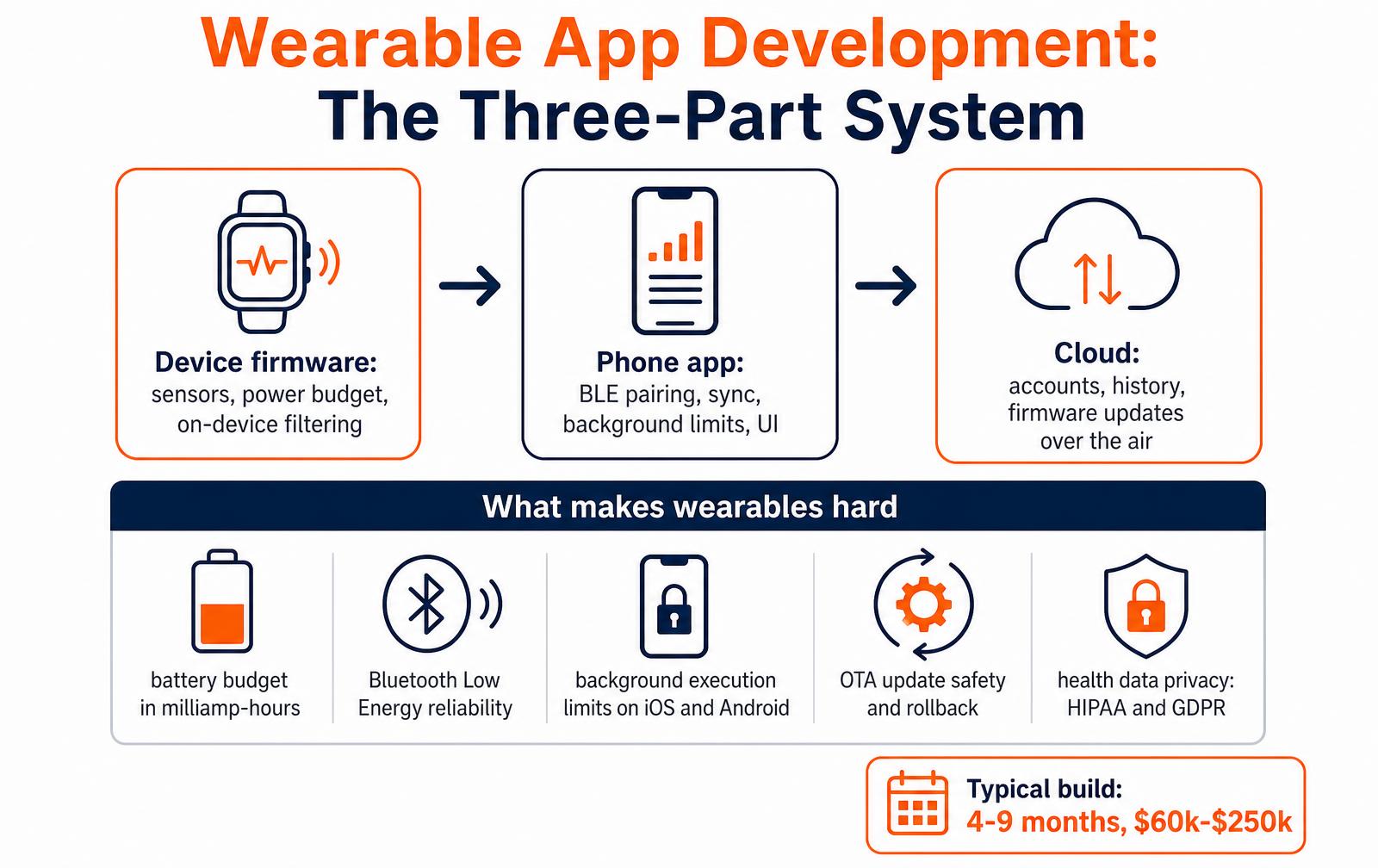
A wearable is not one product, it is three that have to agree with each other. Firmware on a battery-powered device, a phone app that has to sync while the operating system is trying to shut it down, and a cloud service that stores history and pushes updates. Most wearable app development failures are boundary failures — data lost between the three, or a battery budget nobody wrote down.
The three layers, and what each owes the others
- Firmware. Reads sensors, filters on-device, buffers days of data for when the phone is out of range, and manages sleep states. It owns the power budget.
- Phone app. Pairing, reconnection, sync, conflict resolution and the user interface. It must assume it will be killed by the operating system at any moment.
- Cloud. Accounts, long-term history, analytics and over-the-air firmware distribution with staged rollout and rollback.
Define the data contract between these three before writing code: sample rates, packet format, timestamp source and what happens when the device clock drifts. Retrofitting that contract after launch means a migration on devices already on wrists.
The constraints that break naive builds
Constraint | What goes wrong | What to do instead |
|---|---|---|
Battery budget | Continuous BLE advertising drains a 100 mAh cell in a day | Write a milliamp-hour budget per feature before design freeze |
BLE reliability | Sync silently fails when the user walks away mid-transfer | Chunked, resumable transfers with acknowledgements |
Background execution | iOS suspends the app; data appears hours late | Buffer on device, sync opportunistically, never rely on background timers |
OTA updates | A bad image bricks fielded devices | Dual-bank firmware with signed images and automatic rollback |
Health data | HIPAA or GDPR exposure discovered at launch | Encrypt at rest and in transit, minimise fields, decide the legal basis early |
What a wearable app build costs
Scope | Typical cost | Timeline |
|---|---|---|
Firmware plus BLE protocol | $40k-$120k | 3-6 months |
iOS and Android app | $50k-$150k | 3-6 months |
Cloud backend and OTA | $25k-$80k | 2-4 months |
Regulated health features | Add 40-100 percent | Adds 4-9 months |
If the device makes a medical claim, the software becomes part of a regulated device and needs design controls, risk management and verification evidence. Read medical device design before scoping. For the hardware side of the same program, see electronics design.
A sequence that works
- Write the power budget and the data contract first — one page each.
- Build the BLE link and sync layer before any user interface work.
- Test with the radio out of range, the phone in airplane mode and the battery nearly flat; those are your real conditions.
- Ship OTA and rollback in version one, not version two.
- Instrument sync success rate as a product metric from day one.
Battery life is an app decision
On a wearable, the radio dominates the energy budget and the app controls the radio. A connection interval of 30 ms feels instant and can halve run time compared with 200 ms; a phone app that reconnects on every foreground event keeps the link negotiating all day.
The pattern that works is batching: the firmware buffers samples in flash, wakes on a schedule, streams a compressed block, and goes back to sleep. Notification-driven transfers beat polling, and any characteristic the phone reads more than once a second should be reconsidered.
Measure with a current probe on real firmware rather than trusting a datasheet, because the difference between an estimated and a measured budget on a 60 mAh cell is usually days.
Where the effort actually lands
Workstream | Share of effort | Commonly underestimated part |
|---|---|---|
Embedded firmware and BLE stack | 25-35% | Power profiling and connection stability across phone models |
Phone app (iOS and Android) | 30-40% | Background execution rules and OS permission changes |
Cloud sync and API | 15-25% | Conflict resolution when the same record syncs from two devices |
Over-the-air update path | 5-10% | Recovery when an update fails mid-transfer |
Data pipeline and analytics | 5-15% | Time alignment of sensor streams sampled at different rates |
Data integrity rules for offline-first wearables
- Timestamp on the device with a monotonic counter, then correct against phone time at sync; never trust the sync moment as the sample time.
- Never delete from device flash until the cloud acknowledges the block, not just the phone.
- Give every sample a device-generated identifier so a replayed transfer deduplicates instead of doubling.
- Version the payload format from day one; firmware in the field will always be older than the app.
- Store raw and derived data separately so an improved algorithm can reprocess history.
- Plan for the phone being absent for a week: size flash for the worst realistic gap, not the average.
- Log sync failures with a reason code; silent loss is the hardest wearable bug to reproduce.
Testing across the fragmentation
Bluetooth behaves differently on every phone, and a wearable that works on the engineering team handsets will still fail in the field.
Android background execution, aggressive battery optimisers from individual manufacturers, and iOS state restoration rules all change whether a sync happens while the phone is in a pocket.
Build a device matrix that covers at least one current and one three-year-old handset from each of the major manufacturers you expect, then run a multi-day soak with the app backgrounded rather than a bench test with it open.
Add a firmware matrix to that: the field will always contain older firmware, so every app release has to be tested against the oldest version you still support.
- Soak test for at least 72 hours with the app backgrounded and the phone locked.
- Include older and budget handsets; aggressive power management lives there.
- Test the reconnect path after airplane mode, out-of-range and phone restart.
- Verify OTA on a low battery and on an interrupted transfer, then verify recovery.
- Keep a fleet of field firmware versions in the lab for regression runs.
- Watch battery drain on the phone too; a chatty wearable gets uninstalled.
Wearable app development: what the companion app actually has to do
A wearable's app is rarely the interesting engineering, but it is where most schedule slips and most one-star reviews come from. The companion app owns pairing, firmware updates, data sync and the account, and each of those has failure modes that a phone-only app never encounters.
Function | Hard part | Common failure |
|---|---|---|
Pairing and onboarding | BLE permissions across OS versions | User stuck on a spinning connect screen |
Background sync | OS background execution limits | Data gaps of hours or days |
Firmware OTA | Resumable transfer, rollback on failure | Bricked device in the field |
Battery and charge state | Accurate estimation across cell aging | Sudden shutdown at reported 20% |
Data model | Time zones, gaps, device clock drift | Charts that disagree with the device |
Account and privacy | Health data handling and consent | App store rejection |
Platform requirements that catch teams late
- Background execution. iOS and Android both restrict long-running BLE work; design for opportunistic sync, not continuous.
- Health data permissions. Writing to Apple Health or Health Connect requires declared purposes and a privacy policy.
- OTA safety. Dual-bank firmware with signature verification and automatic rollback is the baseline, not a nice-to-have.
- Clock discipline. The device clock will drift; timestamp on the phone and reconcile, or your charts will lie.
- Store review. Hardware-dependent apps often need a demo mode or a review unit shipped to the reviewer.
- Accessibility. Dynamic type and screen reader support are frequently the reason an otherwise finished app is rejected.
Firmware, app and cloud have to be planned as one system — our electronic design services scope them together rather than handing the app off at the end.
The three-layer stack, budgeted
Wearable app development is never just an app. Every program carries firmware on the device, a companion phone app, and a cloud tier — and skipping any one of them at budget time is how projects run 60% over.
Layer | What it owns | Typical effort | Typical cost | Main risk |
|---|---|---|---|---|
Device firmware | Sensor sampling, power management, BLE stack | 10-20 weeks | $40,000-$140,000 | Battery life misses target |
Companion app (iOS+Android) | Pairing, sync, UI, notifications | 12-20 weeks | $60,000-$180,000 | Background BLE limits on iOS |
Cloud / backend | Auth, data pipeline, OTA, analytics | 6-12 weeks | $30,000-$90,000 | Cost per active device at scale |
OTA update system | Signed images, rollback | 3-5 weeks | $15,000-$40,000 | No rollback path = bricked units |
Compliance (if medical) | QMS, cybersecurity, verification | 12-30 weeks | $80,000-$300,000 | Underestimated by 2-3x |
Power budget worked example
Function | Duty cycle | Average draw | Share of budget |
|---|---|---|---|
MCU sleep | 98% | 4 uA | 12% |
Sensor sampling at 25 Hz | 1.5% | 180 uA | 31% |
BLE advertising | continuous | 60 uA | 18% |
BLE sync, 4x/day | 0.3% | 8 mA burst | 28% |
Display wake | 0.2% | 12 mA burst | 11% |
A 120 mAh cell at roughly 33 uA average lasts about 150 days. Move sampling to 50 Hz and it halves. Decide the sampling rate before you pick the battery, never the other way around.
Pre-build decisions that cannot be reversed cheaply
- BLE versus Wi-Fi — Wi-Fi kills coin-cell designs; assume a rechargeable pack if you need it.
- Data ownership and retention — retrofitting HIPAA or GDPR handling after launch is a rewrite.
- OTA from day one — the first firmware bug in the field is a matter of when, not if.
- Pairing UX — most one-star reviews for wearables are pairing failures, not features.
- Antenna placement and enclosure material — metal trim rings routinely cost 10 dB of range.
Frequently asked questions
Key takeaways
A wearable is three products that must ship together: firmware, a phone app and a cloud service, each with its own release cadence and failure modes.
The teams that ship on time size the firmware and OTA work honestly, treat battery life as an app-level design constraint, and test across old handsets and old firmware rather than on the newest device in the office.
Get the sync and update paths right early, because they are the parts you cannot easily fix once units are in the field.
Frequently asked questions
What is wearable app development?
It is the combined development of device firmware, a companion mobile app and a cloud backend so a wearable can collect data, sync reliably, present it to the user and receive firmware updates. All three must be designed against a single data contract.
How much does it cost to build a wearable app?
A first commercial release typically runs $60,000 to $250,000 across firmware, mobile app and cloud. Regulated health features add 40 to 100 percent because of design controls, cybersecurity documentation and verification testing.
Why do wearable apps lose data?
Almost always because sync assumed a stable connection and a running app. Devices must buffer locally for days, transfers must be chunked and resumable with acknowledgements, and the app must sync opportunistically rather than on a background timer.
Does a Wearable App Need Hipaa Compliance?
Only if it handles protected health information on behalf of a covered entity such as a provider or insurer. Consumer wellness apps usually fall outside HIPAA but still sit under GDPR, state privacy laws and app store health data rules — so encryption, data minimisation and clear consent are required either way.
Work with LA NPDT: if you are moving from here to execution, start with our software development services or talk to us about AI product development .
Filed under:Tech Talk Podcast
Services related to this guide
- Product design servicesIndustrial design and CAD taken all the way to manufacturable files.
- Rapid prototypingWorking prototypes in days, from 3D printing to vacuum casting.
- Electronic design servicesSchematic, PCB layout, firmware and bring-up, through to production handoff.
- Product development examplesReal projects we designed, prototyped and shipped.