Packaging and Brand Design for Cosmetic Products: Process and Costs
What packaging and brand design for cosmetic products actually involves: pack selection, decoration, compliant labeling, tooling investment and realistic launch timelines.
January 13, 20206 min read

Written by Ashok Chintagunta, MS Computer Science, Louisiana Tech University
CTO & Software Engineer, AI and Automation
Published January 13, 2020Updated September 2, 2026
Packaging and Brand Design for Cosmetic Products
In cosmetics, the pack is the product experience. Formula quality is invisible on a shelf or a product page. The closure action, the wall thickness, the finish of the cap and the hierarchy of the label are what a buyer judges in three seconds. Packaging and brand design for cosmetic products works best as one workstream, because a positioning decision made in week one dictates which pack tooling you can afford in month six.
Stock versus custom packaging
Route | Tooling cost | Unit cost | Time to launch | Best fit |
|---|---|---|---|---|
Stock pack + custom decoration | $0 | $0.35-$1.80 | 8-14 weeks | First launches and line extensions |
Stock pack + custom cap tool | $8k-$25k | $0.60-$2.50 | 16-24 weeks | Recognisable detail on a modest budget |
Fully custom bottle or jar | $25k-$120k | $0.80-$4.00 | 24-40 weeks | Hero SKUs and prestige positioning |
Airless or pump dispensing system | $15k-$70k | $1.20-$5.00 | 20-32 weeks | Actives that degrade with air exposure |
Refillable system + secondary carton | $20k-$90k | $1.50-$6.00 | 28-44 weeks | Sustainability-led brands |
What compliant labeling requires
- Ingredient declaration. INCI names in descending order of concentration, legible at the specified minimum type size.
- Net contents. Metric and US customary units on the principal display panel.
- Responsible party. Name and address of the manufacturer, packer or distributor.
- Period after opening or expiry. The open-jar symbol for EU and UK markets, plus batch coding space.
- Warnings and claims. Any drug-adjacent claim, such as SPF, changes the regulatory category entirely.
- Artwork tolerance. Leave bleed and a colour bar; decorated glass and shrink sleeves shift more than flat labels.
Where cosmetic launches slip
Three failures repeat. Compatibility testing is skipped, and twelve weeks later the fragrance has attacked the liner or the formula has stress-cracked the bottle. Artwork is signed off before the pack is final, so every dieline changes and print plates are re-cut.
And the filler is chosen last, only to reject the container because it will not run on their line at speed. Book compatibility and stability testing when the pack shortlist is set, and bring the contract filler into the review before tooling is released.
Related reading: flexible packaging manufacturers and how to brand your own product.
Cost of a first cosmetic packaging run
Line item | 3,000 units | 25,000 units | Notes |
|---|---|---|---|
Primary container | $0.45-$1.90 ea | $0.30-$1.20 ea | Airless pumps sit at the top of the range |
Decoration (label vs silkscreen) | $0.12-$0.55 ea | $0.07-$0.35 ea | Silkscreen needs screens per color, $150-$400 each |
Secondary carton | $0.18-$0.60 ea | $0.10-$0.35 ea | Foil and soft-touch add 20-40% |
Custom mold (if any) | $8k-$45k one-time | $8k-$45k one-time | Amortize over 24 months before committing |
Compatibility and stability testing | $3k-$9k | $3k-$9k | Non-negotiable for regulated claims |
Fill and assembly | $0.25-$0.80 ea | $0.15-$0.45 ea | Hand assembly is what kills small-run margin |
Pre-production checklist
- Run compatibility on the actual formula and actual resin. Twelve weeks at 40C minimum before you order components.
- Approve a physical color draw-down. Screen proofs lie, especially on frosted and metallized substrates.
- Confirm fill line and closure torque. Ask the filler for their component spec before you order a single case.
- Verify INCI order, net contents and responsible-party address. Artwork errors mean relabeling by hand.
- Order 5-8% overage on decorated components. Decoration scrap is normal and stockouts stop the line.
- Lock a barcode and case pack spec. Retail and 3PL onboarding both stall without it.
Cosmetic packaging: compatibility and stability testing
Cosmetic packaging is a chemistry problem wearing a graphic design costume. The formula sits against the container for two to three years, and the interactions — absorption, leaching, discoloration, swelling, seal failure — only show up under accelerated testing. Skipping it is how a brand discovers, after the first production run, that its serum turns amber in a clear PET bottle.
Test | Duration | Watching for |
|---|---|---|
Accelerated stability (40°C/75% RH) | 12 weeks ≈ 2 years | Color, odor, separation, pH drift |
Real-time stability | 24–36 months | Confirms the accelerated prediction |
Compatibility with container | 12 weeks | Absorption into plastic, panel collapse, leaching |
Freeze-thaw cycling | 3–5 cycles | Emulsion breakdown, crystallization |
Light exposure | 4–8 weeks | Fading of dyes and actives in clear packaging |
Preservative efficacy (PET/challenge) | 28 days | Microbial protection in the actual container |
Decoration methods and what they cost
- Pressure-sensitive labels: lowest setup ($150–$600 per plate set), best for launch volumes and frequent artwork changes.
- Silk screen: $200–$500 per color per SKU setup; durable, limited color count, ideal for one or two spot colors on glass.
- Hot stamping / foil: $300–$900 die cost; premium metallic effect that photographs well.
- Shrink sleeves: full 360° graphics, $500–$1,500 setup, hides container seams but complicates recyclability.
- Direct digital print: no plates, higher per-unit cost; useful for limited editions and personalization.
Timeline from brief to first shipment
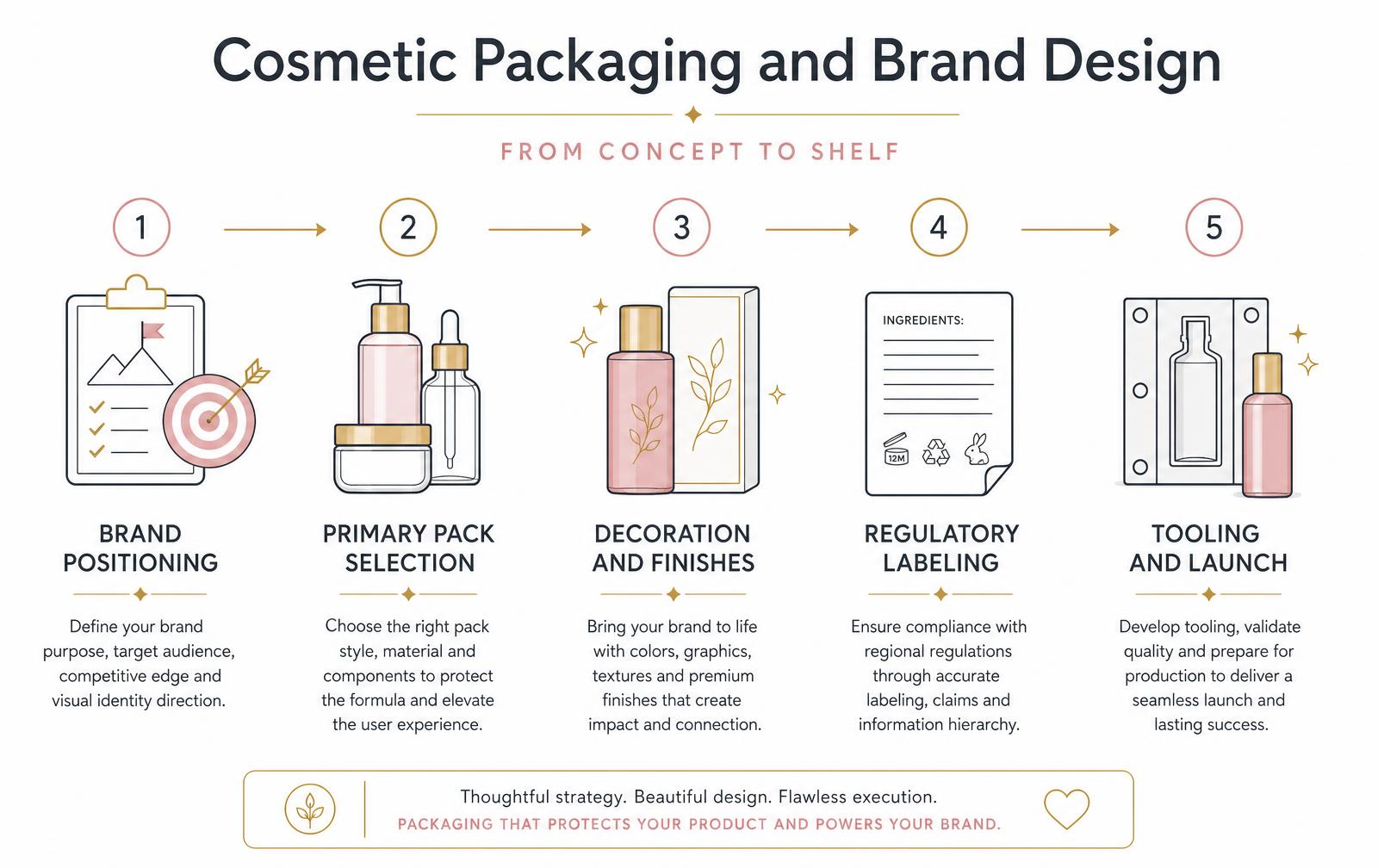
A realistic cosmetic packaging program runs five to nine months: two to four weeks on positioning and brand direction, four to eight weeks on structural and graphic design, twelve weeks of stability and compatibility testing running in parallel with artwork approval, six to twelve weeks for component tooling or stock-component sourcing, and four to six weeks for filling, decoration and quality release.
The critical path is almost always stability testing, which is why it should start on the day a candidate container is chosen rather than after artwork is signed off.
Brand, structure and formula constraints have to be resolved together — see how we approach product design for consumer goods.
Frequently asked questions
How much does cosmetic packaging and brand design cost?
Brand identity and pack artwork for a small range typically runs $12,000 to $60,000 of design work. Custom pack tooling adds $8,000 for a cap up to $120,000 for a bespoke bottle and closure system, while a stock pack with custom decoration avoids tooling entirely.
How long does a cosmetic packaging project take?
Eight to fourteen weeks with stock components and custom decoration; twenty-four to forty weeks when a bottle or closure is tooled from scratch. Stability and compatibility testing usually runs twelve weeks in parallel and is the item most often forgotten in the schedule.
Should a new brand start with stock or custom packaging?
Start with stock components and invest the budget in decoration, secondary packaging and photography. Tool a custom pack once a hero SKU has proven demand, since tooling only amortises sensibly above roughly 50,000 units.
The cosmetic packaging development sequence
Cosmetic packaging is developed in two parallel tracks that have to meet on a fixed date: primary packaging, which touches the formula and must pass compatibility and stability testing, and secondary packaging plus decoration, which carries the brand. Teams that run these sequentially lose a quarter.
The formula chemist, the packaging engineer, and the brand designer should be in the same review from concept onward, because a fragrance oil that swells a PP gasket can invalidate a finished carton design six weeks before launch.
Component | Common material | Tooling cost | MOQ | Lead time |
|---|---|---|---|---|
Stock jar or bottle | PET, PP, glass | None (stock) | 1k-5k | 3-6 weeks |
Custom bottle | PET or HDPE blow mold | $8k-$25k | 10k-25k | 10-16 weeks |
Airless pump | PP with stock engine | $12k-$40k for custom shell | 10k+ | 12-18 weeks |
Folding carton | SBS or FSC board | $1.5k-$4k die | 2k-10k | 3-5 weeks |
Decoration | Silkscreen, hot stamp, label | $300-$1.2k per screen | 1k+ | 2-4 weeks |
Compatibility and stability testing you cannot skip
- Compatibility. Filled samples held at 40C for 12 weeks, checked for panelling, weight loss, colour shift, and pump failure.
- Stability. Formula held at 4C, 25C, 40C plus freeze-thaw cycles, with pH and viscosity logged.
- Preservative efficacy (PET or challenge test). Required for any water-containing formula.
- Transit testing. ISTA 3A on the retail-ready carton, especially for glass and for direct-to-consumer shipping.
- Labelling review. INCI ingredient order, net contents, responsible-person address, and claim substantiation before print files are released.
Where budgets go wrong
Two mistakes dominate. The first is committing to a custom bottle for a first launch: the tooling and the 25,000-unit minimum consume the working capital that should have funded marketing. Stock componentry with distinctive decoration and a strong carton reaches the same shelf presence at a tenth of the cash risk.
The second is ordering print before the fill line is confirmed - a change in filler or capper can alter the label placement window and turn 20,000 cartons into scrap.
- Key takeaway 1: Run primary packaging and brand design in parallel with a shared review gate.
- Key takeaway 2: Stock components with premium decoration outperform custom tooling for a first launch.
- Key takeaway 3: Compatibility and stability testing runs 12 weeks - schedule it, do not discover it.
- Key takeaway 4: Lock the filling line before releasing print files.
Launching a cosmetic line?
We take beauty products from positioning through pack design, tooling and production-ready artwork.
Primary pack selection for cosmetics
Pack type | Typical MOQ | Tooling | Formulation fit | Cost per unit at 25k |
|---|---|---|---|---|
Stock jar + custom decoration | 5k-10k | Decoration setup only, $500-$3k | Creams, balms | $0.35-$1.20 |
Airless pump bottle | 10k-30k | $0 stock, $25k-$60k custom | Actives sensitive to oxygen | $0.80-$2.50 |
Custom-moulded bottle | 30k-100k | $30k-$90k | Brand-defining hero SKUs | $0.45-$1.60 |
Aluminium tube | 20k-50k | $2k-$8k print setup | Cleansers, masks | $0.30-$0.90 |
Glass dropper bottle | 10k-25k | Stock plus custom closure | Serums and oils | $0.70-$2.20 |
Decoration and finish trade-offs
Technique | Setup cost | Durability | Best use |
|---|---|---|---|
Pressure-sensitive label | $300-$1,500 | Good, edge lift over time | Fast SKU proliferation, small runs |
Silk screen | $400-$2,000 per colour | Excellent | One or two colour brand marks |
Hot stamp / foil | $800-$3,000 | Very good | Premium accents, metallic type |
Shrink sleeve | $1,000-$4,000 | Excellent, full coverage | Complex graphics, 360° artwork |
Metallisation / soft-touch coating | $2,000-$10,000 | Varies with formulation contact | Luxury positioning — test chemical resistance |
Regulatory labelling essentials
- Ingredient declaration in INCI order — descending by weight above 1%, with colourants listed last.
- Net contents in both metric and, for US retail, US customary units.
- Responsible person and address — an EU or UK responsible person is required for those markets, not just an exporter.
- Batch code and period-after-opening symbol or a durability date where shelf life is under 30 months.
- Warnings and function where the product form is not obvious from the pack.
- Claim substantiation on file before the claim reaches the carton — "dermatologically tested" requires a study, not a supplier's brochure.
Compatibility and stability testing
- Run formulation-in-pack stability at 4 °C, 25 °C, 40 °C and 45 °C for a minimum of twelve weeks before committing tooling.
- Test the closure and dip tube materials separately — most incompatibility failures start at the pump, not the bottle.
- Check decoration chemical resistance against the formulation itself and against common contaminants such as sunscreen and alcohol.
- Include transit testing: drop, vibration and compression on a filled, palletised configuration.
- Photostability matters for natural actives; clear glass looks premium and can shorten shelf life by months.
Launch timeline
Phase | Duration | Key output |
|---|---|---|
Brand and pack strategy | 3-5 weeks | Positioning, SKU architecture, format shortlist |
Structural design and CMF | 4-8 weeks | Pack drawings, decoration spec, renders for retailer pitches |
Tooling or component sourcing | 8-16 weeks | First articles, filled samples |
Stability and compatibility | 12-16 weeks (parallel) | Signed-off shelf life |
Artwork and compliance | 4-6 weeks | Print-ready files, regulatory dossier |
First production run | 6-10 weeks | Retail-ready inventory |
Frequently asked questions
Stock components or custom tooling? Launch on stock components with distinctive decoration. Move to custom moulds once one SKU proves repeat volume — custom tooling on an unproven line is the most common way small beauty brands run out of cash.
How early should regulatory work start? During formulation. Ingredient restrictions vary by market and can force a reformulation that invalidates completed stability testing.
What does refillable actually require? A separable, cleanable primary container, a refill format that survives shipping unprotected, and pricing that makes the refill obviously cheaper. Retrofitting refillability onto an existing pack rarely works.
Work with LA NPDT: if you are moving from here to execution, start with our packaging design services or talk to us about new product marketing.
Filed under:Tech Talk Podcast
Services related to this guide
- Product design servicesIndustrial design and CAD taken all the way to manufacturable files.
- Rapid prototypingWorking prototypes in days, from 3D printing to vacuum casting.
- Electronic design servicesSchematic, PCB layout, firmware and bring-up, through to production handoff.
- Product development examplesReal projects we designed, prototyped and shipped.