Car Manufacturing Robots: Applications, Costs and Payback
A practical look at car manufacturing robots: which operations they own, what an installed cell costs, and how to run the payback calculation before committing.
January 21, 20206 min read

Written by Konstantin Dolgan, Ph.D., NPDP
Founder & CEO, Product Development Engineer
Published January 21, 2020Updated September 2, 2026
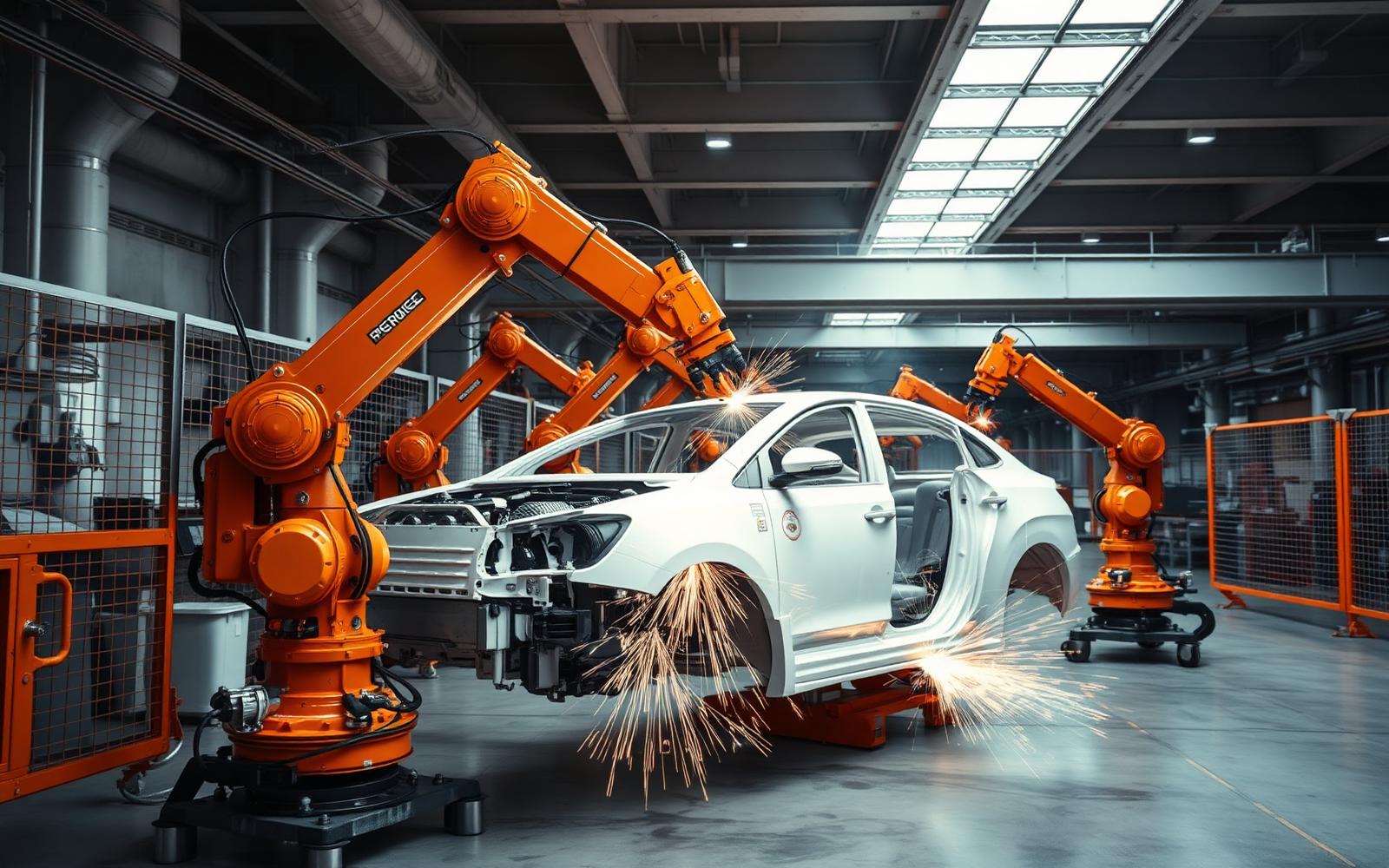
Automotive is the most robot-dense industry on earth, and body shops routinely run above 90 percent automation. That density is not a technology story; it is a repeatability story. Car manufacturing robots win where the cycle is fixed, the part presentation is controlled and the volume justifies fixturing — and they lose money quickly anywhere those three conditions are not true.
Applications, payloads and installed cost
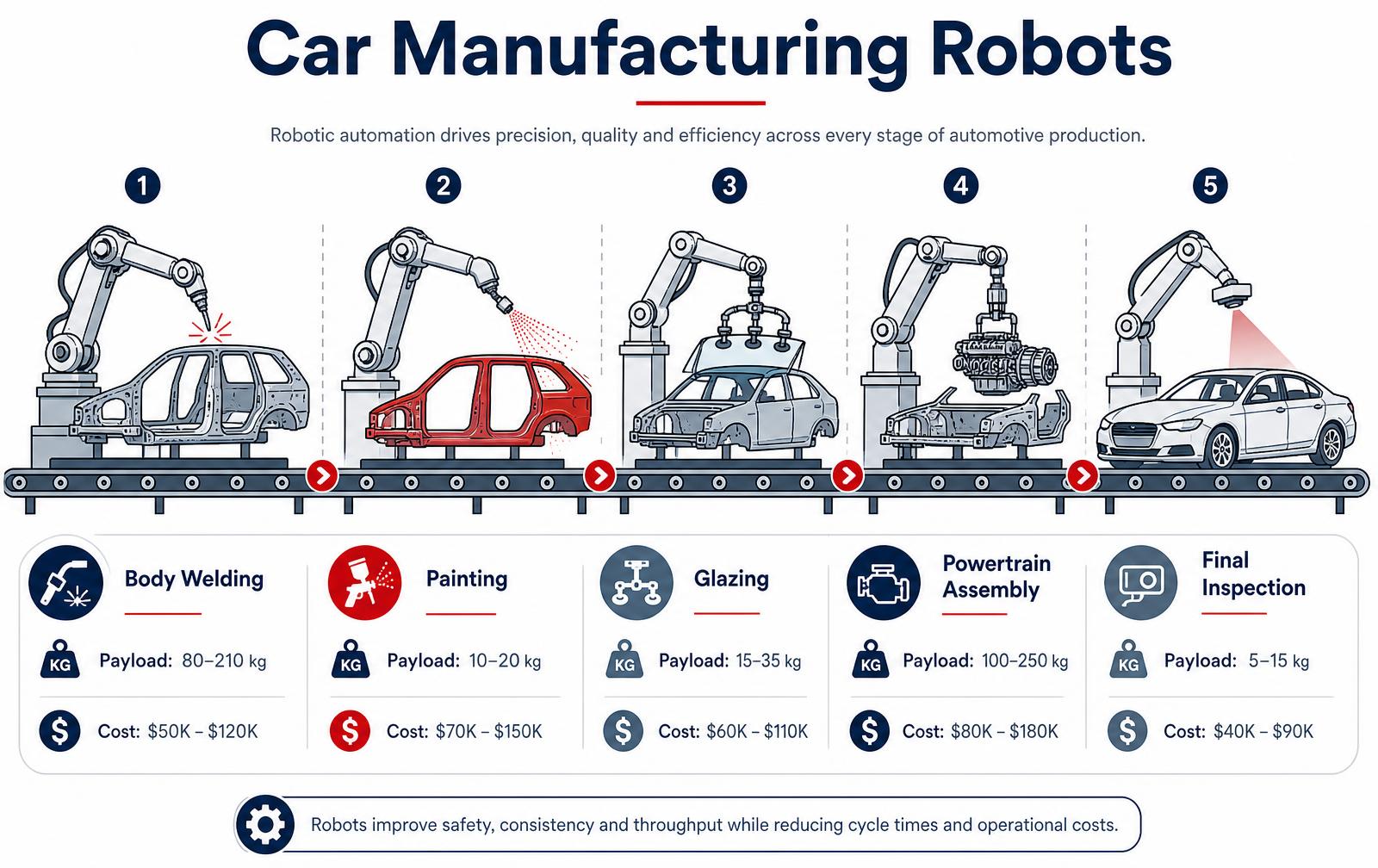
Application | Typical payload | Installed cell cost | Why a robot wins |
|---|---|---|---|
Body-in-white spot welding | 80-210 kg | $150k-$400k | Thousands of identical welds at fixed geometry |
Paint and sealant application | 10-20 kg | $200k-$600k | Consistent film build in an environment hostile to people |
Glazing and windscreen set | 15-35 kg | $180k-$450k | Heavy, awkward parts placed to sub-millimetre accuracy |
Powertrain and marriage assembly | 100-250 kg | $250k-$800k | High load with force-controlled insertion |
Vision inspection and gap-and-flush | 5-15 kg | $90k-$300k | Repeatable measurement feeding SPC data |
What the robot price excludes
- End-of-arm tooling. Grippers, weld guns and vacuum cups: $15k to $120k per station and product-specific.
- Fixturing and part presentation. Usually the single largest line item after the robot itself.
- Safety engineering. Fencing, light curtains, scanners and a risk assessment to ISO 10218 and ISO/TS 15066.
- Integration and programming. Commonly 40 to 100 percent of hardware cost for a first cell.
- Controls and data. PLC integration, traceability and MES connectivity.
- Maintenance. Trained technicians, dress-pack consumables and a critical spares kit.
Running the payback maths
Take the fully loaded cost of the shifts the cell displaces, add the value of scrap and rework it removes, then divide the installed cell cost by that annual figure. Two shifts of manual welding at a fully loaded $60,000 each plus $40,000 of avoided rework pays back a $300,000 cell in under two years.
One shift, unstable part presentation and a model change in eighteen months does not — and that is the case where a collaborative robot or a semi-automated fixture is the better answer.
Related reading: robotics in manufacturing and collaborative robots in manufacturing.
Integration timeline for a robotic cell
Phase | Duration | Deliverable |
|---|---|---|
Concept and simulation | 2-4 weeks | Reach study, cycle time model, layout |
Detailed design | 4-6 weeks | End effector, fixtures, safety concept, controls schematic |
Build and mechanical install | 6-10 weeks | Cell assembled and powered on the floor |
Programming and debug | 3-6 weeks | Paths taught, I/O integrated, error handling |
Safety validation and buyoff | 2-3 weeks | Risk assessment, verification per ISO 10218 / TS 15066 |
Production ramp | 2-4 weeks | Run rate and first-pass yield targets met |
Total cost of ownership beyond the robot
- Spares package. Cables, grippers and a spare controller board; downtime costs more than the parts.
- Preventive maintenance. Budget 3-5% of installed cost per year for service and calibration.
- Operator and technician training. Two to four people trained, or the cell stops when one person is on vacation.
- Program change capacity. New part numbers mean new fixtures and paths - price that in the business case.
- Utilities and floor space. Compressed air, dedicated power and guarding footprint are real recurring costs.
What robots actually do on an automotive line
Automotive body shops are the most heavily automated factories in the world, routinely running above ninety percent automation, while final assembly remains stubbornly manual. The reason is variation.
Welding a body-in-white involves rigid parts in fixed positions, which suits a robot perfectly. Routing a wire harness through a trimmed interior involves flexible parts, tight access and constant model variation, which does not. Paint sits between the two, automated for coverage and manual for inspection and touch-up.
Understanding that split matters for any manufacturer looking at automotive practice, because copying the body shop model into a low-volume, high-variation operation is the classic way to buy expensive idle equipment.
Automation by production stage
Stage | Typical automation | Dominant robot task | Why the rest stays manual |
|---|---|---|---|
Stamping | Very high | Press tending, part transfer | Die changes and quality checks |
Body-in-white | 90%+ | Spot welding, adhesive, handling | Fixture setup and repair welds |
Paint | High | Spray application, sealing | Inspection, sanding, touch-up |
Powertrain | High | Machining tending, assembly, torque | Rework and variant handling |
Final assembly | 10-30% | Windshield set, seat and cockpit lift | Flexible parts, model mix, access |
Lessons for smaller manufacturers
- Automate the fixture before the robot. Repeatable part presentation is what makes a cell viable.
- Pick tasks with stable geometry and high repetition, not the tasks people complain about most.
- Design the product for automated handling: flat datums, grip features, self-locating parts.
- Use collaborative arms for low volume where guarding and floor space dominate the cost.
- Budget the integration, which usually costs two to three times the robot itself.
- Keep a manual path for variants and for the weeks a cell is down.
Electrification is redrawing the automotive line
An electric vehicle has far fewer powertrain parts than a combustion vehicle, and that shifts where automation matters.
Engine and transmission machining lines shrink or disappear, replaced by battery module and pack assembly, which is a very different problem: heavy, sensitive to contamination, electrically hazardous and dominated by adhesive dispensing, laser welding of busbars and end-of-line electrical test.
Giga-casting large structural aluminium parts removes dozens of stamped and welded components along with the robots that joined them. For suppliers, the practical implication is that automation investment aimed at combustion content has a shorter horizon than its depreciation schedule assumes.
- Battery assembly favours precision dispensing, laser welding and electrical test over spot welding.
- Structural castings eliminate joining operations and the cells built around them.
- Safety systems change: high-voltage work requires interlocks and trained staff, not just guarding.
- Traceability requirements rise, since every cell and module is tracked individually.
- Evaluate new equipment for redeployability, because product mix will keep moving.
What car manufacturing robots actually do, station by station
Automotive assembly is the most robot-dense manufacturing in the world, but the robots are not interchangeable. Payload, reach and repeatability are chosen per station, and the differences drive both the cell cost and how quickly a line can be retooled for a new model.
Station | Robot type | Typical payload | What decides the spec |
|---|---|---|---|
Body-in-white spot welding | 6-axis articulated | 150–250 kg | Gun weight plus cable dress |
Sealing and adhesive | 6-axis with dispenser | 20–50 kg | Bead consistency, path speed |
Paint | Explosion-proof articulated | 10–25 kg | Atomizer reach into interiors |
Powertrain assembly | SCARA / articulated | 10–80 kg | Insertion force feedback |
Final assembly (glass, seats) | High-payload with vision | 300–700 kg | Part weight and locating tolerance |
Inspection | Cobot or gantry with sensors | 5–15 kg | Scan resolution and cycle time |
Cycle time, uptime and the numbers that decide the business case
A line running 60 jobs per hour gives every station 60 seconds, minus conveyor indexing. Robot programs are written against that takt with a safety margin of roughly ten percent, because a station that runs at 59 seconds has no room for a dressing change or a slow part feed. Availability matters more than raw speed: at 60 JPH, one percent of downtime is around five vehicles per shift.
- Takt discipline. Balance the slowest station first; adding speed anywhere else changes nothing.
- Tool changeover. Quick-change end effectors turn a model change from days into hours.
- Preventive maintenance windows. Gearbox and dress-pack wear are predictable; unplanned failures are not.
- Spare strategy. One shared spare robot per cell family is cheaper than line-down time.
- Offline programming. Simulating paths in software keeps commissioning off the critical path.
- Operator interaction. Any shared workspace needs a force and speed assessment under ISO/TS 15066.
For smaller manufacturers the lesson translates directly: pick the constraint station, size the robot for the worst-case payload including the gripper, and budget commissioning at roughly a third of the hardware cost. That last figure surprises most first-time buyers.
Key takeaways
Automotive robotics is a lesson in matching automation to variation. The body shop is nearly fully automated because the parts are rigid and identical; final assembly is not because they are neither. Smaller manufacturers get the same benefit by fixing part presentation, designing products for automated handling, and automating the stable, repetitive middle of the process rather than its messiest edges.
Frequently asked questions
Where robots sit on an automotive line
What do car manufacturing robots do?
An automotive plant is really four robot populations with different duty cycles, tooling and payback profiles. Body shop welding is the densest and most automated; final assembly remains the hardest to automate because of soft trim, harnesses and human-scale dexterity. Knowing which shop you are quoting for is the difference between a 24-month payback and a stranded asset.
They handle spot and arc welding of the body-in-white, paint and sealant application, adhesive dispensing and glass setting, powertrain and chassis marriage, part handling between stations, and vision-based inspection such as gap-and-flush measurement.
Shop | Typical robots | Main task | Automation level | Payload class |
|---|---|---|---|---|
Body shop | 300-800 | Spot welding, laser welding, framing | 90-98% | 150-500 kg |
Paint shop | 40-120 | Sealing, primer, base and clear coat | 85-95% | 20-60 kg (explosion-proof) |
Powertrain | 60-200 | Machine tending, assembly, leak test | 60-80% | 20-200 kg |
Final assembly | 20-80 | Glazing, cockpit, wheel and seat load | 5-20% | 100-500 kg |
How much does an automotive robot cell cost?
Cost per installed robot and payback
The robot arm alone is typically $40,000 to $180,000 depending on payload and reach. A fully installed cell including tooling, fixturing, safety guarding, integration and programming generally lands between $90,000 and $800,000.
Installed cost per automotive robot generally runs $110,000-$260,000 including tooling, safety and controls - the arm itself is often under a third of that.
Payback comes from cycle-time stability more than headcount: a body shop line holding 60-second takt with 99% availability produces predictable volume, and predictable volume is what amortises a $2B plant. On a 250,000-unit-per-year line, one second of takt is worth roughly 1,000 additional units annually.
Are robots worth it at low production volumes?
Collaborative robots and the human-scale gap
Rarely in the traditional caged form. Below a few thousand units a year, a collaborative robot with quick-change tooling, or a semi-automated fixture with a human operator, usually reaches payback faster because fixturing and integration cost less and can be redeployed when the product changes.
- Cobots fit final assembly tasks under 15 kg where fencing would block operator access.
- Speed-and-separation monitoring lets a cobot run near full speed until a human enters the zone.
- Force-limited operation costs cycle time - expect 30-50% slower motion than a fenced industrial arm.
- Torque sensing enables insertion tasks (connectors, clips) that traditional position control fails.
- Risk assessment still applies: a cobot with a sharp gripper is not inherently safe.
Designing a product for automated assembly?
We design parts and processes so robotic cells run at rate from day one.
What suppliers should prepare before a line quote
Deliverable | Why the integrator needs it | Typical lead time |
|---|---|---|
Part CAD with tolerance stack | Gripper and fixture design | 2-4 weeks |
Takt time and volume ramp | Station count and buffer sizing | 1-2 weeks |
Weld or joint schedule | Gun selection and duty cycle | 3-5 weeks |
Plant utilities and floor plan | Reach study and cell layout | 2-3 weeks |
Quality plan and gauge R&R | In-line inspection strategy | 4-6 weeks |
Work with LA NPDT: if you are moving from here to execution, start with our industrial equipment and machine design or talk to us about short-run manufacturing.
Filed under:Tech Talk Podcast
Services related to this guide
- Product design servicesIndustrial design and CAD taken all the way to manufacturable files.
- Rapid prototypingWorking prototypes in days, from 3D printing to vacuum casting.
- Electronic design servicesSchematic, PCB layout, firmware and bring-up, through to production handoff.
- Product development examplesReal projects we designed, prototyped and shipped.