Medical Device Manufacturing: Design Transfer, Validation and What It Costs
A released design is not a manufacturable device. Here is what happens between design freeze and the first validated lot, and what drives the cost of each unit.
January 27, 20205 min read

Written by Ashok Chintagunta, MS Computer Science, Louisiana Tech University
CTO & Software Engineer, AI and Automation
Published January 27, 2020Updated September 2, 2026
In most fields, making things starts when drawings are done. In medical devices, that is just the start of the paperwork. You must document and check every step that touches the product. You must keep proof for audits years later. This makes medical device work slower and costlier than consumer goods. It also makes your work hard to copy once it works.
Design transfer: turning a design into a process
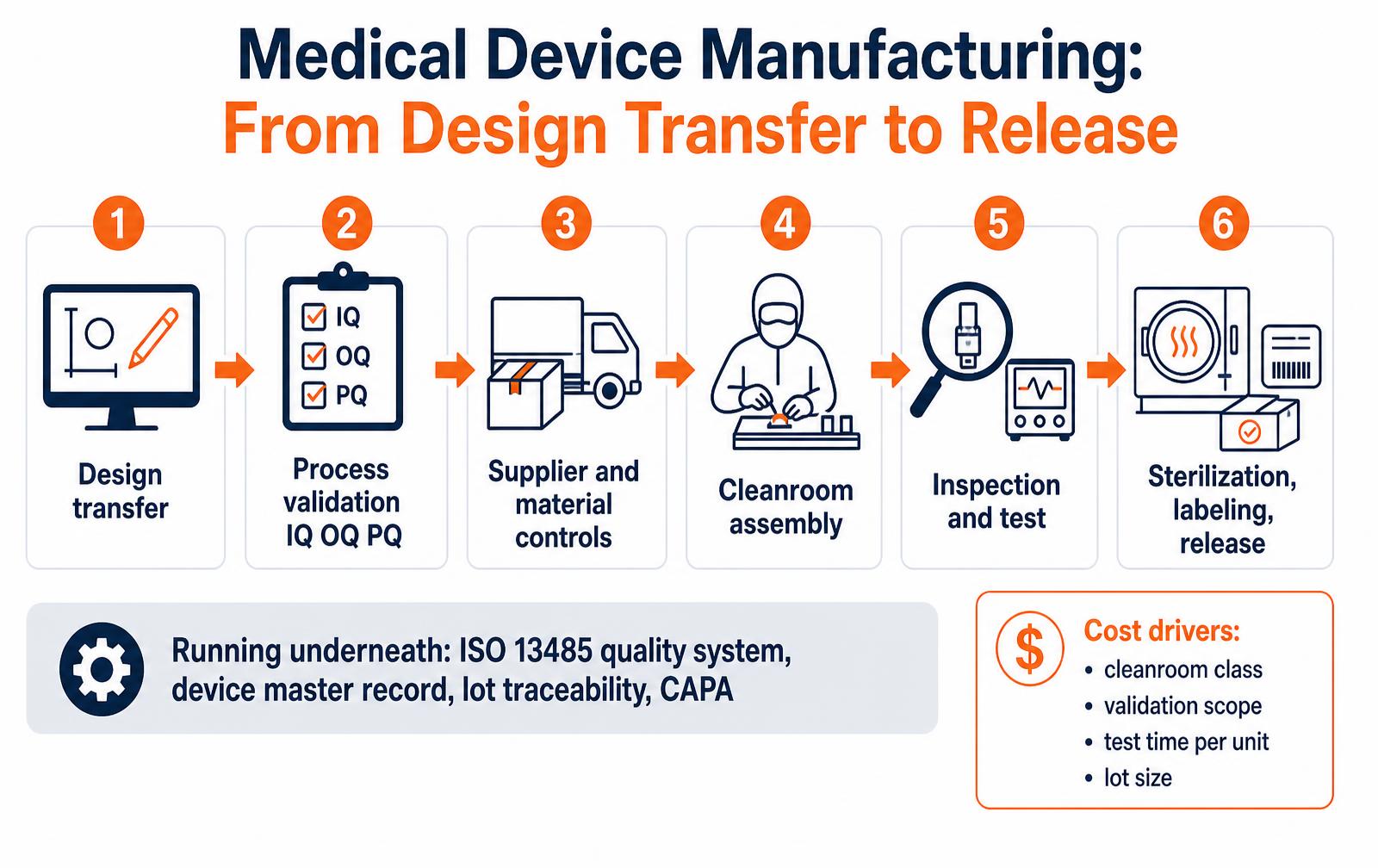
Design transfer is the formal handoff required by 21 CFR 820.30(h). It creates the device master record. This includes drawings, parts lists, and approved suppliers. It also lists work steps, test rules, and labels. Transfer is not done until an operator can build it using only these files.
Process validation: IQ, OQ, PQ
- IQ — installation qualification. The equipment is what the specification says, installed correctly, calibrated and documented.
- OQ — operational qualification. The process produces conforming product across the edges of its parameter window, not just at nominal settings.
- PQ — performance qualification. Consecutive production lots, run by production staff under normal conditions, meet acceptance criteria.
- Any process whose output cannot be fully verified by inspection must be validated — welding, sealing, moulding, bonding, sterilization and cleaning are the usual list.
What drives cost per unit
Driver | Low-cost end | High-cost end | Why it matters |
|---|---|---|---|
Environment | Controlled bench assembly | ISO Class 7 cleanroom | Gowning, monitoring and downtime add overhead to every hour |
Sterilization | Non-sterile device | EO or gamma with dose validation | Adds lot cycle time, transport and biocompatibility testing |
Test time | Visual and dimensional | 100% functional and electrical safety test | Test seconds per unit set the labour rate at volume |
Lot size | Thousands | Tens per year | Validation and changeover cost is amortized over the lot |
Traceability | Lot-level | Unit-level UDI with serialization | Drives labelling, scanning and record-keeping systems |
Build it yourself or use a contract manufacturer
Most firms making under a few thousand units use a certified contract maker. Building and keeping a legal plant costs a lot of money. You trade away some control. You stay the legal maker. You must still handle supplier checks and complaints. Making units in-house pays off when your volume is high or your process is a secret.
No matter your path, you made the key choices earlier. These happen during medical device product design and design for manufacturing. A device with fewer complex steps is cheaper to check. It stays cheaper for its whole life.
Frequently asked questions
What is design transfer in medical device manufacturing?
It is the formal move from a finished design to production steps. Rule 21 CFR 820.30(h) requires this. The result is the device master record. It holds drawings, parts lists, and suppliers. It also has work steps, test methods, and labels.
Do all medical devices need a cleanroom?
No. Cleanroom use depends on the needs for dirt and germ control. This usually applies to sterile or implanted items. Many Class I and non-sterile Class II goods are made in clean shops. These shops have clear rules but are not rated cleanrooms.
How long does it take to get a medical device into production?
After your design is frozen, plan for four to nine months. Six to twelve weeks go to design transfer and tooling. Eight to sixteen weeks cover process validation and first articles. Sterilization validation and regulatory clearance often run at the same time.
Preparing a device for production?
We take medical products through design freeze, transfer documentation and manufacturing partner selection.
Why medical device manufacturing is a different discipline
Medical device making is standard work plus proof. You must prove every step that touches safety or function. Trace each unit to its parts and staff. You must record and fix every error. Tasks like molding and assembly look common. Most new teams miss the proof that agents check.
The main result is the schedule. Validation and documentation gates control the build, not just tooling lead times. You cannot speed up these gates by paying for faster machining.
Device class sets the burden
Class (US FDA) | Risk | Typical examples | Usual pathway | Manufacturing implications |
|---|---|---|---|---|
Class I | Low | Exam gloves, manual instruments | Mostly exempt, registration and listing | Good manufacturing practice, basic records |
Class II | Moderate | Infusion pumps, powered wheelchairs, many diagnostics | 510(k) | Full QMS, process validation, design controls |
Class III | High | Implants, life-sustaining devices | PMA | Pre-approval inspection, extensive validation and lot control |
In the EU, the MDR uses Class I, IIa, IIb, and III. A notified body gets involved starting at Class IIa. Class choice is a key production decision, not an afterthought. It sets the quality system, supplier needs, and the amount of validation your partner must do.
Design transfer: the step teams skip
Design transfer is the formal handoff from a working design to production specs. It is a strict rule under ISO 13485 and the FDA. Most schedule loss starts here. This happens because teams think a CAD package is enough.
- Device master record assembled: drawings, specifications, software versions, labelling, packaging and process instructions in one controlled set.
- Work instructions written at operator level, with the acceptance criteria stated as measurable limits rather than adjectives.
- Inspection and test methods defined, including gauge R&R for critical measurements.
- Test fixtures and tooling qualified, not just built.
- Component suppliers approved and under quality agreements with change notification obligations.
- Training records completed for every operator performing a validated process.
Process validation: IQ, OQ, PQ in plain terms
Stage | Question it answers | Typical evidence | Common failure |
|---|---|---|---|
IQ — installation qualification | Is the equipment installed and calibrated as specified? | Utilities, calibration certificates, software versions | Undocumented equipment moves |
OQ — operational qualification | Does it work across the full operating range? | Worst-case parameter runs, DOE, challenge conditions | Testing only nominal settings |
PQ — performance qualification | Does it produce conforming product consistently in real conditions? | Three consecutive production lots, real operators, real materials | Engineer-run lots that production cannot reproduce |
You must validate any step where later checks cannot prove the result. This list has sterilization, molding, welding, bonding, cleaning, and sealing. Use verification if you check every single unit. If you cannot check every unit, you must validate.
Cleanroom classification: buy what the product needs
ISO class | Rough FED-STD equivalent | Typical device use | Cost posture |
|---|---|---|---|
ISO 5 | Class 100 | Aseptic filling, open implant handling | Highest — gowning, monitoring, airflow validation |
ISO 7 | Class 10,000 | Sterile device assembly before terminal sterilisation | Common for Class II devices |
ISO 8 | Class 100,000 | Controlled assembly and packaging | Practical default for many builds |
Controlled not classified | — | Non-sterile devices with particulate sensitivity | Lowest — documented controls without classification |
Traceability and records
Every build creates a device history record. This record proves you made each unit to the current specification. It shows you used trained staff and qualified gear. Unique Device Identification rules also add labeling and database duties. Your partner's record system is a key choice for your team. A shop that cannot give you a full DHR cannot support a regulated product.
- Lot and serial traceability from incoming component to shipped unit.
- Nonconformance and CAPA handling with defined timelines and effectiveness checks.
- Change control that distinguishes changes needing regulatory notification from those that do not.
- Complaint handling and post-market surveillance feeding back into production controls.
- Sterilisation validation and, where relevant, biocompatibility documentation retained per ISO 10993.
Choosing a manufacturing partner
Criterion | Ask for | Disqualifier |
|---|---|---|
Quality system | Current ISO 13485 certificate and last audit findings | Certificate expired or scope excludes your process |
Inspection history | Summary of regulatory inspections and outcomes | Unresolved observations in a related process |
Validation capability | Example IQ/OQ/PQ protocol for a similar process | Validation outsourced entirely to the customer |
Capacity fit | Line time available at your forecast volume | Your volume is under their minimum attention threshold |
Change discipline | Written notification terms for process and supplier changes | Silent component substitution |
Budgeting the first production year
Line item | Class I typical | Class II typical |
|---|---|---|
Design transfer engineering | $15,000-$40,000 | $40,000-$120,000 |
Tooling and fixtures | $20,000-$80,000 | $60,000-$250,000 |
IQ/OQ/PQ execution | $10,000-$30,000 | $40,000-$150,000 |
Test method validation and gage R&R | $5,000-$15,000 | $15,000-$60,000 |
Sterilization and packaging validation | Often not required | $25,000-$90,000 |
Quality system and audit readiness | $10,000-$25,000 | $30,000-$80,000 |
Two tasks drive the schedule more than the budget. First, sterilization validation takes time that you cannot cut. You must wait for dose-setting and aging studies to finish. Second, PQ lot builds need real materials at full speed. Plan both dates back from the launch day.
Key takeaways
- Transfer a controlled document package, not a folder of files.
- Flag critical-to-quality dimensions or the sampling plan cannot be written.
- Validate your measurement system before you validate the process.
- Sterilization and aging studies are calendar-bound — schedule them backwards from launch.
- Your quality system obligations do not transfer to the contract manufacturer, even when it is ISO 13485 certified.
Work with LA NPDT: if you are moving from here to execution, start with our our product development process or talk to us about end-to-end product development.
Frequently asked questions
How long does medical device manufacturing setup take?
For a Class II device, plan for six to twelve months. This covers the time from design release to validated production. Design transfer and paperwork take two to four months. Tooling takes three to five months. IQ/OQ/PQ takes two to three months. You can overlap these steps where risk allows.
Do I need ISO 13485 if my contract manufacturer has it?
You need a quality system for your role as the legal maker. It must cover design controls, risk management, and supplier controls. It also covers post-market duties. Your partner's certification covers their work, not yours.
What is the difference between verification and validation in production?
Verification proves an output meets its spec. You can often check this unit by unit. Validation shows a process will always make good output. You must use it when inspection alone cannot fully check the result.
Can a device be built without a cleanroom?
Yes, you can avoid it when the device is non-sterile. This applies if dust or particles do not hurt safety or performance. The need comes from risk studies and your plan to kill germs. It does not come from the device type alone.
What a design transfer package actually contains?
Design transfer fails more often from missing documents than from bad engineering. A contract manufacturer cannot build to intent; it builds to released, revision-controlled records. If a dimension is critical to function but is not flagged as such on the drawing, it will be inspected at the same rate as a cosmetic radius, and the first field failure will trace back to that omission.
Filed under:Tech Talk Podcast
Services related to this guide
- Product design servicesIndustrial design and CAD taken all the way to manufacturable files.
- Rapid prototypingWorking prototypes in days, from 3D printing to vacuum casting.
- Electronic design servicesSchematic, PCB layout, firmware and bring-up, through to production handoff.
- Product development examplesReal projects we designed, prototyped and shipped.