Production Tracking: Traceability, Yield and Getting Off Paper Travelers
Production tracking records what was built, by whom, from which lot and whether it passed. Here is what to capture and which system level fits your line.
February 8, 20207 min read

Written by Konstantin Dolgan, Ph.D., NPDP
Founder & CEO, Product Development Engineer
Published February 8, 2020Updated September 2, 2026
Most small manufacturers can tell you how many units they shipped last month, and almost none can tell you which station cost them the most time. Production tracking closes that gap: it records what was built, by whom, from which lot, how long it took and whether it passed — one unit at a time. In regulated production it is mandatory. Everywhere else it is the cheapest yield improvement available.
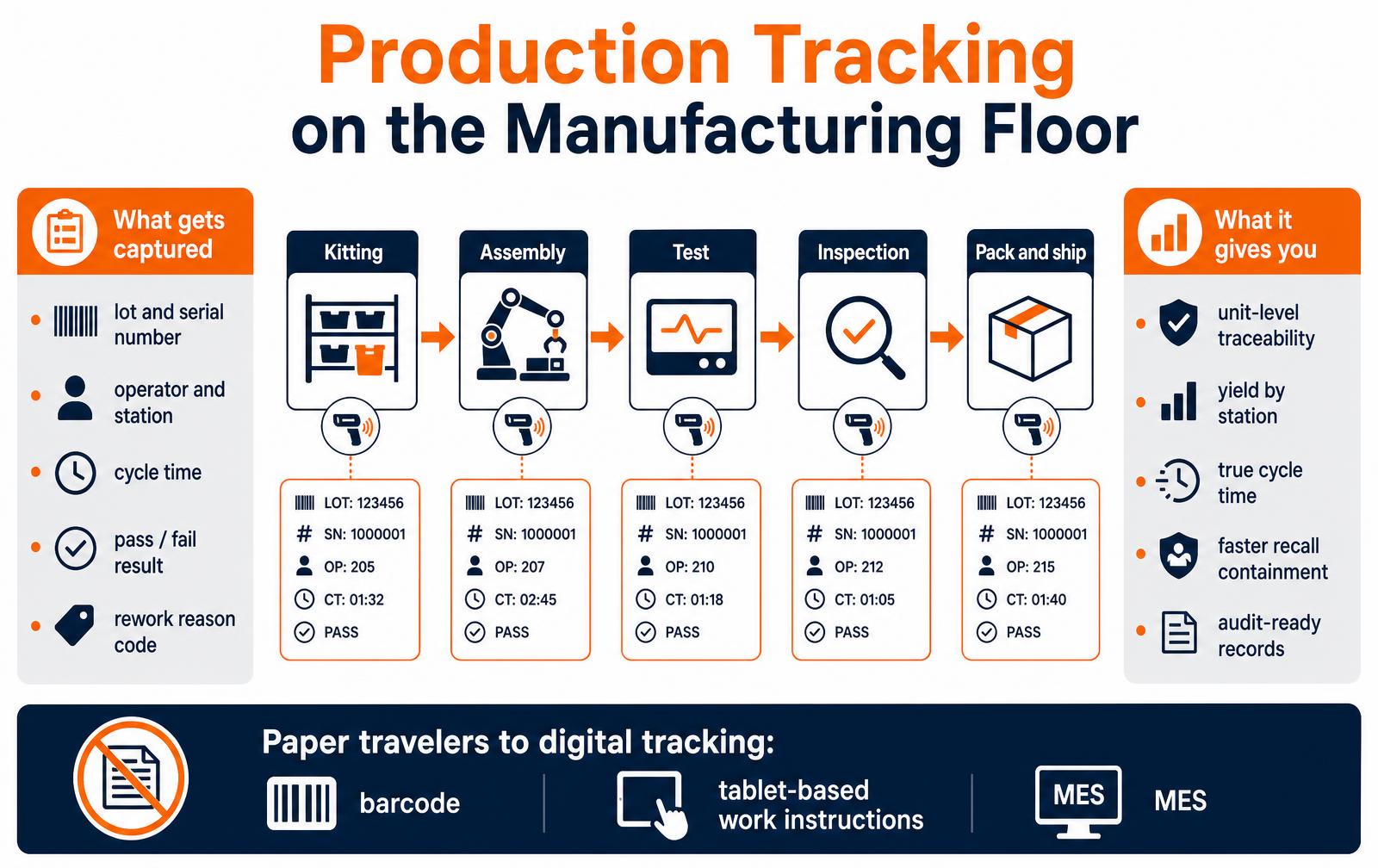
What production tracking actually captures
- Genealogy. Which component lots went into which finished serial number. This is what makes a recall a hundred units instead of a whole year of production.
- Station and operator. Not for blame — for finding the work instruction that is ambiguous or the fixture that is worn.
- Cycle time. Real seconds per station, which is the only honest input to capacity planning and quoting.
- First-pass yield and failure codes. Where units fail and why, ranked, so engineering fixes the top cause rather than the loudest one.
- Rework history. A unit reworked three times is a warranty claim waiting to happen; you can only know that if it was recorded.
Choosing a level of system
Approach | Typical cost | Setup effort | Fits |
|---|---|---|---|
Paper travelers plus spreadsheet | Near zero | Days | Under ~50 units a month, non-regulated |
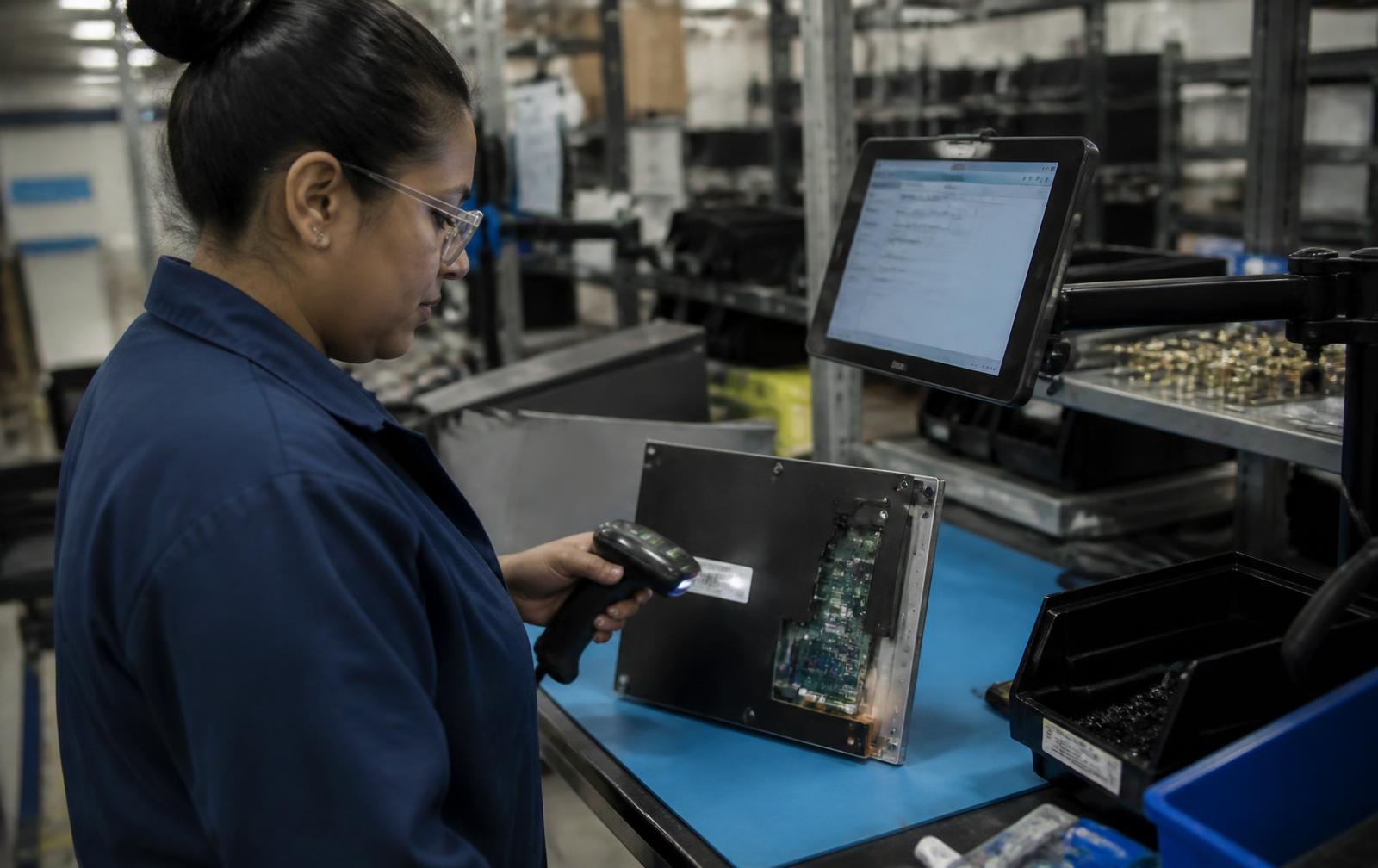
Barcode scanning into a shared database | $2k-$15k | 2-6 weeks | Small lines that need traceability now |
Tablet-based digital work instructions | $10k-$50k | 4-10 weeks | Complex assemblies, frequent revisions |
MES / QMS platform | $50k-$300k+ | 3-9 months | Regulated or multi-line manufacturing |
Machine data (IIoT) layered on top | Varies | Ongoing | Automated cells where equipment sets the pace |
Start one level below what looks impressive. A barcode scan at five stations, feeding one database, beats an unfinished MES rollout every time — and it can be running before the next production lot.
Regulated production raises the bar
For medical devices, records must show that each unit was built to the released device master record, by trained staff, on validated equipment, with unique device identification where required. Electronic records themselves fall under 21 CFR Part 11, meaning audit trails and controlled access, not an editable spreadsheet. Plan tracking as part of medical device manufacturing setup, not as an afterthought once the auditor books a date.
A rollout that actually sticks
- Pick the three questions you cannot answer today, and track only the data that answers them.
- Serialize the finished unit before anything else — genealogy without a serial number is a filing cabinet.
- Make scanning faster than the paper it replaces, or the line will quietly go back to paper.
- Give operators the yield chart. Data they never see becomes data they stop entering carefully.
- Review failure codes weekly with engineering, and retire codes nobody uses.
Traceability levels and what they cost
Level | What is captured | Typical setup cost | Recall exposure |
|---|---|---|---|
Paper travelers | Batch date, operator initials | Near zero | Entire production run |
Barcode at final assembly | Serial number and build date | $3k-$12k | Full build lot |
Station-level scanning | Serial plus per-station pass/fail | $15k-$60k | Single station window |
Full component genealogy | Serial linked to component lot codes | $50k-$200k | Only units with the suspect lot |
Getting off paper travelers
- Serialize at the first station, not at packout, or you cannot tie in-process data to a unit.
- Record pass/fail plus the measured value. Pass/fail alone hides drift before it becomes scrap.
- Track first-pass yield by station weekly. It is the earliest signal a process is going out of control.
- Log component lot codes at kitting, which is where genealogy is cheapest to capture.
- Keep the operator interface to one scan and one button. Anything slower gets bypassed on a busy shift.
What traceability buys you when something goes wrong
Traceability feels like overhead right up to the first field failure. Then it decides whether you recall two hundred units or twenty thousand. If you can tie a failing unit back to a serial number, a build date, a work order and the component lot fitted that day, containment is a narrow, survivable event.
If you cannot, the only defensible action is to recall everything that might contain the suspect lot, and the cost difference between those two outcomes typically dwarfs a decade of tracking effort.
The same records answer questions you will face regularly even without a failure: which units received a firmware revision, whether a warranty claim is inside the covered build window, and whether a supplier's claimed process change actually correlates with a defect rate shift. Each of those is unanswerable from paper travelers filed in a cabinet.
Scope matters. Full component genealogy on every resistor is rarely justified. Trace what is safety-critical, expensive, single-sourced or historically troublesome, and record the rest at lot level. A focused system that people actually use beats a comprehensive one they route around.
Getting a small shop off paper
The failure mode of shop-floor digitization is buying a system before defining the process. Start with the data you would need in a recall, work backwards to the minimum number of scans that capture it, and only then choose tooling. Most small operations need three events recorded: work order opened against a build, serialized unit associated with its key component lots, and final test result attached to the serial. Everything else is refinement.
Keep data entry inside the operator's existing motion. A scan while the part is already in hand costs seconds; a form filled at a shared terminal at the end of a shift produces fiction. If a step cannot be captured without pulling someone away from the bench, either redesign the capture or accept that the record will be unreliable and plan accordingly.
Run paper and digital in parallel for two or three weeks, then stop paper deliberately on a named date. Indefinite parallel running guarantees the digital record stays incomplete, because everyone knows the paper copy is the real one.
- Serialize at the highest level that can fail in the field, not every subassembly by default.
- Capture lot codes for safety-critical, expensive and single-sourced parts only.
- Attach final test data to the serial, so a warranty claim can be checked in seconds.
- Set a hard cutover date from paper, and enforce it.
We build these records into production programs through short-run manufacturing and manufacturing consulting, and design them in early during engineering so serialization is part of the product rather than bolted on.
Using the data instead of just storing it
Collected records only pay off if someone looks at them on a schedule. A weekly review of first-pass yield by station tells you where the process is drifting before it produces scrap. A monthly look at defect Pareto by component lot exposes a supplier problem while you still have leverage.
A quarterly comparison of field returns against build date validates whether the corrective action you implemented actually worked, which is the question most organizations never answer.
Assign one owner for the review and give them authority to stop a build. Data with no decision rights attached becomes an archive, and archives do not prevent recalls.
What it costs to implement
A workable serialization and traceability setup for a small assembly operation is far cheaper than most teams assume.
Barcode or QR labels, two or three scanners, a tablet per station and a modest cloud database land in the low thousands of dollars for hardware, with software either a small monthly subscription or a few weeks of internal build.
The real investment is process design and the discipline to keep it running, which is measured in attention rather than capital.
Full component genealogy with supplier lot integration is a different scale of project, typically requiring a proper MES and months of rollout. Do not start there. Implement the minimum viable record, run it for a quarter, and let the gaps you actually experience justify the next increment. Systems specified in advance of experience are consistently over-built in the areas that do not matter and thin in the ones that do.
One more consideration is auditability. If you sell into medical, aerospace, automotive or industrial channels, a customer or a registrar will eventually ask to see records for a specific unit, and the request usually arrives with a short deadline.
Being able to produce a build history, component lots and test results for a serial number within an hour is the difference between a routine audit finding and a corrective action that stalls shipments.
Design the retrieval path deliberately, and test it once a quarter by pulling a random serial and timing how long the answer takes.
Key takeaways
- Track the three questions you cannot answer today, not everything possible.
- First-pass yield by station and true cycle time justify most implementations alone.
- Retire the paper traveler the day scanning starts, or you get neither system.
- Keep defect reason codes under fifteen and give them an owner.
- Review on a schedule — unread data is overhead, not traceability.
Work with LA NPDT: if you are moving from here to execution, start with our our product development process or talk to us about end-to-end product development.
Frequently asked questions
What is production tracking?
It is the practice of recording what happened to each unit as it moves through manufacturing: component lots consumed, station and operator, cycle time, test results and any rework. The output is unit-level traceability plus yield and throughput data by station.
Do small manufacturers need an MES?
Usually not at first. Barcode scanning into a single database, costing a few thousand dollars and a few weeks, delivers most of the traceability and yield benefit. A full manufacturing execution system makes sense with multiple lines, frequent engineering changes or formal regulatory requirements.
How does production tracking help with recalls?
Because each finished serial number is linked to the component lots inside it, a defective supplier lot can be traced to exactly the units that contain it. Containment then covers those units and their customers rather than every unit built that quarter.
Which metrics to compute once the data exists?
Collecting scans is the easy half. The value shows up when three or four numbers are computed automatically and reviewed on a fixed cadence. Shops that track everything and review nothing end up paying for a system that only helps during audits.
Pick two of these for the first ninety days. First-pass yield by station and true cycle time will usually pay for the whole implementation, because both expose a bottleneck that everyone suspected and nobody could prove.
Where shop-floor rollouts fail?
Scanning added on top of paperwork. If operators do both, they will do the paper and fake the scans. Retire the traveler on the same day the scan goes live.
Data entry that costs more than fifteen seconds per unit. Anything slower gets batched at the end of shift, which destroys cycle-time accuracy. No owner for the reason codes.
A defect list that grows to sixty free-text entries cannot be analysed. Keep it under fifteen, curated by one person. Wi-Fi dead zones at the far stations.
Scanners must buffer offline and sync, or the shift’s data disappears. Reports nobody opens. Put one printed page in the Monday production meeting before building a dashboard.
Filed under:Tech Talk Podcast
Tagged:CarsiOSLatest GadgetsTech NewsTech UpdatesTechnology News
Services related to this guide
- Product design servicesIndustrial design and CAD taken all the way to manufacturable files.
- Rapid prototypingWorking prototypes in days, from 3D printing to vacuum casting.
- Electronic design servicesSchematic, PCB layout, firmware and bring-up, through to production handoff.
- Product development examplesReal projects we designed, prototyped and shipped.