Prototype Companies: How to Choose the Right Partner
Prototype companies fall into fabrication shops, engineering-led prototype developers and full product development partners. Here is how to tell them apart, screen a shortlist and read a quote.
January 8, 20195 min read

Written by Konstantin Dolgan, Ph.D., NPDP
Founder & CEO, Product Development Engineer
Published January 8, 2019Updated September 2, 2026
Prototype companies fall into three groups: fabrication shops that make parts from your files, prototyping bureaus that make parts and advise on process, and product development firms that design the thing and then prototype it. Picking the wrong group is the most common reason a first prototype answers no useful question.
This guide explains what each type of shop does, how to screen a longlist down to two finalists, what a complete quote contains, what prototypes realistically cost, and the warning signs that should end a conversation.
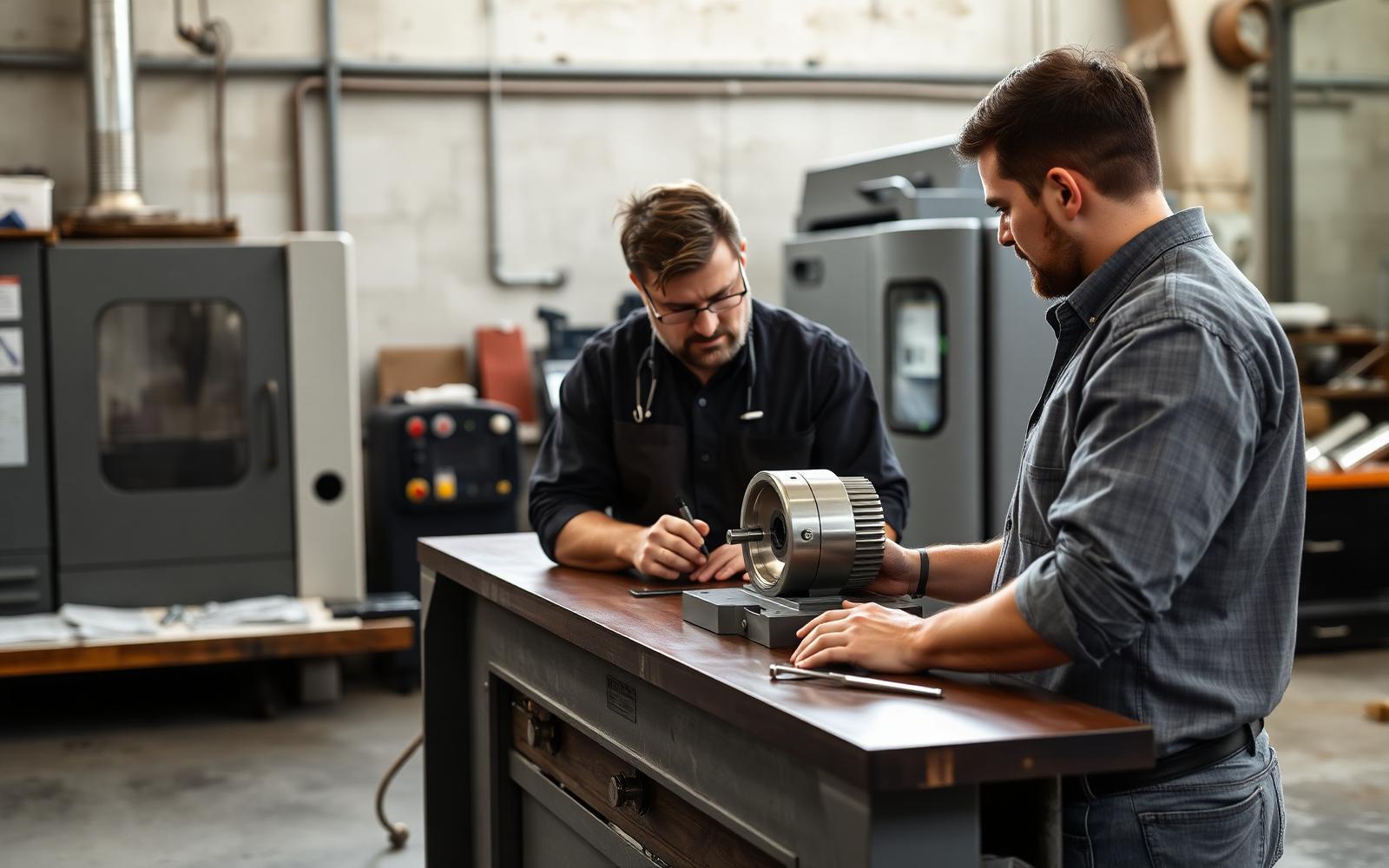
The three kinds of prototype companies
Type | What they deliver | Best when | What they will not do |
|---|---|---|---|
3D printing bureau | Printed parts from your STL or STEP files, often overnight | You need form and fit checks fast and cheaply | Tell you the design is wrong |
CNC and machine shop | Machined metal and plastic parts to drawing tolerances | You need functional, load-bearing or heat-tolerant parts | Produce the drawings for you |
Prototyping bureau | Multiple processes plus finishing, assembly and process advice | You are unsure which process suits the part | Own the engineering outcome |
Electronics prototype house | Board fabrication, assembly, bring-up support | Your product is PCB-driven | Write your firmware |
Product development firm | Requirements, design, engineering, prototypes and production handoff | You have a concept, not a file set | Compete with a printing bureau on part price |
If you already have manufacturing-ready CAD and drawings, buy parts from a shop. If your files are a starting point rather than an answer, a product design and development firm is cheaper overall, because the alternative is paying to build the wrong part several times.
Screen a longlist before you ask for quotes
Send every shop on the longlist the same short questionnaire. The aim is to eliminate mismatches early, not to collect prices.
Screen | What to ask | Disqualifying answer |
|---|---|---|
Process fit | Which process do you recommend for this part and why? | Whatever machine they happen to own |
Materials | Can you deliver the resin, alloy or finish the design assumes? | A substitute proposed without discussing properties |
Tolerances | What tolerance do you hold on features like this? | A number quoted with no measurement method |
DFM feedback | Will you review the files before quoting? | Quote only, no engineering review |
Path to production | What happens when this design moves to tooling? | No answer, or no relationships with production shops |
IP handling | Do you sign an NDA and who owns the files? | Hesitation, or ownership retained by the shop |
A shop that sends back three questions about your drawing before quoting is worth more than one that returns a price in an hour.
What a complete prototype quote contains
- Process and material named exactly, including finish and colour.
- Tolerance and inspection method, so "it fits" is measurable rather than an opinion.
- Quantity breaks, because the second unit is usually far cheaper than the first.
- Lead time from file approval, not from the date you sent the email.
- Revision policy covering what happens when a change is needed mid-build.
- Shipping, duties and post-processing, which frequently exceed the part price on small orders.
What prototypes cost and how long they take
Prototype type | Typical cost | Typical lead time | What it proves |
|---|---|---|---|
Printed appearance model | $150 to $1,500 | 2 to 7 days | Size, proportion, grip and layout |
Machined functional part | $300 to $5,000 | 1 to 3 weeks | Strength, tolerance and real material behaviour |
Electronics prototype (PCB plus assembly) | $1,500 to $15,000 | 2 to 6 weeks | Circuit function, power draw, firmware bring-up |
Working integrated prototype | $10,000 to $75,000 | 6 to 16 weeks | The whole product doing its job for a user |
Bridge or pilot units | $15,000 to $150,000 | 8 to 20 weeks | Repeatability and readiness for tooling |
Cost scales with the question you are asking. Do not buy a working integrated prototype to learn whether the handle is comfortable; that is a printed model and an afternoon of user testing. See our rapid prototyping guide for how to sequence those builds.
Red flags when evaluating prototype companies
- No questions asked. A shop that quotes complex geometry without querying anything has not read the files.
- Refusal to sign an NDA or vague answers about who owns the resulting files.
- Prices far below the field. Usually a different material, a thinner wall or a hidden finishing charge.
- No inspection report offered on tolerance-critical parts.
- No production story. A partner who cannot describe the handoff to tooling leaves you restarting later.
- Portfolio without context. Renders and photographs that no one will explain in a call.
Run a paid pilot before you commit
Give the two finalists the same small real job: one representative part, the same files, the same deadline. Compare the DFM comments, the communication, the inspection data and whether the delivered part matches the quote. That single test predicts the relationship better than any reference call.
Questions to ask on the first call
- Which of your recent projects most resembles mine, and what went wrong on it?
- Who will actually do the work — in-house staff or a subcontractor you manage?
- What do you need from me to quote accurately, and what will you assume if it is missing?
- How do you handle a part that fails inspection: rework, recut, or credit?
- What is your standard tolerance, and what triggers an upcharge?
- Who owns the CAD, the drawings and any design improvements you contribute?
- How do you handle confidentiality before an NDA is signed?
- What does a typical change request cost in time and money mid-build?
Comparing quotes on the same basis
Comparison line | What to normalize | Red flag |
|---|---|---|
Scope | Parts only versus parts plus assembly | Assembly assumed but not priced |
Material | Exact grade and finish | 'Or equivalent' with no grade named |
Tolerance | Stated default plus critical callouts | No tolerance statement at all |
Iterations included | Number of revisions before recharge | Unlimited revisions promised verbally |
Inspection | Dimensional report included or extra | No inspection deliverable |
Lead time | Business days from PO or from file approval | Clock starts at an undefined moment |
Payment terms | Deposit, milestone, delivery | Full payment before any deliverable |
Key takeaways
- Interview for judgment and communication, not just machine list and price.
- Normalize quotes onto one scope before comparing numbers.
- Settle IP ownership and confidentiality in writing before files leave your machine.
- Run a small paid pilot before committing a full program to any shop.
Files, tolerances and what to send with an RFQ
The quality of a prototype quote is set by the package you send, not by the shop's goodwill. Incomplete packages produce padded prices because the shop is pricing unknowns, and they produce parts that are technically correct and functionally useless because nobody stated which dimensions mattered.
Item to send | Why the shop needs it | What happens without it |
|---|---|---|
STEP or Parasolid geometry | Machine-readable geometry for CAM and printing | Mesh files force manual rebuild and added cost |
2D drawing with critical dimensions | Tells the shop where tolerance matters | Everything held loose, or everything priced tight |
Material and finish called out by grade | Cost and lead time depend on the exact grade | Substitution you find out about at delivery |
Quantity and intended use | Drives process choice | A one-off priced as production, or vice versa |
Inspection expectation | Defines what "good" means | No measurement data, disputes on arrival |
Deadline and shipping method | Slots the job realistically | Quoted lead times that slip quietly |
Tolerance discipline is where money is made or lost. As a rule of thumb, machined parts hold ±0.005 in comfortably and ±0.001 in at a premium; SLS and MJF nylon hold roughly ±0.3 percent of nominal; FDM should be treated as ±0.5 mm unless the shop proves otherwise. Call tight tolerances only on mating and sealing features, and let everything else run at standard.
Working with a prototype shop through the iterations
The first parts are rarely the last. What distinguishes a good relationship from a transactional one is how the second and third rounds go: whether the shop remembers your setup, keeps the fixture, and tells you when a design change will move the price.
- Batch design changes into deliberate rounds instead of drip-feeding revisions; each restart costs setup time you pay for.
- Ask for the DFM notes in writing, and apply them to the CAD rather than to the individual order.
- Keep revision control strict. Name files with revision and date, and confirm the revision the shop is running before every build.
- Request measurement data on critical dimensions from round two onward; it turns "it does not fit" into a specific number.
- Pay promptly on small jobs. Prototype shops slot fast for reliable customers, and queue position is often worth more than a discount.
Expect three to five rounds on a typical hardware program: proof of concept, one or two functional iterations, an appearance-accurate build and a production-intent pilot. Related reading: rapid prototyping services and what prototypes cost.
About the Tech to Market event series
Not sure which prototype you actually need?
Tell us what you are trying to prove and we will scope the smallest build that answers it.
Work with LA NPDT: if you are moving from here to execution, start with our product discovery for inventors or talk to us about prior art search.
Frequently asked questions
What do prototype companies do?
Prototype companies turn a design into physical parts or working units so a team can test form, fit and function before investing in tooling. Some only fabricate from supplied files, while product development firms also create the design, engineering and drawings the prototype is built from.
How much does it cost to have a prototype made?
A printed appearance model typically runs $150 to $1,500, a machined functional part $300 to $5,000, and a working integrated prototype $10,000 to $75,000. The price is set by the question the prototype answers, not by its size.
Should I hire a machine shop or a product development firm?
Hire a shop when you already have manufacturing-ready CAD, drawings and tolerances. Hire a development firm when the design still has open questions, because a shop will build exactly what your files describe, including the mistakes.
How do I protect my idea when contacting prototype companies?
Use a mutual NDA before sharing files, confirm in writing that you own the deliverables and the CAD, and consider filing a provisional patent application before wide disclosure. Any credible shop signs an NDA without argument.
How long does a prototype take?
Printed parts arrive in two to seven days, machined parts in one to three weeks, and electronics prototypes in two to six weeks. A fully integrated working prototype usually takes six to sixteen weeks because it depends on several suppliers finishing in sequence.
Filed under:News
Services related to this guide
- Product design servicesIndustrial design and CAD taken all the way to manufacturable files.
- Rapid prototypingWorking prototypes in days, from 3D printing to vacuum casting.
- Electronic design servicesSchematic, PCB layout, firmware and bring-up, through to production handoff.
- Product development examplesReal projects we designed, prototyped and shipped.