Inventions That Changed the Way We Celebrate Thanksgiving
Ideas come in all shapes & sizes even at Thanksgiving, here are five inventions and products that were created to solve holiday problems.
November 22, 20189 min read

Written by Konstantin Dolgan, Ph.D., NPDP
Founder & CEO, Product Development Engineer
Published November 22, 2018Updated September 3, 2026
In 1863, President Abraham Lincoln made Thanksgiving a national holiday and in a lot of ways, the traditional Thanksgiving celebration has remained the same since the very popular “first” Thanksgiving meal between American Indians and pilgrims a few centuries ago.
A few processes, tools and meals have remained stalwart on the list of Thanksgiving products, like cranberries and turkeys. Even the sweet potato casserole (marshmallow-topped) is more than 100 years old.
But, while a lot of things have remained the same, a lot of other things have changed (some quite drastically). Since the first Thanksgiving — and even in the last 50 years alone. Thanksgiving products and inventions come in all shapes and sizes and work to solve a myriad of problems and this has led to food trends shifting, and meal prep processes evolving completely!
Below, we’ll cover five Thanksgiving products that were created to solve holiday problems that you never knew existed.
Automatic Mashed Potato System
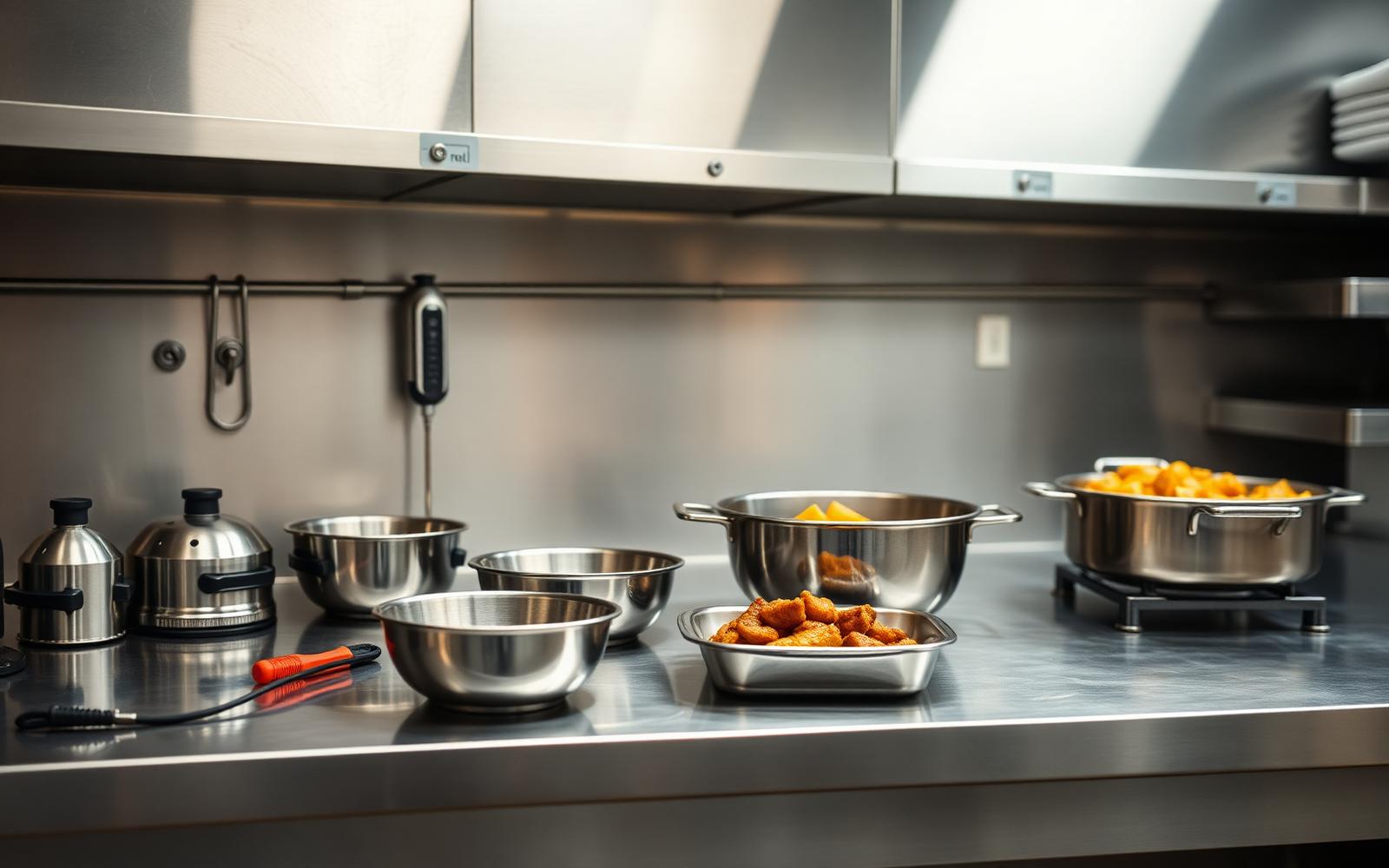
This invention is quite recent as it was only created in 2007. In an effort to solve the problem of the inconsistent and time-consuming process that was the conventional potato-mashing process.
This machine takes away most of the stress associated with making mashed potatoes as all you have to do is feed the machines the potatoes through a unit in the upper cavity of the machine and it’ll handle the rest.
The Automatic Mashed Potato System would then pass the potatoes to a removable collection tray through a seasoning unit where you can easily collect your seasoned mashed potatoes. Voila! Your mashed potatoes to be served!
Pie Filling Device
Though this device may not sound earth shattering, this 1986 Thanksgiving invention is actually quite useful. This pie Filling Device was created to fill pie shells within a hot oven with a fluid filling using a pumping apparatus. This Device was invented because filling pie shells while they were still cooking was a tedious task no one looked forward to.
Pumpkin Powder
I know that pumpkin powder does not very exciting or appetizing but it was invented in 1897. In order to alleviate the stress associated with making pies. The pumpkin powder was created by mashing the edible part of a pumpkin, sweet potato or squash into meal or powder form. This way the powder created could then be combined with milk or water to make pies.
Frozen stuffed Fowl
Not everyone wants to, or has the time to stuff their own turkeys and in 1960, an invention was created to improve the tools and process used for the preparation of frozen stuffed fowl. This way, Thanksgiving cooks could take their turkeys directly from the freezer. Placing the turkeys in the oven – no need to thaw, stuff, sew or truss anymore.
Pop-Up Timers
Today, it is generally recommended turkeys be cooked until they reach an internal temperature of 165 degrees Fahrenheit. This wasn’t always the case. In the 1960s, recipes called for a very slow and very low roasting like 325 for 9 HOURS until the turkey registers 190 degrees Fahrenheit.
But this led to Turkeys constantly being over cooked so Pop-up timers we invented and introduced in the 1960s to be placed in turkeys so as to try to combat the overcooking problem.
When we think about Thanksgiving, the first thing that comes to mind is food and now that we’ve seen five inventions that have changed the way we cook and eat during Thanksgiving, have you discovered a new-found respect for your Thanksgiving tools?
Happy Thanksgiving to you and your family from all of us at LA New Product Development Team!
Key Thanksgiving Inventions and Their Purposes
Invention | Year Introduced | Purpose Solved |
|---|---|---|
Automatic Mashed Potato System | 2007 | Inconsistent, time-consuming mashed potato preparation |
Pie Filling Device | 1986 | Tedious task of filling hot pie shells |
Pumpkin Powder | 1897 | Stress associated with making pies |
Frozen Stuffed Fowl | 1960 | Time-consuming turkey stuffing and preparation |
Pop-Up Timers | 1960s | Overcooking of turkeys |
What these Thanksgiving inventions have in common
Read the five patents together and a pattern appears that has nothing to do with turkey. Every one of them removes a specific, repeated, unpleasant step from a task people already perform: peeling and mashing, filling a shell without spilling, cooking down a pumpkin, stuffing a bird, guessing when the meat is done. None of them invented a new occasion. They subtracted labor from an old one.
- They target a chore, not a category. The insight is always a verb — mash, fill, stuff, check — that someone repeats under time pressure.
- They fit the existing ritual. A pop-up timer works because it needs no new appliance, no wiring and no instructions.
- They win once a year, at scale. Seasonal demand is small per household and enormous in aggregate, which is exactly the economics of a low-cost molded part.
- They survive on simplicity. The pop-up timer is a plastic body, a spring, a plunger and a plug of alloy that melts near 85 °C. Four parts, no electronics, no failure modes anyone notices.
The pop-up timer, as an engineering exercise
The pop-up timer is the best teaching example in the group. Its whole function is a eutectic alloy plug that stays solid until the meat around it reaches the target temperature, then melts and releases a spring-loaded stem.
The engineering content is in the tolerances: alloy melting point, spring force, friction in the bore, and the depth at which the cook inserts it. Get any of those wrong and it pops early or never — which is why the device is a doneness hint rather than a substitute for a probe thermometer.
Design parameter | Why it matters | Consequence if wrong |
|---|---|---|
Alloy melting point | Sets the indicated temperature | Pops early — undercooked bird — or late and dry |
Spring force vs. bore friction | Must overcome drag from cooked-on juices | Stem sticks and never rises |
Insertion depth and location | Reads the slowest-heating muscle | Breast reads done while the thigh is not |
Material food safety | Hours at 175 °C in contact with food | Warping, odor, or migration failures |
What seasonal product ideas teach inventors
Seasonal products are a good school for first-time inventors because they force honesty about volume, cost and shelf placement. A product that sells for six weeks needs a landed cost low enough for a retailer to gamble on, packaging that survives a warehouse for eleven months, and a manufacturing lead time that lets you commit inventory the previous spring. Those constraints are the whole business, and they exist long before the design is pretty.
- Work backwards from a retail price and a retailer margin to a target factory cost, then design to it.
- Plan tooling and a production run to land inventory roughly four months ahead of the season.
- Prototype with the real cooking, freezing or dishwasher cycle — kitchen products fail on thermal and cleaning abuse, not on use.
- File a provisional application before you show the concept at a trade show or on social media.
- Assume one season of feedback before the design is right; budget for a second tool revision.
If you have a kitchen gadget or a seasonal product idea, the path from sketch to shelf is the same one we run for medical and industrial clients: discovery, design, prototype, and manufacturing support. Read our guide on when to file a patent application before you show it to anyone.
Frequently asked questions
What is the Automatic Mashed Potato System?
The Automatic Mashed Potato System is an invention from 2007 designed to simplify mashed potato preparation. This machine handles the mashing process, requiring users to feed potatoes into its upper cavity. It then passes the potatoes through a seasoning unit to a removable collection tray, providing seasoned mashed potatoes ready for serving.
When was the Pie Filling Device invented and what does it do?
The Pie Filling Device was invented in 1986. This device uses a pumping apparatus to fill pie shells with fluid filling while they are still in a hot oven. It was created to solve the problem of filling cooking pie shells, which was considered a tedious task.
How did Pumpkin Powder change pie making?
Pumpkin Powder, invented in 1897, aimed to reduce the effort involved in making pies. It is created by mashing the edible parts of pumpkins, sweet potatoes, or squash into a meal or powder form. This powder can then be combined with milk or water to prepare pies, simplifying the traditional process.
What problem did Frozen Stuffed Fowl solve for Thanksgiving cooks?
Frozen Stuffed Fowl, an invention from 1960, provided a solution for cooks who lacked time or desire to stuff turkeys themselves. This invention improved the preparation of frozen stuffed fowl, allowing cooks to take turkeys directly from the freezer and place them into the oven without needing to thaw, stuff, sew, or truss them.
Why were Pop-Up Timers invented for turkeys?
Pop-up timers were invented in the 1960s to address the problem of overcooked turkeys. Earlier recipes recommended very slow and low roasting for extended periods, often resulting in turkeys reaching temperatures like 190 degrees Fahrenheit. These timers were introduced to help combat overcooking by indicating when the turkey reached a safe internal temperature.
What seasonal inventions reveal about product timing
Thanksgiving inventions are a useful case study in seasonal product economics. A product that sells in a six-week window has a completely different cash cycle from a year-round product, and that timing — not the idea — is usually what determines whether a seasonal product succeeds commercially.
Seasonal product calendar
Month before season | Activity | Cash impact |
|---|---|---|
12 | Concept and validation | Low spend |
9 | Tooling commitment | Largest outflow |
6 | Retail buyer meetings | Determines volume |
4 | Production run | Full inventory outflow |
3 | Freight and warehousing | Ongoing carrying cost |
1-0 | Sell-through window | Only revenue period |
+1 | Returns and markdowns | Margin erosion |
The gap between tooling spend and revenue can approach a year for a seasonal product. Inventory left after the window is worth a fraction of its cost until the following year, so conservative first-run quantities matter far more here than in year-round categories.
Seasonal product checklist
- Work backwards from retail buyer calendars, not from launch dates.
- Size the first run to sell out, not to meet demand.
- Budget carrying cost for unsold inventory for a full year.
- Plan a secondary channel for post-season clearance.
- Confirm packaging and dating do not lock inventory to one year.
Key takeaways
- Seasonal products live or die on calendar timing and cash cycle.
- Size the first run to sell out; leftovers carry for a year.
- Plan a clearance channel before the season starts.
The seasonal product calendar that decides whether the idea works
Every invention on this list shares one brutal constraint: it sells during a six-week window. Miss the window and the inventory sits for eleven months, absorbing warehouse cost and financing. That constraint dictates the schedule backwards from the shelf date, and the schedule is far earlier than most first-time inventors expect. Retail buyers for holiday categories review lines in the first quarter of the year for the following November.
Milestone | When it must happen | Why that date |
|---|---|---|
Concept and cost target set | January-February | Buyer meetings need a price and a package concept |
Retail buyer presentations | February-April | Holiday planograms are locked well before summer |
Tooling kickoff | April-May | Injection tooling and validation runs take 10-16 weeks |
First article and packaging approval | June-July | Leaves room for one correction cycle |
Production run | July-August | Ocean freight adds 4-6 weeks in transit |
Inventory at distribution center | September-early October | Retailers require goods in DC before the season sets |
Sell-through window | November-December | The entire year's revenue lands here |
Costing a holiday kitchen gadget
Seasonal products live or die on landed cost, because the retail price is anchored by what shoppers expect to pay for a holiday impulse item. Work backwards: pick the shelf price, subtract the retailer's margin, subtract your own, subtract freight and duty, and what remains is the factory cost you must design to. For a gadget with a $19.99 shelf price, that ceiling is usually between three and four dollars.
Cost element | Share of a $19.99 shelf price | Typical value | Where it goes wrong |
|---|---|---|---|
Retailer margin | 40-50% | $8.00-$10.00 | Assuming a lower margin than the category standard |
Distributor or broker | 0-10% | $0-$2.00 | Skipped in the model, discovered at contract |
Freight, duty and warehousing | 5-10% | $1.00-$2.00 | Ocean rate volatility and holiday peak surcharges |
Packaging | 5-8% | $1.00-$1.60 | Retail-ready packaging costs more than the gadget sometimes |
Factory cost of goods | 15-20% | $3.00-$4.00 | Design not costed to target; overbuilt mechanism |
Your gross margin | 10-20% | $2.00-$4.00 | Eaten entirely by one air freight rescue shipment |
Testing a food-contact product before it ships
A kitchen gadget touches food, heat and a dishwasher, which puts it in a stricter compliance category than a comparable desk accessory. Skipping these checks is the most common reason a seasonal product is pulled after its first season, and a recall in November destroys a year of work.
- Food-contact material compliance - resins and colorants must carry FDA food-contact status; ask the supplier for documentation, not a verbal assurance.
- Thermal exposure - validate the material at oven, microwave or dishwasher temperature, whichever the packaging claims, including repeated cycles rather than one pass.
- Cleanability - run 50 dishwasher cycles and check for crazing, warp, colorant migration and trapped residue in undercuts.
- Mechanical safety - no pinch points, no sharp edges after wear, and secure retention of any spring or small part that could separate.
- Labeling and claims - every claim on the package - BPA free, dishwasher safe, oven safe to a stated temperature - needs test data behind it.
- Drop and abuse testing - a filled unit dropped from counter height onto tile, because that is the first real-world test every kitchen product faces.
The five inventions in this article all survived because they solved a repeated, timed chore and were cheap enough to buy without thinking. That is the standard any seasonal product idea has to meet. If you have one, the path from sketch to shelf is the same one we run for medical and industrial clients: discovery, engineering, prototyping and manufacturing hand-off.
Developing a seasonal consumer product?
Filed under:EducationInspirationNews
Services related to this guide
- Product design servicesIndustrial design and CAD taken all the way to manufacturable files.
- Rapid prototypingWorking prototypes in days, from 3D printing to vacuum casting.
- Electronic design servicesSchematic, PCB layout, firmware and bring-up, through to production handoff.
- Product development examplesReal projects we designed, prototyped and shipped.