The Impact of Technology Product Concepts on Modern Trends
What is design in technology or what product concepts are leading technology advancement? Check out this article for answers and tech trends.
May 25, 20238 min read

Written by Ashok Chintagunta, MS Computer Science, Louisiana Tech University
CTO & Software Engineer, AI and Automation
Published May 25, 2023Updated September 2, 2026
On April 20, SpaceX launched the world’s most powerful rocket. The news of the rocket taking off from its launch site is one of the most recent peaks of technological advancement. For instance, it shows the growing implementation of technology product concepts.
We have seen several others in recent times like ChatGPT, NFT, Metaverse, etc. These technologies are part of many other ones that may not have made the news as such. Importantly, they are pointers to other similar product concept breakthroughs.
In this article, we shall be considering some of those product concepts. Undoubtedly, technologies like Web 3, AI, IoT, Robotics, Blockchain, and a lot more are shaping how products are being made. Therefore, this article examines trends in technology product concepts.
Trend 1: Smarter Technology Product Concepts
One of the most modern trends in product concepts is making items smart. For example, consider a wristwatch that can be used as a substitute for a mobile phone, perform medical checks, and serve as a personal assistant. The same goes for buildings, tables, and fashion, even clothes.
This GPS-tracking bracelet shows a glimpse of how smart concept designing has become. IT (Information Technology) is using these smart products to collect data efficiently. From counting steps to monitoring data usage, blood pressure, etc., every product is fast becoming a data collection device.
In no time, every appliance and device will be computerized. Furthermore, this implementation of everything becoming computerized is important to IoT (Internet of Things). This technology product concepts seek to connect every appliance.
Behind these smart technologies is sophisticated computing power. This power keeps expanding i.e., the speed of internet connection keeps increasing. Also, the rate at which devices share and receive data is faster.
Trend 2: AI and ML Concept Design Engineering
Closely related to smart techs and constantly increasing computing power is data modification. By studying humans’ patterns of doing things, concept design engineering can replicate them. Hence, industrial, house, or office chores can be carried out by data-driven technologies.
Students may ask the question, what is design in engineering? Then, a correct answer is creating a product using data-driven ideas. The data-driven technology presently taking the world by storm is AI.
The AI (Artificial Intelligence) design concept replicates human decision-making capability. Also, the design concept factors in all the possible reasons or influence cognitive activities. AI is not only used as a product but a tool to identify the right product.
For instance, production companies can use AI to determine the pattern of their customer’s behavior by analyzing their data in real time. This aspect of AI is called ML (Machine Learning). Similar to these technology design engineering is robotics.
Robotics aims to create products that have similar features to humans or other animals. By doing so, the product – robot – can perform duties cognitively. Find out more here about how this technology concept is influencing fashion.
Trend 3: AR, VR, & XR Concept Design Engineering
Web 3 is another mainstream concept design engineering idea. Its improvement to the previous forms of technology product concept is the introduction of 3D reality. Although man can see in 3D and create 3D products, digital reality has been in 2D for a long time.
This concept is improving digital reality to also accommodate 3D experiences. A good example is being able to check around a building before it is built. Usually, consumers can only see a simulation on their phone or computer screen.
Now, you can swim, ride a bicycle, play games, and develop products that require full engagement without leaving your room. Hence, this concept is creating reality without any tangible presence. Some of the leading Web 3 trends are AR (Augmented Reality), VR (Virtual Reality), and XR (Extended Reality).
Trend 4: 3D Printing of Technology Product Concept
In time past, prototypes are usually made with the same material as the final product. If there are corrections to be made, the product will be recreated. Also, they have to mold every part one after the other, which usually takes a long time.
Using the 3D orienting technology product concept, manufacturers can create a prototype at once and in a short time. In addition, they get to pick cheaper materials for the prototype. Then, they can use the more expensive and usually more durable material for production.
The 3D product concept is an all-round improvement to the production process. For instance, many of the materials used can be recycled.
Trend 5: Safety Technology Product Concepts
Technology products concepts are getting safer by the day. With impeccable data protection programs, you can protect your product from being accessed by anyone. Cyber security technology product concept is dominating most of the traditional means of protection.
Products with biometric fingerprint locks are considered safer. Also, those with optic or face scanners have a higher rate of keeping unauthorized users out. Another form of safety is online storage.
By using cloud technology product concepts, devices can access and upload data for future use online. Cloud storage a fast replacing the traditional disks and drives used to store data. In addition, there is the safety of the transaction.
Blockchain has improved significantly the banking system, especially how money is stored. Likewise, it has provided alternative currencies and more mediums of exchange through NFT and cryptocurrencies. Check this article for ways technology can change the world by 2027 and see the ones that have happened already.
FAQs about The Role of Technology Product Concepts in Modern Trends
Below are some of the commonly asked questions about how technology has been influencing product development trends.
1. What are the top product design trends?
Many of the products on the market now are made of transparent material. Many AI designs are retro-inspired. Lastly, product designs are focusing on sustainability.
2. What are the most common emerging types of technology?
There are several disciplines of technology. Some of the most prominent ones at the moment are IT, biotech, nanotech, clean tech, and manufacturing tech.
3. What is product design technology?
Product design technology bridges the gap between product design and design engineering. It uses design thinking and problem-solving to solve users' problems. Product design is creating an idea that solves users' needs using imaging. While the design engineer makes a functional product for end users. With product design technology, the design can easily be transformed into the final product.
Final Words
The technology product concept is reshaping how product designers come up with devices. And the rate of the changes being made is at a much faster pace now than it was before. Hence, we have highlighted some of the main trends.
These trends are available for your business to use and improve its services to customers. Hence, you cannot afford to design products that are not smart. On the business side, you can maximize your production cost with 3D printing technology.
Implement the sleekest technology trend in your business today with LA NPDT. We are a prototyping firm with a cross-functional team that will help transform your business idea into a new-world masterpiece.
Are you interested in making the next best product? Contact us today through our website lanpdt.com or call us at 318-243-5789.
Technology Product Concept Trends
Trend Category | Description | Key Technologies / Examples |
|---|---|---|
Smarter Technology | Products collect data and connect appliances. | IoT, smart watches, computerized devices |
AI and ML Design | Products replicate human decision-making and analyze data. | AI, Machine Learning, Robotics |
AR, VR, & XR Design | Products create immersive 3D digital realities. | Web 3, Augmented Reality, Virtual Reality, Extended Reality |
3D Printing | Rapid and cost-effective prototyping and production. | 3D printing technology |
Safety Technology | Products improve data protection and secure transactions. | Cybersecurity, Biometrics, Cloud storage, Blockchain, NFTs, Cryptocurrencies |
Turning a technology concept into a buildable program
Emerging technology products fail less often on the technology than on the gap between a demo and a manufacturable unit. A concept that works on a bench with a development kit still needs power budgeting, thermal headroom, certification and a supply chain. The useful discipline is to score each concept against readiness before committing tooling money.
Concept readiness scorecard
Dimension | Not ready | Ready to fund |
|---|---|---|
Technical proof | Works on a dev kit under lab conditions | Works in a form-factor prototype at target power |
Cost | BOM estimated from single-unit pricing | BOM quoted at production volume with alternates |
Compliance | Unknown certification path | Standards identified, pre-scan budgeted |
Supply | Key part is single-source or unreleased | Two sources or a qualified alternate exists |
User evidence | Internal enthusiasm | Paid pilots or letters of intent |
Serviceability | Not considered | Field update and repair path defined |
Any concept scoring 'not ready' on two or more dimensions belongs in a funded de-risking sprint, not a product plan. Those sprints are cheap relative to a tooling commitment and they usually resolve in six to ten weeks.
De-risking sprint checklist
- Build the riskiest subsystem at target form factor, not on a breadboard.
- Measure real power draw and thermals in the enclosure you plan to ship.
- Run a pre-compliance scan before layout freeze if there is a radio.
- Get quotes at your actual first-run volume, not distributor pricing.
- Put a working unit in front of five real users and record what they do.
Key takeaways
- Score concepts on readiness across cost, compliance and supply, not just function.
- Two or more weak dimensions means a de-risking sprint, not a program launch.
- Form-factor prototypes reveal the power and thermal problems dev kits hide.
Separating the technology from the product concept
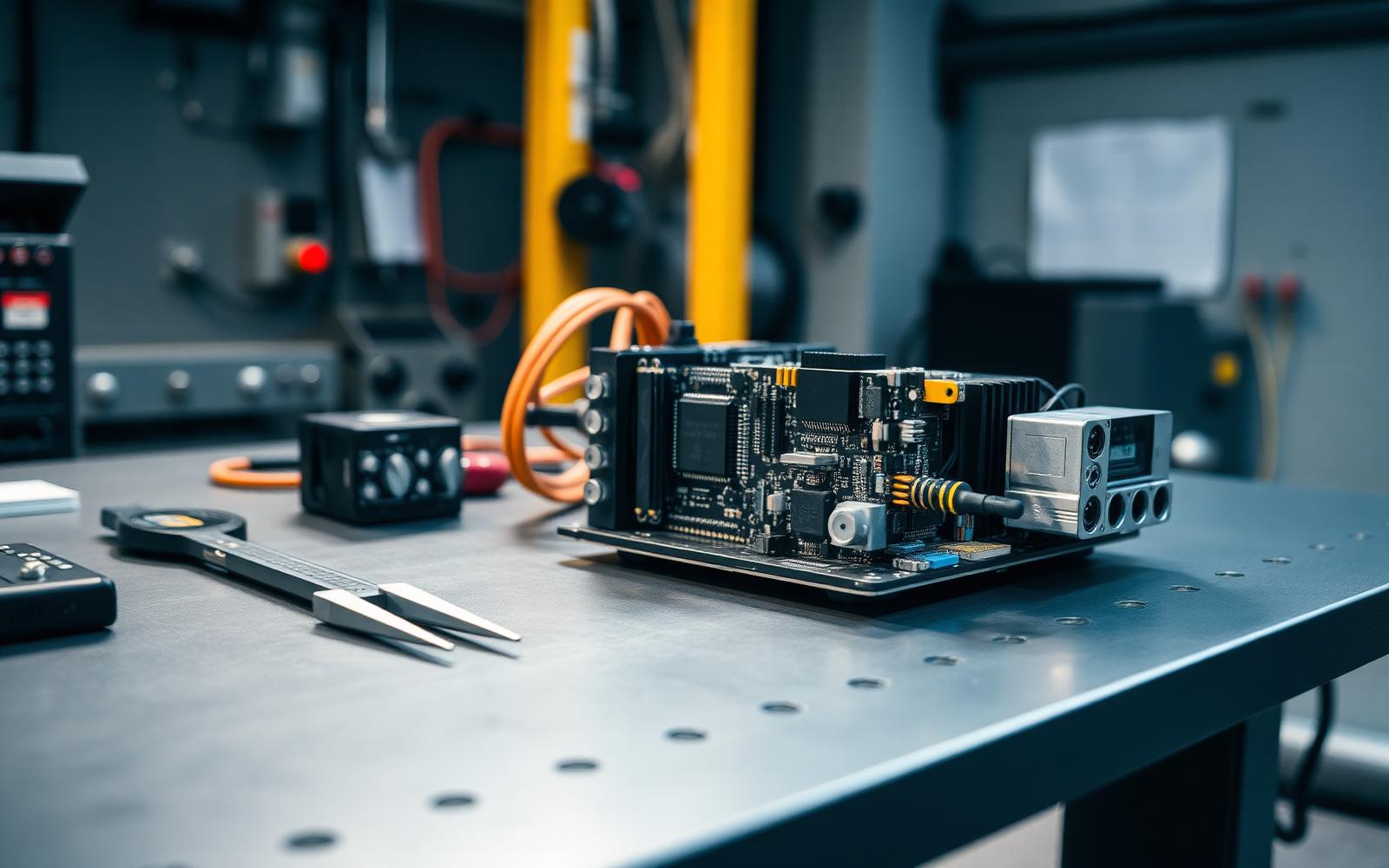
Emerging technology products stall for a predictable reason: the team is in love with a capability rather than a job. A new sensing method, a battery chemistry, or a model running on-device is an ingredient. The product concept is the claim you make to a buyer about a result they can verify. When those two are confused, the roadmap turns into a technology showcase and the buyer cannot tell what problem is being solved.
A useful discipline is to write the concept as a single sentence containing the user, the job, the measurable improvement, and the constraint: field technicians can verify pipe wall thickness in under two minutes without removing insulation. If the technology changes but that sentence survives, you have a product. If the sentence changes every time the technology changes, you have a lab project.
Concept test | Weak signal | Strong signal |
|---|---|---|
Job clarity | Enables new possibilities | One named task, timed today, timed after |
Buyer | Everyone with a home | A role with budget authority |
Proof | Demo under ideal conditions | Bench data across the stated envelope |
Switching cost | Ignored | Quantified: training, integration, downtime |
Unit economics | BOM only | BOM plus support, returns, and calibration |
De-risking sequence for a novel technology
Build in the order of what would kill the program. If the physics is uncertain, the first build is a bench rig that proves the measurement across the full operating envelope — temperature, vibration, contamination — and nothing else.
If the physics is known and the risk is integration, build the interfaces and let the core function be simulated. If both are known, the remaining risk is usually commercial, and the right next build is whatever a paying pilot customer must hold in their hands.
Teams that skip this sequencing tend to produce a beautiful enclosure around an unproven core, then spend the next two funding rounds discovering that the sensor drifts at 45 °C. Ugly-but-instrumented always beats polished-but-unmeasured at the early stage.
- State the concept as user, job, measurable result, and constraint in one sentence
- Build against the biggest kill risk first, not the most visible component
- Test across the full stated operating envelope, not at room temperature
- Quantify switching cost for the buyer before pricing the product
- Include support, calibration, and returns in unit economics from the first model
Have an emerging technology concept you want to de-risk?
Filed under:EducationInspirationWords
Services related to this guide
- Product design servicesIndustrial design and CAD taken all the way to manufacturable files.
- Best industrial design firmsWhich studios take an idea from form to manufacturable hardware, and what they charge.
- Prototype designLooks-like, works-like or pre-production: what each proves and what it costs.
- Product development examplesReal projects we designed, prototyped and shipped.