NPD Stage Gate Process: A 7-Step Strategy That Works
The seven stages of the NPD stage gate process, what has to be true at each gate, and the mistakes that let weak projects survive review.
August 3, 20237 min read

Written by Konstantin Dolgan, Ph.D., NPDP
Founder & CEO, Product Development Engineer
Published August 3, 2023Updated September 2, 2026
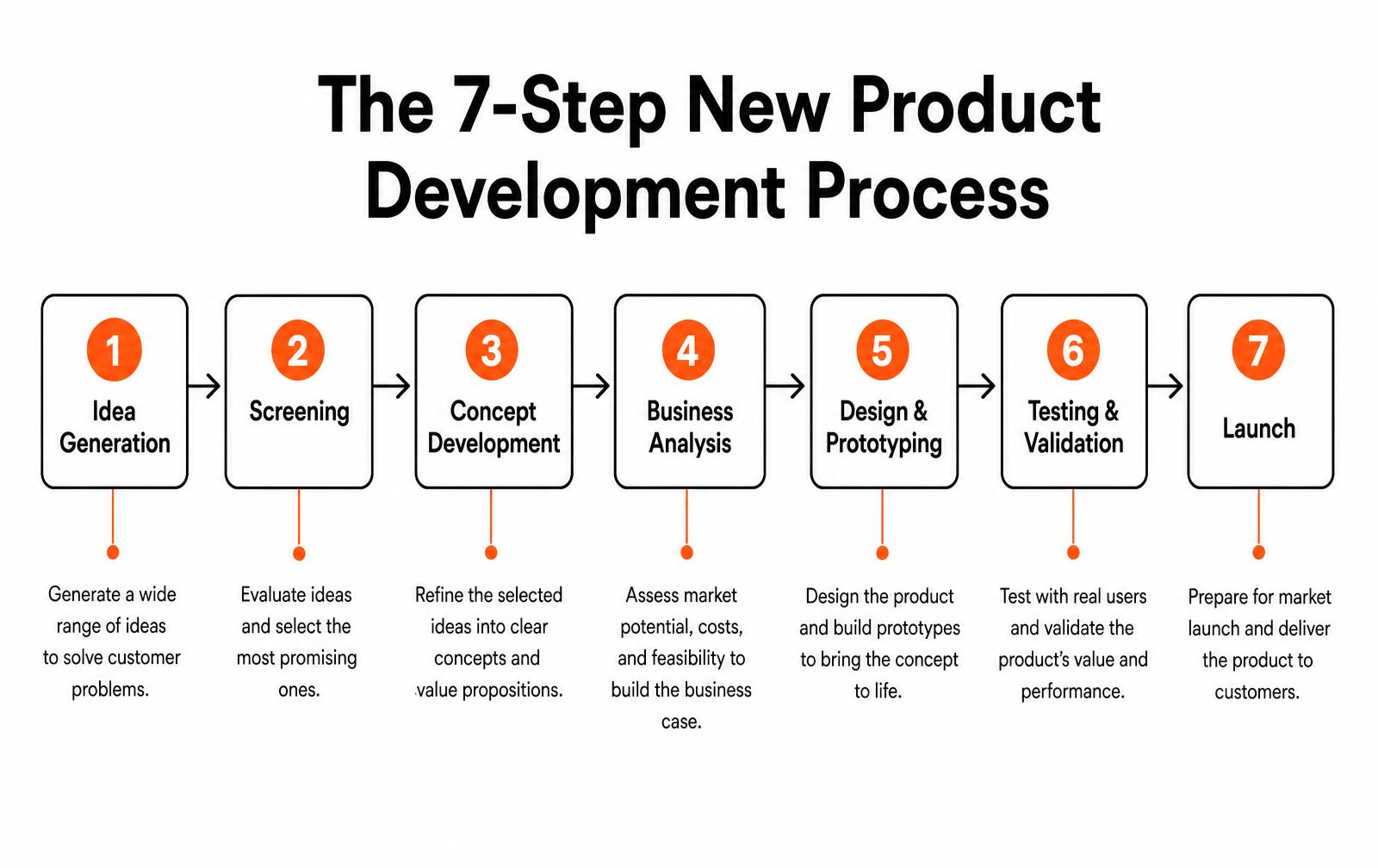
The new product development process is the structured sequence a company follows to take an idea from first sketch to a product customers can buy: idea generation, screening, concept development, business analysis, design and prototyping, testing and validation, and launch. Each stage exists to kill bad ideas cheaply and to earn the right to spend more on the good ones.
Most teams do not fail because they skipped a stage. They fail because they ran a stage without a decision at the end of it. Below is how each step works in a real hardware program, what it typically costs, and the specific mistake that kills it.
The 7 steps at a glance
# | Stage | Question it answers | Typical duration |
|---|---|---|---|
1 | Idea generation | What problems are worth solving? | 2 to 4 weeks |
2 | Idea screening | Which ideas survive a hard filter? | 1 to 2 weeks |
3 | Concept development | What exactly are we building, and for whom? | 3 to 6 weeks |
4 | Business analysis | Does the math work at volume? | 2 to 4 weeks |
5 | Design and prototyping | Can it be built, and does it work? | 8 to 20 weeks |
6 | Testing and validation | Will it pass certification and real use? | 6 to 16 weeks |
7 | Launch | Can we make, ship and support it? | 4 to 12 weeks |
End to end, a straightforward consumer device usually runs nine to eighteen months. Regulated products — medical, automotive, anything with a safety certification — routinely run two to three years because stage 6 expands dramatically.
Step 1: Idea generation
Idea generation is a search for problems, not features. The strongest inputs are customer complaints, warranty and support data, field observation, distributor feedback and adjacent-industry technology that has just become cheap enough to use.
- Run structured sessions with a written problem statement rather than open brainstorming.
- Mine your own support tickets — recurring complaints are pre-validated demand.
- Watch people work. What they improvise around is a product waiting to be built.
- Track patent expirations and component cost curves in your category.
Failure point: generating solutions before anyone can state the problem in one sentence a customer would recognize.
Step 2: Idea screening
Screening kills ideas on purpose. The cheapest failure in the new product development process happens here, so the filter should be uncomfortable. Score each idea against strategic fit, addressable market, technical feasibility, regulatory burden, and your ability to sell it through existing channels.
Screen | Pass condition |
|---|---|
Strategic fit | Uses a capability or channel you already have |
Market size | Enough units at a plausible price to cover development and return a profit |
Feasibility | No unsolved physics or unavailable component |
Regulatory path | Known standards with a known cost and timeline |
Defensibility | Something — IP, tooling, brand, distribution — makes copying slow |
Failure point: passing everything. If nothing is killed at screening, the filter is decorative and the cost will show up in stage 5.
Step 3: Concept development
A concept is a specific description of the product, the user and the value: who buys it, what it replaces, what it costs them, and what it must do to win. This is where product discovery and early industrial design work overlap — sketches, use scenarios, rough form models, and a first requirements list.
Test the concept before you engineer it. Show three to five distinct directions to real buyers and record which one they can explain back to you. Concepts that need explaining do not survive a retail shelf or a product page.
Step 4: Business analysis
Business analysis converts the concept into numbers: bill of materials, landed cost, tooling investment, price point, channel margin, break-even volume and development budget. If the target retail price cannot support a healthy margin at a realistic volume, the program stops here — not after tooling.
Line item | Typical early-stage range |
|---|---|
Concept and industrial design | $8,000 to $35,000 |
Mechanical and electrical engineering | $30,000 to $150,000 |
Prototyping across iterations | $5,000 to $50,000 |
Tooling (per part family) | $3,000 to $150,000 |
Certification and testing | $5,000 to $75,000+ |
Ranges are wide because complexity, regulation and part count drive everything. The useful discipline is building the model early and updating it at every gate rather than treating it as a one-time exercise.
Step 5: Design and prototyping
This is where the concept becomes an engineered product: CAD, electronics, firmware, materials selection, and design for manufacturing. Prototypes should be built to answer specific questions, not to look finished.
- Works-like prototype — proves the mechanism or circuit, ugly and oversized is fine.
- Looks-like model — proves form, size, ergonomics and shelf appeal.
- Integrated prototype — the real architecture in near-final materials.
- Engineering validation build — production-intent parts from production-intent processes.
Our rapid prototyping work usually runs three to five iterations before design freeze. Teams that budget for one iteration always pay for the missing ones later, at a worse exchange rate.
Step 6: Testing and validation
Validation covers three separate questions and they are often confused: does it work (functional), does it comply (regulatory), and do people succeed with it (usability).
Test type | Purpose | When |
|---|---|---|
Functional and environmental | Drop, thermal, vibration, life cycle, ingress | As soon as integrated prototypes exist |
Regulatory and safety | FCC, CE, UL, FDA or category-specific standards | On production-intent hardware |
Usability | Real users completing real tasks unaided | Before design freeze, not after |
Pilot production | Proves the process, not just the product | Before full launch |
Failure point: starting certification after design freeze. A failed EMC test at that stage means a board respin, a schedule slip and often a tooling change.
Step 7: Launch
Launch is an operations problem as much as a marketing one. The product needs packaging, manuals, support content, spare parts, a returns path, channel inventory and a forecast the factory can actually meet. Coordinate the marketing calendar with the first production ship date, not with the design freeze.
- Run a soft launch or limited release to catch field issues while volume is small.
- Instrument early units — warranty and support data from month one is your next roadmap.
- Lock a change-control process; every post-launch change now has an inventory cost.
Stage-gate: what makes the process work
The seven steps only produce results when each one ends in a documented go, kill or recycle decision with named criteria. A gate that always says go is not a gate. The purpose of the new product development process is not to guarantee success — it is to make failure cheap and early instead of expensive and late.
Frequently asked questions
What are the 7 steps of the new product development process?
The seven steps are idea generation, idea screening, concept development and testing, business analysis, design and prototyping, testing and validation, and commercialization or launch. Each stage ends in a go, kill or recycle decision before spending increases.
How long does the new product development process take?
A straightforward consumer product typically takes nine to eighteen months from idea to launch. Regulated products such as medical devices commonly take two to three years because testing, validation and certification expand significantly.
How much does new product development cost?
Most hardware programs land between $50,000 and $500,000 through first production, depending on complexity, part count and regulatory burden. Industrial design typically runs $8,000 to $35,000, engineering $30,000 to $150,000, and tooling $3,000 to $150,000 per part family.
What is the difference between the NPD process and stage-gate?
The NPD process is the sequence of work stages. Stage-gate is the governance layer on top of it: a formal review with defined criteria at the end of each stage where leadership decides to fund the next stage, kill the project, or send it back for rework.
Why do new products fail?
The most common causes are solving a problem customers do not have, unrealistic cost targets discovered after tooling, skipping usability testing, and starting certification too late. Nearly all of these are gate failures rather than engineering failures.
Can steps be run in parallel?
Yes, and mature teams do. Long-lead activities such as regulatory strategy, supplier selection and tooling design start during design so they do not become the critical path. What cannot be parallelized is a gate decision — spending on stage six before stage four's math is settled is how programs overrun.
Writing gate criteria people can actually fail
An NPD stage gate process only works if a gate can reject a project. Most organizations write gate criteria as activities completed rather than evidence produced, which turns every review into a formality. The fix is to define each gate by the specific artifact that must exist and the number it must show.
Gate criteria by stage
Gate | Evidence required | Decision made |
|---|---|---|
After screening | Scored shortlist against agreed criteria | Which concepts get funded to explore |
After concept | Architecture plus cost estimate within target | Commit to detailed design or stop |
After business analysis | Volume, price and margin model with sources | Fund development or shelve |
After design | DFM review closed, prototype results | Commit to tooling spend |
After validation | Verification results against protocols | Approve design transfer |
Before launch | Readiness review passed, inventory in place | Ship or delay |
Give the gate an owner who is not the program manager. Reviewing your own work is not a gate, and the projects that most need stopping are the ones with the most invested advocacy behind them.
Making gates real
- Define each gate by artifacts and numbers, not by activities.
- Give gate authority to someone outside the program team.
- Allow a conditional pass with a dated, owned action list.
- Record every stop decision and the reason; that is organizational learning.
- Keep the number of gates small enough that they are taken seriously.
Key takeaways
- Gates need evidence-based criteria, not activity checklists.
- The gate owner should sit outside the program team.
- Record stop decisions; they are the process's most valuable output.
Stage-gate scorecard: what each gate must produce
A stage-gate process only works when each gate has an owner, a decision, and evidence that can be checked. The scorecard below is the version we use on client programs; the pass thresholds are deliberately concrete so the review is a decision rather than a discussion.
G1 Idea screen | Product lead | Problem statement, market size, rough revenue model | Serviceable market above target, no blocking prior art |
|---|---|---|---|
G2 Concept | Product + engineering | Three directions, requirements list, rough BOM | Landed cost within 40% of target |
G3 Development | Engineering lead | Detailed CAD, schematic, DFM notes | All top-five risks retired with test data |
G4 Validation | Quality | EVT/DVT reports, certification plan | Zero open critical defects |
G5 Launch | Commercial | Pilot build yield, channel readiness | Pilot yield above 95% |
Gate review anti-patterns
Frequently asked questions
- Conditional passes that accumulate: three conditional gates in a row means the program is running unmanaged risk.
- Evidence produced by the team being reviewed with no independent check.
- Cost targets restated as aspirations instead of measured against a quoted BOM.
- Gates scheduled around a launch date rather than around evidence readiness.
What is the stage gate process in new product development? It is a decision framework where each of the seven stages ends in a gate: a formal go/no-go review with named criteria and a named person who signs off. The gate is what turns a checklist into a management tool — work only continues when the evidence justifies the next stage's budget.
How long each stage typically runs
How long does the seven-step process take? A straightforward consumer device typically runs nine to eighteen months from idea to launch. Regulated products — medical, automotive, anything needing safety certification — routinely take two to three years, because testing and validation expands dramatically.
Discovery and concept | 6 – 10 weeks | 8 – 14 weeks | 10 – 20 weeks |
|---|---|---|---|
Detailed development | 12 – 20 weeks | 16 – 30 weeks | 24 – 52 weeks |
Validation and certification | 8 – 16 weeks | 10 – 20 weeks | 20 – 60 weeks |
Pilot and ramp | 6 – 12 weeks | 8 – 16 weeks | 10 – 24 weeks |
Can you skip steps to move faster? You can overlap stages, but skipping gates is how bad products reach expensive stages. The most common fatal shortcut is jumping from concept straight to prototyping before business analysis — you end up engineering a product nobody priced.
The seven-step sequence does not change between those columns — only the evidence bar and the calendar do. Teams get into trouble when they copy a consumer timeline into a regulated program and treat design history documentation as paperwork to be completed after the fact.
Want a development process with gates that actually hold?
Work with LA NPDT: if you are moving from here to execution, start with our our product development process or talk to us about end-to-end product development.
Filed under:EducationInspirationWords
Services related to this guide
- Product design servicesIndustrial design and CAD taken all the way to manufacturable files.
- Rapid prototypingWorking prototypes in days, from 3D printing to vacuum casting.
- Electronic design servicesSchematic, PCB layout, firmware and bring-up, through to production handoff.
- Product development examplesReal projects we designed, prototyped and shipped.