Hardware Startups: Why Physical Products Are Different and How to Survive It
Hardware startups do not fail for the same reasons software startups do. Here is what actually kills them, and the sequence that keeps a physical product fundable.
September 2, 20226 min read

Written by Konstantin Dolgan, Ph.D., NPDP
Founder & CEO, Product Development Engineer
Published September 2, 2022Updated September 2, 2026
Software will keep eating the world, but it still needs something to run on, sense with and act through — which is why hardware startups are not going away, and why they keep being harder than their founders expect. The difference is not difficulty of engineering. It is that in hardware, decisions become expensive and then irreversible, capital is consumed before revenue, and a bug is a recall rather than a patch.
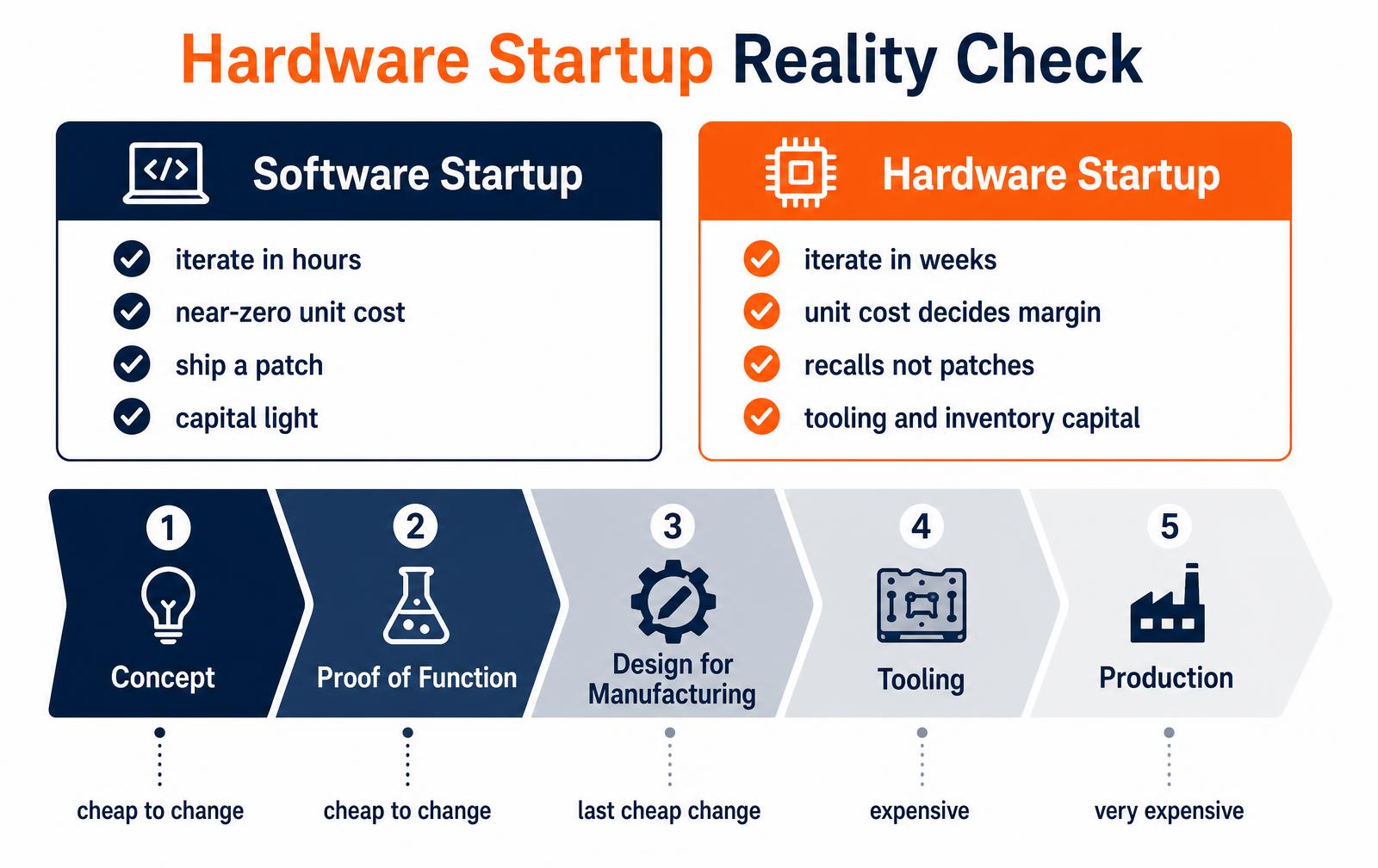
Four constraints that define hardware
- Unit cost is the business model. A software feature costs nothing to serve to the next customer. A physical product costs the bill of materials, assembly, freight, duty and returns every single time. If landed cost is more than roughly a quarter to a third of retail, a retail channel will not work.
- Iteration is measured in weeks. A design change means new parts, new prints, sometimes new tooling. Teams that batch several questions into each prototype round move far faster than teams that build one change at a time.
- Tooling is a capital wall. Injection mould tooling for a modest consumer product commonly runs tens of thousands of dollars and takes six to twelve weeks. That money buys repeatability, not learning — so do the learning first.
- Inventory is cash. A production order converts funding into boxes. Forecast badly and the company is solvent on paper and broke in practice.
Where the money goes, stage by stage
Stage | Typical duration | Typical spend | What it buys |
|---|---|---|---|
Concept and requirements | 3-6 weeks | $5k-$20k | A specification and a defensible product definition |
Proof of function | 4-10 weeks | $15k-$60k | Evidence the core mechanism or electronics actually work |
Industrial design and looks-like models | 4-8 weeks | $10k-$40k | Form, ergonomics and something you can show buyers |
Design for manufacturing | 6-12 weeks | $25k-$90k | A design that a factory can build at your target cost |
Tooling and first articles | 8-16 weeks | $20k-$150k+ | Repeatable production parts |
Pilot production | 6-12 weeks | Varies with volume | Yield data, packaging, certification and first inventory |
Ranges depend enormously on complexity — a passive mechanical product sits near the bottom, a connected device with custom electronics, firmware, an app and regulatory testing sits well above the top. Our prototype cost calculator gives a starting estimate for the build phases.
How hardware startups actually fail
- Cutting tooling before the design is settled. Tool modifications are possible but slow and sometimes impossible; a steel change can cost more than the original cavity.
- Designing to a prototype, not to a process. A 3D-printed part that snaps together beautifully may be unmouldable, unassemblable at volume, or too slow to produce profitably.
- Discovering certification late. Radio, safety, energy efficiency and packaging rules shape enclosures and boards. Finding them after tooling is the classic expensive surprise.
- Crowdfunding the wrong number. Campaign pricing set from prototype cost, before landed cost and fulfilment are known, produces a funded company that loses money on every unit.
- Single-sourcing a critical component. One allocated microcontroller can stall an entire product line for months. Choose parts with second sources wherever the design allows.
The sequence that keeps a hardware startup fundable
Investors in physical products fund reduced risk, not enthusiasm. Each round should retire a specific category of doubt: does the technology work, will people buy it, can it be built at cost, and can it be built repeatedly. Prove them in that order and every subsequent raise is cheaper. Prove them out of order — tooling before demand, or scale before yield — and the capital is gone before the evidence exists.
Practically, that means keeping the early phases deliberately cheap and ugly, using rapid prototyping to answer one question per build, and only then investing in design for manufacturing and tooling once the product definition has stopped moving.
Where the money actually goes
Hardware failures are rarely engineering failures. They are cash-cycle failures. Software companies spend money on people and recover revenue within weeks of shipping; hardware companies spend money on tooling, inventory and freight months before a single unit is paid for. Understanding that gap is the difference between a company that scales and one that runs out of money while growing.
Cost category | When it is spent | Typical range for a first product | Recoverable? |
|---|---|---|---|
Industrial and mechanical design | Months 1-4 | $25,000-$120,000 | No |
Electronics design and firmware | Months 2-7 | $40,000-$200,000 | No |
Prototypes and iterations | Months 2-8 | $10,000-$60,000 | No |
Certification and compliance testing | Months 6-10 | $15,000-$80,000 | No |
Injection mold tooling | Months 7-11 | $5,000-$60,000 per tool | Amortized over volume |
First production run inventory | Months 10-13 | $50,000-$500,000 | Yes, on sale |
Freight, duty and warehousing | Months 12-14 | 8-18% of landed cost | Yes, on sale |
Returns, warranty and support | Ongoing | 2-8% of revenue | No |
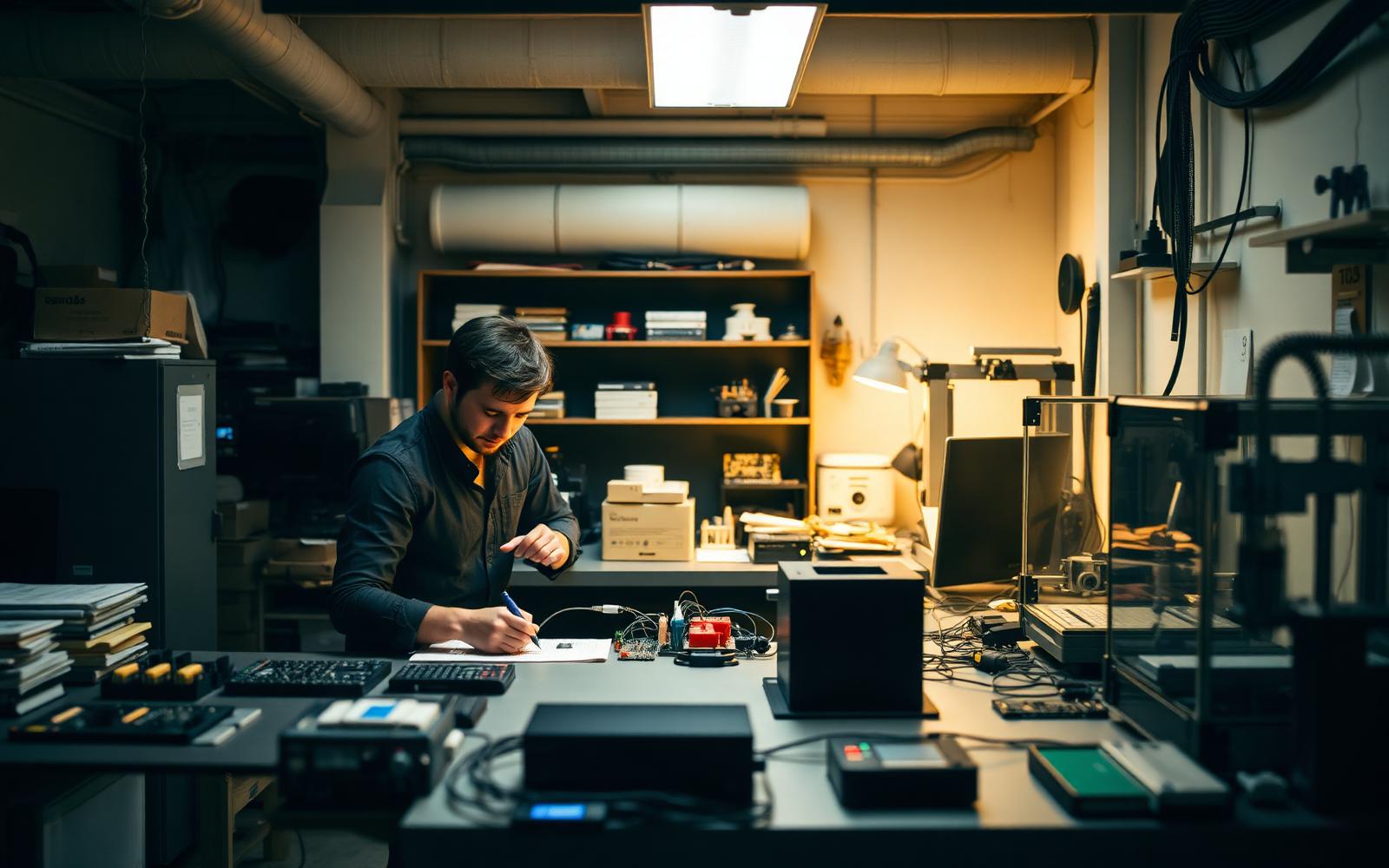
The cash cycle that kills companies
A typical import cycle runs 120 to 180 days from deposit to customer payment: 30% deposit at purchase order, 60 to 90 days of production, 30 to 45 days of ocean freight, balance due before release, then 30 to 60 days for a retail buyer to pay. Every unit of growth consumes cash before it produces cash, which is why profitable hardware companies still fail. Price for it, finance it, or sell direct where the customer pays first.
- Model growth in cash, not revenue. Build a 24-month cash schedule with deposits, freight and payment terms, not a monthly profit-and-loss.
- Delay tooling until the design is genuinely frozen. A steel change order costs less than a new tool but still costs weeks.
- Order the first run small even when the unit price stings. The cost of unsold inventory exceeds the savings on volume pricing.
- Qualify a second source for every long-lead component before it becomes the reason the line stops.
- Treat certification as a design input, not a checkpoint - the standards dictate creepage, materials and enclosure design.
Signals a hardware startup is on track
- The bill of materials cost is known within 10% before tooling is cut.
- Design for manufacturing review has been run with the factory that will actually build it.
- A functional unit built on production tooling has passed a real user test, not a demo.
- Compliance testing is scheduled with a lab and the pre-scan results are in hand.
- Return rate assumptions are based on a pilot batch in customer hands, not a guess.
- The team can state the landed cost, the wholesale price and the retail price, and the gaps between them hold at scale.
Key takeaways
- Hardware discipline is financial as much as technical; the cash cycle, not the engineering, decides survival.
- Freeze the design before tooling and keep the first production run deliberately small.
- Certification and freight are line items to plan from day one, not surprises at month twelve.
- Physical products still win where the value is inseparable from the object - and that is a permanent category, not a nostalgic one.
What hardware investors actually diligence
Hardware startups get evaluated on different evidence than software companies. Growth curves matter less; unit economics, manufacturability and supply risk matter more, because those determine whether growth is even survivable. Knowing the checklist in advance lets a team collect the evidence during development rather than assembling it under fundraising pressure.
Diligence areas and the evidence expected
Area | What is asked | Strong evidence |
|---|---|---|
Unit economics | Gross margin at scale | Quoted BOM at volume, plus landed cost model |
Manufacturability | Can this be built repeatably | DFM review, first article results, yield data |
Supply risk | What breaks the ramp | Alternates on critical parts, quoted lead times |
Demand | Will anyone buy it | Paid pre-orders or signed purchase orders |
Compliance | What blocks shipping | Certification plan with a booked lab |
Team | Has anyone shipped hardware before | Named prior programs and outcomes |
Capital plan | What does the next milestone cost | Tooling, inventory and certification budget lines |
Inventory is the line item founders under-model most. Hardware businesses pay for goods months before they get paid for them, so a plan that shows working capital needs alongside the burn rate is far more credible than one showing only headcount and engineering spend.
Evidence to collect during development
- Volume-based BOM quotes, refreshed each quarter.
- Yield and defect data from every build, however small.
- A documented DFM review with actions closed.
- Signed purchase intent from real buyers, not survey interest.
- A working capital model showing the cash cycle, not just burn.
Key takeaways
- Hardware diligence centers on unit economics, manufacturability and supply.
- Collect yield and BOM evidence during development, not at fundraising.
- Model working capital; inventory timing kills more hardware firms than burn.
Frequently asked questions
How much money does a hardware startup need to reach production?
For a straightforward consumer product, development through first tooling commonly lands between $100k and $400k, with inventory on top. Connected devices with custom electronics, firmware, apps and regulatory testing routinely run past $500k. The variable that moves the number most is how many times the product definition changes after design for manufacturing begins.
Why are hardware startups harder than software startups?
Because iteration takes weeks instead of hours, every unit carries a real cost, tooling and inventory consume capital before revenue arrives, and defects in the field become recalls rather than patches. None of that makes hardware a bad business — margins on a defensible physical product are durable — but it does mean the sequence of decisions matters far more.
Should a hardware startup build in-house or use a development partner?
Hiring a full mechanical, electrical, firmware and manufacturing team is slow and expensive for a product that may need each skill only for a few months.
Most early-stage teams use a development partner through prototyping and design for manufacturing, then bring in-house whatever becomes the ongoing core of the business. Work with LA NPDT: if you are moving from here to execution, start with our CAD engineering services or talk to us about design optimization .
Filed under:EducationInspirationWords
Services related to this guide
- Product design servicesIndustrial design and CAD taken all the way to manufacturable files.
- Rapid prototypingWorking prototypes in days, from 3D printing to vacuum casting.
- Electronic design servicesSchematic, PCB layout, firmware and bring-up, through to production handoff.
- Product development examplesReal projects we designed, prototyped and shipped.