
Contract Manufacturing Process: Steps, Costs and Timelines
How the contract manufacturing process works step by step: RFQ package, supplier selection, tooling, first articles, pilot run and full production.
October 11, 20228 min read

Written by Konstantin Dolgan, Ph.D., NPDP
Founder & CEO, Product Development Engineer
Published October 11, 2022Updated September 2, 2026
Manufacturing starts long before you contact a factory. Most first production runs fail on documentation, not on the factory - incomplete drawings, an unpriced bill of materials and tolerances nobody agreed to. Get the paperwork right and the rest is scheduling.
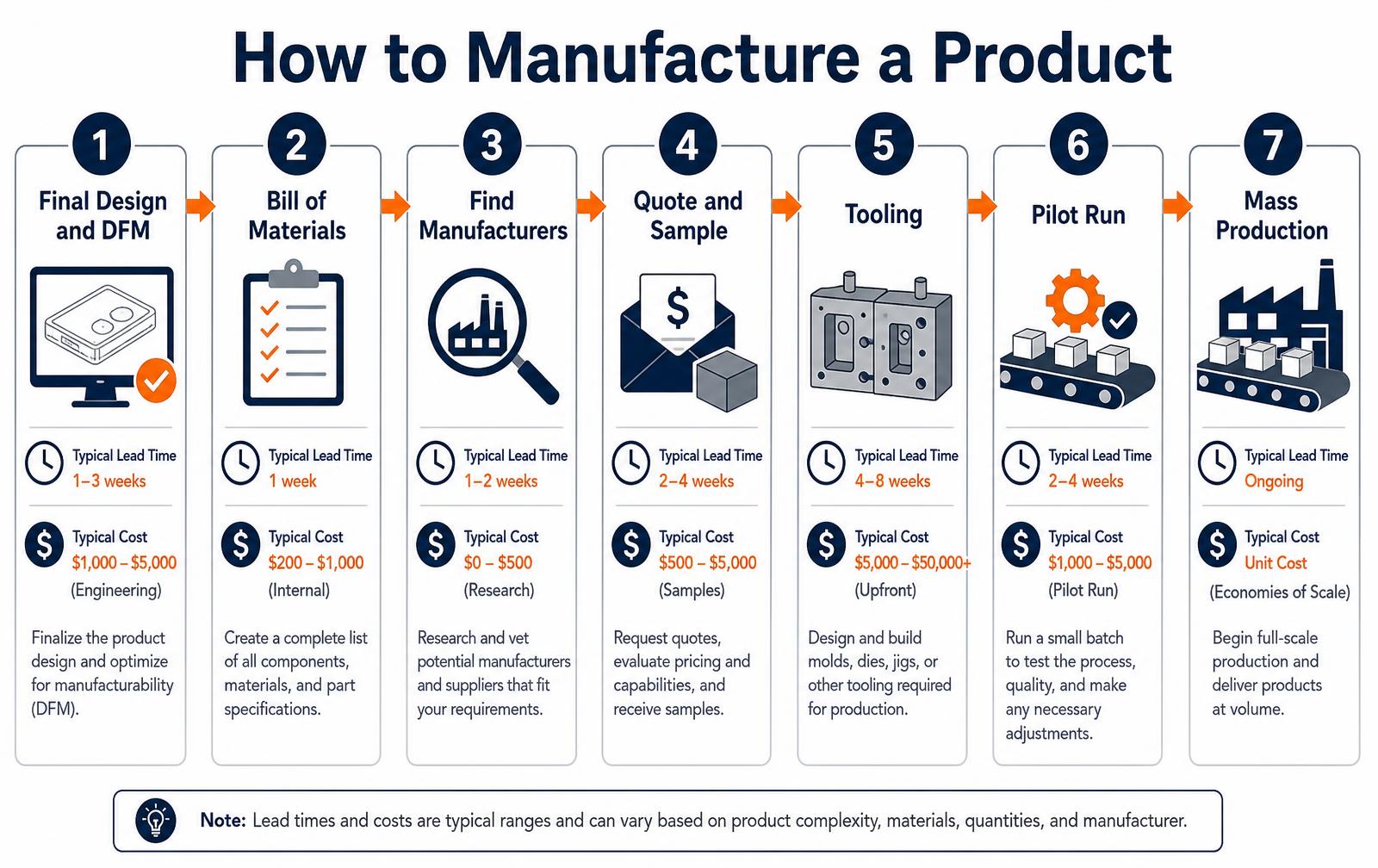
The seven stages
Stage | What you produce | Lead time | Typical cost |
|---|---|---|---|
Final design and DFM | Released drawings, 3D data, tolerance stack | 1-3 weeks | $1k-$5k |
Bill of materials | Costed BOM with approved vendors | 1 week | $200-$1k |
Find manufacturers | Shortlist of 3-5 vetted factories | 1-2 weeks | $0-$500 |
Quote and sample | Quotes, T1 samples, DFM feedback | 2-4 weeks | $500-$5k |
Tooling | Molds, dies, fixtures, test jigs | 4-8 weeks | $5k-$50k+ |
Pilot run | 50-200 units built on the real process | 2-4 weeks | $1k-$5k |
Mass production | Repeatable output at target quality | Ongoing | Unit cost |
What a factory needs from you
- 2D drawings with tolerances - not just STEP files. Tolerances are what you can hold them to.
- A costed BOM with manufacturer part numbers and approved alternates.
- Material and finish specs - resin grade, color standard, surface texture, plating.
- Acceptance criteria - what defines a pass, and how many units get inspected.
- Packaging and labeling artwork, barcodes and shipping-carton specs.
Domestic vs overseas
Factor | Domestic | Overseas |
|---|---|---|
Unit cost | Higher | Typically 20-50% lower at volume |
Tooling cost | Higher | Often half |
Lead time | 2-4 weeks | 6-12 weeks including freight |
Travel and oversight | Easy | Requires an agent or inspection service |
Best for | Low volume, fast iteration, regulated parts | High volume, cost-driven consumer goods |
Mistakes that wreck unit economics
- Designing before setting a target cost. Cost is a requirement, not an outcome.
- Skipping the pilot run and finding assembly problems at 5,000 units.
- Ordering tooling on an unfrozen design - every change after steel is cut costs weeks and thousands.
- Ignoring landed cost: freight, duties, packaging and yield loss often add 15-30%.
Related reading: contract manufacturing models, design for manufacturing and injection molding costs.
What a contract manufacturing quote should contain
Quote line | Why it matters | Question to ask |
|---|---|---|
Tooling and fixtures | Often 40-70% of first-year spend | Who owns the tool and can it be transferred? |
Piece price by volume break | Reveals the real MOQ | What is the price at 1k, 5k and 25k? |
NRE and engineering | Hidden in vague setup fees | What is included and what is billed hourly? |
Test and inspection | Quality is not free | Is functional test in the price or extra? |
Packaging and freight | Can add 10-20% landed | Is the quote EXW, FOB or DDP? |
Payment and lead time terms | Drives working capital | Deposit, balance terms and quoted lead time? |
Quality controls worth paying for
- First article inspection. Dimensional report against your drawing before mass production starts.
- Golden sample. A signed physical reference held by both parties for appearance and fit disputes.
- In-process checks. Defined sampling plan (AQL 2.5 general, tighter for safety features).
- Pre-shipment inspection. Third-party audit of a random carton set before you release the balance payment.
- Corrective action loop. A written 8D process so a defect found in the field changes the line, not just the shipment.
What a contract manufacturer needs from you
A contract manufacturer quotes what they can see. Incomplete packages produce padded quotes, because the shop prices the risk of the unknowns. The difference between a vague package and a complete one is routinely twenty percent on unit price and several weeks on lead time.
- Released 3D and 2D data at a named revision, with critical dimensions and tolerances called out.
- An indented bill of materials with approved manufacturers, part numbers and any acceptable alternates.
- Assembly instructions including torque values, adhesives, cure times and orientation-sensitive steps.
- Test and inspection criteria: what gets checked, on what sample, and what constitutes a failure.
- Packaging and labeling specs, including serial numbering and traceability requirements.
- Annual volume forecast and order pattern, which drives tooling choice, batch size and price tiers.
Cost breakdown at a typical production run
Cost element | Share of unit cost | Notes |
|---|---|---|
Direct materials | 40–60% | Largest lever; resin, PCBA and metal dominate |
Labor and assembly | 10–25% | Falls quickly with fixture and automation investment |
Tooling amortization | 5–15% | Depends on how the tool cost is spread across volume |
Scrap and yield loss | 2–8% | First runs are worse; expect improvement by run three |
Test and inspection | 2–6% | Higher for regulated or safety-critical products |
CM margin | 8–20% | Lower at volume, higher for low-volume complex builds |
Managing quality once production starts
Quality after handoff is a monitoring problem, not a hope. Agree on a sampling plan (ANSI/ASQ Z1.4 is the common baseline), require a first article inspection report on every new tool or lot, and define what happens when a lot fails before a lot fails. Add a short on-site or third-party inspection at the pilot run — the cheapest defect is the one found on the line rather than in a customer's hands.
- Define AQL levels separately for critical, major and cosmetic defects.
- Require lot and date code traceability so a field issue can be bounded.
- Hold golden samples for cosmetic and color reference, refreshed annually.
- Review scrap and rework data monthly; rising rework is an early warning of tool wear.
Turnkey, consigned or hybrid: choosing the contract model
Before negotiating price, decide who owns the material. The model you choose determines working capital, who absorbs component shortages and how much visibility you have into real cost. Most first-time hardware companies default to turnkey because it is simpler, then discover they cannot explain their own unit cost.
Model | Who buys components | Cash impact on you | Best when |
|---|---|---|---|
Turnkey | The contract manufacturer | Lowest; you pay per finished unit | Low volume, small team, standard parts |
Consigned | You buy and ship to the factory | Highest; you carry all inventory | High-value or allocated parts you can source better |
Hybrid | You buy the critical few, factory buys the rest | Moderate | One or two long-lead or single-source components |
Full contract with NPI support | Factory, plus engineering hours | Moderate, plus NRE | Design needs DFM work before it can run |
Whatever the model, insist on a costed bill of materials with visible component pricing and a stated markup on materials rather than a single blended unit price. A blended price hides both the margin and the effect of component cost swings, which means you cannot tell whether a mid-program price increase is real. Ask for the markup structure in writing at quotation, not after the first purchase order.
Second-sourcing and transferring production later
Every production program eventually needs a second source, either because volume grows past the first factory, quality drifts, or the commercial relationship goes wrong. The transfer is straightforward if it was anticipated and expensive if it was not.
- Own the tooling and say so in the purchase order, including the right to remove it on notice and who pays for refurbishment.
- Keep the data package current at your end. If the only accurate drawings live at the factory, you do not have a transferable design.
- Avoid factory-proprietary processes where a generic equivalent exists; a bespoke fixture design you cannot replicate is a lock-in.
- Qualify the second source on a real order, not a sample: first article inspection, capability study, then a small production lot.
- Expect 8 to 20 weeks and $15k to $80k for a molded product transfer, driven mainly by tool refurbishment and re-validation.
Run the two sources in parallel through one full demand cycle before releasing the first. The overlap costs inventory carrying and is far cheaper than a stockout during ramp. Related reading: the benefits of reshoring and injection molding costs.
Frequently asked questions
How much does it cost to manufacture a product?
Expect $5,000-$50,000 in tooling and setup for a modest plastic or electromechanical product, then a unit cost of roughly 2.5x to 4x the bill of materials depending on volume, complexity and region.
How long does it take to manufacture a product?
Three to six months from released design to first production units is typical: four to eight weeks of tooling, two to four weeks of samples and revisions, then the pilot run before scaling.
How do I find a manufacturer for my product?
Start from process, not directory. Identify the processes your product needs, then shortlist factories that already run those processes at your volume band, request references and audit before the first purchase order.
The contract manufacturing process from RFQ to shipment
Contract manufacturing runs on a documented handoff. The factory quotes from your data package, builds tooling, proves the process with samples, then produces at volume against an agreed inspection standard. Programs go wrong when the data package is incomplete - a quote based on a rendering and a verbal description will be revised, and the revision always lands after you have committed a deposit.
Stage | What you provide | Duration | Typical cost |
|---|---|---|---|
RFQ and quoting | Drawings, 3D CAD, BOM, volumes | 2-3 weeks | No charge |
DFM review | Design intent and tolerances | 1-2 weeks | $0-$3k |
Tooling | Approved final design | 5-10 weeks | $8k-$120k |
T1 samples and iteration | Inspection criteria | 3-6 weeks | $1k-$8k per revision |
Engineering pilot (EVT/DVT) | Test plan | 4-8 weeks | $5k-$40k |
Golden sample and PPAP | Signed approval | 1-2 weeks | $1k-$6k |
Mass production | Purchase order and forecast | 3-6 weeks per run | Unit price plus 30% deposit |
What a complete data package contains
- 3D CAD in a neutral format (STEP) plus native files.
- 2D drawings with critical dimensions, tolerances, datums and surface finish.
- Bill of materials with approved manufacturer part numbers and permitted alternates.
- Material and colour specifications including Pantone or master chips and UL ratings.
- Packaging and labeling artwork with dielines and barcode data.
- Inspection standard defining critical, major and minor defects with AQL levels.
- Test procedure for end-of-line functional testing, including pass criteria.
Payment terms, quality gates and how to protect yourself
Standard terms are 30% deposit with the balance against a passing pre-shipment inspection - never against bill of lading alone. Book a third-party inspection at AQL 2.5 major and 4.0 minor, and hold the golden sample yourself. Make tooling ownership explicit in the purchase order, including the right to remove the tool, and keep a second source qualified for at least one critical component so a single factory cannot hold a launch hostage.
- Key takeaway 1: A complete data package is what makes a quote binding.
- Key takeaway 2: Pay the balance against a passing inspection, not against shipment.
- Key takeaway 3: Put tooling ownership and removal rights in writing.
- Key takeaway 4: Qualify a second source before you need one.
How to qualify a contract manufacturer
- Ask for parts, not brochures. Request samples they produced in your process and material, and measure them yourself.
- Check the mix. A shop whose smallest customer runs 500,000 units will not prioritize your 5,000-unit order.
- Audit the quality system. ISO 9001 is a floor, not a differentiator. Ask how nonconformances are documented and who signs them off.
- Confirm tooling ownership in writing. Who owns the mold, where it lives, and what it costs to move it.
- Quote three shops on identical documentation. Different drawings produce different prices and teach you nothing.
- Visit or send an agent for the first article. The first production run is where assumptions break.
What drives the quote
Cost driver | Effect on unit price | What you control in design |
|---|---|---|
Cycle time | Direct, often 30-50% of molded part cost | Wall thickness, uniformity, resin choice |
Cavitation | Higher cavity count cuts price, raises tooling | Volume forecast accuracy |
Secondary operations | Each pad print, insert or ultrasonic weld adds cost and scrap | Part-count reduction, molded-in features |
Tolerance tightness | Tighter tolerances lower yield | Only tighten features that mate or show |
Material grade | Specialty resins can double raw cost | Grade selection early, with alternates |
Order quantity | Break points at 1k, 5k, 25k, 100k | Bridge strategy before committing tooling |
Packaging and freight | Often 5-15% of landed cost | Pack density, carton sizing, air vs ocean |
A realistic timeline for a first production run
From a frozen design, a typical injection-molded consumer product reaches mass production in 16 to 26 weeks. Quoting and shop selection takes two to four weeks. Tooling kickoff, T1 samples and two rounds of tool corrections take eight to fourteen weeks depending on part complexity and cavity count.
A pilot run of 100 to 300 units takes two to three weeks including assembly-line setup. Certification and packaging validation run in parallel but frequently become the critical path when a product needs FCC, CE or UL work.
The schedule breaks in predictable places. Designs that are not frozen force tool changes that cost two to four weeks each. Components with 14-week lead times ordered after tooling starts delay the pilot. Missing inspection plans turn first-article review into a debate rather than a measurement. Budget contingency in weeks, not just dollars.
Finally, treat the pilot run as a real experiment. Its purpose is not to make sellable units - it is to find the three assembly steps that take twice as long as planned, the connector that installs backwards, and the cosmetic defect that only appears on the fifth shot. Fixing those at 200 units costs a few thousand dollars. Finding them at 20,000 units costs a season.
Documentation package that prevents rework
The single strongest predictor of a smooth first production run is the completeness of the package you hand the factory.
A complete package contains released 2D drawings with tolerances and datums, native and STEP 3D data, a costed bill of materials with manufacturer part numbers and approved alternates, an assembly sequence with torque and adhesive specifications, a packaging drawing, and an inspection plan naming which dimensions are checked on every unit versus each lot.
Add a cosmetic specification with approved limit samples if any surface is visible to the customer.
Factories are good at making what is specified and inconsistent at guessing what is not. Every ambiguity becomes a decision made by someone on the floor at 2 a.m. who is optimizing for throughput. Writing the specification is cheaper than arguing about the result.
Payment terms and risk
- Stage tooling payments against milestones - kickoff, T1 samples, tool acceptance - not a single up-front lump.
- Tie the final production payment to first-article approval and an agreed yield threshold.
- Put tooling ownership, storage and transfer terms in the purchase order, not in an email.
- Hold a documented change-control process: any engineering change gets a cost and schedule impact in writing before approval.
- Keep a second source qualified for at least your longest-lead component, even if you never order from it.
Looking for the Tony Lytle story? The Original Doggie Fountain story now lives at Tony Lytle, The Original Doggie Fountain.
Ready to manufacture?
We prepare production documentation, source factories and manage pilot builds.
Work with LA NPDT: if you are moving from here to execution, start with our low-volume manufacturing or talk to us about design for manufacturing.
Filed under:Education
Services related to this guide
- Product design servicesIndustrial design and CAD taken all the way to manufacturable files.
- Rapid prototypingWorking prototypes in days, from 3D printing to vacuum casting.
- Electronic design servicesSchematic, PCB layout, firmware and bring-up, through to production handoff.
- Product development examplesReal projects we designed, prototyped and shipped.


