Trademark Application Fee: What a US Filing Really Costs
A US trademark application costs $350 per class in USPTO fees, plus avoidable surcharges and separate attorney fees. Here is what drives the total.
March 10, 20227 min read

Written by Yelena Rymbayeva, MPhil Communication & Media Studies, BTech Quality Control
Marketing & Product Leader, Technology Commercialization
Published March 10, 2022Updated September 2, 2026
A US trademark application costs $350 per class in USPTO fees when you file electronically and describe your goods and services with pre-approved wording from the Trademark ID Manual. Surcharges of $100 or $200 per class apply if the application is incomplete or uses free-form descriptions, and attorney fees are separate.
Your real total depends on three things: how many classes you file in, how you word the goods and services, and whether you file before or after you start using the mark.
This guide breaks the trademark application fee into its parts, shows the current USPTO fee schedule line by line, and works through what typical filings actually add up to. It was originally contributed by trademark attorney Joshua Saltz and has been rewritten by the LA NPDT editorial team against the USPTO fee schedule that took effect on January 18, 2025.
What changed in 2025
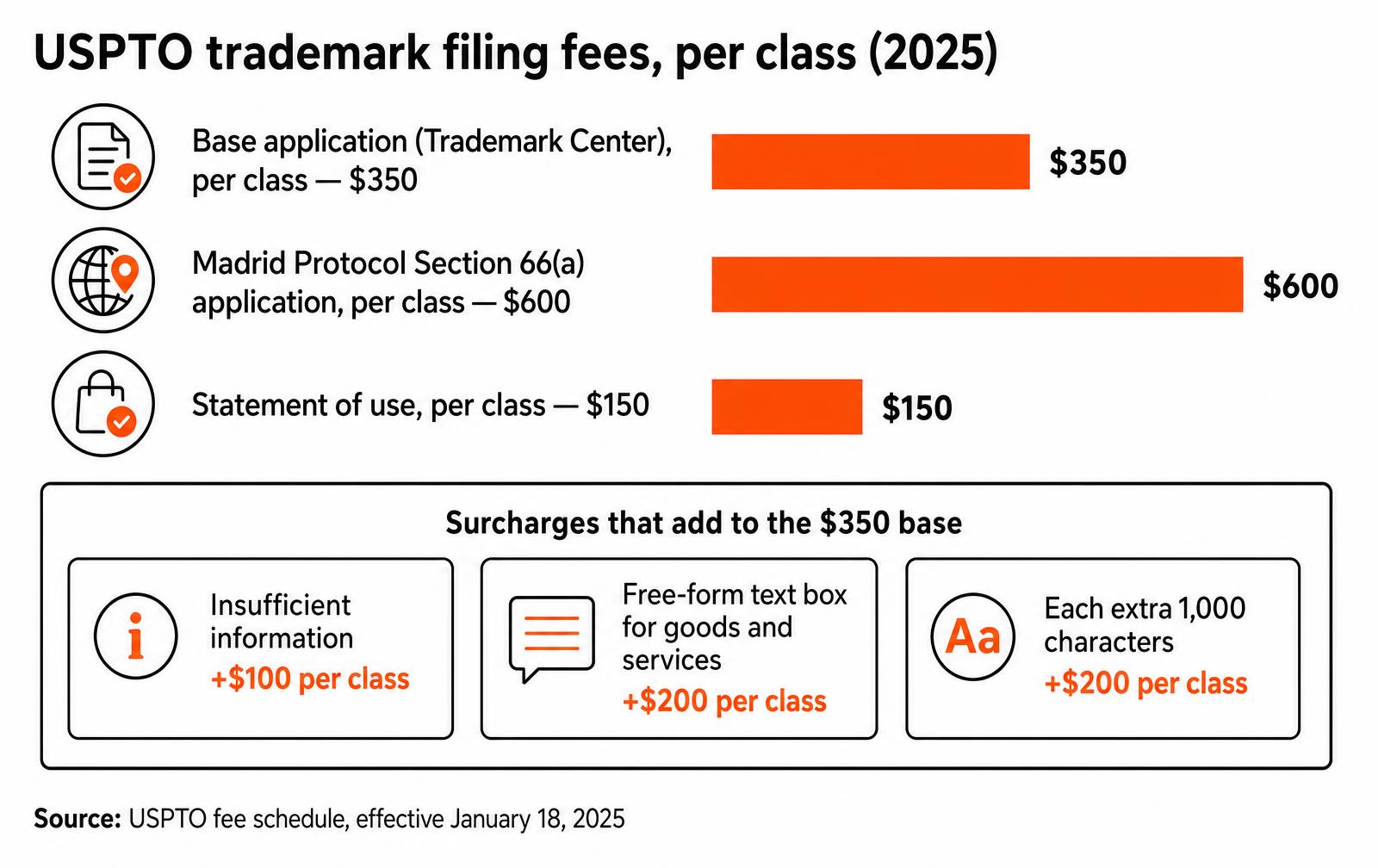
Until January 2025 the USPTO offered two application options, TEAS Plus at $250 per class and TEAS Standard at $350 per class. Both were retired. There is now a single base application fee of $350 per class filed through Trademark Center, plus surcharges that apply only when the application creates extra examination work. If you are reading older advice that quotes $250, it is out of date.
USPTO trademark fee schedule at a glance
Filing | Electronic fee | Notes |
|---|---|---|
Base application, per class | $350 | Filed in Trademark Center using Trademark ID Manual wording |
Insufficient information surcharge, per class | +$100 | Required application information is missing |
Free-form text box for goods and services, per class | +$200 | Applies when you do not use ID Manual wording |
Each additional 1,000 characters of free-form text, per class | +$200 | Charged per affected class |
Section 66(a) application filed through WIPO, per class | $600 | Madrid Protocol route into the US |
Amendment to allege use, per class | $150 | Filed before publication |
Statement of use, per class | $150 | Required to register an intent-to-use application |
Six-month extension to file a statement of use, per class | $125 | Up to five extensions available |
Petition to revive an abandoned application | $250 | After a missed deadline |
Section 8 declaration of use, per class | $325 | Due between years 5 and 6, then with each renewal |
Section 9 renewal, per class | $325 | Every 10 years |
Fees are from the USPTO fee schedule and are current as of this update. Paper filing is only permitted in narrow circumstances and costs more.
Driver 1: how many classes you file in
Every fee above is charged per class. Goods and services are sorted into 45 international classes: classes 1 to 34 cover goods and 35 to 45 cover services. One application can cover several classes, but you pay the full fee for each one.
Multiple products do not automatically mean multiple classes. Phones, phone cases and eyewear all sit in Class 9, so a single-class application covers them. Add jewelry and you are into Class 14, and the filing fee doubles. Search the Trademark ID Manual for each item you sell before you assume a class count.
Class count is the single largest lever on a trademark budget. File in the classes that reflect what you actually sell in the next few years, not everything you might one day sell.
Driver 2: how you describe the goods and services
If every item in your application is copied from the Trademark ID Manual, you pay the $350 base and nothing more. Type your own description into the free-form box and the USPTO adds $200 per class, plus another $200 for each additional 1,000 characters of that free-form text. A long, custom description across two classes can add $800 to a filing that needed no surcharge at all.
The surcharge is avoidable in most cases. If your product does not appear in the ID Manual under one name, try a plainer one: "training aids for golf" and "golf practice apparatus" may both resolve to accepted wording. If nothing fits, the surcharge is the cost of an accurate description, and an accurate description is worth more than the saving.
Driver 3: filing on use versus intent to use
You can file once the mark is in use in commerce, or file earlier on an intent to use basis. Filing on intent to use secures your priority date against anyone who adopts a confusingly similar mark afterwards, which matters when a product is still in development and the launch date is months out.
The trade-off is cost. An intent-to-use application does not register until you prove use, and proving use means a statement of use at $150 per class. If you are not ready in time, each six-month extension costs $125 per class, and up to five are available. A brand that slips two years to launch can spend more on extensions than on the original application.
What typical filings add up to
Scenario | USPTO fees | How it gets there |
|---|---|---|
One class, ID Manual wording, already in use | $350 | Base fee only |
One class, free-form description, already in use | $550 | $350 base plus $200 surcharge |
Two classes, ID Manual wording, already in use | $700 | $350 per class |
One class, intent to use, registers after one extension | $625 | $350 base, $125 extension, $150 statement of use |
Two classes, intent to use, no extensions | $1,000 | $700 base, $300 statement of use |
These are government fees only. They exclude attorney fees, and they exclude the cost of responding to an office action or defending an opposition.
Attorney fees and what they should cover
Most firms quote a flat legal fee to prepare and file an application, with an additional amount per extra class. Fees vary widely by firm and region, so compare written quotes rather than headline numbers. What matters more than the figure is what the quote includes.
- Availability search. Preliminary searches check the USPTO register; comprehensive searches also cover common-law use, state registers and domains. Ask which one you are buying.
- Classification and wording. Getting the class count and the ID Manual descriptions right is where a filing is won or lost.
- Post-filing reporting. Some firms bill separately for reporting on publication and registration. Ask up front.
- Office action responses. Almost always billed separately. Ask for the typical range.
- Opposition or refusal. Rare but expensive. Confirm it is out of scope so the number does not surprise you later.
Where trademark cost fits in a product budget
For a hardware product, the trademark is usually the smallest line in the intellectual property budget and the easiest to get wrong by waiting. Name searching belongs in the same window as concept design, because discovering a conflict after you have tooled packaging is far more expensive than the filing fee. If you are also weighing patent protection, our guide to preparing an invention for production covers how the two run in parallel with engineering.
Frequently asked questions
How much is a trademark application fee in the US?
The USPTO base application fee is $350 per class of goods or services when filed electronically through Trademark Center using descriptions from the Trademark ID Manual. Surcharges of $100 or $200 per class apply for incomplete applications or free-form descriptions. Attorney fees are separate and are quoted by the firm.
Why do some sites still say $250 per class?
Because they predate January 18, 2025. The USPTO retired the TEAS Plus ($250) and TEAS Standard ($350) options that day and replaced them with one $350 base fee per class plus targeted surcharges. Any quote based on TEAS Plus is no longer accurate.
Can I file a trademark application myself?
Yes, if you are a US-domiciled applicant. Foreign-domiciled applicants must be represented by a US-licensed attorney. Self-filing saves legal fees but the common errors, wrong class, over-broad wording, an unsearched conflict, cost more than the saving when they trigger a refusal.
Are trademark application fees refundable?
No. USPTO filing fees are processing fees and are not refunded if the application is refused or abandoned. This is why an availability search before filing is worth its cost.
What does it cost to keep a trademark alive?
A Section 8 declaration of use at $325 per class is due between the fifth and sixth year after registration. After that, a combined Section 8 and Section 9 renewal is due every ten years, at $325 per class for each filing. Grace-period surcharges apply if you miss the window.
Sources
- USPTO fee schedule — current trademark and patent fees, updated as rules change.
- USPTO Trademark ID Manual — pre-approved descriptions that avoid the free-form surcharge.
- USPTO trademark basics — filing bases, examination and maintenance requirements.
This article is general information, not legal advice. Fees change. Confirm the current schedule with the USPTO before filing. Originally contributed by Joshua Saltz, Managing Member of Joshua IP, a trademark law firm in Boca Raton, Florida.
Budgeting for the costs after the application fee
The trademark application fee is the smallest predictable part of a brand protection budget. Office actions, extensions and eventual maintenance filings usually exceed the initial filing cost, and international protection multiplies it. Planning the whole sequence avoids the common situation where a mark lapses because nobody budgeted the renewal.
Cost events across a trademark lifetime
Event | When | Typical cost driver |
|---|---|---|
Initial filing | Year 0 | Per class, plus description surcharges |
Office action response | Months 4-12 | Attorney time, often the largest single item |
Extension of time (ITU) | Every 6 months | Per class, repeatable up to the statutory limit |
Statement of use | On first sale | Per class government fee |
Section 8 declaration | Years 5-6 | Per class, plus specimen preparation |
Section 9 renewal | Every 10 years | Per class, ongoing forever |
Foreign filings | Anytime | Per country or Madrid designation |
Docket the Section 8 and Section 9 deadlines in a calendar the company actually maintains, not only in the attorney's system. Missed maintenance deadlines are the most common way a valid registration is lost, and refiling means losing the original priority date.
Brand budget checklist
- Budget for at least one office action response per application.
- Decide classes deliberately; each one multiplies every later fee.
- Use the standard ID manual wording to avoid surcharges.
- Docket maintenance deadlines internally and externally.
- Plan foreign filings within the six-month priority window if relevant.
Key takeaways
- Filing fees are a minority of total trademark cost over time.
- Every extra class multiplies every future fee, not just the first.
- Docket maintenance deadlines internally; missed ones lose the registration.
Planning a product launch and brand protection together?
What Drives the Total Trademark Application Fee
The government filing fee is only one line in the total. Class count, filing basis, attorney involvement, and post-filing responses each move the number, and a founder who budgets only for the base fee is usually surprised twice: once at filing, when the class count is larger than expected, and again months later when an office action arrives.
Choosing a Mark That Costs Less to Register
Descriptive names feel like free marketing and are the most expensive marks to protect. A name that describes the product invites refusal on descriptiveness grounds and, even when registered, sits in a crowded field where enforcement is weak.
Coined and arbitrary marks clear faster, draw fewer objections, and defend more cheaply for the entire life of the brand. The naming decision is therefore a legal-cost decision made months before any legal work begins.
Sequence That Keeps Fees Predictable
- Shortlist three names and run knockout searches on each before falling in love with one.
- Confirm domain and marketplace handle availability at the same time, since a blocked handle can force a rename anyway.
- Decide the classes from your actual revenue lines, not your five-year plan.
- File as use-based when you are already selling, which avoids later extension and statement-of-use fees.
- Diary the maintenance windows the day the registration certificate arrives.
Fees change periodically, so verify current amounts with the trademark office before budgeting. What does not change is the structure: the controllable costs are the ones you decide during naming and class selection, long before the first payment is made.
Work with LA NPDT: if you are moving from here to execution, start with our product discovery for inventors or talk to us about prior art search.
Filed under:Uncategorized
Services related to this guide
- Free trademark searchScreen a product name against the live USPTO register in seconds.
- Idea evaluationAn honest read on whether an idea is worth building.
- Product design servicesIndustrial design and CAD taken all the way to manufacturable files.
- Product development examplesReal projects we designed, prototyped and shipped.