
Patent search
Free US Patent Search
Describe the mechanism behind your product or type in keywords, and we search the full text of US patents and published applications. Free, no sign-up, with a link to every official record.
Search US patents and published applications, free
Full text of US granted patents and published applications, with assignee, inventor, dates, matched abstract and the first drawing for every record.
After the search
From search to filed application
- 01
Search here
Open the records that read on your mechanism and note their numbers.
- 02
Deep search
InventDraft ranks prior art by relevance and summarizes the claims.
- 03
Draft and draw
Application help and patent drawings for the idea that survives.
- 04
Build it
Our team takes the product from concept design to a working prototype.
InventDraft
When you need a professional answer
A full prior-art study, patentability and freedom-to-operate analysis and a view of the patent landscape around your idea. It is a separate tool: you start a new project there with a free account.
- Prior art beyond keywordsRelevance ranking and claim-level summaries.
- Patentability, feasibility and viabilityScored in one written report.
- Drafting and patent drawingsFrom the same platform that ran the search.
Want a second pair of eyes?
Built by our team in Ruston, Louisiana, since 2015. We search this index for our own clients.
Quick answer
How do I search US patents for free?
Type how your idea works into the search box above, not the product name. Results cover every granted US patent and published US application, each linked to the official record. Open the closest matches, read claim 1, and check whether each record is still in force.
The video walks through what a prior art search is for and what a professional search adds on top of a keyword screen.
Coverage
What this search covers, and what it does not
Covered
- Full text of every granted US patent
- Every published US patent application
- A link to the official record for each result, so you can read the claims
- Worldwide records, when you widen the coverage
Not covered
- Filings still inside their confidential period of roughly 18 months
- Products already on sale that were never patented
- Articles, papers and other non-patent prior art
- An opinion on novelty: this is a screen, not a legal review
Novelty is judged against all prior art worldwide, in any language, including products already on sale. That is why a clean result here is a good start, not a green light.
Reading results
How to read what you find
Granted patent
- What it is
- An enforceable right with examined claims
- Can it stop you?
- Yes, while it stays in force
- Counts as prior art?
- Yes
- What to do
- Compare your product against claim 1
Published application
- What it is
- A filing made public, not yet granted
- Can it stop you?
- Not yet. Its claims may narrow or never issue
- Counts as prior art?
- Yes
- What to do
- Watch its status and how the claims change
Expired or abandoned
- What it is
- A patent or application no longer in force
- Can it stop you?
- No. It is free to practice
- Counts as prior art?
- Yes
- What to do
- Use it freely, but you cannot patent the same thing
Worked example: “collapsible silicone bottle”
A real result from this tool. Here is what each part tells you.
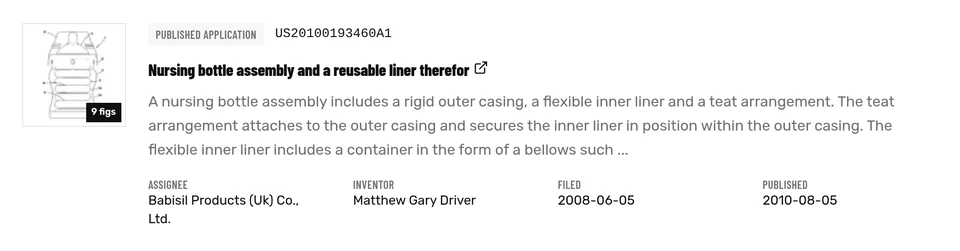
Swipe the example sideways to read it.
- 1
Record type and number
The label tells you granted patent or published application. The number opens the official record.
- 2
Title and abstract
Good for sorting results, but they read broader than what the patent actually protects.
- 3
Dates
Filed and granted or published dates are your first clue to whether the record is still in force.
- 4
Drawing
Click the thumbnail to page through every figure, then compare the claims, not the pictures.
If something close is active, that is usually a steering problem rather than a dead end, and the close art often shows exactly where the open space is.
How it works
How to search for prior art on your own
Step 1
Search the mechanism, not the product name
Examiners index inventions by how they work. "Collapsible silicone bottle with magnetic lid latch" finds art; "Burple bottle" finds nothing.
Step 2
Use examiner vocabulary
Run several phrasings of the same idea: retaining collar, compliant hinge, magnetic latch, living hinge. Prior art that reads on your claim often uses none of the words you would pick.
Step 3
Read the claims, not the title
A patent only covers what its claims say. Open the record and read claim 1: that is the boundary. The title and abstract routinely sound far broader than the protection actually granted.
Step 4
Check whether the record is still in force
Expired and abandoned patents are free to practice. A granted US patent runs 20 years from its earliest filing date, and lapses earlier when maintenance fees go unpaid.
FAQ
Patent search questions we get asked
Is this US patent search free?
Yes. No account, no email gate, no limit beyond a fair-use cap that stops automated scraping. Every result links to the official published record.
What does the search cover?
The full text of US granted patents and published applications, with an option to widen to worldwide records. It does not cover unpublished applications, filings stay confidential for roughly 18 months, so recent art may not be visible to anyone yet.
I found nothing. Does that mean my idea is patentable?
No. An empty keyword search is a weak signal. Novelty is judged against all prior art worldwide, in any language, including non-patent publications and products already on sale. Treat a clean search as permission to keep going, not as an opinion.
I found something close. Is my idea dead?
Usually not. Compare your product against the claims, not the pictures. Most concepts survive with a change to the mechanism, and the close art often tells you exactly where the open space is.
What is the difference between a granted patent and a published application?
A granted patent is an enforceable right with examined claims. A published application is a filing that has been made public but not yet granted: its claims may narrow substantially or never issue at all. Both count as prior art.
Does this replace a professional prior-art search?
No. This is a keyword screen. A patentability or freedom-to-operate opinion requires a classification-based search and a claim-by-claim analysis by a registered patent attorney or agent.
Do you provide legal advice on patents?
No. LA NPDT is a product development firm, not a law firm. Everything here is general information and automated screening. For legal advice, work with a registered patent practitioner.
Disclaimer: LA NPDT is a product development firm, not a law firm. The information and automated search results on this page are provided for general guidance only and are not legal advice or a substitute for advice from a licensed attorney.
Free tools
The rest of our free inventor tools
- Invention idea analyzer
Score feasibility, novelty and commercial fit before you spend on tooling.
- Free US trademark search
Screen your product name against live and pending federal marks.
- Product name generator
Six name directions, each screened for domains and active marks.
- AI product idea generator
Still deciding what to build? Explore product directions first.
See all free tools: every calculator, search and AI tool we publish, in one place.
Next step
Found patents close to your idea?
Close art usually means steering, not stopping. Our team can tell you whether the mechanism still has room, what it would take to build, and what it costs.