Using Consumer Feedback to Improve Concept Design Services
Are you pumped about improving your concept design services? Here are some tips on applying consumer feedback to create successful products.
August 10, 20237 min read

Written by Konstantin Dolgan, Ph.D., NPDP
Founder & CEO, Product Development Engineer
Published August 10, 2023Updated September 2, 2026
Building successful products requires a good knowledge of target customers’ preferences and their pain points. Therefore, you need to create a product that resonates with your target audience when offering concept design services. That requires that you deliberately craft your product idea using collected and analyzed customer feedback.
In this article, you will get to know the benefits of using customer data to improve consumer concept design. Also, we have provided practical tips and case studies for collecting, analyzing, and producing successful products.
The Importance of Using Customer Feedback in Product Concept Design
Collecting customer feedback early in the product development process is very vital. For instance, it helps your product concept to connect well with the needs of your target audience. As concept design services, customer feedback can help you to:
Know customer needs
Concept design feedback can help you to identify the preferences and dislikes of your target audience. So, through keeping tabs on their challenges, you can provide solutions that meet their pressing needs.
Product refinement
Customer feedback can also help you to adjust your product concept. Therefore, gathering information on raw materials, components, and usage, you can make informed decisions on how to improve your products.
Reduce development costs
Incorporating consumer concept design feedback helps to reduce the risk of a product failing to meet the needs of your target audience. Latter on, it can help avoid costly design changes later in the development process.
Increase consumer delight
Developing a product that covers options approved your target audience, you could increase patronage and customer loyalty. Subsequently, it can lead to repeat customers and positive word-of-mouth marketing.
Practical Tips for Gathering Consumer Feedback
To gather consumer feedback effectively, you need to use a variety of methods and tools. Here are some practical tips for gathering consumer feedback:
Surveys
This is a common method for gathering feedback from users. There are several online tools that are available to use for surveys.
Examples include SurveyMonkey or Google Forms to create and distribute surveys to your target audience. Bear in mind that Surveys should include questions that help you understand consumer pain points.
Interviews
With interviews, you can glean more in-depth insights into what your users actually want. There are replete ways to conduct interviews. You can do it in person, over the phone, or through video conferencing tools such as Zoom or Skype.
Try as much as possible to structure your interviews. This would help you to gather the information you need to improve your consumer concept design.
Observe user behavior
You can learn a lot from how consumers interact with similar products. By observing the behavior of users, you can get to understand valuable insights into their needs and preferences.
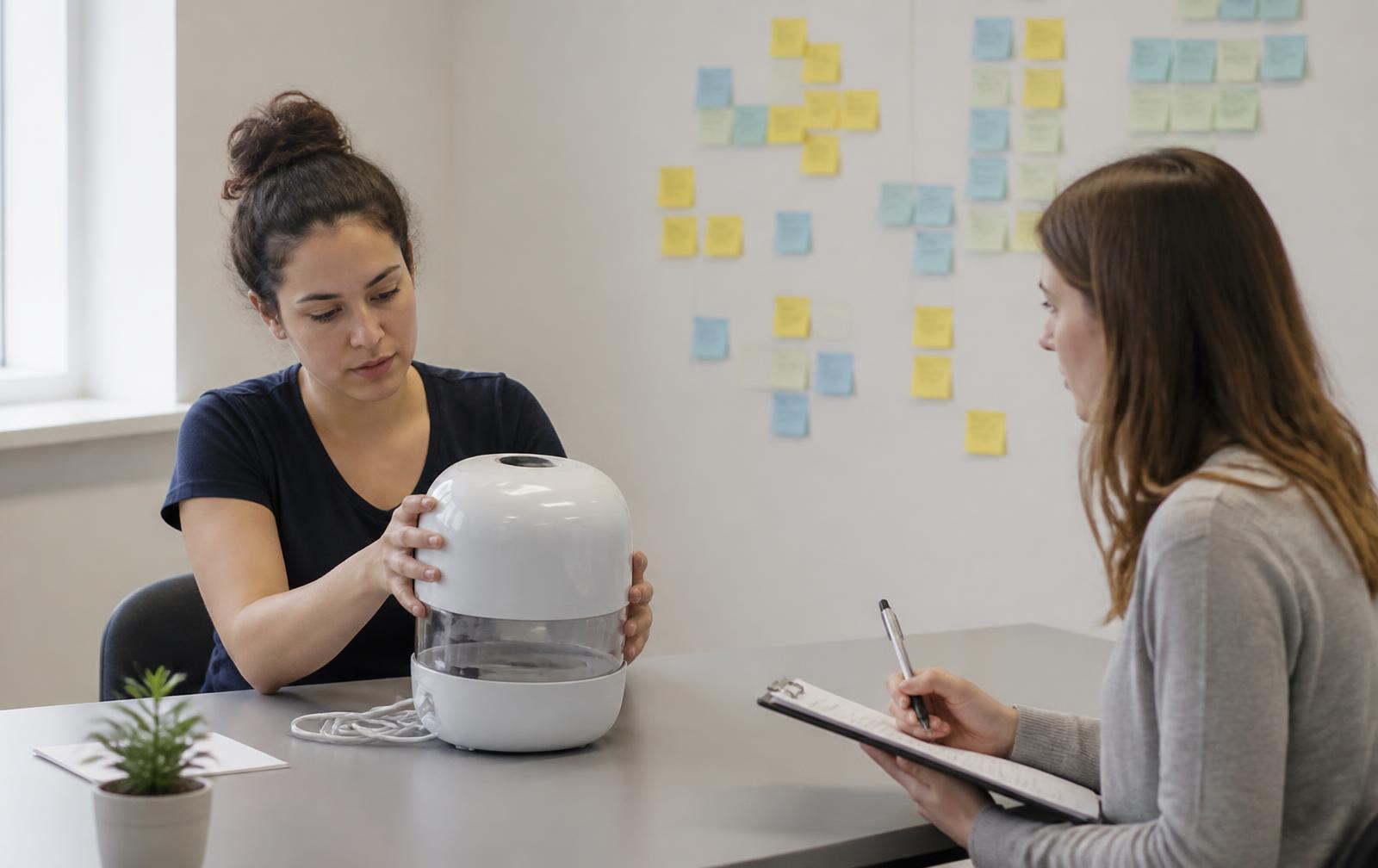
You can also conduct user testing sessions to closely observe how people use similar products. With that, you can pick usability issues and adjust your product concept design.
Use social media
Social media platforms such as Facebook, Twitter, and Instagram are powerful tools for gathering consumer feedback. You can use social media to ask for concept design feedback on product features, design elements, and usability. Survey polls on these platforms are also good ways to get feedback.
Hottest Questions on Using Consumer Feedback to Improve Your Product Concept Design
1. How to implement consumer feedback in product design
Practical steps businesses can take to incorporate consumer feedback into their product concept design process include creating a design strategy motivated by feedback, setting up a feedback collection system, and analyzing feedback to identify reviews to be worked on.
2. The importance of consumer feedback in product design
This SERP topic could discuss the significance of using consumer feedback to improve product concept design. It could include the benefits of customer-centric design, how feedback helps to create products that meet customer needs and expectations, and how it can increase customer satisfaction and brand loyalty. This topic is useful for businesses that want to understand the value of incorporating feedback in their product design process.
3. Tools for gathering and analyzing consumer feedback for product design
There is a list of tools to collect customer feedback to improve product concept design. It could include survey tools, user testing software, social media listening tools, and data analysis tools.
It’s a Wrap
In conclusion, using consumer feedback is a powerful tool for businesses to improve their product concept design. By implementing feedback-motivated design strategies and analyzing feedback effectively, businesses can create products that meet their customers’ needs and stay ahead of their competitors in today’s competitive market.

Does your company want to move ideas from mind to market? Do you need any form of prototyping in your product development?
LA NPDT is a prototyping firm that exists to assist you in transforming your ideas into commercial products. Our team of experts are equipped to help you with achieving your goals with your customers. For any concept design needs, you may contact us at 318-243-5789 or at our website, lanpdt.com.
Methods for Gathering Consumer Feedback
Method | Description | Tools/Approach |
|---|---|---|
Surveys | Collects feedback from many users. | Online tools like SurveyMonkey or Google Forms |
Interviews | Gleans in-depth insights from users. | In-person, phone, or video conferencing (e.g., Zoom) |
Observe User Behavior | Learns from how consumers interact with products. | User testing sessions |
Social Media | Gathers feedback and opinions from online communities. | Facebook, Twitter, Instagram, survey polls |
Frequently asked questions
Why is customer feedback important for concept design?
Collecting customer feedback early helps product concepts connect with target audience needs. It allows you to understand customer preferences and dislikes, providing solutions to their pressing needs. Feedback also aids in refining product ideas, reducing development costs by avoiding later design changes, and increasing customer delight with approved options.
How can businesses implement consumer feedback into product design?
Businesses can incorporate consumer feedback by creating a design strategy motivated by this input. This involves setting up a system for collecting feedback and then analyzing it to identify specific reviews that need to be addressed. This ensures the product concept design directly reflects customer input.
What methods can be used to gather consumer feedback?
Effective methods for gathering consumer feedback include surveys, which can be distributed online using tools like SurveyMonkey or Google Forms. Interviews offer in-depth insights and can be conducted in person or via video conferencing. Observing user behavior with similar products and utilizing social media platforms for polls and discussions are also valuable.
What are the benefits of using consumer feedback in product design?
Using consumer feedback helps businesses know customer needs and allows for product refinement based on user input. It can reduce development costs by minimizing the risk of a product not meeting market needs, thus avoiding expensive changes later. This approach also increases consumer delight, leading to greater patronage and customer loyalty.
Turning raw feedback into design decisions
Collecting customer feedback in product development is easy; converting it into a change a designer can act on is where most teams stall. Comments arrive as opinions and preferences, while designs need requirements with numbers. The bridge is a simple triage that separates what people say from what they do, and what is a defect from what is a preference.
Feedback triage model
Feedback type | Example | Reliability | Action |
|---|---|---|---|
Observed failure | User cannot open the latch | Very high | Fix; it is a requirement |
Repeated friction | Three of six users hesitate at setup | High | Redesign the step |
Stated preference | "I would prefer it in blue" | Low | Log; decide with the range plan |
Requested feature | "Add Bluetooth" | Low | Find the underlying job first |
Comparison to a rival | "The other one feels sturdier" | Medium | Investigate the specific cue |
Price objection | "Too expensive" | Medium | Test against value framing, not cost |
Weight observation over opinion every time. Five users struggling with the same step is a stronger signal than fifty survey responses ranking features, because behavior does not flatter the interviewer.
A repeatable feedback loop
- Test with five to eight users per round; more rounds beat bigger rounds.
- Record sessions and tag every hesitation, error and workaround.
- Convert each recurring issue into a numbered requirement with an acceptance test.
- Feed the requirement into the next prototype and re-test the same task.
- Close the loop with participants; it costs nothing and improves recruiting.
Key takeaways
- Separate observed behavior from stated preference before acting.
- Convert recurring friction into numbered requirements with acceptance tests.
- Frequent small test rounds outperform one large survey.
Need concept design grounded in real user testing?
Turning Customer Feedback in Product Development Into Design Decisions
Feedback is only useful when it changes something. Most teams collect plenty of it and act on very little, because the raw input arrives as opinions rather than as decisions. The fix is a structure that separates what people say from what they do, weights the signal by cost of change, and routes each finding to a specific owner and gate.
Match the Method to the Question
Weight Feedback by When It Arrives
A usability finding discovered at concept stage costs a sketch. The same finding after tooling costs a mold change and weeks of schedule. Front-load the questions whose answers change geometry, and defer the ones that only change packaging, color, or copy. A simple rule works well: anything that could change a part boundary must be answered before CAD is frozen.
Separate Observation From Interpretation
- Record what the participant did, in their words and actions, before writing what you think it means.
- Count how many participants hit the same obstacle rather than quoting the most articulate one.
- Ignore requests for features and look for the underlying task the request implies.
- Treat effusive praise from anyone who knows you as unusable data.
- Watch the first sixty seconds of unboxing and setup closely; most abandonment happens there.
A Feedback Loop That Closes
- Log every finding with the evidence, the participant count, and the affected requirement.
- Classify as blocker, improvement, or backlog based on impact and cost to change.
- Assign an owner and the gate by which it must be resolved.
- Re-test the change with a fresh set of participants, never with the same ones.
- Report back what changed to the people who reported it, which measurably increases future participation.
Post-Launch Feedback Is Still Design Input
Reviews, returns, and support tickets are the cheapest research a company will ever run, and the only source that reflects unsupervised long-term use.
Tag return reasons consistently, read the three-star reviews first because they contain the most specific criticism, and feed the recurring themes into the next revision. Products that improve steadily across generations are almost always run by teams that treat this stream as data rather than as noise to be managed.
Filed under:EducationInspirationWords
Services related to this guide
- Consumer product design firmsFirms compared for retail-bound goods: packaging, cost targets and first production runs.
- Best product design companiesDesign studios compared by scope, industry and what they hand off.
- Low-volume manufacturingFirst production runs without full injection-mould tooling.
- Product development examplesReal projects we designed, prototyped and shipped.