Walmart Open Call: How to Get Your Product Ready for the Pitch
Walmart Open Call gives American-made products a direct meeting with a buyer. Getting the meeting is the easy part; this is what your product, cost model and packaging must look like before you walk in.
March 4, 20245 min read

Written by Konstantin Dolgan, Ph.D., NPDP
Founder & CEO, Product Development Engineer
Published March 4, 2024Updated September 2, 2026
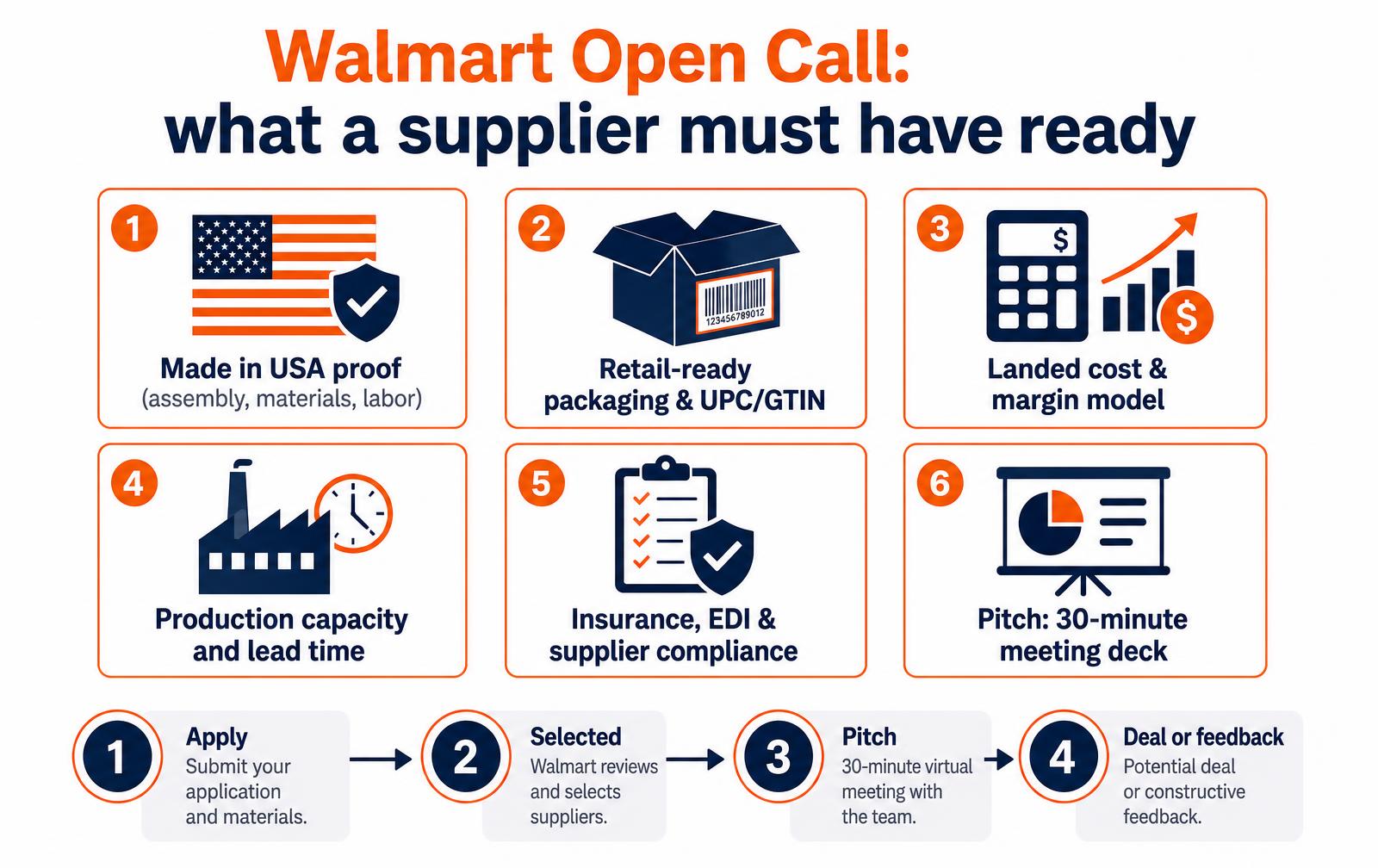
Walmart Open Call is the annual event where a US company can apply to pitch an American-made product directly to a Walmart or Sam's Club merchant in a short one-on-one meeting. Applications are open to companies of any size, there is no fee to apply, and a meeting can end in a deal, a request for more information, or a clear explanation of why the product is not ready.
The application is not the hard part. Being able to answer six questions about your product with documents rather than intentions is.
What Open Call is
Open Call sits inside Walmart's commitment to source more products made, grown or assembled in the United States. Suppliers apply online with product, company and cost information; a subset is selected for a scheduled meeting with the merchant who owns that category. The meeting is short — plan for roughly half an hour — and the merchant is deciding one thing: whether this item can sit on a shelf, sell through, and be resupplied without becoming a problem.
Dates, formats and eligibility details change from year to year, so confirm the current cycle on Walmart's supplier site before you build a schedule around it. What does not change is the readiness bar described below.
The six things a merchant will probe
Requirement | What proof looks like | Common failure |
|---|---|---|
Made in USA claim | Bill of materials with country of origin, assembly location, labor share | Assembled from imported subassemblies and marketed as US-made |
Retail-ready packaging | Shelf-legible pack, UPC/GTIN, case pack and pallet configuration | Beautiful e-commerce box that cannot be merchandised or shipped in a case |
Cost and margin | Landed cost per unit, wholesale price, retail price, gross margin | Price built for a direct-to-consumer margin, with nothing left for retail |
Capacity | Units per week at full run, lead time, second-source plan | Prototype-scale production with no plan for a purchase order of 30,000 |
Compliance | Product safety testing, liability insurance, supplier agreement, EDI capability | Testing and insurance treated as paperwork to do after the deal |
The pitch | One page: what it is, who buys it, why now, what it costs, how fast you can ship | Twenty slides of company story and no unit economics |
A merchant is not evaluating your idea. They are estimating the risk that a shelf slot given to you underperforms or fails to resupply. Every item above lowers that estimate.
Get the cost model right before anything else
Retail pricing works backwards. Start from the shelf price a shopper will accept for this category, subtract the retailer's margin, and what remains is your wholesale price. From that, subtract landed cost — materials, labor, packaging, freight, duty where applicable, scrap and warranty — and what remains is yours.
If that number is negative, no pitch fixes it. A design for manufacturing pass that removes parts, simplifies assembly or changes process usually can.
- Cost at volume, not at prototype quantity. Quote your parts at 10,000 and 50,000 units, not at the 100 you have built.
- Include the packaging in the BOM. Retail packaging, inserts and case cartons are often ten to twenty percent of landed cost and are routinely forgotten.
- Model freight and pallet efficiency. A product that wastes cube on a pallet loses money on every shipment.
- Reserve for chargebacks and returns. Retail programs assume both; a model with zero allowance is not credible.
Packaging is part of the product
On a shelf you have about three seconds and no salesperson. The pack has to state the category, the benefit and the differentiator from six feet away, survive a drop test, hang or stack the way the planogram expects, and carry a scannable UPC in a position the store can read. Merchants notice immediately when a founder has only ever shipped in a mailer box, because the pack is designed for unboxing rather than for a store aisle.
A 12-week preparation plan
Weeks | Work | Output |
|---|---|---|
1-2 | Category and shelf-price research, competitor teardown | Target retail price and required landed cost |
3-5 | DFM pass, supplier quotes at volume, origin documentation | Costed BOM and Made in USA evidence |
6-8 | Retail packaging design, UPC/GTIN, case and pallet plan | Physical retail-ready sample |
9-10 | Safety testing, insurance, capacity and lead-time letter from your manufacturer | Compliance pack |
11-12 | Pitch build and rehearsal against hostile questions | One-page leave-behind and a tested deck |
Twelve weeks is realistic when the product already works and is manufacturable. If you are still changing the design, add a development cycle in front of this plan — start with the prototype cost calculator to size it.
What retail buyers check before they discuss the product
A pitch to a national retailer is a supply-chain review with a product attached. Buyers assume the product works; what they are testing is whether your company can ship it repeatedly, on their terms, without creating exceptions in their system.
Requirement | What the buyer expects | Consequence if missing |
|---|---|---|
GS1 UPC codes | Owned by your company, one per sellable unit | Cannot be listed or scanned |
Case pack and pallet configuration | Documented Ti-Hi, case dimensions and weights | Rejected at the distribution center |
Packaging drop and transit testing | ISTA 3A or retailer-specific protocol | Damage claims and chargebacks |
EDI capability | Purchase orders, invoices and shipping notices | Manual handling fees, delisting risk |
Product liability insurance | Typically $1-5 million per occurrence | Vendor agreement cannot be signed |
Compliance and safety documentation | CPSIA, Prop 65, FCC or UL as applicable | Immediate rejection |
Capacity plan | Ability to fulfill a full-chain order | Losing the second order after winning the first |
The pitch itself: fifteen slides, thirty minutes
- Open with the shelf. Which category, which aisle, which existing item you displace or complement.
- Lead with the numbers. Landed cost, wholesale price, suggested retail, and the retailer margin at that price.
- Bring the physical product. Production-representative, in final packaging, not a prototype in a box.
- Show proof of demand. Sell-through data from any channel beats a market-size chart every time.
- Be explicit about capacity. State the units per week you can ship today and what a scale-up requires.
- Name the risks yourself. Single-source components, seasonality, lead times - buyers trust vendors who already know.
Cost realities to model before you quote a price
Line item | Typical impact on margin | Notes |
|---|---|---|
Retailer margin | 30-50% of retail | Non-negotiable in most categories |
Freight and distribution allowances | 2-8% of wholesale | Often deducted automatically |
Promotional and markdown funds | 3-10% of wholesale | Budget for it, it will be requested |
Chargebacks and compliance penalties | 1-5% of wholesale | Avoidable with correct labeling and packing |
Payment terms | Net 60-90 | Finance the gap before the order, not after |
Returns and defective allowance | 1-4% of wholesale | Set by category history, not your quality data |
Key takeaways
- Retail readiness is packaging, data and logistics; the product is the entry ticket, not the argument.
- Model the full deduction stack before quoting wholesale, or the winning order loses money.
- Capacity credibility matters as much as price - the second order is the one that builds the business.
- Bring a production-representative unit in final packaging; buyers evaluate what a shopper would see.
Retail compliance requirements behind a purchase order
Winning interest at Walmart Open Call is the beginning of a compliance process, not the end of the sales process. Large retailers require supplier setup, item data, testing evidence and logistics compliance before a first shipment moves, and each has lead time. Suppliers who start these after a buyer says yes typically lose a season.
Supplier readiness requirements
Requirement | What it involves | Typical lead time |
|---|---|---|
Supplier agreement and setup | Legal terms, insurance certificates, banking | 2-6 weeks |
Product safety testing | Third-party lab reports for the category | 3-8 weeks |
Item data and GS1 barcodes | GTINs, dimensions, images, attributes | 2-4 weeks |
Packaging and labeling compliance | Country of origin, warnings, case markings | 2-6 weeks |
EDI capability | Purchase orders, invoices, shipping notices | 4-8 weeks |
Logistics compliance | Routing guide, pallet and case standards | 2-4 weeks |
Chargebacks are the quiet killer. A shipment that violates the routing guide or arrives with the wrong case markings can erase the margin on the order, so treat the routing guide as a specification and check the first shipment against it line by line.
Pre-pitch preparation checklist
- Confirm which safety tests your category requires and budget for them.
- Obtain GS1 barcodes in your own company name.
- Verify the packaging carries every required marking for retail.
- Confirm your manufacturer can meet the quoted lead time at volume.
- Model landed cost including freight, chargeback risk and payment terms.
Key takeaways
- Retail compliance work has weeks of lead time; start before the pitch.
- Chargebacks from routing violations can erase order margin.
- Own your GS1 barcodes rather than borrowing a supplier's.
Frequently asked questions
Do you have to be a big company to apply to Walmart Open Call?
No. Open Call is explicitly aimed at companies of all sizes, including first-time suppliers, as long as the item is made, grown or assembled in the United States. What matters is whether you can supply consistently, not how many employees you have.
What counts as Made in the USA for Open Call?
Walmart's program covers products made, grown or assembled in the US, and origin claims also have to satisfy FTC labeling rules. Keep a bill of materials that documents where each part comes from and where final assembly happens, and describe the claim precisely rather than generously.
What happens if the meeting does not end in a deal?
Most meetings do not. The common outcomes are a request for more information, guidance on what to change, or a referral to a different category or a later cycle. Treat the merchant's objection as free category research and fix it before the next application.
How much inventory do you need before pitching?
You do not need warehouse stock, but you do need a credible path to volume: a manufacturer under agreement, quoted lead times and a financing plan for the first purchase order. Retail orders are usually funded before they are paid, and that gap sinks unprepared suppliers.
How merchants score a first-time supplier
Item economics a merchant can audit
Line item | Typical range | Why the buyer cares |
|---|---|---|
Factory cost at 25,000 units | Baseline | Sets the ceiling on every downstream margin |
Inbound freight and duty | 4-12% of factory cost | Often forgotten, always deducted |
Packaging and labeling | 5-15% of factory cost | Retail pack costs more than e-commerce pack |
Retailer gross margin | 30-45% | Category dependent; non-negotiable in most lines |
Promotional allowance | 2-8% of net sales | Funds features, endcaps, seasonal ads |
Returns and defect reserve | 1-3% of net sales | Protects both sides on a first-run item |
Your remaining margin | Whatever is left | If it is negative at 25k units, the program fails |
Capacity questions you will be asked
- What is your lead time from purchase order to dock, and how much of it is tooling versus production?
- What happens to lead time if the order is three times larger than the forecast?
- Who is your second source for the longest-lead component, and have you qualified it?
- How much finished goods inventory can you carry, and where is it stored?
- Can you support a regional pilot and a chain-wide rollout from the same supply chain, or does the rollout require new tooling?
- What is your plan if the first production run has a defect rate above your reserve?
After the pitch: the ninety days that decide the program
Common reasons a promising Open Call pitch stalls
From the archive
Getting a product retail-ready for a major buyer?
Work with LA NPDT: if you are moving from here to execution, start with our product development consulting or talk to us about end-to-end product development.
Filed under:News
Services related to this guide
- Product design servicesIndustrial design and CAD taken all the way to manufacturable files.
- Rapid prototypingWorking prototypes in days, from 3D printing to vacuum casting.
- Electronic design servicesSchematic, PCB layout, firmware and bring-up, through to production handoff.
- Product development examplesReal projects we designed, prototyped and shipped.