Flexible Packaging Manufacturers: How to Choose and What It Costs
A buyer guide to flexible packaging manufacturers: converter types, film structures, print and tooling costs, MOQs, and how to qualify a supplier before the first run.
August 28, 20228 min read

Written by Yelena Rymbayeva, MPhil Communication & Media Studies, BTech Quality Control
Marketing & Product Leader, Technology Commercialization
Published August 28, 2022Updated September 2, 2026
Choosing between flexible packaging manufacturers is mostly a structure and volume decision, not a price decision. Converters specialise: some run gravure at high volume, some run digital short runs, some make pouches and some only sell roll stock. Matching the converter to your barrier requirement, order size and filling line saves more money than negotiating cents per pouch.
Print methods, tooling and minimums
Print method | Tooling cost | Typical MOQ | Best for |
|---|---|---|---|
Digital | None | 2,000-10,000 pouches | Launches, SKU variety, seasonal art |
Flexography | $300-$900 per plate | 25,000-100,000 | Mid-volume, cost-sensitive graphics |
Rotogravure | $1,200-$3,000 per cylinder | 100,000+ | High volume, photographic quality |
Pouch die / zipper | $1,500-$6,000 | Per format | Stand-up pouches, spouts, custom shapes |
Pick the structure before the supplier
- Barrier. Shelf life drives the oxygen and moisture transmission targets, which decide whether you need EVOH, metallised film or foil.
- Seal and machinability. The sealant layer has to match your filling line temperature, dwell and pressure, or you will chase leakers at speed.
- Optics and finish. Matte, gloss, soft-touch and clear windows all change lamination and ink choices.
- Recyclability. Mono-material PE or PP structures are store-drop-off friendly; mixed laminates usually are not.
- Regulatory scope. Food contact, drug or child-resistant applications add documentation and testing the converter must already support.
Qualifying a converter before the first run
Step | What you get | Lead time |
|---|---|---|
Structure recommendation | Film spec with barrier and seal data | 1-2 weeks |
Digital or hand-made samples | Unprinted and printed mock pouches | 1-3 weeks |
Colour proof and press check | Approved ink targets on the real substrate | 2-4 weeks |
Line trial | Seal integrity and speed data on your filler | 2-4 weeks |
First production run | Qualified rolls or finished pouches | 4-8 weeks |
See our product packaging design services and the retail packaging case study for structure and graphics work we have taken to production.
Flexible packaging cost drivers
Driver | Low-cost choice | Premium choice | Cost impact |
|---|---|---|---|
Print process | Digital, no plates | Rotogravure, 8-10 plates | $0 vs $8k-$20k in plates |
Number of colors | 2-4 colors | 8-10 colors plus spot varnish | +15-35% on print |
Structure | 2-layer PE laminate | Foil or EVOH barrier laminate | +25-60% on material |
Features | Plain pouch | Zipper, valve, spout, matte lacquer | +$0.03-$0.12 per unit |
Order quantity | Full-width master roll | Sub-MOQ short run | 2-4x unit cost penalty |
The artwork package converters expect
- Dieline at 100% scale with seal zones, gusset and tear-notch positions marked.
- Vector artwork with all fonts outlined and images at 300 dpi or higher at final size.
- Named spot colors with Pantone references, plus a agreed press-side tolerance.
- Barcode at correct magnification with quiet zones preserved and a verification report.
- Regulatory panel - net weight placement, allergen statement, country of origin, recycling marks.
- Signed press proof on the actual substrate, not a paper proof, before the full run.
Choosing a flexible packaging structure
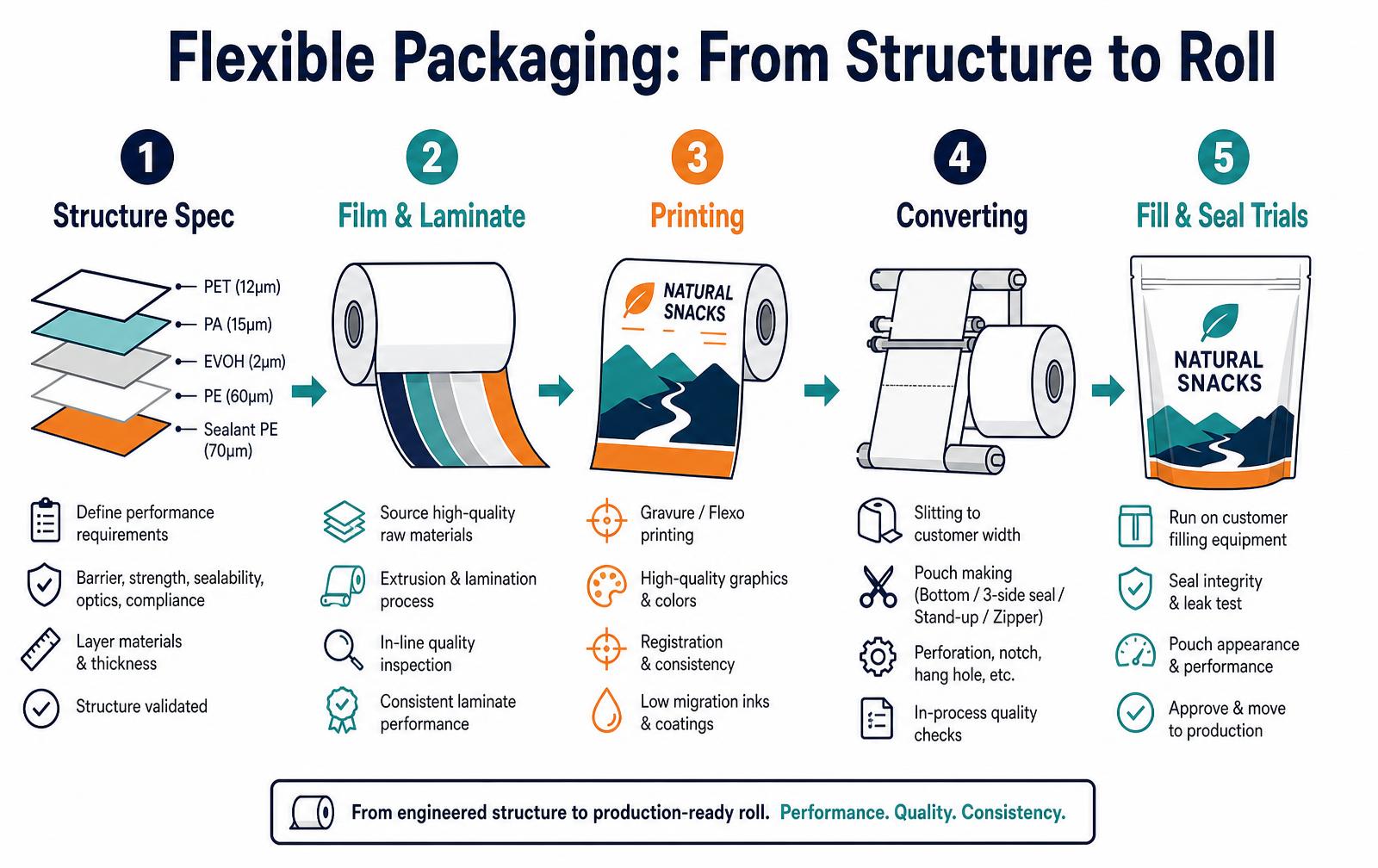
A flexible package is a laminate, and each layer is doing a job: print and stiffness on the outside, barrier in the middle, a sealant on the inside. Match the barrier to what actually spoils the product. Oxygen ruins fats and coffee, moisture ruins powders and crackers, light ruins vitamins and oils.
Over-specifying is expensive and increasingly a liability, because a metallised or foil layer that solves a modest oxygen problem also makes the pack unrecyclable in every store drop-off stream.
Mono-material polyethylene structures with a coated barrier now cover a surprising share of shelf-stable products, and they are the first thing to test before defaulting to a foil laminate.
Common structures and what they cost
Structure | Barrier | Relative cost | Recyclability | Typical use |
|---|---|---|---|---|
PE mono-material | Moderate moisture | Low | Store drop-off | Dry goods, frozen, non-sensitive |
PET / PE laminate | Moderate | Low-medium | Poor | General food, snacks |
Metallised PET / PE | High oxygen and light | Medium | Poor | Coffee, snacks, supplements |
Foil laminate | Highest | High | None | Pharma, long shelf life, aggressive products |
Coated mono-PE | High, without foil | Medium-high | Store drop-off | Brands with recyclability commitments |
What to settle before art goes to the printer
- Fill line compatibility: pouch format, seal width and film gauge must match the machine that will run it.
- Print method: digital for launch quantities, rotogravure or flexo once volume justifies plates.
- Colour approval on the actual film, never on a paper proof.
- Regulatory copy: net contents, allergens, nutrition and country-of-origin placement.
- Barcode verification on the printed substrate, including on a curved or gusseted surface.
- Drop, transit and shelf-life testing with product inside, not with a dummy fill.
Sustainability claims you can actually defend
Recyclability language on packaging is now a legal exposure, not a marketing flourish. A claim has to reflect whether the structure is accepted by facilities available to a substantial majority of consumers, and multi-layer laminates generally are not, whatever the resin code suggests.
Several states have added extended producer responsibility fees that scale with how hard a package is to recycle, which turns material choice into an ongoing cost rather than a one-time decision.
The defensible route is to design the structure for the recovery stream that genuinely exists in your markets, then describe it in plain terms, including the store drop-off qualifier when that is the only realistic path.
- Check the structure against recognised recyclability guidance before designing artwork around a claim.
- Prefer mono-material where the barrier allows, because it survives both regulation and retailer scorecards.
- Use precise qualifiers like store drop-off rather than an unqualified recyclable label.
- Right-size the pack; reducing material usually beats changing it.
- Track producer responsibility fees in the landed cost model, not as an afterthought.
Key takeaways
Packaging design is a structural and regulatory decision wearing a graphic design coat. Define the barrier the product actually needs, verify the structure runs on the fill line you will use, and validate print and barcodes on real film before committing to plates and minimum film orders.
How to qualify a flexible packaging manufacturer
Flexible packaging converters are not interchangeable. A converter that runs stand-up pouches on rotogravure for national brands will quote your 5,000-unit launch as a nuisance. A digital-print shop that happily runs 2,000 pouches cannot hold the barrier spec a two-year shelf life needs.
Qualify on four axes before you talk price: print process, lamination and barrier capability, filling compatibility, and minimum order quantity on both film and finished bags.
Print process | Typical MOQ | Plate / tooling cost | Lead time | Best for |
|---|---|---|---|---|
Digital (HP Indigo, inkjet) | 500-5,000 units | $0-$500 | 2-4 weeks | Launches, SKU proliferation, seasonal runs |
Flexographic | 10,000-25,000 units | $1,200-$4,000 per SKU | 4-8 weeks | Mid-volume consumer goods, 6-8 colors |
Rotogravure | 50,000+ units | $6,000-$20,000 per SKU | 8-14 weeks | High-volume national distribution, photographic art |
Pre-made pouch + digital label | 250-2,000 units | Label die only | 1-3 weeks | Test market and crowdfunding fulfillment |
Ask every candidate for three things in writing: a film structure recommendation with the oxygen and moisture transmission rates, the seal window their equipment holds on your filler, and the tolerance on bag width and seal placement. A converter who cannot state OTR and WVTR numbers is buying film from someone else and reselling it, which is fine at low volume and expensive at scale.
Film structures, barrier and shelf life
Barrier is what your packaging design is actually buying. Structure choice sets shelf life, and shelf life sets your distribution model - a 90-day product cannot go through a slow retail channel no matter how good the artwork is.
- PET/PE (2-ply). Cheapest laminate, moderate moisture barrier, poor oxygen barrier. Fine for dry goods with 3-6 month turns.
- PET/MET-PET/PE (3-ply metallized). The workhorse for snacks and coffee. Oxygen transmission near 0.5 cc/m2/day, 9-18 month shelf life, no see-through window.
- PET/AlOx or SiOx/PE. Clear high-barrier for products that must be visible. Costs 15-30 percent more than metallized and survives retort and microwave.
- Mono-material PE or PP. Recyclable in store drop-off streams and increasingly required by retail sustainability policies. Barrier is weaker unless a coating is added; validate seal strength early because the seal and the substrate melt in the same temperature range.
- Foil laminates. Absolute barrier, used for pharma and single-serve. Not recyclable, pinholes if flexed, and the highest film cost per square meter.
Run accelerated shelf-life testing (typically 40C / 75 percent RH) on the exact structure and the exact seal your production filler makes, not on hand-sealed samples. Most shelf-life failures in launched products trace to seal contamination from product dust, not to the film specification.
What drives the quoted price of flexible packaging
Two quotes for what looks like the same pouch can differ by a factor of two, and the difference is almost never the converter's margin. It is film structure, print process, tooling amortization and run length. Understanding which of those you control is the difference between negotiating and simply accepting a number.
Cost driver | Low-cost choice | Premium choice | Practical impact |
|---|---|---|---|
Film structure | Two-layer PET / PE | Five-layer with EVOH and foil | Barrier requirement sets this, not preference |
Print process | Flexo, 4 – 6 colors | Rotogravure, 8+ colors | Gravure cylinders cost far more but print longer runs cheaper |
Tooling | Reuse an existing die | New pouch die and plates | One-time charge, amortized over the first order |
Run length | Full-pallet runs | Frequent short runs | Setup waste dominates cost on short runs |
Finishing | Plain three-side seal | Zipper, spout, laser score, matte varnish | Each feature adds both unit cost and qualification time |
Minimum order quantities follow from the same logic. A converter charges for the film it wastes bringing a press up to color, so the floor is set by material, not by policy. Expect meaningful minimums per SKU on gravure work and lower ones on flexo, and consider a single printed film with different labels applied downstream if you have many low-volume variants.
Qualifying packaging before the first production run
- Approve a structure, not just a look. Get the layer stack, thicknesses and sealant type in writing; the graphic proof tells you nothing about shelf life.
- Run seal integrity and leak tests on pouches filled with the actual product, not water — oils and powders behave very differently in the seal area.
- Confirm the film runs on your filling line. Web tension, seal jaw temperature and registration marks are machine-specific; a film that runs beautifully at the converter can jam at your co-packer.
- Validate shelf life with real product, including accelerated aging if the claim exceeds a few months.
- Check drop and transit performance on full cases, since flexible packaging fails at the corners and seals long before the film itself tears.
- Verify label and regulatory copy at press-proof stage — a compliance error discovered after printing scraps the entire run.
Build roughly eight to twelve weeks into the launch plan between approving artwork and having qualified inventory on hand, longer if the structure is new to the converter. Packaging is the part of a product program most often left to the end and most likely to delay a launch, because unlike a design change it cannot be worked around: without a qualified pouch there is nothing to ship.
Choosing between flexible packaging manufacturers
Converters are not interchangeable. Some are built for long gravure runs for national brands and treat a startup order as a nuisance. Others specialize in short flexo runs, digital printing and stock pouch structures, and will hold your hand through qualification. Ask directly what a typical order looks like for them.
If your volume sits at the bottom of their range you will get last priority on press time, which shows up as missed dates rather than a bad quote.
- Ask for a structure recommendation, not just a price — a converter who proposes a film stack for your product understands the application; one who only quotes what you specified does not.
- Request references in your category, especially if your product is oily, acidic, aromatic or moisture-sensitive.
- Confirm food-contact, FDA or other compliance documentation exists before the first order, not after.
- Get tooling ownership in writing. Plates, cylinders and dies you paid for should be transferable if you change suppliers.
- Compare landed cost, including freight and duty on imported film — overseas quotes often lose their advantage once lead time and MOQs are priced in.
Finally, treat the first order as a pilot regardless of how confident everyone is. Order the smallest quantity the converter will run, put the pouches through your real filling line and your real distribution route, and only then commit to volume pricing. The cost of a small qualification run is trivial against a pallet of packaging that will not seal.
Frequently asked questions
How do I choose a flexible packaging manufacturer?
Start from your film structure, annual volume and filling equipment, then shortlist converters that already run that structure and print method at your volume. Ask for barrier data, references in your category, a line trial before committing, and written MOQ, tooling and lead time terms.
What is the minimum order for custom flexible packaging?
Digitally printed pouches start around 2,000 to 10,000 units with no plate charges. Flexographic runs generally need 25,000 to 100,000 units to absorb plate costs, and rotogravure typically requires 100,000 units or more per SKU.
How long does it take to get custom pouches made?
Plan on eight to sixteen weeks from approved structure to qualified production stock: one to two weeks for the structure spec, two to four for samples and colour approval, two to four for a line trial, and four to eight for the production run. Digital short runs can compress this to four to six weeks. Work with LA NPDT: if you are moving from here to execution, start with our packaging design services or talk to us about new product marketing .
Filed under:EducationInspirationWords
Services related to this guide
- Consumer product design firmsFirms compared for retail-bound goods: packaging, cost targets and first production runs.
- Best product design companiesDesign studios compared by scope, industry and what they hand off.
- Low-volume manufacturingFirst production runs without full injection-mould tooling.
- Product development examplesReal projects we designed, prototyped and shipped.