When Do You Need to Start Working on Your Product’s Prototype?
ccc
February 8, 20239 min read

Written by Konstantin Dolgan, Ph.D., NPDP
Founder & CEO, Product Development Engineer
Published February 8, 2023Updated September 2, 2026
So, you’ve got the next big idea that will shake the market. It makes you so happy that you can’t even sleep at night because of how excited you are. You just cannot wait to hold this creation in your hands.
Guess what? That is really great. But ideally, holding your stellar idea in your palms might need to stall a bit after a few boxes have been checked.
In your product development journey, you have to realize that you are in a marathon, not a sprint. Any inventor or business person running the market race as a sprint would fizzle out faster than they came to the limelight. So, you have to understand to be patient in order to get the gold out of your invention.
When Do You Need To Start Working On Your Product’s Prototype?
Definitely NOT immediately you get the product idea in itself. This is the mistake most businesses make when thinking of how to get a product prototype made.
Typically, you start thinking of creating a prototype after you have gotten the box of “concept design” ticked in your product development journey. This is because you would need the design files to build your prototype. Or at least you would need what kinds of components to purchase to put together your prototype.
And once you have gotten the design files, your product testing phase is around the corner. This is because prototyping is what guarantees a usability and viability test for the product in the market before it is eventually mass released at a later time after all necessary finetuning has been done.
So, you have gotten the necessary design files, and prototyping is finally here. What are the things you need to pay attention to at this phase?
Find Out What Type of Prototype You Need
A good way to go about this is by asking people. Ask relevant people in the prototyping process, such as the stakeholders, as well as your typical target market. Ask questions on what they look forward to seeing in the prototype and if they have any special features they would love to see.
Further, you could also just take the initiative. And this works by being specific about the goals and aim of the prototype. The goals typically include:
- Target Audience Review
- Investment Leverages
- Proof-Of-Concept
Do you know that prototyping can take just a few hours? And on the other hand, are you aware that it could also take several years? Yes, things could be quite out-of-the-box when it comes to creating a model.
Prototyping is not a one-way street. When you are thinking of how to make a prototype, always know that it depends on the type of product and the materials needed to make it. It just makes sense that the time it takes to prototype a kitchen device would be lesser than the time to model a software application.
The Durability of Prototypes
How long do prototypes last? This is a question of how the product prototype itself was made. Was it made to last long?
Usually, prototypes aren’t made to last long. They are made for the sole purpose of showcasing the details of a product. Thus, it is not the real thing.
Hence, a product prototype is weak and fragile. And as such, it is easy to break. Except it is well handled.
How you use the prototype and what it is used for will determine its durability. A 3D product prototype can retain its materials for up to a year, after which it begins to degrade due to the forces of nature acting on it for a long time.
Hottest Questions on When Do You Need to Start Working on Your Product’s Prototype?
1. When Should We Make Prototypes?
Making prototypes gives you a great view of the details of your idea. It helps you to know the parts of your product which are undone and need some revamping. Thus, you must create one as soon as the concept design has been finalized.
2. How Long Does It Take to Develop a Product Prototype?
Largely once the design of your product prototype is ready, then the process takes less time. It takes about a month or two at most for the prototyping to be done. It all boils down to your design process.
3. At What Stage Is a Prototype Developed and Why Is It Important?
Developing a prototype is so important because it is an experiment. It is the process where your idea turns into reality through the use of a model. It is a delicate stage, but it is essential to the success of your product.
4. What Is the First Step to Developing Prototype?
The very first stage is the idea generation stage. Once youngest an idea, then you have something to work with and turn into a 3D model.
Conclusion
It is easy to get your product prototype done. However, ticking all the necessary boxes before taking the prototyping step guarantees the product’s viability. So, by taking into cognizance the necessary information above, you have a great approach to how to get a prototype made.
LA NPDT is a company that leverages the power of excellent product development to give you an edge in the market. We have a remarkable team made up of professionals who are on edge to transform your ideas into products that do well in the market.
A few of the services that we take on at LA NPDT are building prototypes, CAD models and PCB circuits, and more. Message us today through Lanpdt: schedule consultation la npdt or call directly at 318-243-5789.
Product Prototype Stages and Timelines
Stage | Description | Typical Timeline |
|---|---|---|
Idea Generation | First step to developing a prototype. | Not specified |
Concept Design Finalization | Finalizing the concept design. | Not specified |
Prototype Creation | Building the prototype based on design files. | About one to two months |
Testing and Refinement | Guarantees usability and viability of the product. | Not specified |
Sources and standards
- ISO/ASTM 52900 additive manufacturing terminology — Standard definitions for additive manufacturing processes.
- NIST additive manufacturing research — Process and material research underpinning 3D printing quality.
- USPTO — patent basics — Official guidance on provisional and non-provisional filings for new products.
How to develop a product prototype at the right moment
The timing question has a precise answer: build a prototype as soon as the cheapest way to resolve your biggest open question is to hold something physical. Before that point, prototyping substitutes activity for thinking. After it, delay is just accumulating risk, because every week spent refining CAD around an unproven assumption is a week of work that may be discarded.
In practice, three signals tell you the moment has arrived. You are arguing about something that cannot be settled by drawings, such as whether a grip feels secure or whether a mechanism binds. You need to show something to someone whose decision depends on believing it works, whether that is an investor, a licensee or a buyer. Or you have a technical unknown at the heart of the concept, and no amount of analysis is going to convert it into a known.
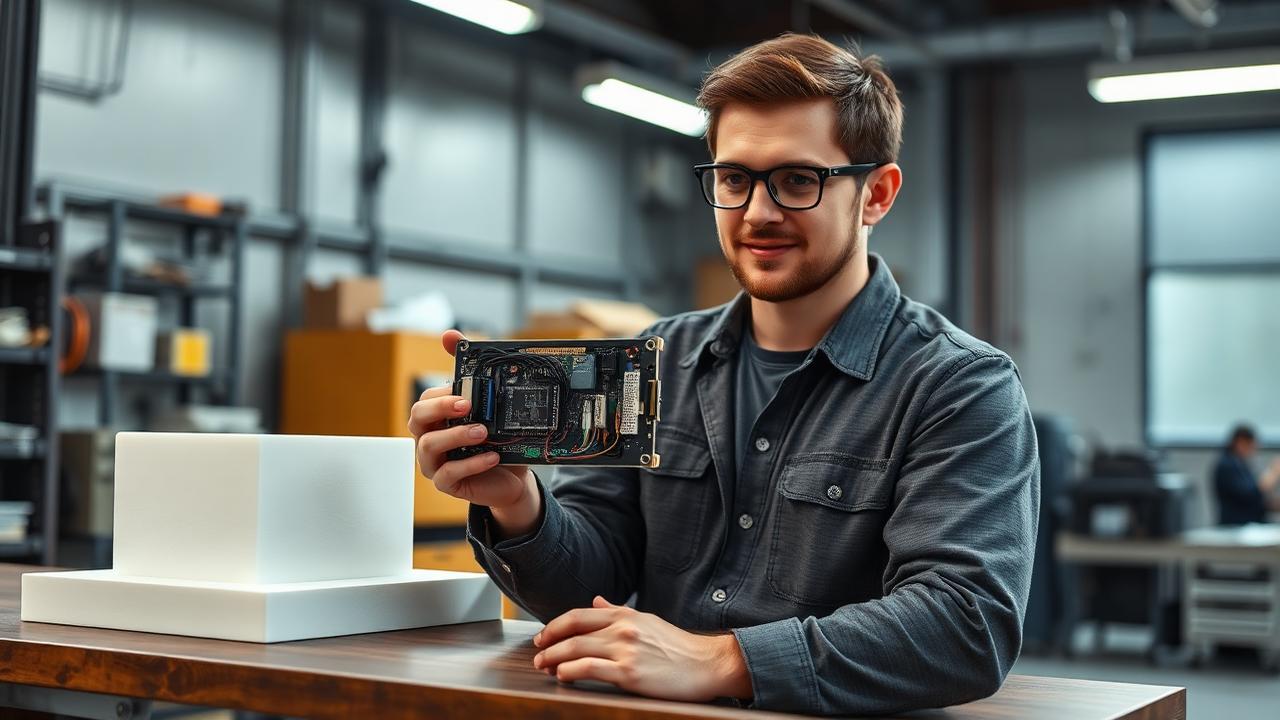
Prototype types and when each one is due
Prototype type | Build it when | Typical cost | Lead time | What it proves |
|---|---|---|---|---|
Sketch model in foam or card | Concept exists, proportions unresolved | $100-$1,000 | 2-5 days | Size, proportion, basic ergonomics |
Looks-like appearance model | Before customer or investor presentations | $1,500-$8,000 | 1-3 weeks | Visual design, finish, perceived quality |
Works-like functional rig | A core mechanism or circuit is unproven | $3,000-$25,000 | 2-6 weeks | The mechanism functions within needed tolerance |
Integrated alpha prototype | Form and function both broadly settled | $15,000-$60,000 | 4-10 weeks | The product works as one assembled system |
Engineering validation build | Design for manufacture is complete | $25,000-$100,000 | 6-12 weeks | Repeatability, tolerance stack-up, assembly time |
Production validation build | Tooling is cut and pilot parts exist | Tooling dependent | 8-16 weeks | Production units meet specification at yield |
Signs you have started prototyping too early or too late
- Too early: you cannot state in one sentence what the prototype is meant to prove.
- Too early: the requirements are still changing weekly, so every build is obsolete before it is finished.
- Too early: you are prototyping the enclosure before the electronics that must fit inside it are defined.
- Too late: you have spent months in CAD and never held anything.
- Too late: you are about to commit to tooling without having assembled a working unit by hand.
- Too late: a customer or investor has asked to see it twice and been shown renderings both times.
- Too late: a known technical risk has been deferred to 'later in engineering' for more than one phase.
Our rapid prototyping service builds both the works-like rigs and the presentation models, prototype design handles the CAD that makes them buildable, and product discovery is the better starting point if requirements are still moving.
A prototype schedule that works backwards from tooling
The question is rarely whether to prototype but how late you can afford to start. Work the schedule backwards from the tooling purchase order, because that is the last cheap moment to change geometry.
Injection mould steel takes four to eight weeks to cut and another two to three weeks to sample, so a design freeze happens roughly three months before first shipments. Every prototype round you want before that freeze needs its own slot: two weeks to build, one week to test, one week to redesign.
Four rounds is a five-month runway, and that is the honest answer to when prototyping starts.
Teams that skip this arithmetic discover it at the worst possible time, when a tooling change order costs five figures and pushes launch past a retail window. Teams that do it start earlier, with cruder models, and spend less overall.
Round | Fidelity | Typical cost | Question it answers | Lead time |
|---|---|---|---|---|
R0 appearance | 3D print + paint | $400-$1,500 | Does the form read correctly in hand? | 3-5 days |
R1 works-like | Printed housing, off-the-shelf electronics | $2,000-$8,000 | Does the core function work at all? | 2-3 weeks |
R2 integrated | CNC housing, custom PCB | $8,000-$30,000 | Does it work as one assembled product? | 4-6 weeks |
R3 pre-tool | Soft tooling or bridge parts | $15,000-$60,000 | Will the production process hold tolerances? | 6-8 weeks |
R4 pilot | Production tooling, small lot | Tooling cost | Can we build it repeatably at yield? | 8-12 weeks |
Signals that you already waited too long
Prototyping late is a decision, not an accident, and it announces itself through a handful of recognisable symptoms. Any two of these appearing together means the build should have started a month ago.
- Two engineers argue about ergonomics using renders instead of foam models.
- The bill of materials contains parts nobody has physically held.
- A supplier quote arrives with the caveat "pending final geometry" for the third time.
- The battery runtime figure in the pitch deck is a spreadsheet estimate, not a measurement.
- Certification testing is scheduled but no representative sample exists to submit.
- Marketing photography is booked before a works-like unit is on the calendar.
Budgeting prototypes against the cost of being wrong
The useful frame is not what a prototype costs but what it prevents. A $6,000 works-like round that reveals a motor is undersized saves a tooling revision and, more importantly, saves the months of field returns that an underpowered product generates.
Compare the cost of the round against the cost of discovering the same fact one stage later, where the multiplier is roughly ten times per stage: caught in CAD it is an afternoon, caught in prototype it is a few thousand dollars, caught in tooling it is tens of thousands, caught in the field it is the brand.
Allocate roughly fifteen to twenty per cent of a hardware development budget to prototyping and testing. Programs that allocate less almost always spend the difference later on engineering change orders, and they spend it under deadline pressure with fewer options available.
Frequently asked questions
How do you develop a product prototype step by step?
Define the single question the prototype must answer, choose the cheapest build that answers it, produce the CAD or rig, build it, test it against a written criterion, and record what changed. Then repeat only if a new question emerged. The step most often skipped is the written criterion, and skipping it is why teams end up with a shelf of prototypes and no decisions.
How long does it take to build a product prototype?
A rough form model takes days. A presentable appearance model takes one to three weeks. A functional prototype that genuinely works takes four to eight weeks for most electromechanical products, and longer when custom electronics need board fabrication and firmware. Plan on the whole prototyping phase spanning two to four months across several iterations rather than a single build.
Do I need a prototype before filing a patent?
No. A patent requires that you can describe how to make and use the invention, not that you have built it. In practice, prototyping frequently improves the application, because building reveals the variations and alternate embodiments worth claiming. A common sequence is a provisional filing first, then prototyping during the twelve-month window, then a utility application shaped by what the builds taught you.
Can I skip prototyping and go straight to manufacturing?
Only for products that are near-copies of something you have already made. For anything new, tooling is the point of no return: steel is expensive to cut and more expensive to modify, and defects discovered in the first production run cost tens of thousands to fix. A prototype phase that costs twenty thousand routinely prevents a tooling change that would have cost far more and delayed launch by months.
Filed under:EducationInspirationWords
Services related to this guide
- Best prototyping companiesDevelopment firms, instant-quote bureaus and local shops — who fits which job.
- Free prototype cost calculatorFive to eight questions, an instant cost range for a first prototype.
- Prototype development companiesWhich firms take a sketch to a working prototype — and which only fabricate parts.
- Rapid prototypingWorking prototypes in days, from 3D printing to vacuum casting.