Why You Should Pursue Your Product Ideas
If you ever dreamed to develop product ideas but wasn't sure where to start or why to care about, this post is must to read.
March 5, 202219 min read

Written by Yelena Rymbayeva, MPhil Communication & Media Studies, BTech Quality Control
Marketing & Product Leader, Technology Commercialization
Published March 5, 2022Updated September 2, 2026
Why You Should Develop Product Ideas
Guest post by Onega Ulanova and Konstantin Dolgan.
Every day, thousands of ideas are birthed. Unfortunately, only a few of these ideas ever get to see the light of the day because not all idea people develop product ideas.But then, while it is challenging enough to get great ideas, the bigger task lies in converting the ideas into reality.
Many of us have conceived ideas that can change society and earn us a fortune.
But we often lack the willingness to give life to these ideas because entrepreneurship comes withtaking risks.So,Reid Hoffman, founder of LinkedIn, was right when he said:“The entrepreneurial journey starts with jumping off a cliff and assembling an airplane on the way down.”
In this article, we show you why you should take the necessary steps to build your ideas in today’s competitive space. You will learn why, how, and what to do to make your product ideas appreciated by the world. Why?
Why you should develop your ideas
Nobody knows your ideas more than you do. So, when you work on your ideas, it is likely that you’ll develop a feeling of innermost satisfaction. Indeed, it will be a dream come true for you.
Many people are led to believe that only a particular set of people can create things. But this belief is wrong. Everyone has a skill.
And we all can develop distinct ideas in different industries. Being an innovator is not a small feat. The mere fact that you’re showing a willingness to develop an idea is a pointer to confidence on your part.
And this is one of the hallmarks of successful entrepreneurs. If you eventually succeed on the project, you’ll experience a boost in your self-esteem. Even if you fail, it is not the end of the road.
There are many other projects to work on in the future. Hence, you will be able to bring lessons learned from your previous actions to bear when you’re developing new ideas. In short, developing your ideas helps you gather the needed experience to survive in any competitive industry.
Have you ever thought of how regretful Mark Zuckerberg would have been if he had never worked on his social networking idea? As of January 2022, Facebook was worth over$958 Billion. You think that figure is overwhelming?
Well, what if I told you that you could make way more than that. The only thing still limiting you is that you’re not taking action on your ideas.
Why you should develop this idea exactly
If you are unsure of an idea, there’s no harm in giving it time. However, if the idea sticks with you for more than 3 days, you should start gathering some facts about it. Once you’ve conducted personal research, don’t hesitate tobegin developingthe idea.
Subsequently, you can fine-tune and experiment with the idea before putting it out there for investors and the general public. Thankfully, the world we now live in is one with unlimited problems. Hence, solutions are desperately needed to combat many of these challenges.
If you are creative enough, you can exploit the market opportunities by developing the best ideas. There’s always an aspect of society in dire need of workable innovations. So, it is left for you to develop and sell your ideas as the best out there.
You should probably bear in mind that your innovation is not only to be enjoyed by the public. Sometimes, your product can be incredibly beneficial for personal use. If you need a tool that can make things easier for you at home or the workplace, you should create such a tool by every means possible.
Also, someone out there might need the same tools from your co-workers. You can make some bucks from selling the products to such customers. You can conceive many ideas at once.
But the choice is yours in determining the best product to develop at a particular time. If you need help deciding which idea satisfies you personally or financially, or keeping a track of all those great ideas you have, I recommend theRealizr tool.
Consequences of not developing the idea
You must be aware that not taking risks simply means you are not ready to make any gains. If you are scared to develop that idea, it only implies that you will not develop any skills that can help you in the future. Think of saving your money in the bank versus investing in the stock market.
It is true that the latter takes some time and bears more risks. But you are confident of making good profits if you are patient enough. This same analogy applies to developing your ideas.
Ideas will remain idle until you develop them. You will never grow unless you take the initiative of building your idea. Most importantly, I hope you wouldn’t cry yourself to bed after discovering that someone else is making waves with a similar project you initially conceived.
Why you are afraid to start
It is natural for human beings to be fearful when they venture into something for the first time. The chances are that you will want to withdraw from taking action for fear of doing something wrong, looking foolish, or not meeting expectations. But you must learn to overlook these obstacles.
Quite frankly, for entrepreneurs, courage is not the absence of fear. It is the ability to persist despite it. Experience has made us realize that failure is part of the process.
There’s enough proof that those who fail more are likely to succeed more. For instance, ThomasEdison and James Dyson had to try several times without any luck. But their efforts paid off one day, and they got the desired breakthrough.
Whenever it seems as if your ideas are not working, just remember what Edison said about him failing to make an electric bulb 1000 times. Edison noted that:“I didn’t fail 1,000 times – the light bulb was an invention with 1,000 steps.”
Fear is a temporary cognitive and emotional reaction to a threat or potential achievement. So, let the fear of failure be a source of motivation to succeed.Like I said earlier, understanding the motivation behind your idea is crucial. This will later be your source of strength when fear or fatigue sets in.
Why you should work with the team, not by yourself alone
When the entire village looks after a child, he will have better qualities, unlike another child raised only by his parents. This concept is the same with developing a new product. Multiple disciplines are needed to bring your product idea to reality.
Hence, you can’t be a master of everything. Trying to figure out everything by yourself will only result in feeling overwhelmed. In fact, research has shown that the best of ideas are not inspired when we are alone.
They are obtained during interactions with like-minded people. You need to brainstorm with other informed professionals to arrive at the best product. Otherwise, you might repeat the same mistakes previous developers have made.
Building a product requires a lot of time and concentration. If you devote all your time to one innovation, how will you keep up with other aspects of your life? Of course, time is money. And you should put yours into more valuable tasks.
How to go about your product development idea if it’s not your primary business
Not every product developer designs products for a living. It may be the case that product development is a side-hustle for you. However, you should look before you leap.
It is not in your best interest to dive straight into product development without first mapping out a plan. The first step is to carry out comprehensive research on the product you want to design. If you check online, there’s an abundance of information on these products.
Also, you get to see companies that have tried to create these products. Take a book and pen down why they failed. What was their business model?
Did they have a target audience? What are the challenges faced in such an industry? You must answer these crucial questions before even setting up a team to actualize your idea.
Next is to find how to include such a project in your schedule. Then you must be able to keep track of the progress and also set milestones. In addition, new developers must learn to measure gaps in their skills and resources.
So, you can write out what you need to do to cover these lapses. After you have learned the basics of developing a new product, you should talk to experienced developers to guide you. Just make sure that your notes and reference materials are organized.
Later on, you can develop a plan with milestones. Further, you have to define your responsibilities. You must make a list of one-time and recurring tasks that will help develop a tool that has the potential of disrupting the market.
How to determine if your idea is worth it
It is unwise to spend time, energy, and resources on a project that will most likely not materialize right from the onset. Hence, you should probe the potential of a product. Firstly, new developers ought to do a proper guestimate on the market size of a product.
You’ve got to determine the Total Addressable Market (TAM) and the Serviceable Addressable Market (SAM). But note that these are not the only indexes for guestimate. Once the guestimate is done, you should estimate your potential sales and profits.
This is a smart way of decoding what amount to pump into your project as capital. And don’t hesitate to check out market data about trends looking upward. If your products have already been developed, you should try to sell them on marketplaces like Etsy or Kickstarter.
This process is called Pretotyping or pre-sale launch. You are merely testing the interests of potential customers and acceptance of your products on the internet.
How to develop a plan for creating a product
Having a plan helps you achieve your goals faster as an entrepreneur. If you are set to draw out a plan for your project, using theLA New Production Development Team’s planis a good idea. There’s more to developing a product than the manufacturing process.
It is also essential that you put some factors into consideration. Some pre and post-production activities and expenses will go a long way in determining the success of your product. Some of these considerations include legal, marketing, and other factors.
When entrepreneurs find it hard to succeed, it is not because they are not brilliant. In most cases, new developers lack consistency. You must determine how much time you can allocate to a project per week and ensure you meet that target.
And don’t beat yourself up when it’s taking longer to develop a product. It usually takes time to turn in excellent products if you are not yet a professional. Moreover, you need to talk to potential engineers and manufacturers to find out lead times.
Then you can look forward to the best time to launch your new products. You may decide to make Christmas sales or consider other strategic events.
How to find providers for product development
Remember we said earlier that you can’t develop a product alone if you want the best? You need business partners that you can collaborate with. Developers need to consider what kind of partnership is most suitable for their particular cituation.
It could be Marketing, Sales, Engineering, etc. Your next assignment is to write a job description for each partner. This is to let you have a clear understanding of what you need from them. They all perform different functions for the overall efficiency of your development process.
At this stage, you have to make Google your best friend. Open your PC and search for the best partners you can ever get. They are all over the internet, including Quora, Reddit, Linkedin, Facebook groups.
And you can also rely on the words of mouth of professional developers, accelerators, and incubators about potential partners.
How to define the end goals of product development
Before committing to product development, there are metrics & indicators you need to set for yourself. Knowing when you would stop product development motivates you to target milestones in your career. Do you think you should do it your whole life and full time?
What if you take it up as a seasonal project? Do you want to sell it? If the product idea is not sustainable, you shouldn’t even consider making it your primary source of income.
You also have to estimate the lifetime of your product. At what point will you need to raise additional capital, if need be? Likewise, you must determine what it means to you if the project is successful or not.
How to put yourself up for success
Funding is the backbone of any successful project. How do you intend to see your project to a reasonable success without money? In fact, there’s a general principle that you need money to make more money.
Thus, you should be on the lookout for reliable investors that believe in your dreams. Notwithstanding, you can waste money on a product if the project suffers attention. Your energy should be channeled towards actualizing your goals as a young developer.
I cannot overemphasize why you have to create a special time for your project. And, of course, things might not go as always planned. It is a given that entrepreneurs experience challenges in their journey.
There will be bad days just like the good days. But tough times don’t last; only tough people do. So, you have to stay motivated and keep your head in the game.
What you should do to get comfortable with pursuing this idea (or how to get comfortable with being uncomfortable with pursuing your idea)
You will not always feel comfortable pursuing your dreams. Likely, challenges are bound to discourage you. But you must find a way to get comfortable with pursuing your ideas.
Let me show how. First, you need to ask yourself if you are comfortable not developing that idea. If you discover it is in your best interest to pursue it, give it a try.
Equally, it is better to pull out from the start if you are comfortable with not doing such an idea. More so, don’t make the plan too hard on yourself. You should see it as an experiment.
And having a contingency plan will help you navigate failures. It is dangerous to put all your eggs in one basket like regular investments. Hence you must diversify your resources and have an exit strategy in case things go south.
Knowing how to repurpose your resources is also crucial. Trust is the currency of business. Once people find a reason to trust you, you will get the most out of your relationship with them.
If you can establish trust with your team and business partners, trust me, the sky is only the starting point for you. Finally, you must learn to trust the process. Don’t put your focus on the final product but the process.
Knowing the process and what to expect (the best and worst-case scenario) lets you stay ahead of the steps.
Minimizing losses if my product development process will not go as planned
At every point, developers must have a review of their milestones. This is where the board of advisors plays a crucial role. If you suffer losses in product development, the best option is not to quit.
You only have to take action in minimizing losses. Selling resources to similar companies is a smart way to make enough profits to cover your losses. In the same vein, you could try to repurpose your resources to other ventures or sell the idea on Flippa-like sites. Or you could share knowledge with others as a coach or mentor in the form of a course.
What will happen if I don’t pursue my idea?
When you pull back from giving life to your idea, you will likely feel a high level of disappointment. You may ask why. And the reason is that competition is stiff out there.
Other developers are probably conceiving similar ideas as yours. They will stop at nothing to see their products on the shelves. I hope you wouldn’t feel bad when such a product enjoys wide acceptance.
Above this, opportunity cost is lost. And you would be saving money and time if you didn’t take action. But remember, this means no progress at all. You certainly don’t want that to happen.
What tools can I use to feel more confident to start working on the idea?
Developers need tools that can help them develop their ideas better. You can get tons of information and utilities using Realizr, Trello, or Notion tools. And if you’d like to detail your progress, you can keep all communication in one channel like Slack.
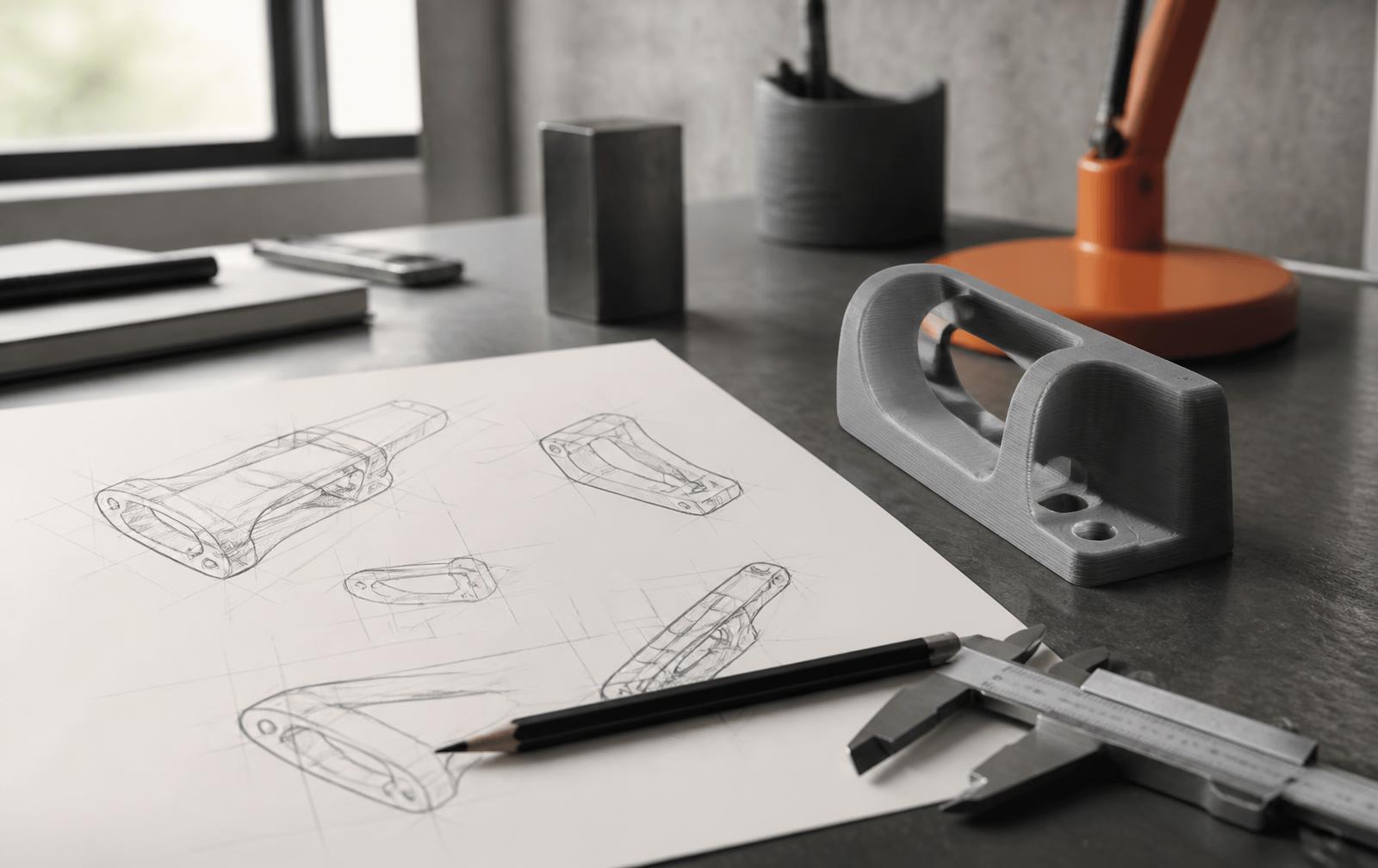
Every product developer preferably needs to acquire skills on CAD, Photoshop, etc. And if your idea relates to developing an app, you should learn the soft language. Getting to know the basics of 3D printing is also fantastic. And Calipers with other measuring tools are equally important.
Online research is not excluded from the options. Likewise, you should be conversant with SWOT analysis and get milestone templates.
What if I don’t have enough money right now?
It’s okay not to have everything figured out at the moment. You don’t need to have the whole bucks at the beginning. You are in a marathon and not a sprint.
The most practical step is to manage your income and see if you have monthly spare to invest in your idea. If you can get partners who love your idea, you can ask them to join you and ensure you have a cash reserve.
If the capital is not sufficient, you can get in touch with investors and research grants or other government programs since you’re just starting. You may also want to ask what traction is needed. A conventional loan is the least preferred option.
On top of this, you should gear up and participate in pitch competitions The Bottom Line Opportunities for product developers are so many that you would only be short changing yourself by refusing to work on your ideas.
If your ideas are consistently innovative, I assure you that you are covered for life in terms of personal financial security. As long as your product is a solution, you will continue to make more money. And you may even decide to invest some of your profits in other ventures.
Don’t fall into the trap of needless worries about securing your project’s finance. That one will come. What should bother you is developing your ideas and making them more acceptable and sellable.
Remember that the more time you spend doubting yourself, the better chances for others with similar ideas to make more money. And you don’t want to live the rest of your life in regret. Don’t delay your success by“waiting for the right time.”Indeed, there’s no better time than now.
If you need more guidance on developing the best products,click here. about Entrepreneur.comYou should get to work immediately and build your ideas today!
How to develop a product idea without betting everything on it
Deciding to pursue an idea is the easy part. Deciding how much to risk, in what order, and against which milestone is where most first-time founders lose money. The useful frame is staged commitment: every phase of development buys a specific piece of information, and you only fund the next phase when the previous one delivered. Treated this way, a product programme stops being one terrifying leap and becomes a series of small, survivable decisions.
The sequence below is what we run with clients, and the costs are the ranges we actually see for a modest consumer or light industrial product. They are not quotes; they are the order of magnitude you should plan around so that the first surprise does not end the project.

Staged commitment: what each phase costs and answers
Phase | Typical cost | Duration | Question it answers | Kill signal |
|---|---|---|---|---|
Discovery and market validation | $5,000-$20,000 | 3-6 weeks | Does a buyer with a budget exist? | No one will pre-commit at a viable price |
Concept and industrial design | $10,000-$35,000 | 4-8 weeks | Can it be a product people want to hold? | No concept satisfies the constraints |
Proof-of-concept prototype | $8,000-$40,000 | 4-10 weeks | Does the core mechanism work? | The mechanism needs new science, not engineering |
Engineering and design for manufacture | $40,000-$150,000 | 3-6 months | Can it be made repeatably at target cost? | Landed cost exceeds what the market will pay |
Tooling and pilot production | $25,000-$200,000 | 3-5 months | Do production units meet spec? | Yield or defect rates make unit economics impossible |
Launch and first replenishment | $20,000-$100,000 | 2-4 months | Will it sell at the price you modelled? | Acquisition cost exceeds contribution margin |
Readiness checklist before you fund the next phase
- Write the kill criterion first. Before spending, state in one sentence what result would make you stop. If you cannot write it, you are not running a phase, you are hoping.
- Confirm the buyer, not the market. A market size figure from a report is not evidence. Names of people who said they would pay are.
- Know the target landed cost and the retail price it implies, including channel margin, freight and duty, before engineering starts.
- Protect what is protectable. A provisional filing before public disclosure costs little and preserves options for twelve months.
- Line up the next phase's funding before starting the current one. Running out mid-tooling is the most expensive place to pause.
- Agree who owns the IP with every contractor and design partner, in writing, before work begins.
- Set a decision date, not just a budget. Phases without deadlines drift and quietly consume the runway meant for production.
If you want a structured version of the first two rows, our product discovery stage exists precisely to make the go/no-go call cheaply. From there, rapid prototyping answers the feasibility question and end-to-end product development carries it to production.
Frequently asked questions
How do you develop a product idea with limited money?
Buy information in the cheapest order. Validation before design, a crude proof of concept before polished engineering, and off-the-shelf components before custom parts. Most of the cost in product development sits in tooling and production, so every question you can answer before that point is answered at a fraction of the price. A realistic minimum to reach a credible, demonstrable prototype is fifteen to fifty thousand dollars depending on complexity.
Should I quit my job to develop a product idea?
Almost never at the start. The early phases are calendar-bound rather than effort-bound: you are waiting on prototype builds, supplier quotes and test results, and those waits do not shorten because you are available full time. The point where full-time attention genuinely changes the outcome is usually launch and early sales, when response speed matters daily. Keep the income until then.
How do I know when to stop pursuing an idea?
When a phase returns its kill signal and the fix requires a fundamentally different product. Cost overruns and schedule slips are normal and rarely mean stopping. What means stopping is discovering that the buyer will not pay what the product must cost, or that the core mechanism cannot be made reliable with existing technology. Both are honest answers, and finding them for twenty thousand dollars instead of two hundred thousand is a good outcome.
Do I need a team to develop a product idea?
You need access to skills, not necessarily headcount. Very few founders can cover industrial design, mechanical and electrical engineering, firmware, regulatory work and supply chain themselves, and hiring all of it early is the fastest way to burn capital. Most successful small programmes use a development partner for the technical span and keep the founder focused on customers, funding and decisions.
Six steps, in order, with what each costs
Deciding what to do with a product idea is mostly a sequencing problem. Each step below is cheap, and each one is capable of killing the idea before the expensive step begins — which is exactly what you want it to do.
Step | What you produce | Typical cost | Time | Kill criterion |
|---|---|---|---|---|
1. Write it down | One page: user, problem, how it works, why now | $0 | 1 day | You cannot name a specific user |
2. Prior-art search | List of the ten closest existing products and patents | $0-$1,500 | 3-7 days | It already exists and sells poorly |
3. Demand evidence | 20 conversations or a landing-page test with real traffic | $100-$2,000 | 2-3 weeks | Nobody will name a price |
4. Rough cost model | Parametric unit-cost estimate and a target price | $0-$4,000 | 1 week | No margin at a price people accept |
5. Provisional patent | Filed application holding a priority date | $1,500-$5,000 | 1-2 weeks | No novel, defensible mechanism |
6. Cheapest proof | A prototype that answers the single riskiest question | $500-$8,000 | 2-6 weeks | The core mechanism does not work |
Caption: total exposure through step six is typically under $15,000 — against a $40k-$150k development programme that these steps decide whether to start.
The evidence that makes step three real
Most idea validation collapses because it asks the wrong question. 'Would you buy this?' produces polite yes answers and no information.
Useful evidence looks like: a stated price the person would pay, a description of what they use today and what it costs them, a pre-order or a deposit, or a landing page that converts cold traffic at a measurable rate.
Twenty specific conversations with people who have the problem beat two hundred survey responses from people who do not.
Protecting the idea without overspending
- Do the prior-art search yourself first on Google Patents and Amazon before paying for an opinion — it costs a weekend and rules out a surprising share of ideas.
- File a provisional before any public disclosure: trade show, crowdfunding page, social post or pitch to a manufacturer.
- Use NDAs with suppliers and contractors, and accept that most retailers and investors will not sign one.
- A provisional buys twelve months to gather evidence; use them, because the non-provisional is the expensive filing.
- Do not spend $15,000 on patent work to protect an idea you have not yet shown anyone will buy.
When to stop and when to commit
Commit when three things are simultaneously true: someone who is not related to you has named a price they would pay, a rough cost model leaves a workable margin at that price, and a cheap prototype has proven the mechanism works. Stop when two of the three have failed twice after honest attempts to fix them. The most expensive outcome in product development is not a fast no — it is a slow maybe funded for three years.
When the evidence points forward, the next step is a structured one: our product discovery engagement converts a validated idea into a defined programme, and rapid prototyping builds the proof that step six calls for.
Frequently asked questions
What should I do first with a new product idea?
Write it down as one page naming the user, the problem, the mechanism and why now — then run a prior-art search before spending anything. Those two steps cost almost nothing and eliminate a large share of ideas that cannot work commercially.
Should I patent my idea before developing it?
File a provisional once the mechanism is defined and before any public disclosure, but after you have some demand evidence. A provisional costs $1,500-$5,000 and holds a priority date for twelve months, which is the right amount of protection at the idea stage.
How do I know if my product idea is worth pursuing?
Someone unrelated to you names a price they would pay, a rough cost model leaves margin at that price, and a cheap prototype proves the mechanism. Missing any one of the three means keep testing rather than start development.
Can I sell my product idea without building it?
Licensing is possible but rare, and it almost always requires a filed application plus a working prototype and some demand evidence. Companies license de-risked products, not ideas, and typical royalties run 2-5% of wholesale.
Filed under:EducationInspiration
Services related to this guide
- Product design servicesIndustrial design and CAD taken all the way to manufacturable files.
- Rapid prototypingWorking prototypes in days, from 3D printing to vacuum casting.
- Electronic design servicesSchematic, PCB layout, firmware and bring-up, through to production handoff.
- Product development examplesReal projects we designed, prototyped and shipped.