You have an idea – what’s next?
You’ve experienced the blinding glow of your lightbulb moment, the moment of clarity. Your brilliant idea has finally come to you! Contact us today!
December 1, 20168 min read

Written by Konstantin Dolgan, Ph.D., NPDP
Founder & CEO, Product Development Engineer
Published December 1, 2016Updated September 2, 2026
You’ve experienced the blinding glow of your lightbulb moment, the moment of clarity. Your brilliant idea has finally come to you, and you want to bring it to fruition. But how?
The minds of entrepreneurs are constantly experiencing an influx of ideas, and often times, they aren’t great ones. An idea is just a starting place. Before truly embarking on this ambitious quest, it is critical to brainstorm to ensure that this is the project you want to pursue and that there is potential for success.
Define your idea.
- Focus on the purpose and heart of your concept- the who, what, why, and how. Who is your clientele? What are the specifics of your product? Why are you putting this on the market? How will it benefit your customer? Asking these key questions allows you to devise a well-formulated concept. Ideas typically begin one way and end another. Be flexible, and open to any change of direction, as it can lead to magnificent things!
- Consider collecting some outside perspective. Talking to friends, family, fellow entrepreneurs, or your potential clientele, allows you to gain new perspective and refine your idea into one worth pursuing.
- Scope out competitors. Ensure that your idea is, in fact, a unique one. If similar products and ideas exist on the market, determine how you can take yours to the next level.
Develop a course of action.
A house can’t build itself. It requires an exhaustive blueprint outlining measurements and materials. The same concept applies to developing an idea! Rather than allowing your idea to fruitlessly simmer in your mind, develop a detailed plan that enables you to take action.
- Create a manageable checklist of action steps. Make this list as detailed as possible. Include deadlines and resources. Consider creating SMART goals – Specific, Measurable, Accepted, Realistic, and Timely. All that matters is that you devise a system that works for you.
- Record any “backburner items”, the ideas that randomly come to mind as you work through your checklist. Periodically refer back to these. You will reject some, but others will be worth keeping.
- Keep track of relevant references- any notes, articles, and supporting documents that might help you along the way.
- Identify resources. Your pursuit requires ample reliable resources, including anything that will propel your concept forward. Teammates, investors, funding, loans – you name it. Amass a solid foundation of resources to support you through this journey and allow you to mark items odd of your checklist!
Even when the going gets tough, don’t give up. This doesn’t mean aimlessly chasing an idea with no potential- but it does mean following through and not giving up due to inevitable discomfort, fear and setbacks.
The best ventures and pursuits require fierce strength and follow through, even in the face of excruciating difficulty. Overcoming roadblocks and coming out on top is one of the most fulfilling accomplishments you can experience.
The more you overcome, the more confident you will feel in your ability to chase your goals. Whatever you do, don’t wait. The clock is ticking, and you can’t turn back time.
Rather than allowing this brilliant idea to get lost among the abandoned others, develop your plan and take action. Only you can make this happen.
Don’t give up.
You miss 100% of the shots you don’t take.
Turn your dreams into reality!
Contact our experts today!
Three reasons why our clients love working with us:
If you ever thought of developing a new product, don’t wait any longer. Talk with one of our experts today.
- 3D (7)
- ecommerce (1)
- Education (230)
- Inspiration (121)
- Market Reports (4)
- Media (17)
- News (50)
- none (61)
- Stories (7)
- Tech (27)
- Tech Talk Podcast (31)
- Time Management (1)
- Uncategorized (109)
- Words (62)
Receive Pdp Example
Please submit your contact info to receive an example of a new product development plan.
Thank you for choosing LA New Product Development Team for your New Product development plan.
If you have any questions or need assistance with your order, please don’t hesitate to contact us.
Thank you for choosing LA New Product Development Team for your Prior Art Search.
Please fill out the form to submit your order.
Upon successful payment, you will receive an email with a Non-Disclosure Agreement (NDA) and a questionnaire regarding your product idea.
Your privacy and security are paramount to us, so rest assured that your information will be handled with the utmost confidentiality.
Step 1: Fill in your contact and billing details.
Step 2: Review your order summary.
Step 3: Submit payment.
After your payment is processed, please check your email for the NDA and questionnaire. Completing these documents promptly will allow us to start your Prior Art Search without delay.
If you have any questions or need assistance with your order, please don’t hesitate to contact us.
Thank you for choosing LA New Product Development Team for your Prior Art Search.
Please fill out the form to submit your order.
Upon successful payment, you will receive an email with a Non-Disclosure Agreement (NDA) and a questionnaire regarding your product idea.
Your privacy and security are paramount to us, so rest assured that your information will be handled with the utmost confidentiality.
Step 1: Fill in your contact and billing details.
Step 2: Review your order summary.
Step 3: Submit payment.
After your payment is processed, please check your email for the NDA and questionnaire. Completing these documents promptly will allow us to start your Prior Art Search without delay.
If you have any questions or need assistance with your order, please don’t hesitate to contact us.
Thank you for choosing LA New Product Development Team for your Prior Art Search.
Please fill out the form to submit your order.
Upon successful payment, you will receive an email with a Non-Disclosure Agreement (NDA) and a questionnaire regarding your product idea.
Your privacy and security are paramount to us, so rest assured that your information will be handled with the utmost confidentiality.
Step 1: Fill in your contact and billing details.
Step 2: Review your order summary.
Step 3: Submit payment.
After your payment is processed, please check your email for the NDA and questionnaire. Completing these documents promptly will allow us to start your Prior Art Search without delay.
If you have any questions or need assistance with your order, please don’t hesitate to contact us.
Steps to Develop a Product Idea
Step | Description |
|---|---|
Define Your Idea | Identify clientele, product specifics, market purpose, and customer benefits. |
Gather Perspectives | Seek input from others; talk to friends, family, or potential customers. |
Analyze Competition | Scope out competitors to ensure uniqueness or plan improvements. |
Develop Action Plan | Create a detailed checklist with deadlines and resources. |
Identify Resources | Amass reliable resources like teammates, investors, or funding. |
Frequently asked questions
What should I do after I have a new product idea?
First, define your idea by asking key questions like who your clientele is, what your product specifics are, why it is on the market, and how it benefits customers. Consider outside perspectives from friends, family, or potential clientele to refine your idea. Research competitors to ensure uniqueness or identify improvements.
How can I develop a plan for my product idea?
Create a detailed plan by making a manageable checklist of action steps. Include deadlines and necessary resources. Consider using SMART goals: Specific, Measurable, Accepted, Realistic, and Timely. Track 'backburner items' and relevant references to support your progress.
What resources are needed to pursue a new product idea?
Your pursuit requires ample reliable resources. These can include teammates, investors, funding, and loans. Amass a solid foundation of resources to support your journey. This will help you complete items on your action checklist.
How can I receive an example of a New Product Development Plan?
You can submit your contact information to receive an example of a New Product Development Plan. LA New Product Development Team can provide this resource to help you understand the process.
What happens after submitting a Prior Art Search order?
After successful payment for a Prior Art Search, you will receive an email. This email will contain a Non-Disclosure Agreement (NDA) and a questionnaire about your product idea. Completing these documents promptly allows the search to begin without delay, ensuring confidentiality.
Sources and standards
- USPTO — patent basics — Official filing guidance from the US Patent and Trademark Office.
- WIPO PCT system — International patent filing route for products sold abroad.
- NIST Manufacturing Extension Partnership — Federal program supporting US small and mid-size manufacturers.

I have an idea — what next, in the first ninety days
The gap between an idea and a product is mostly a sequence problem. Most first-time inventors spend money in the wrong order: a full patent filing before anyone has confirmed the concept is manufacturable, or a production tool before a single user has held a prototype.
The cheapest ninety days you will ever spend are the ones that answer four questions in order — does it already exist, can it be made at a sensible cost, will anyone pay for it, and what is the smallest version worth building.
Step | What it answers | Typical spend | Typical time |
|---|---|---|---|
Prior art and patent search | Has someone already done this? | $300–$2,500 | 1–3 weeks |
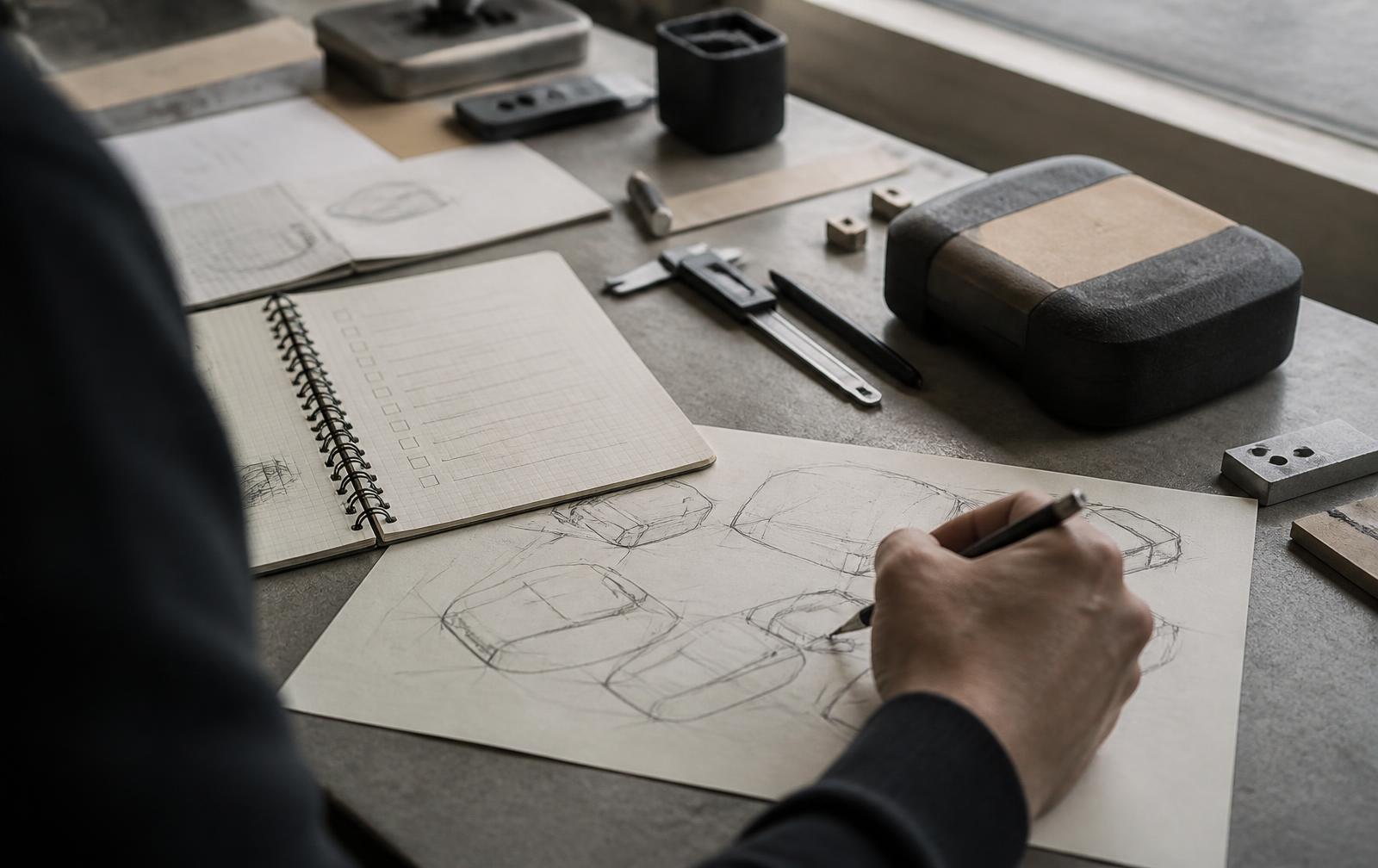
Concept sketches and feasibility review | Can it physically work? | $1,500–$6,000 | 2–4 weeks |
Cost-of-goods estimate | Is there room for a margin? | $1,000–$4,000 | 1–2 weeks |
Looks-like or works-like prototype | Does it convince a real user? | $2,500–$15,000 | 3–8 weeks |
Provisional patent application | Does it protect a real claim? | $1,500–$4,000 | 1–2 weeks |
Small user test (8–15 people) | Will anyone actually pay? | $500–$3,000 | 2–3 weeks |
Ranges are wide because complexity is wide — a molded consumer accessory and a connected medical device do not share a budget. What holds across categories is the order. A prior art search that costs a few hundred dollars can end a project before it consumes fifty thousand, and that is a good outcome, not a failure.
A cost-of-goods estimate done early tells you whether the retail price your market will bear leaves anything for you, your retailer, and your distributor.
Separating a product from a feature
Many strong ideas are features of existing products rather than standalone businesses. That is not a death sentence; it changes the path. A feature-shaped idea is usually better licensed to an incumbent or sold as an accessory to an installed base than launched as a new brand.
A product-shaped idea has its own reason to be purchased, its own shelf position, and a buyer who can describe it without referencing another product. Deciding which one you have — honestly, early — determines whether you should be preparing a licensing package or a full development plan.
What to prepare before your first engineering conversation
- A one-paragraph description of who the user is and what problem the product removes.
- Two or three reference products, with what you like and dislike about each.
- Your target retail price and expected first-year volume, even if both are guesses.
- Any hard constraints: size, weight, battery life, regulatory environment, materials you must or cannot use.
- Sketches or photos of anything you have already built, including the failures — they are the most useful input in the room.
- A realistic budget range and the date by which you need to be selling.
Bring those six items and a first consultation moves from a vague brainstorm to a scoped development plan. Bring none of them and the first several hours of paid engineering time get spent reconstructing information only you have. The most common regret we hear is not that a project was too expensive — it is that the expensive stage started before the cheap questions were answered.
Finally, protect momentum. Ideas rarely die from a technical obstacle; they die from a six-month pause after a discouraging quote. Set a small next action with a date on it — one search, one sketch review, one conversation — and the project stays alive long enough to become a product.
Key takeaways
- Spend in order: search, feasibility, cost estimate, prototype, filing, user test.
- A prior art search that kills a project early is the cheapest result available.
- Decide whether you have a product or a feature — the two need different business paths.
- Arrive at your first engineering meeting with users, constraints, price, volume, and budget written down.
Filed under:Inspiration
Tagged:IdeaIdea MarketingIdeationInnovationLouisianaMarketingMarketing PlanNew Product DevelopmentProduct DesignProduct DevelopmentProduct LaunchProduct MarketingPrototypingRoad GearShreveportWomen Bikers
Services related to this guide
- Product design servicesIndustrial design and CAD taken all the way to manufacturable files.
- Rapid prototypingWorking prototypes in days, from 3D printing to vacuum casting.
- Electronic design servicesSchematic, PCB layout, firmware and bring-up, through to production handoff.
- Product development examplesReal projects we designed, prototyped and shipped.