Design for Reliability: Methods to Extend Product Lifespan From Day One
Reliability is decided during design, not verified at the end. The methods, the failure sources and the cost of getting it wrong.
June 12, 20265 min read

Written by Konstantin Dolgan, Ph.D., NPDP
Founder & CEO, Product Development Engineer
Published June 12, 2026Updated September 2, 2026
Design for reliability is the discipline of predicting how a product will fail and removing those failure modes before tooling. It is not a test you run at the end. By the time a unit is on a shake table, the material choices, tolerances, thermal margins and connector selections that determine its lifespan were locked months earlier.
Read the bathtub curve before you argue about warranty
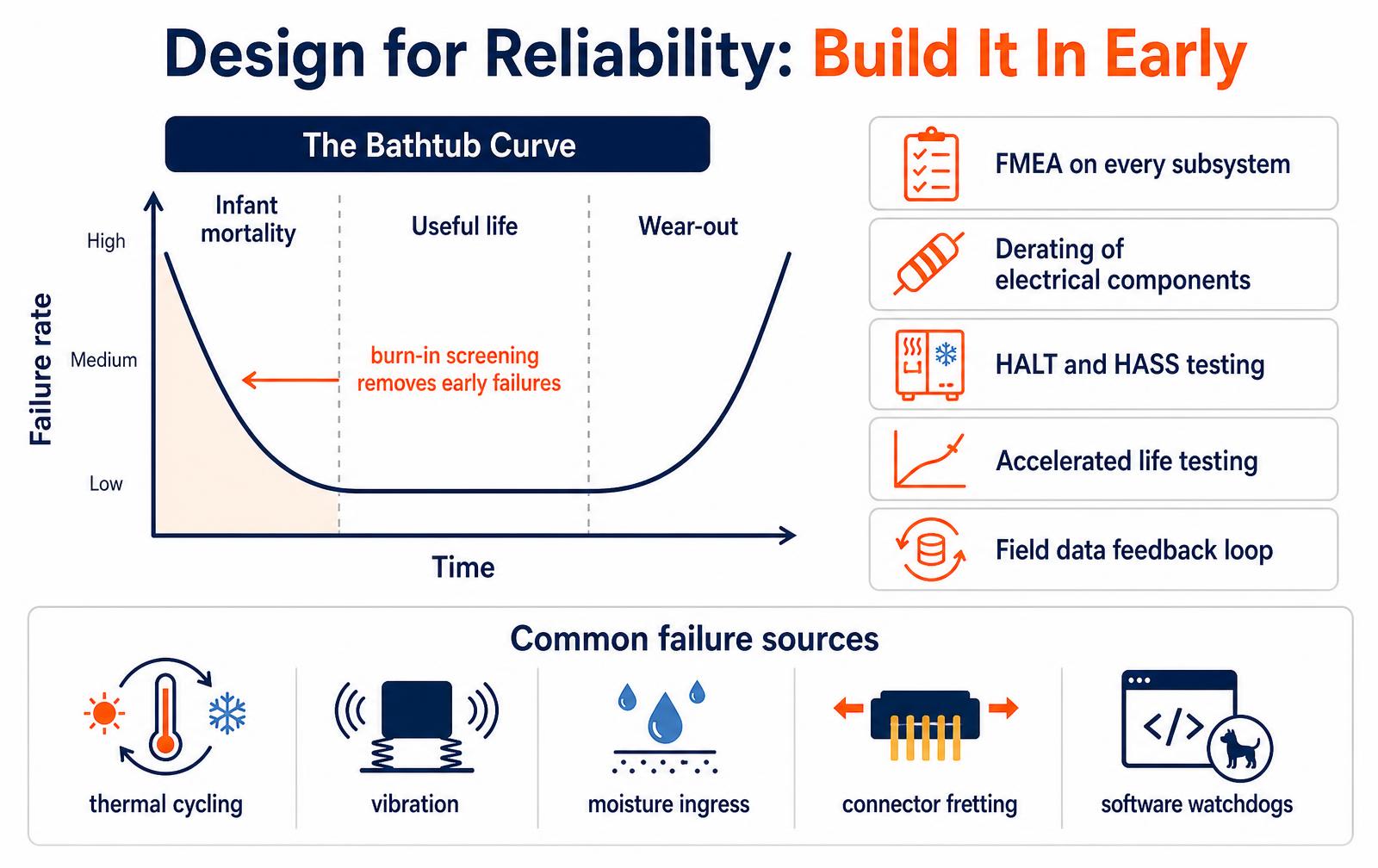
Failures cluster in three regions. Early failures come from manufacturing defects and are attacked with process control and burn-in screening. Random failures during useful life come from margin — thermal, electrical, mechanical — and are attacked with derating and robust design.
Wear-out comes from physics: bearings, batteries, elastomers, adhesives and connector plating all have a finite number of cycles. Knowing which region your returns are coming from tells you whether to fix the factory or the design.
The five methods that do most of the work
- FMEA on every subsystem. List the ways each part can fail, the effect, the likelihood and the detection method. Half the value is in the arguments the exercise starts.
- Derating. Run capacitors, MOSFETs, connectors and motors well below their rated limits. A component at 50% of rating lasts an order of magnitude longer than one at 90%.
- HALT and HASS. Highly accelerated life testing finds design margins by breaking units deliberately; HASS screens production units against those margins.
- Accelerated life testing. Thermal cycling, humidity, vibration and duty-cycle testing scaled with known acceleration factors to estimate field life in weeks rather than years.
- A field data feedback loop. Serialised units, logged returns and teardown of failed parts. Without it, every generation repeats the previous generation's mistakes.
What reliability work costs — and what failure costs
Activity | When | Typical cost | What it prevents |
|---|---|---|---|
FMEA workshops | Concept and detailed design | $3k-$12k | Single points of failure nobody noticed |
Thermal and structural simulation | Detailed design | $5k-$20k | Hot spots, resonances and warping found after tooling |
HALT on early prototypes | Pre-DVT | $8k-$25k | Shipping a product with no known margin |
Accelerated life testing | DVT | $10k-$40k | Warranty claims in year one |
HASS screening in production | Ongoing | $1-$8 per unit | Infant-mortality returns reaching customers |
A 3% field failure rate | After launch | $150k+ per 10k units | Nothing — this is the bill |
Those return costs assume replacement, freight, support time and the reviews. They exclude the retailer who drops the line, which is usually the larger number.
Where products actually break
- Thermal cycling. Differential expansion cracks solder joints and loosens fasteners long before any part reaches its temperature limit.
- Vibration and drop. Unsupported heavy components on a PCB, and screw bosses designed without a torque spec.
- Moisture ingress. Gaskets compressed by a boss that creeps, or a vent that was value-engineered out.
- Connector fretting and cable flex. The most common electromechanical failure in portable products, and the easiest to design out with strain relief.
- Software. Memory leaks and missing watchdogs turn a reliable device into one that needs a weekly power cycle.
Most of these are cheap to fix during prototyping and effectively unfixable after tooling. Reliability reviews belong alongside design for manufacturing, not after it.
Reliability methods and when each one pays off
Reliability is not a test at the end; it is a set of decisions made while the design is still cheap to change. The methods below are ordered by how early they apply, and the earlier ones cost hours while the later ones cost weeks.
Method | When | Effort | What it catches |
|---|---|---|---|
Design FMEA | Concept to detailed design | 1–3 days workshop | Failure modes nobody owned |
Derating analysis | Electronics schematic | 1–2 days | Components run near their limits |
Tolerance stack-up | Detailed design | 0.5–2 days per stack | Assemblies that bind at the extremes |
HALT (highly accelerated life test) | First functional prototypes | 1–2 weeks, $8k–$25k | Design margins and weak links |
Accelerated life testing | Pre-tooling | 4–8 weeks | Wear-out mechanisms, expected life |
HASS in production | After launch | Ongoing | Process drift, supplier changes |
The failure mechanisms that dominate hardware returns
- Connector and cable flex fatigue — most field failures on portable products start at a strain relief.
- Thermal cycling on solder joints, especially under heavy components with no mechanical support.
- Plastic creep and stress relaxation in snap fits held under constant load.
- Seal and gasket compression set, which turns a waterproof product into a warranty claim in month nine.
- Battery capacity fade accelerated by charging at temperature extremes.
- Fastener loosening under vibration where no thread locking or preload was specified.
Setting a reliability target you can design against
"Should last a long time" is not a requirement. Convert it: state a service life, a duty cycle and an acceptable failure rate — for example, five years at 300 cycles per year with under 2% failures in the first two years. That number sets the accelerated test duration, the derating margin and, ultimately, the warranty reserve on the financial model. Without it, testing has no pass criterion and engineers negotiate reliability project by project.
Product type | Typical service-life target | Warranty rate that signals a design problem |
|---|---|---|
Consumer electronics accessory | 2–3 years | >3% in year one |
Household appliance | 7–10 years | >1.5% in year one |
Industrial equipment | 10–20 years | >1% per year |
Medical device (non-implant) | 5–7 years | Any trend, per complaint handling |
Building reliability into the supply chain
- Specify critical-to-function dimensions and materials on the drawing; anything unmarked will eventually be substituted.
- Require a first-article inspection report and keep it as the baseline for later disputes.
- Approve second sources before you need them, and test them rather than trusting the datasheet.
- Lock the finish and adhesive systems by supplier part number — chemistry substitutions cause silent field failures.
- Run periodic ongoing reliability testing on production samples, not only on pre-production units.
Our engineering team builds these methods into program plans — see also our consulting page.
Frequently asked questions
What is design for reliability?
It is a set of engineering practices — FMEA, derating, margin analysis, accelerated testing and field feedback — applied during design so that a product meets a defined lifespan in real conditions. It differs from quality control, which verifies that units match the design rather than that the design is durable.
What is the Difference Between Halt and Accelerated Life Testing?
HALT deliberately destroys units with escalating stress to discover where the design's limits are; it does not predict field life. Accelerated life testing applies controlled stress with known acceleration factors to estimate how long units will survive in service. You want both: HALT to find weaknesses, ALT to quantify lifespan.
How much does reliability engineering add to a project?
Typically 5-15% of development cost — roughly $25,000 to $100,000 on a mid-sized consumer or industrial program. A 3% field failure rate on 10,000 units routinely costs more than that in replacements and support alone, before counting reputation.
When should reliability work start?
At concept. The target lifespan and use environment belong in the requirements document, because they drive material, sealing, thermal and component choices. Starting at DVT means discovering problems you can no longer afford to fix.
Reliability methods and when to use each
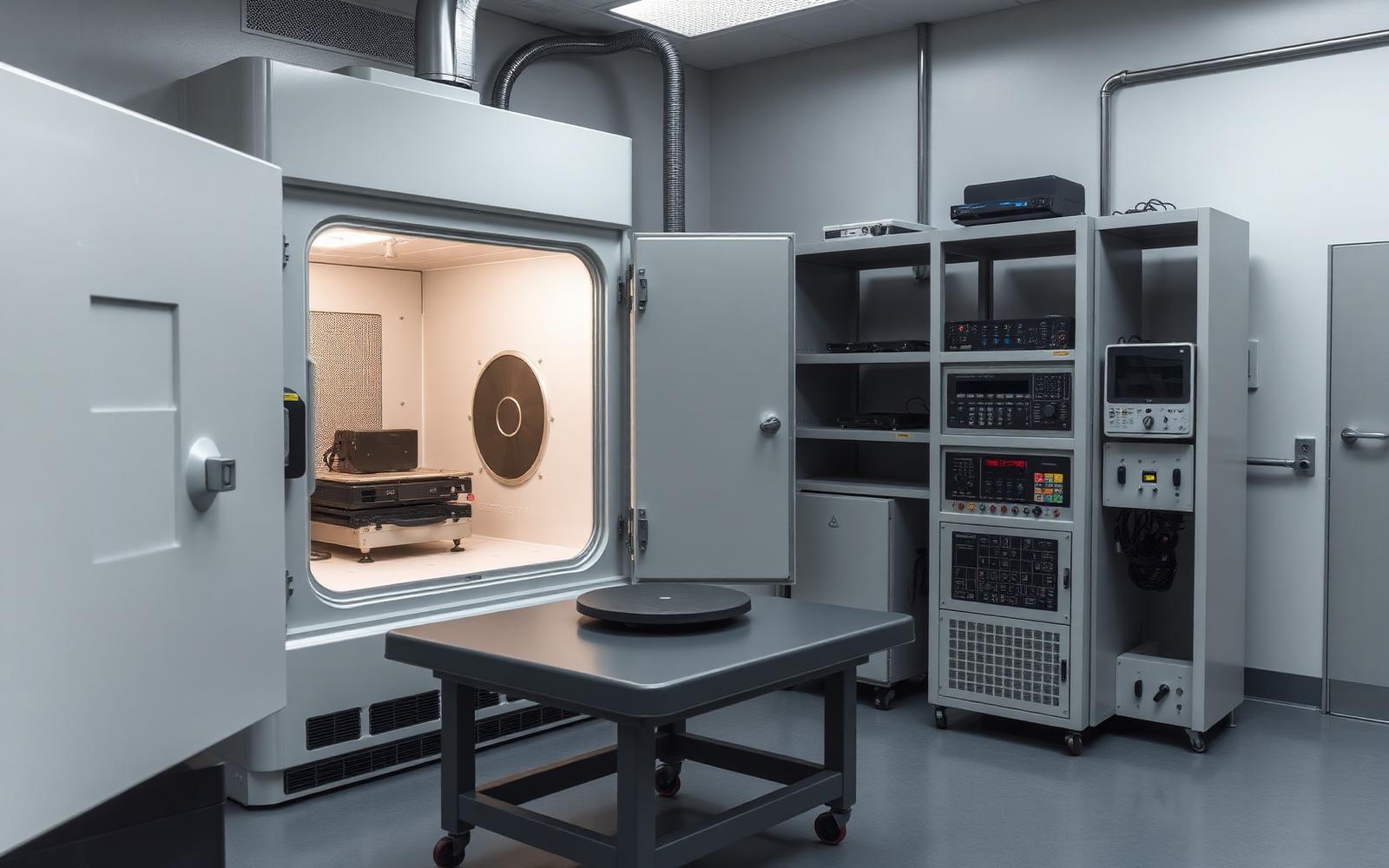
Design for reliability is a set of scheduled activities, not an attitude. Each method answers a different question: what can fail, how fast does it wear, what margin do we have, and how long will it last in the field. Running them in order - analysis before testing, testing before qualification - keeps the expensive chamber time focused on real risks instead of confirming what an engineer already knew.
Method | Question it answers | When | Typical cost |
|---|---|---|---|
DFMEA | What can fail and how severe is it | Concept to design freeze | $5k-$25k of team time |
Derating analysis | Are components operating within safe margins | Schematic review | $3k-$10k |
HALT | Where are the design margins and weak links | First integrated prototype | $12k-$35k |
Accelerated life testing | How long will wear items last | Design validation | $15k-$60k |
HASS in production | Are units leaving with latent defects | Manufacturing ramp | $20k-$80k setup |
Field data analysis | What is actually failing | Post launch, continuous | Ongoing |
The failure mechanisms that account for most returns
- Connector and cable fatigue - flex cycles at the strain relief, by far the most common consumer hardware failure.
- Electrolytic capacitor wear-out - halves in life for every 10C rise; derate voltage and keep them off hot spots.
- Solder joint fatigue - thermal cycling on large BGAs and heavy connectors; check with cross sections after cycling.
- Plastic creep and stress cracking - snap fits held under permanent load, worsened by cleaning chemicals.
- Seal degradation - compression set in gaskets and UV attack on exposed elastomers.
- Fastener loosening - vibration on unsecured threads; specify thread lockers or prevailing-torque hardware.
Setting a reliability target you can actually verify
A useful target names a metric, a confidence level, and a use profile: for example 95% survival at three years with eight hours daily use at 25-40C. From that you can derive an accelerated test plan with a defined acceleration factor and a sample size. A target expressed as high quality or industrial grade cannot be tested, cannot be argued with, and will not stop anyone from shipping a marginal design.
- Key takeaway 1: Analysis first, HALT next, life testing last - in that order.
- Key takeaway 2: Most field failures are connectors, capacitors, solder joints and seals, not exotic mechanisms.
- Key takeaway 3: Reliability targets need a metric, a confidence level and a use profile.
- Key takeaway 4: Feed field failure data back into the DFMEA or the next product repeats the same faults.
Worried your product will not survive the field?
We run FMEA, margin analysis and accelerated testing as part of engineering — before the tool is cut.
Work with LA NPDT: if you are moving from here to execution, start with our AI product development or talk to us about software development services.
Filed under:EducationUncategorized
Tagged:2025
Services related to this guide
- Product design servicesIndustrial design and CAD taken all the way to manufacturable files.
- Best industrial design firmsWhich studios take an idea from form to manufacturable hardware, and what they charge.
- Prototype designLooks-like, works-like or pre-production: what each proves and what it costs.
- Product development examplesReal projects we designed, prototyped and shipped.