Product Localization: Engineering Products for Global Markets
Product localization is the work of adapting a physical or connected product to a specific market's power, regulations, language and expectations. Done at design time it costs little; done after launch it costs a redesign.
June 3, 20266 min read

Written by Onega Ulanova, IRCA Lead Auditor, MS Eng. & Tech. Management, Executive MBA
Co-Founder, Quality Management Executive & Lead Auditor
Published June 3, 2026Updated September 2, 2026
Product localization is the process of adapting a product to a target market's technical, regulatory, linguistic and cultural requirements. For hardware it covers voltage and plug type, certification marks, units of measure, language on labels and interfaces, ergonomics, and packaging — and each is far cheaper to design in than to retrofit.
Translation is the visible part and the smallest part. The expensive parts are a power supply that will not certify, a label that omits a required mark, and an enclosure sized for a shelf standard that does not exist in the destination country.
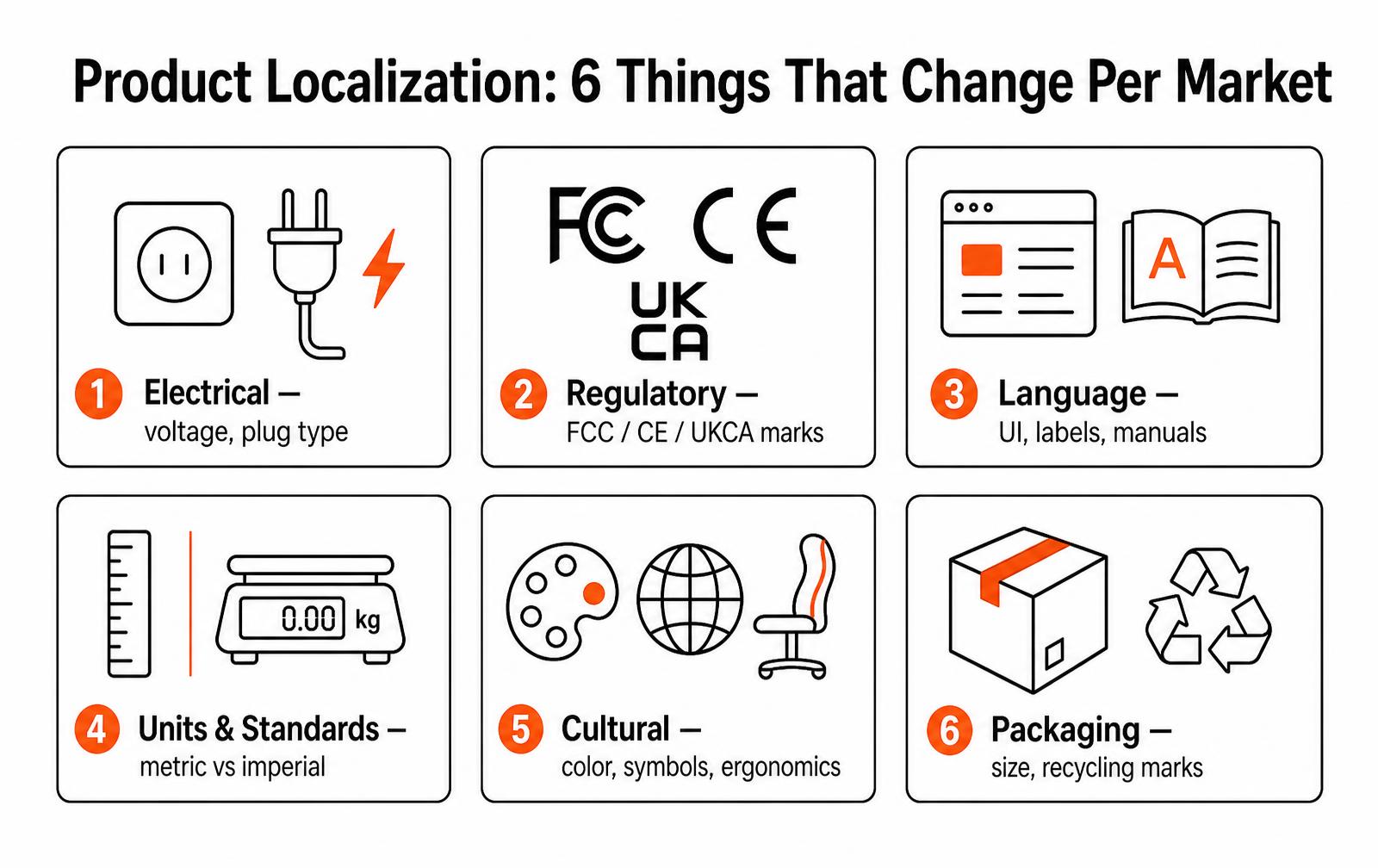
The six things that change per market
1. Electrical
Mains voltage, frequency, plug geometry and grounding differ by region. Designing around a universal input supply (100–240 V, 50/60 Hz) with an interchangeable plug or detachable cord set typically costs a few dollars per unit and removes a whole class of variants. Battery products face separate transport rules under UN 38.3.
2. Regulatory and certification
Region | Core marks | Notes |
|---|---|---|
United States | FCC, UL/ETL listing | Emissions testing plus safety listing for mains products |
European Union | CE, plus RoHS, REACH, WEEE | Self-declaration with a technical file; EU importer required |
United Kingdom | UKCA (CE still accepted for many goods) | Separate declaration and UK responsible person |
Canada | ISED, CSA | Bilingual labeling requirements |
Japan | PSE, MIC (Giteki) | Radio module approvals often need re-testing |
Australia / NZ | RCM | Supplier registration required |
Pre-certified radio modules are the single largest cost saver for connected products: they carry approvals in multiple regions and avoid full-system radio testing in each one.
3. Language and content
- Interface strings, labels, packaging copy, quick-start guides and full manuals
- Text expansion — German and French commonly run 20 to 35 percent longer than English, which breaks fixed-width screens and labels
- Right-to-left layouts for Arabic and Hebrew markets
- Character sets and fonts for CJK languages, including on embedded displays with limited memory
- Voice, warning phrasing and legally mandated wording that cannot be paraphrased
4. Units, standards and interfaces
Metric versus imperial affects displayed values, documentation and sometimes hardware — fastener threads, hose fittings, rack widths and paper sizes. Date, time, currency and decimal separators matter in firmware and apps as much as in marketing.
5. Cultural and ergonomic fit
Color carries different meaning by region, symbols do not travel reliably, hand and body dimensions vary across populations, and household norms — counter height, room size, storage habits — change what a good product looks like. Anthropometric data for the destination market belongs in the requirements document, not in a post-launch review.
6. Packaging and logistics
Box dimensions interact with retail shelf standards and pallet efficiency. Recycling marks, material declarations and importer details are legally required in several regions. And multilingual packaging is often cheaper than region-specific SKUs until volume justifies splitting.
Design for localization instead of localizing later
- Pick target markets during requirements, not after launch. Even a ranked list of "launch here, expand there" changes early architecture decisions.
- Design a common platform with variant points. Universal power input, region-specific cord set, modular label area, externalized strings.
- Never hard-code text or units. Resource files and a units abstraction cost hours up front and save firmware revisions later.
- Leave label real estate. Certification marks accumulate; a crowded label forces tooling changes to the enclosure.
- Select pre-certified components. Radios, power supplies and cord sets with existing approvals collapse test scope.
- Budget certification per region. Typical ranges run $5,000 to $30,000 per region depending on product class and radio content.
Planning to sell in more than one market?
We build compliance and localization requirements into the design from the start, so your second market is a variant instead of a redesign.
What localization typically costs
Work item | Typical range | When to do it |
|---|---|---|
Market and compliance research | $3,000 – $15,000 | Before architecture is fixed |
Certification testing per region | $5,000 – $30,000 | On production-intent hardware |
Translation and documentation | $0.10 – $0.30 per word | After UI strings are frozen |
Packaging redesign per region | $2,000 – $10,000 | With final artwork |
Late hardware rework for compliance | $25,000 – $250,000+ | Avoidable entirely |
The last row is the reason this belongs in early product development planning. Localization is not a marketing task appended to launch; it is an engineering requirement set.
Expanding a product into new regions?
Our engineering and compliance teams map the requirements for each target market and design one platform that serves all of them.
Frequently asked questions
What is product localization?
Product localization is adapting a product to the technical, regulatory, linguistic and cultural requirements of a specific market. For physical products it includes power and plug compatibility, certification marks, units of measure, translated interfaces and labels, ergonomic fit, and market-specific packaging.
How is localization different from translation?
Translation converts text from one language to another. Localization covers everything else a market requires: electrical compatibility, safety and emissions certification, units, date and currency formats, color and symbol meaning, ergonomics, packaging standards and legal labeling.
How much does product localization cost?
Compliance research typically runs $3,000 to $15,000, certification testing $5,000 to $30,000 per region, translation $0.10 to $0.30 per word, and packaging redesign $2,000 to $10,000 per region. Retrofitting hardware for compliance after launch commonly costs $25,000 or more.
When should localization be planned?
During requirements definition, before architecture is locked. Choices such as a universal-input power supply, a pre-certified radio module, externalized text strings and reserved label space cost almost nothing early and are expensive to add later.
What certifications are needed to sell electronics internationally?
Common requirements include FCC and UL or ETL for the United States, CE with RoHS, REACH and WEEE for the European Union, UKCA for the United Kingdom, ISED and CSA for Canada, PSE and MIC for Japan, and RCM for Australia and New Zealand. Radio-equipped products need additional approvals per region.
Can one product design serve multiple markets?
Usually yes. A platform approach with defined variant points — cord sets, label artwork, language packs and firmware region settings — lets one core design serve most markets, with region-specific SKUs reserved for cases where regulation or user expectations genuinely differ.
Product localization is an architecture decision, not a late edit
Product localization for physical goods is usually treated as a shipping-stage problem: swap the power cord, translate the manual, print a new label.
Teams that do it that way discover in month nine that the European variant needs a different enclosure because the certification body objects to a creepage distance, and that the mains transformer sized for 120 V will not pass at 230 V. The cost of that discovery is a tooling change, not a documentation change.
The alternative is to decide, before the mechanical architecture freezes, which regions the platform must serve and which parts are allowed to vary. Everything downstream — certification budget, bill of materials complexity, packaging, inventory — follows from that one decision.
The electrical baseline by region
Region | Mains voltage / frequency | Plug types | Safety mark | EMC regime |
|---|---|---|---|---|
United States / Canada | 120 V, 60 Hz | NEMA 1-15, 5-15 | UL / cUL, ETL | FCC Part 15 |
European Union / UK | 230 V, 50 Hz | CEE 7/7, BS 1363 | CE / UKCA, ENEC | EN 55032 / 55035 |
Japan | 100 V, 50 and 60 Hz | JIS C 8303 | PSE | VCCI |
Australia / New Zealand | 230 V, 50 Hz | AS/NZS 3112 | RCM | AS/NZS CISPR 32 |
China | 220 V, 50 Hz | GB 2099 | CCC | GB 9254 |
Brazil | 127 V and 220 V, 60 Hz | NBR 14136 | INMETRO | ANATEL for radio |
A universal 100-240 V switching supply removes most of this table from the design problem and costs $2-$8 more per unit than a single-voltage supply. On any product expected to sell in more than one region, that is the cheapest localization decision available.
Certification cost and schedule
Certification is the long pole. Testing cannot start until the design is stable, and a failure means a redesign followed by a retest, so the schedule risk compounds.
Certification | Typical cost | Lead time | Triggered by |
|---|---|---|---|
FCC Part 15 Class B | $4k-$12k | 2-4 weeks | Any digital electronics |
CE (LVD + EMC) | $6k-$20k | 4-8 weeks | EU market entry |
UKCA | $2k-$8k incremental | 2-4 weeks | Great Britain market entry |
UL / ETL listing | $10k-$35k plus annual audits | 8-16 weeks | Mains-powered products |
CCC (China) | $8k-$25k | 10-16 weeks | Import into China |
PSE (Japan) | $5k-$15k | 6-12 weeks | Mains-powered products |
Radio module (BT/Wi-Fi) per region | $3k-$15k each | 3-8 weeks | Any intentional radiator |
Using a pre-certified radio module rather than a discrete radio design typically removes $20,000-$60,000 and several months from a multi-region launch, at a bill of materials premium of a few dollars per unit.
Labels, language and documentation
- The EU requires instructions in the official language of each member state where the product is sold; a single English manual is not compliant.
- Canada requires bilingual English and French for consumer product labelling and safety information.
- Country-of-origin marking rules differ: the US requires it on the article where feasible, the EU on the packaging in most categories.
- WEEE and battery symbols are mandatory in the EU and must be moulded or permanently marked, which affects tooling, not just artwork.
- Energy efficiency labelling (EU ErP, US DOE) applies to more categories every year and can force a hardware change, not a sticker.
- Leave physical label real estate for the worst case region from the start — retrofitting 40% more label area onto a finished enclosure is a tooling change.
Preference differences that are not regulatory
Compliance defines what you may sell. Preference defines what will actually sell. These differences rarely appear in a requirements document written in a single market.
Dimension | North America | Europe | Japan | Design consequence |
|---|---|---|---|---|
Typical kitchen footprint | Generous | Constrained | Very constrained | Depth budget drives the whole enclosure |
Preferred capacity | Large single unit | Medium | Small, frequent use | Vessel and packaging sizing |
Noise tolerance | Moderate | Low | Very low | Fan and motor selection, damping |
Colour and finish | Bold accents accepted | Muted, matte | White, compact, minimal | CMF variants per region |
Repairability expectation | Low | High and rising | Medium | Fastener choice, spare parts strategy |
Retail shelf format | Large carton, warehouse club | Compact, sustainable | Small, gift-quality | Packaging structure and cost |
A variant strategy that does not multiply the bill of materials
The goal is one platform with a small number of intentional variation points. In practice that means fixing the parts that are expensive to duplicate and letting the cheap parts absorb the differences.
Element | Common across regions | Varies by region | Cost of variation |
|---|---|---|---|
Main enclosure tooling | Yes | No | $15k-$80k per variant |
Main PCB | Yes, universal supply | No | $8k-$25k per variant |
Power cord and plug | No | Yes | $1-$4 per unit |
Regulatory label | No | Yes | Under $0.20 per unit |
Printed manual | No | Yes | $0.30-$1.50 per unit |
Retail carton graphics | Structure yes, print no | Print varies | Plate change only |
Firmware region table | One binary | Runtime configuration | Engineering time only |
Keep region behaviour in a firmware configuration table rather than separate builds. One binary that reads its region at first boot removes an entire class of manufacturing errors and lets a distributor be added without a software release.
Frequently asked questions
What does product localization mean for physical products?
It is the set of engineering, regulatory and commercial changes that let one product platform sell legally and successfully in another country: electrical compatibility, certification, labelling and language, packaging format, and any dimensional or behavioural change that regional buyers expect.
How much does it cost to certify a product for multiple regions?
For a mains-powered electronic product, budget $25,000-$70,000 to cover North America and the EU, and $50,000-$120,000 to add Japan, China and Australia. Pre-certified radio modules and a universal 100-240 V supply remove the largest single blocks of that spend.
Should I design one global product or regional variants?
Design one platform with deliberate variation points. Tooling and PCB variants cost tens of thousands each, while cords, labels, manuals and carton print cost cents to a couple of dollars per unit. Put every difference you can into the cheap layer.
When should localization work start?
Before the mechanical architecture freezes. Creepage and clearance requirements, label area, plug retention geometry and packaging dimensions all constrain the enclosure, and all of them are cheap to accommodate in CAD and expensive to retrofit into steel.
Does a CE mark cover the United Kingdom?
Not by default for all product categories. Great Britain uses the UKCA mark, though CE acceptance has been extended for many products; Northern Ireland follows EU rules. Confirm the current status for your specific category before you plan the label artwork, because the requirement has moved several times.
Work with LA NPDT: if you are moving from here to execution, start with our CAD engineering services or talk to us about design optimization.
Filed under:EducationUncategorized
Tagged:2025
Services related to this guide
- Product design servicesIndustrial design and CAD taken all the way to manufacturable files.
- Rapid prototypingWorking prototypes in days, from 3D printing to vacuum casting.
- Electronic design servicesSchematic, PCB layout, firmware and bring-up, through to production handoff.
- Product development examplesReal projects we designed, prototyped and shipped.