


In the business environment, product development generally involves two crucial phases: generating the initial idea and then refining all the finer points. To begin with, understanding Concept Design vs Detailed Design is essential because the first phase evaluates an idea’s feasibility, while the second finalizes every aspect for production.
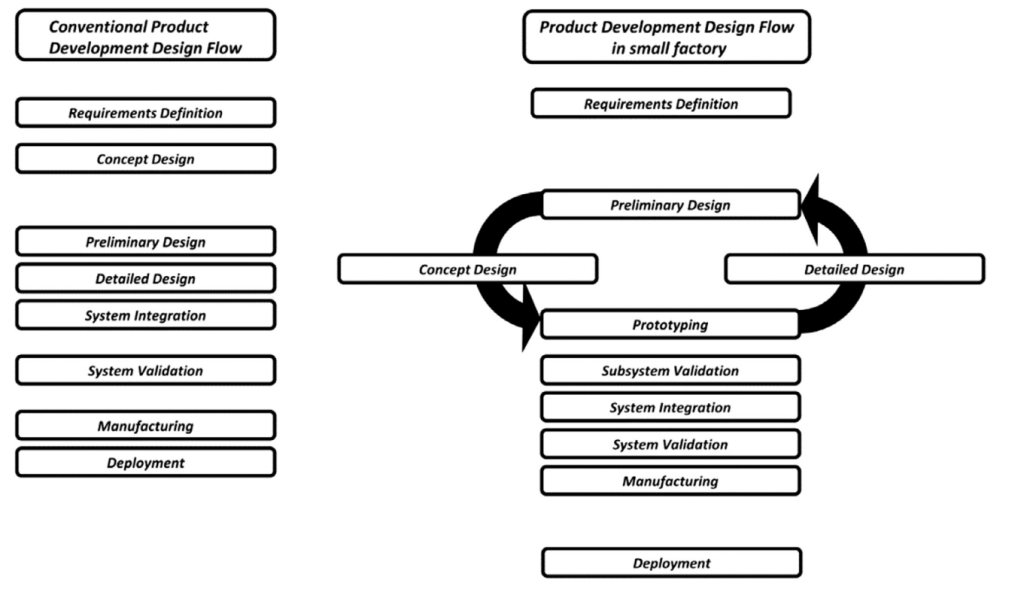
Figure 1. Traditional design process vs. design workflow in a small factory.
Conceptual Design (CD)
Conceptual design is typically performed to establish a “workable” system-level foundation for a new idea. At its core, this is an exploratory stage – focused equally on understanding requirements and exploring potential design directions. In the broader discussion of Concept Design vs Detailed Design, the conceptual stage represents the creative, high-level exploration essential before deeper technical work begins.
At the beginning of any product development effort, the conceptual design phase drives rapid ideation. Engineers and designers quickly generate and refine concepts through open, collaborative brainstorming sessions. As these sessions progress, they review numerous variations – sketches, draft drawings, 2D layouts, 3D models, and renderings – until a preferred direction is chosen. Naturally, this is often the moment when companies most clearly experience the contrast between Concept Design vs Detailed Design.
Regardless of format, this phase gathers a company’s best thinkers to explore ideas that are evaluated, improved, combined, and reinvented. As a result, the richest outcomes emerge through continuous iteration, allowing insights from multiple perspectives to shape the final concept.
Identifying the product’s essential requirements (design intent) is vital. These criteria act as a filter that every idea must pass through to meet project goals. Therefore, as concepts are reviewed, they must be tested against objectives. Organizations must also evaluate their technological capability to determine if they can realistically design and manufacture the proposed product.
Another factor that makes conceptual design so important is the financial commitment it represents. According to ASME, approximately 75% of a product’s manufacturing cost is determined by the end of this phase, making the decisions at this stage crucial when framing Concept Design vs Detailed Design strategies.
This stage also involves capturing and organizing design rationale (DR) – the reasoning behind design decisions. Documenting this knowledge ensures it can be referenced throughout later phases.
Initial studies during conceptual design often define:
- Purpose of the project
- Proposed location
- Total estimated cost (approximately ±30%)
Consequently, deliverables often include the design basis, major process parameters, block flow diagrams, initial space layouts, and early cost approximations.
Conceptual design provides the overarching idea. In practical terms, it may include preliminary sizing calculations and basic flowsheets, enabling rough cost estimates (±30–50%) and comparisons between different approaches.
A commonly accepted definition of design is the act of imagining and planning the structure and parameters of a system, device, or process. Typically, project scope is initiated by leadership. Basic and detailed design are separated by a critical decision on whether to continue, expand, pause, or stop a project.
For high-value projects, additional market research may be required. If necessary, provisional approval may lead to further pilot studies. Final approval marks the beginning of detailed engineering, thus clearly illustrating the transition point between Concept Design vs Detailed Design.
Detailed Design
The primary purpose of detailed design is to produce comprehensive, build-ready documentation, including component drawings, assembly diagrams, and technical specifications. To achieve this, extensive calculations, simulations, documentation research, and adherence to industry standards are required. In many companies, this technical information is generated using CAD, FEM, and other specialized tools, though often stored separately.
When evaluating Concept Design vs Detailed Design, the detailed stage represents the highly technical, precision-driven phase that transforms an idea into a constructible or manufacturable reality.
Developing a new production line often begins with reviewing an existing line to form the first iteration. From here, common procedures include system decomposition, adapting individual devices, searching for innovations, or designing new equipment. Much of a company’s expertise is reflected in its internal standards and established methods.
Example from the Architecture Field
In landscape architecture, the design process includes multiple stages, notably sketch (concept) design and detailed design. This comparison, once again, highlights the importance of understanding Concept Design vs Detailed Design.
Sketch or concept design is the initial stage where broad creative ideas are explored using rough visuals. At this point, these drawings may be coloured but lack technical detail, although experienced contractors may interpret them if the project is simple.
Detailed design is the follow-up stage, where the chosen concept is refined with exact technical information: levels, materials, plant layouts, drainage, lighting, and construction details. Consequently, contractors rely on this information for pricing and building.
Sketch Design
Concept Exploration:
Designers develop conceptual ideas through quick sketches and diagrams.
Spatial Organization:
Focuses on spatial arrangement, functional relationships, and overall aesthetics.
Client Participation:
Feedback from clients and stakeholders helps shape the design direction.
Flexibility:
Concept designs are adaptable and easy to revise.
Detailed Design
Refinement:
The selected concept is expanded into a precise, technical layout.
Technical Documentation:
Detailed plans indicate measurements, materials, construction details, and installation requirements.
Cost Planning:
Cost estimates become far more accurate during this stage.
Compliance:
Regulatory and environmental requirements are analyzed and applied.
Taken together, sketch and detailed design illustrate a clear example of Concept Design vs Detailed Design within the architecture sector.
Contact us today to learn how LA NPDT can assist in realizing your project.
The Right Moment to Shift from Concept Design to Detailed Design
The optimal time to transition is when the concept, scope, and functionality are fully confirmed, and all major design choices (layout, structure, materials) are established. In turn, this minimizes costly revisions and marks the shift from abstract planning to detailed technical development – another key milestone in the discussion of Concept Design vs Detailed Design.
Signs You Are Ready to Transition
- Concept Sign-off: The client formally approves the chosen concept and layout.
- Feasibility Verified: Preliminary regulatory, site, and capability checks are complete.
- Stakeholder Agreement: All parties support the selected direction.
- Sufficient Iteration: Enough alternatives have been studied (typically 2–5).
- Clear Scope: The design intent is well-defined and ready for detailed engineering.


