Systems Thinking in Product Development: Designing Beyond Individual Features
In today’s increasingly interconnected world, products no longer exist as isolated artifacts. They operate within complex ecosystems of users, technologies, workflows, regulation
April 1, 202610 min read

Written by Konstantin Dolgan, Ph.D., NPDP
Founder & CEO, Product Development Engineer
Published April 1, 2026Updated September 2, 2026
Our world is very connected, so products no longer stand alone. They work within systems of users, tech, workflows, and rules. Feature-focused methods often fail. This is why you must use systems thinking. It shows how parts interact and depend on each other.
What Is a System?
A system is a set of parts that work for one goal. These parts include hardware, software, people, and tools. As the text states, a system is “an integrated set of elements, subsystems, or assemblies that accomplish a defined purpose.”
A system is a group of parts that form a whole. These parts can be physical, like car parts. They can also be processes, rules, or data flows. Even values and beliefs can be part of the system.
For example, an R&D team is a system of people and tools. These teams make new products. The manufacturing system builds them, and the sales system sells them. Each part needs the others. The R&D group works within larger systems to help the firm.
Systems Thinking
Systems thinking focuses on understanding or influencing complex situations using the principles of the systems paradigm. It emphasizes recognizing patterns and similarities across systems in different fields.
Donella Meadows says a system is “an interconnected set of elements that is coherently organised in a way that achieves something.” Systems thinking looks at how we see these groups. Systems change shows how they grow.
Contact us today to learn how LA NPDT can assist in realizing your project.
Peter Senge brought systems thinking to firms in The Fifth Discipline. He calls it a key skill for teams that learn. It helps people see how things link together. This view leads to better choices and uses the “blind men and the elephant” story.
In product development, this perspective is especially valuable because products rarely operate independently – they exist within larger, interconnected ecosystems.
Core Principles of Systems Thinking
Systems thinking is grounded in several key principles:
- Seeing the big picture while balancing short‑term and long‑term considerations.
- Recognizing that systems are dynamic, complex, and interdependent.
- Considering both quantifiable and non‑quantifiable factors.
- Acknowledging that we are part of the systems we influence.
It represents a shift from traditional approaches:
Reductionism | Expansionism |
|---|---|
Linear cause‑and‑effect | Producer–product relationships |
Determinism | Indeterminism |
Analysis of parts | Synthesis of wholes |
Analysis explains how a system works; synthesis explains why it works that way. Optimizing one component in isolation can degrade the performance of the entire system.
Thus, in product development, teams must understand how components interact rather than evaluating them separately. Otherwise, changes in one area may unintentionally disrupt others.
Systems Thinking as a Mindset
At its heart, systems thinking is about relationships, interconnections, and context – not isolated features. It is both a methodology and a mindset.
This mindset helps product managers uncover root causes, anticipate unintended outcomes, and understand long‑term implications. It encourages questions such as:
- How will components interact over time?
- How will a small adjustment influence the entire system?
- What behaviors might emerge from these interactions?
- What happens when the system scales?
- What unintended effects might appear in future releases?
Unlike linear thinking, which focuses on immediate fixes, systems thinking recognizes that products exist within complex ecosystems – supply chains, regulations, user environments, data flows, business models, and shifting markets.
This mindset is essential for designing products that remain resilient and adaptable.
Why Systems Thinking Matters in Product Design
Systems thinking helps organizations manage complexity, avoid unintended consequences, and create cohesive, scalable user experiences.
In IoT or wearables, teams often tune parts alone. Hardware, firmware, and cloud tools might work well by themselves. Yet, joining them shows split links, odd loops, and many edge cases.
At this stage, systems thinking becomes crucial. Instead of assembling parts, teams must design interactions, dependencies, and long‑term system behavior.
A medical device links to data rules, clinic work, and security. It also involves privacy, user habits, cloud tech, and upkeep. Fixing one layer without the others can cause new problems.
Systems Thinking Tools
Systems thinking uses a variety of tools, grouped into three categories:
- Dynamic Thinking Tools.
- Behavior Over Time Diagrams (BOTs) – show how variables evolve.
- Causal Loop Diagrams (CLDs) – visualize relationships and feedback loops.
- Systems Archetypes – recurring patterns like “Shifting the Burden,” “Fixes That Fail,” and “Limits to Success”
- Structural Thinking Tools.
- Graphical Function Diagrams.
- Structure–Behavior Pairs.
- Policy Structure Diagrams.
These tools connect system structure to observed behavior.
- Computer‑Based Tools.
- Simulation models
- Management flight simulators.
- Learning labs
These allow teams to test decisions safely and observe long‑term effects by “compressing time.”
Systems Thinking in Product Management
In product management, systems thinking becomes situational awareness – the ability to understand elements in an environment, their relationships, and how they evolve.
Modern SaaS tools are social and tech systems with many actors. Developers, clients, and partners meet at many points. Firm habits affect the product development path.
Linear workflows are no longer sufficient. Teams must consider:
- How products integrate with other solutions.
- How they align with industry trends.
- How internal and external forces shape their evolution.
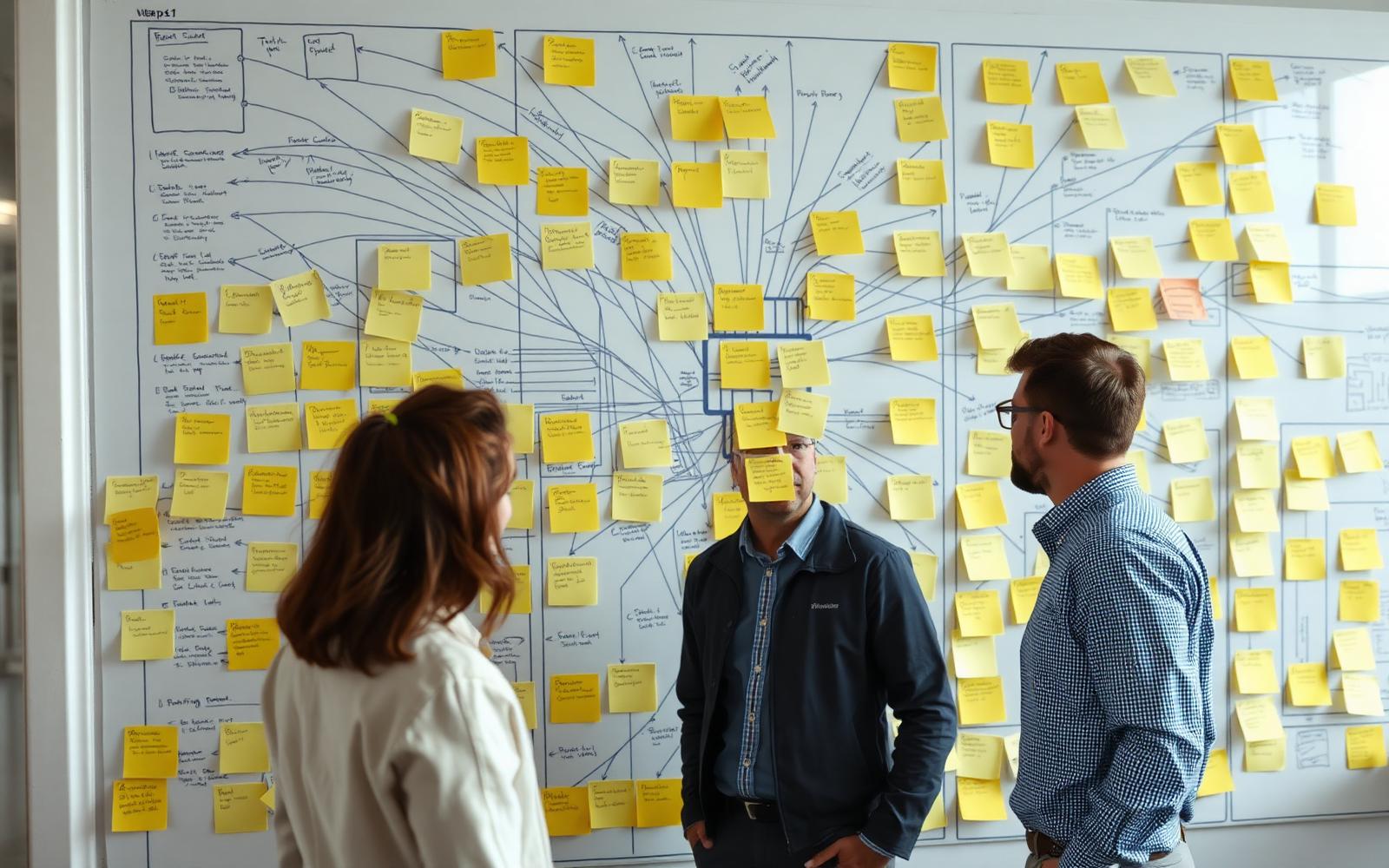
Service design complements this by focusing on touchpoints, layers, and user journeys, helping teams visualize interactions across the entire ecosystem.
Systemic Design
Systemic design blends systems thinking and design thinking to support innovation and continuous learning.
- Systems thinking helps teams understand context, perspectives, and leverage points.
- Design thinking helps create action plans, outcomes, and assumptions.
- Reflective thinking helps teams learn and adapt.
Together, these create a more iterative, informed, and resilient approach to managing complex systems.
Conclusion
These frameworks collectively support more effective, collaborative decision‑making. As products become interconnected ecosystems rather than isolated artifacts, systems thinking reshapes how they are conceived, built, and managed.
Systems thinking looks at links and feedback instead of single features. It helps teams see bad results early and work across borders. You can then build strong, scalable tools.
In complex environments – IoT, SaaS, socio‑technical systems – systems thinking is not optional; it is essential.
Designing for the whole means looking at users, tech, and the firm. Systems thinking gives you the lens to see that whole clearly. It gives you the path to shape it with care.
Subscribe
Dive deep into the dynamic world of new product development with LA NPDT Insights Blog.
Frequently asked questions
Frequently asked questions
What is systems thinking in product development?
What is systems thinking in product development?
Systems thinking helps teams see how product parts work together. This mindset views a product as one whole unit. It does not just look at single features. This method helps you find patterns and links. It aims to reach a goal by linking elements in a complex web.
Systems thinking in product work shows how each part links to others. It goes beyond single features. This method sees that products live in busy systems. It helps teams see the big picture and how small changes affect the whole.
How does systems thinking differ from traditional approaches?
How does systems thinking differ from traditional approaches in product design?
Old ways often focus on single features. Systems thinking looks at the links between parts. It helps you find root causes and guess bad results. Tuning one part alone can hurt the whole system. This mindset looks at all facts to help you make better choices.
Systems thinking is different because it focuses on links and context. It does not look at features alone. Old ways often tune single parts. This can hurt how the whole system works. Systems thinking looks at how parts touch to stop problems. It helps you build tough products in complex webs.
What are the core principles of systems thinking?
What is a system in the context of product development?
Key rules include seeing the big picture and long-term goals. It shows that systems are active and linked. Systems thinking looks at all types of facts. It shows that we are part of the systems we change. This method joins all links into one clear whole.
A system is a set of parts working for one goal. These parts include hardware, software, and people. They also include workflows and tools. In product work, it means a set of parts forming one whole. An R&D team is a system of people, tools, and steps.
Why is systems thinking important in product design?
Why is systems thinking important for product design?
Systems thinking helps manage complex tasks. It stops mistakes in product design. It creates smooth and growing user experiences. Products do not work alone. They live in large, linked systems. This helps you design parts that work together well. It makes sure products stay strong and can change over time.
Systems thinking helps you manage complex tasks and avoid bad surprises. It is vital for tools like IoT or wearables. Parts built alone may not fit together well. This mindset helps you plan how parts act over time. It makes sure products are solid and grow well in their webs.
What are some core principles of systems thinking?
What is a system in the context of product development?
A system is a coordinated collection of elements or subsystems that work together. These elements can include hardware, software, workflows, and people. It is an integrated set of parts accomplishing a defined purpose. For example, an R&D department is a system of people, tools, and processes. Each component depends on the others for a broader purpose.
Main rules include seeing the whole picture. You must balance quick wins with long-term plans. Systems are busy, complex, and linked together. You must look at facts and feelings. Tuning one part alone can hurt the whole system. This is a key rule to follow.
What a systems thinking approach changes in practice
Feature thinking asks whether each part works. A systems thinking approach asks what happens at the boundaries between parts, and what the product does to the environment it lives in. Most expensive late-stage failures in hardware are not component failures; they are interaction failures that no single team owned.
Question | Feature view | Systems view |
|---|---|---|
Battery life is short | Pick a bigger cell | Which subsystems draw current, and when? |
Device runs hot | Add a vent | Where is heat generated, stored and rejected? |
Assembly is slow | Train the operators | Which design decisions created the sequence? |
Returns are high | Improve the manual | What expectation did packaging and marketing set? |
Firmware bug in the field | Patch it | How does the update path itself behave under failure? |
Start with the interface map, not the block diagram
A block diagram shows what exists. An interface map shows what crosses between blocks — power, heat, data, force, fluid, human action — and those crossings are where problems live. List every interface and assign an owner; unowned interfaces are the defects you have not found yet.
Interface type | Example | Typical failure | Owner to assign |
|---|---|---|---|
Power | Battery to main board | Voltage sag under motor load | Electronics |
Thermal | Regulator to enclosure | Hotspot at user contact point | Mechanical + electronics |
Mechanical | Housing to PCB standoffs | Board flex cracking solder joints | Mechanical |
Data | Sensor to firmware | Unhandled out-of-range values | Firmware |
Human | User to control layout | Wrong button under stress | Design + human factors |
Environmental | Product to humidity | Condensation inside enclosure | Systems |
Service | Product to repair process | Cannot access without breaking clips | Mechanical + service |
Feedback loops worth drawing
Systems behave the way they do because of loops, not lists. Two kinds matter to product teams:
Loop | Type | Effect | Design response |
|---|---|---|---|
Heat raises resistance, which raises heat | Reinforcing | Thermal runaway | Thermal cutback in firmware |
More features raise cost, cost raises price, price cuts volume, volume raises unit cost | Reinforcing | Death spiral | Hard cost ceiling |
Higher quality reduces returns, freeing budget for quality | Reinforcing | Virtuous | Fund quality early |
Thermostat cuts power as temperature rises | Balancing | Stability | Explicit control law |
Support load drives documentation, which cuts support load | Balancing | Self-correcting | Instrument support data |
Second-order effects checklist
- If this part gets cheaper, what gets more expensive elsewhere in the BOM or the line?
- If this feature is used constantly rather than occasionally, what wears out first?
- If the user does the wrong thing here, what is the worst downstream outcome?
- If this supplier is late, which other decisions become unchangeable?
- If we ship a firmware update, what happens to devices that lose power mid-update?
- If volume is ten times forecast, which process breaks first?
- If volume is one tenth of forecast, which fixed cost becomes fatal?
- If a competitor copies the visible feature, what remains defensible?
Finding leverage points
Not all changes are equal. In product systems the highest-leverage interventions are almost always upstream and structural, and the lowest-leverage ones are downstream and cosmetic.
Leverage level | Intervention | Relative impact |
|---|---|---|
Highest | Change the goal (cost ceiling, target user) | Redefines the whole system |
High | Change the structure (architecture, platform, part count) | Large, durable |
Medium | Change the rules (design standards, gate criteria) | Moderate, cumulative |
Low | Change parameters (tolerances, set points) | Small, local |
Lowest | Change the messaging about the problem | Usually none |
Practical tools that fit a normal schedule
Tool | Time to run | What it surfaces |
|---|---|---|
Interface matrix (N2 diagram) | Half a day | Unowned boundaries between subsystems |
System FMEA | 1–2 days | Interaction failures and their detectability |
Causal loop diagram | 2 hours | Reinforcing loops driving cost or heat |
Pre-mortem | 90 minutes | Failure modes the team already suspects |
Energy and material flow map | Half a day | Where power, heat and mass actually go |
Use-environment walkthrough | 1 day in the field | Assumptions the office never questions |
How to introduce it without slowing the team down
- Run the interface matrix once at architecture freeze; it is the highest return per hour of any tool here.
- Assign every interface a single named owner and review the list at each gate.
- Add one systems question to every design review: what does this change do to the neighbouring subsystem?
- Instrument prototypes for power and temperature, so loop behaviour is measured rather than argued.
- Keep a decision log with rationale; systems failures often begin when one team quietly reverses another's assumption.
Frequently asked questions
What is a systems thinking approach in product development?
Design for how parts, users, and the world mix. Do not just focus on single features. In real work, you map links and draw feedback loops. Test how changes affect other areas. Do this before you fix your design path.
How is it different from systems engineering?
Systems engineering is a formal way to manage needs and builds. Systems thinking is the mental tool behind it. Even small teams find it helpful. You do not need a formal plan to use these ideas.
What is the fastest way to start?
Use an interface matrix when you freeze your design. List every link between parts. Give each link to an owner. This takes half a day. It finds gaps that cause late failures during testing.
Does systems thinking slow development down?
Spend a few days checking links and loops now. This usually saves weeks of fixing bugs later. It prevents at least one change to your tools. The early cost is clear. The savings are hidden because you stop the failure.
Where do most interaction failures come from?
Consumer hardware faces thermal, power, and interface limits. These three areas cross team lines. Because of this, feature reviews often miss them. Apply systems thinking to your hardware program Feature-level thinking tunes single parts. Systems thinking tunes how parts work together. Most late-stage failures happen at these touchpoints.
Filed under:EducationUncategorized
Tagged:2025
Services related to this guide
- Product design servicesIndustrial design and CAD taken all the way to manufacturable files.
- Best industrial design firmsWhich studios take an idea from form to manufacturable hardware, and what they charge.
- Prototype designLooks-like, works-like or pre-production: what each proves and what it costs.
- Product development examplesReal projects we designed, prototyped and shipped.