


Through validation, companies test assumptions, measure customer interest, examine feasibility, and refine their value proposition early in the process. Instead of relying on internal opinions or intuition, they gather evidence from real users and real market conditions. As a result, decision‑making becomes more grounded, risks decrease, and the chances of commercial success rise.
To understand how organizations validate ideas effectively, it is important to explore market dynamics, innovation processes, research methods, and strategic decision frameworks. With this in mind, the following sections provide a comprehensive overview of these elements and show how they support systematic product development.
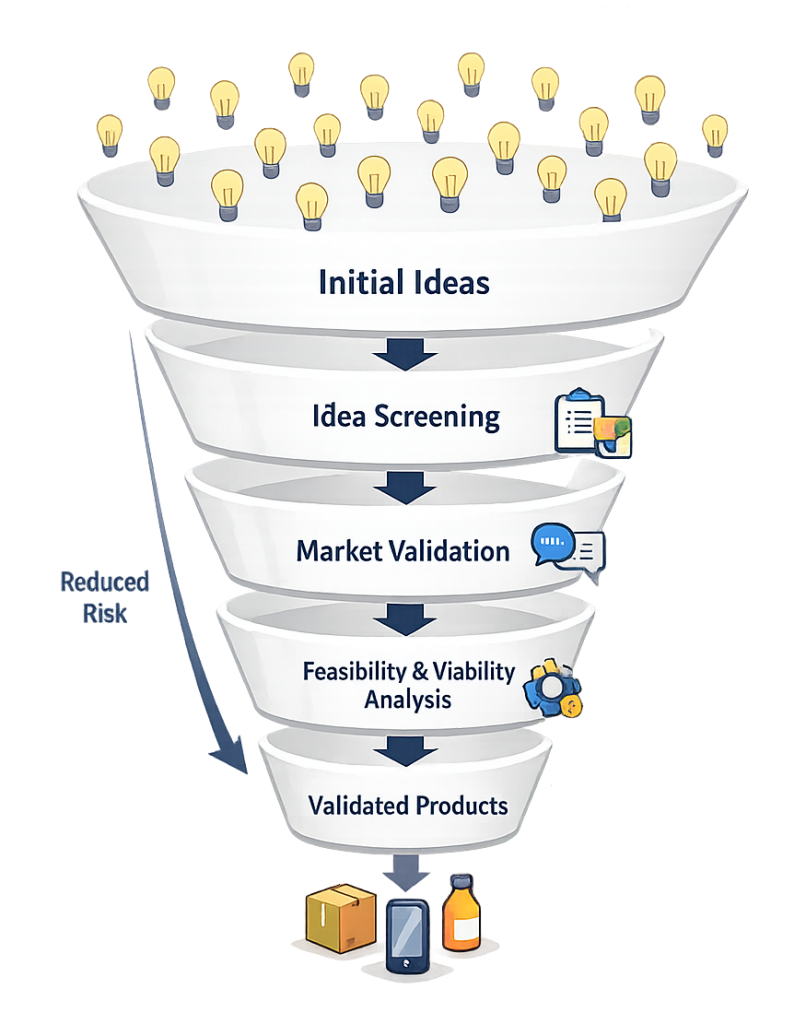
Figure 1. Innovation risk funnel
UNDERSTANDING MARKETS AND MARKET DYNAMICS
Nature and Structure of Markets
A market consists of individuals or organizations that share a specific need and are willing and able to purchase a solution that satisfies it. Markets function as complex systems where customers, competitors, suppliers, and regulators constantly interact. Because of this complexity, companies must understand customer preferences, buying behavior, technological trends, competitive offerings, and regulatory conditions.
Since Market validation of a product idea aims to test how well a concept fits real customer problems, companies need a clear picture of the market structure. Without this understanding, they risk creating solutions that miss expectations or fail to compete effectively.
Furthermore, markets evolve due to technological shifts, economic changes, and social trends. Therefore, organizations must continuously track these developments and adjust their innovation strategies accordingly.
Market Assessment and Opportunity Evaluation
A thorough market assessment helps organizations evaluate whether entering or expanding within a market makes sense. It typically includes:
- market size and growth outlook
- customer segments and target groups
- purchasing patterns and decision criteria
- competitive landscape and substitutes
- entry barriers and regulations
- technological and economic trends
This analysis highlights opportunities and risks, helping companies decide whether demand is strong enough to justify further development. After this assessment, Market validation of a product idea tests specific concepts within the chosen market context.
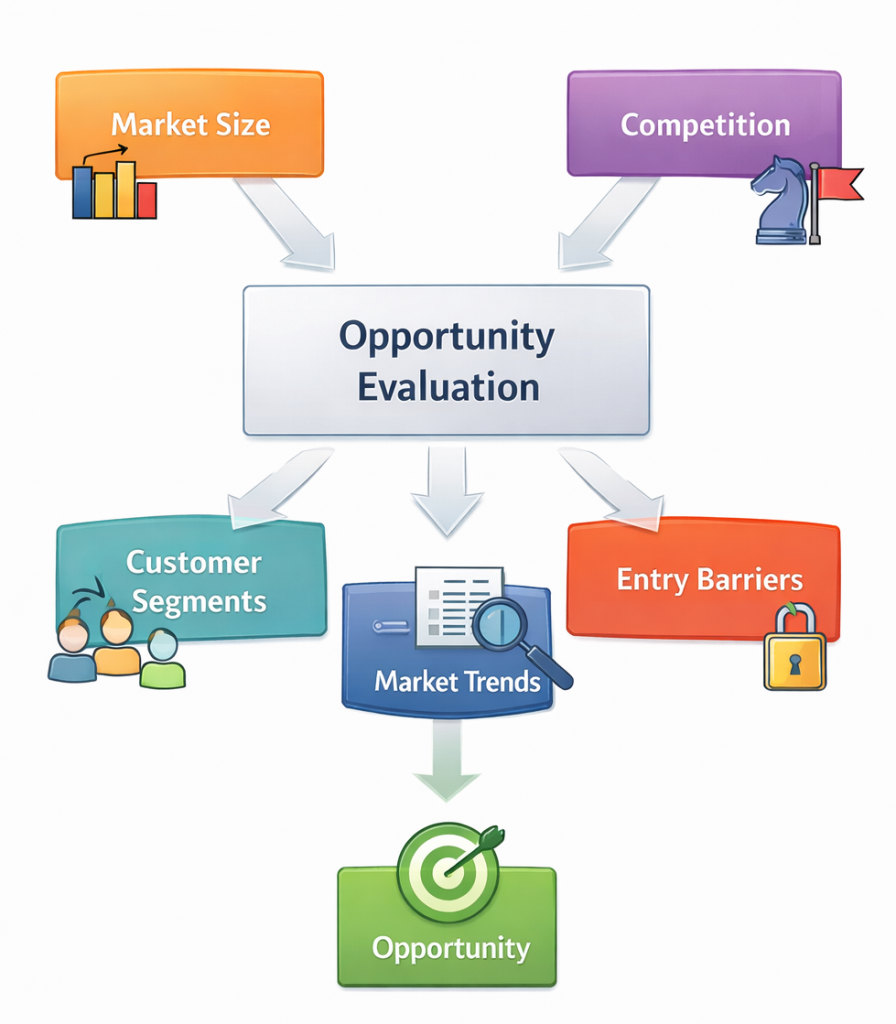
Figure 2. Market assessment model
Contact us today to learn how LA NPDT can assist in realizing your project.
BUSINESS IDEAS AND THE INNOVATION PROCESS
Organizations generate new business ideas through structured innovation processes that transform opportunities into viable products. These processes usually include the Front End of Innovation and the New Product Development phase.
The Front End of Innovation covers opportunity identification, idea creation, concept exploration, and early evaluation. Because information is limited at this stage, uncertainty is high. Decisions made here strongly influence later outcomes.
Next, the New Product Development phase focuses on design, engineering, testing, and commercialization. Although more structured, it still relies on assumptions formed earlier.
Here, Market validation of a product idea acts as a bridge between the two phases. It turns assumptions into tested knowledge and helps organizations determine whether their ideas solve real customer problems and deliver meaningful value.
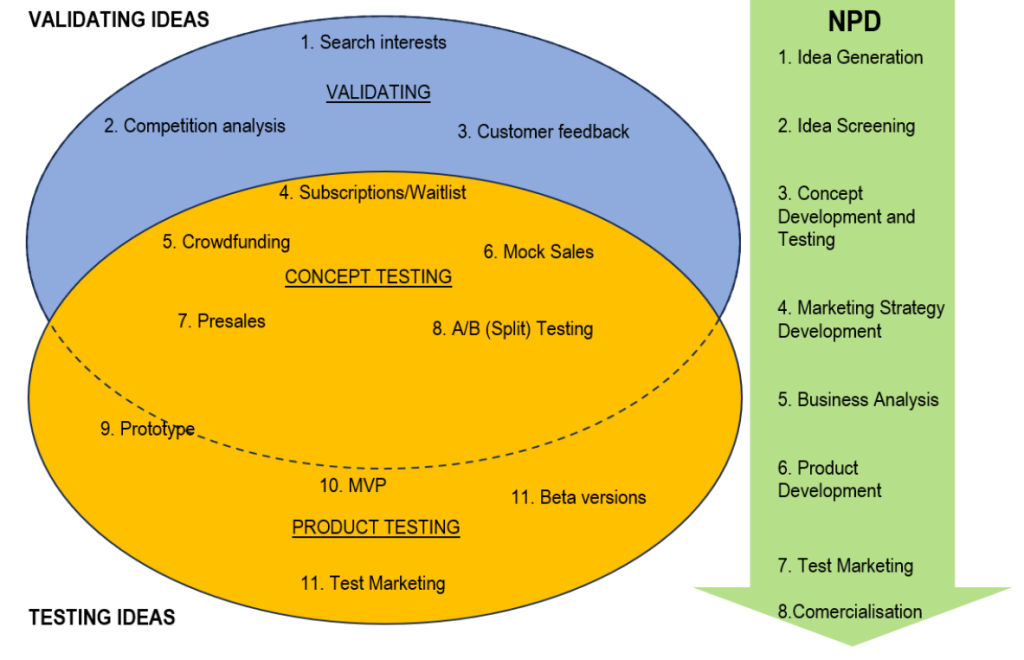
Figure 2. Validating and testing business ideas in the context of the NPD (Source – mrp.ase.ro)
THE IMPORTANCE OF VALIDATION IN INNOVATION
- Innovation Risk and Product Failure
Many new products fail because companies misinterpret customer needs or overestimate demand. Even technically advanced solutions struggle if they lack market relevance. By contrast, Market validation of a product idea helps organizations identify weak assumptions early and redirect resources toward stronger opportunities.
- Benefits of Early Validation
Early validation offers several advantages. It allows teams to test customer interest, refine concepts, uncover unmet needs, and improve product‑market fit. With early feedback, organizations can adjust designs before investing heavily.
Additionally, early validation accelerates learning cycles. Teams gain insights into customer behavior, compare alternative solutions, and strengthen their value proposition through iterative experimentation.
- Commercial Viability and Feasibility
Effective validation examines desirability, technical feasibility, and economic viability at the same time. This integrated view ensures that development decisions consider both market demand and organizational capabilities.
Challenges in Current Validation Practices
Despite its importance, many organizations struggle to validate ideas systematically. Limited resources, time pressure, and restricted access to customers often hinder research. Internal biases also influence decisions, as teams may favor existing ideas and ignore contradictory evidence.
Furthermore, without structured methods, validation becomes inconsistent and unreliable. To overcome these issues, organizations need clear frameworks that support systematic experimentation and learning.
The Product Validation Process
A structured validation process helps organizations evaluate ideas and reduce uncertainty. It begins with identifying key assumptions about customer needs, product functionality, and market demand.
Next, teams design experiments – such as prototypes, simulations, or customer interactions – to test these assumptions. They gather feedback, analyze results, and refine concepts based on real evidence.
Through repeated cycles of testing and learning, Market validation of a product idea strengthens understanding of customer needs and supports better development decisions.
Rapid Validation Methodologies
To speed up innovation, many organizations use rapid validation methods that emphasize quick experiments and direct customer contact. These include interviews, prototype tests, minimum viable products, landing pages, and A/B tests.
Such approaches allow teams to gather insights quickly and with minimal resources. Digital tools further enhance this process by enabling real‑time data collection and automated analysis.
Research Activities Supporting Validation
Validation relies on systematic research. Organizations use qualitative methods – such as interviews, focus groups, and observations – to understand motivations and experiences. They also use quantitative methods – such as surveys and analytics – to measure demand and behavior.
Reliable data collection and objective evaluation are essential, since Market validation of a product idea depends on accurate and unbiased insights.
Validation Across Multiple Dimensions
Effective validation examines several dimensions:
- customer desirability
- technical feasibility
- economic viability
- strategic alignment
Weakness in any of these areas can undermine product success. Therefore, organizations must gather evidence across all dimensions.
Market Appraisal and Customer Feedback
Market appraisal involves presenting concepts to customers and experts, gathering feedback, and analyzing responses. This process helps organizations understand perception, estimate demand, evaluate pricing, and identify improvement opportunities.
By integrating customer feedback into design and strategy, Market validation of a product idea becomes more reliable and actionable.
Financing, Implementation, and Continuous Validation
Once validation confirms potential, organizations secure funding and plan implementation. However, validation does not stop at launch. Companies must continue monitoring performance, collecting feedback, and refining features.
Continuous validation strengthens competitiveness by helping organizations adapt quickly to market changes.
Supporting Frameworks and Tools
Various frameworks support validation, including hypothesis‑driven experimentation, value stream mapping, and customer development models. These tools improve transparency, learning, and consistency throughout the innovation process.


