Product as a Service: Designing Hardware for Recurring Revenue
Subscription hardware only works if the product is engineered to come back, be refurbished and go out again. Here is what changes in the design and in the numbers.
February 8, 20266 min read

Written by Konstantin Dolgan, Ph.D., NPDP
Founder & CEO, Product Development Engineer
Published February 8, 2026Updated September 2, 2026
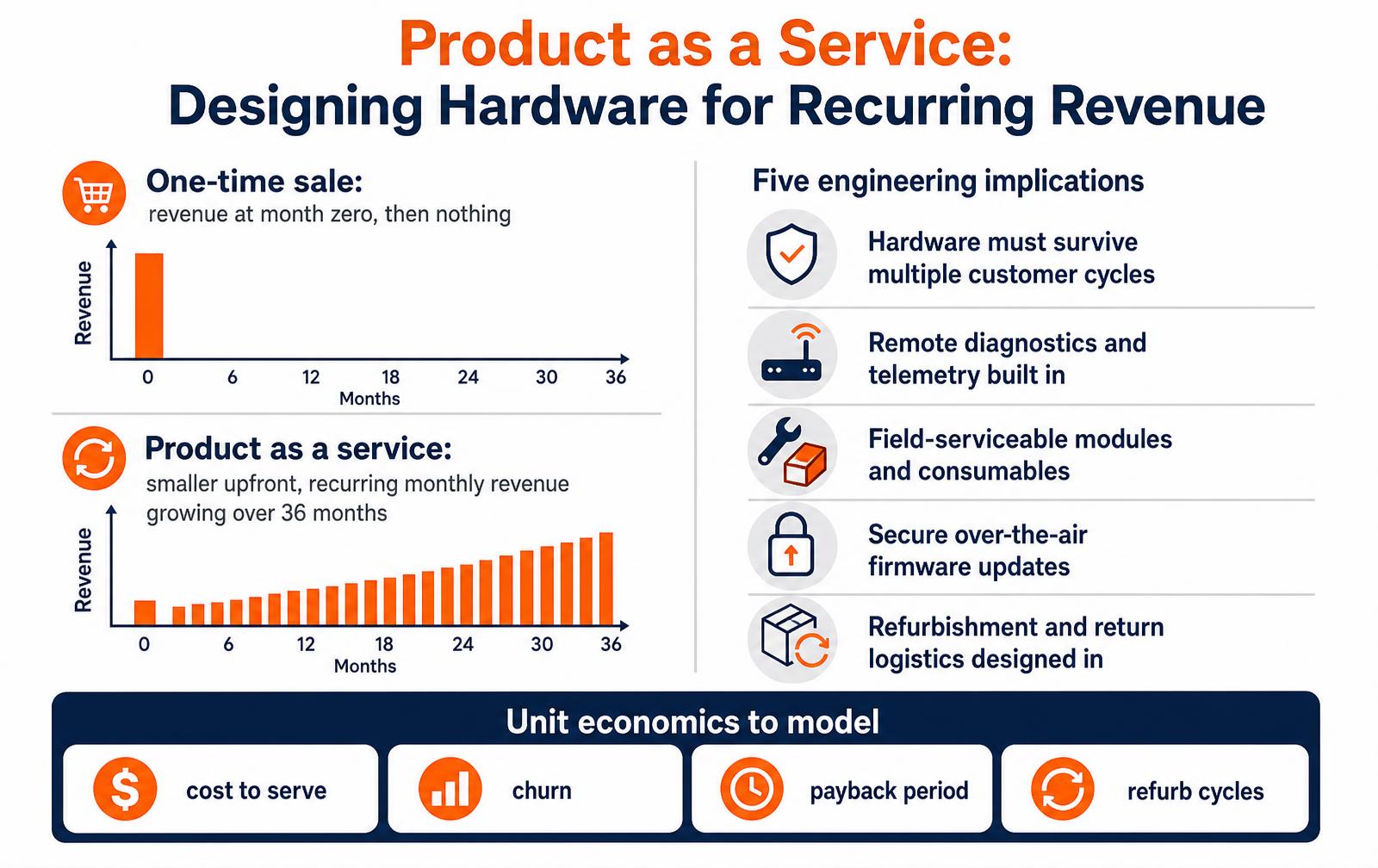
Product as a service means the customer pays for the outcome — clean water, monitored equipment, working coffee — while you keep owning the hardware. The commercial appeal is obvious: predictable revenue and a longer customer relationship. The engineering consequence is less obvious and much harder.
You are no longer designing a product that has to survive one owner; you are designing an asset that has to survive several, be serviced remotely, and come back profitable enough to send out again.
What changes in the hardware
- Design life multiplies. A consumer product designed for three years of light use becomes an asset expected to run through three or four subscribers. Bearings, hinges, seals, connectors and battery chemistry all need to be specified against the total cycle count, not the first one.
- Telemetry is not optional. If you own the fleet, you pay for every truck roll. Instrumentation that predicts a failure before the customer notices is the single largest lever on cost to serve.
- Modules, not monoliths. Wear items — filters, pumps, batteries, contact surfaces — should be replaceable in minutes by someone who is not an engineer, without disturbing the calibrated core.
- Secure over-the-air updates. The fleet will outlive its firmware. Signed updates with rollback are a design requirement from day one, not a later feature.
- Refurbishment is a design constraint. Cosmetic parts that scratch, foams that compress and labels that peel decide whether a returned unit can be re-let at full price or discounted.
The unit economics that decide viability
Variable | What it means | Typical trap |
|---|---|---|
Landed asset cost | Build, freight, duty and installation per unit | Priced from prototype cost rather than production cost |
Payback period | Months of subscription to recover the asset | Anything past 18-24 months makes growth cash-hungry |
Cost to serve | Support, spares, field visits, connectivity | Underestimated because early customers are hand-held |
Churn | Share of subscribers leaving each year | Short contracts plus a slow payback kills the model |
Refurb cost and yield | Cost to return a unit to rentable condition | Never measured until the first big return wave |
A simple test before committing: if the asset costs $600 landed and the subscription is $39 a month, payback is roughly 15 months before support costs. Add $6 a month of cost to serve and it is closer to 18. Now assume 25% annual churn and two refurbishment cycles per unit — the model only works if refurbishment is cheap and the hardware survives it.
Where subscription hardware businesses go wrong
- Selling a product design as a service. Taking a retail product, adding a monthly price and hoping the returns work out. The failure shows up around month 20, when the first cohort comes back unrentable.
- No serial-level history. Without a record of every unit, its firmware, its faults and its refurbishments, warranty exposure and fleet health are guesswork.
- Connectivity as an afterthought. Cellular data costs, certification and roaming agreements change both the BOM and the monthly margin.
- Ignoring reverse logistics. Packaging that survives one outbound trip will not survive four round trips; the shipping damage bill becomes a line item nobody budgeted.
- Growth outrunning capital. Every new subscriber consumes an asset. Fast growth on a long payback is indistinguishable from running out of money.
The practical route is to prove the service with a small instrumented fleet before tooling anything, using rapid prototypes and near-production units to measure real duty cycles, then feed that data into reliability work and the final cost model.
Unit economics of a hardware subscription
Product-as-a-service moves the money but not the cost. You still pay for the hardware up front and recover it over months, which turns a manufacturing business into a financing business. The model only works when lifetime revenue clears hardware cost, service cost and churn with room left over — and the sensitivity to churn is brutal.
Input | Example value | Effect |
|---|---|---|
Hardware cost delivered | $180 | Cash out on day one, per subscriber |
Monthly subscription price | $29 | Revenue recognized over the contract |
Gross margin on service | 70% | After connectivity, cloud and support |
Monthly churn | 3% | Implies ~33-month average life |
Payback period | ~9 months | Hardware cost / monthly contribution |
Lifetime value | ~$490 | Sensitive: 5% churn cuts it by a third |
Engineering decisions that recurring revenue changes
- Design for refurbishment. Returned units that can be cleaned, retested and redeployed cut effective hardware cost dramatically; that means captive fasteners, replaceable wear parts and no glued-shut enclosures.
- Over-specify the parts you cannot service. A bearing or connector rated for three years of use in a purchase model needs five to seven in a service model.
- Plan for firmware you will still be shipping in year six. Leave flash and RAM headroom, and build a signed OTA path from the first unit.
- Instrument the product. Usage and health telemetry drives predictive service and reduces truck rolls, which are the hidden cost that kills margins.
- Design the return journey. Packaging that can ship a unit back, and a reset process that clears user data cleanly.
Contracts, ownership and end of life
When you retain title to the hardware, you also retain the obligations: warranty for the life of the contract, liability for a device you own sitting in someone's home, and disposal at end of life.
Decide early whether the subscriber ever owns the unit, what happens to it on cancellation, and whether the product still functions in a degraded free mode — bricking a device a customer has in their hand generates the worst reviews in hardware and, in a growing number of jurisdictions, regulatory attention.
We help teams model these trade-offs before tooling, as part of product development consulting.
Frequently asked questions
What is product as a service?
Product as a service is a model where customers pay a recurring fee for the use and outcome of a physical product while the provider retains ownership, along with responsibility for maintenance, updates, replacement and end-of-life. Examples include equipment leasing with monitoring, water and air purification subscriptions and managed medical or industrial devices.
How does product as a service change hardware design?
Design life is set by total fleet cycles rather than one owner, telemetry and remote diagnostics become core requirements, wear items are made modular and tool-free to replace, firmware needs secure over-the-air updates, and cosmetics and packaging are chosen so a returned unit can be refurbished cheaply and re-let at full price.
Is product as a service more profitable than selling hardware outright?
Over the life of a customer it usually is, but only after the asset is paid back. It is more capital-intensive up front and more sensitive to churn, cost to serve and refurbishment yield. Model payback period and cost to serve before committing; if payback exceeds roughly two years, growth will need financing.
What changes in the engineering when hardware becomes a service
Under a product-as-a-service model you keep the asset on your balance sheet, so every design decision that shortens life or raises service cost comes straight out of margin. That inverts several familiar trade-offs: bonded assemblies become serviceable ones, consumables become authenticated, and telemetry stops being a nice-to-have because you cannot bill for uptime you cannot measure.
Design decision | One-time sale | Product as a service |
|---|---|---|
Fasteners | Snap fits and adhesive | Screws and service access panels |
Enclosure life target | 2-3 years | 5-8 years across multiple tenants |
Connectivity | Optional | Mandatory for billing and diagnostics |
Consumables | Open | Authenticated with usage metering |
Firmware updates | Occasional | Signed over-the-air with rollback |
Cost focus | Unit BOM | Total cost of ownership per month |
Unit economics you have to model before design freeze
- Payback period. Device cost plus deployment divided by monthly gross margin; under 14 months keeps working capital manageable.
- Refurbishment cost per cycle. Cleaning, replacing wear parts, recertification and repackaging - typically 12-25% of unit cost.
- Connectivity cost. Cellular data plus platform fees, often $0.80-$4.00 per device per month.
- Truck roll cost. Every on-site service call runs $150-$400; remote diagnostics are what keep this number down.
- Churn and asset recovery. Model the percentage of units you never get back; 3-8% is common in consumer fleets.
- Warranty accrual. Under a service model this becomes an ongoing cost line, not a one-time reserve.
Designing for refurbishment
The cheapest fleet is one that can be turned around in under 30 minutes by a technician with a screwdriver. That means modular wear items, a service manual written before launch, serialised subassemblies so you can track failures by lot, and surfaces that survive commercial cleaning. Design reviews should include a teardown-and-rebuild exercise timed with a stopwatch; the number you record is a direct input into gross margin.
- Key takeaway 1: Under PaaS, service and refurbishment cost matter more than unit BOM.
- Key takeaway 2: Connectivity is infrastructure for billing, not a feature.
- Key takeaway 3: Model payback period and asset recovery before design freeze.
- Key takeaway 4: Time a full refurbishment during design review and treat it as a design requirement.
Service-cost model: instrument the unit economics before you sign
Cost driver | Typical monthly impact per unit | Design lever that reduces it |
|---|---|---|
Field service visit | $180-$450 per dispatch, amortized | Field-swappable modules, remote diagnostics, self-test on boot |
Consumables and wear parts | $4-$25 | Longer-life materials, tool-free replacement, usage-based reorder |
Refurbishment between customers | $60-$200 per cycle | Cosmetic-tolerant surfaces, standard fasteners, cleanable housings |
Firmware defects | Unbounded without OTA | Signed over-the-air updates with rollback |
Connectivity and telemetry | $1-$6 | Event-driven reporting instead of continuous streaming |
Reverse logistics | $20-$70 per return | Reusable shipping case designed with the enclosure |
Building hardware for a subscription model?
We design products for fleet duty — serviceability, telemetry and refurbishment built into the first CAD, not retrofitted after the first return wave.
Work with LA NPDT: if you are moving from here to execution, start with our product development consulting or talk to us about end-to-end product development.
Filed under:EducationUncategorized
Tagged:2025
Services related to this guide
- 3D modeling servicesParametric CAD, renders and print-ready files built for manufacturing.
- Best industrial design firmsWhich studios take an idea from form to manufacturable hardware, and what they charge.
- Product design servicesIndustrial design and CAD taken all the way to manufacturable files.
- Product development examplesReal projects we designed, prototyped and shipped.