AI in Product Management: Where It Actually Helps
AI is genuinely useful in parts of the product management workflow and actively harmful in others. Here is the stage-by-stage breakdown, the failure modes to watch for, and a practical adoption sequence.
May 10, 20266 min read

Written by Ashok Chintagunta, MS Computer Science, Louisiana Tech University
CTO & Software Engineer, AI and Automation
Published May 10, 2026Updated September 2, 2026
AI in product management is most useful where the work is high-volume synthesis — reading hundreds of support tickets, drafting a first-pass spec, summarizing usage data — and least useful where the work is judgment: deciding what matters, what to cut and what to defend in front of the business. Teams that get value from it are precise about that boundary. Teams that are not end up with confident documents nobody trusts.
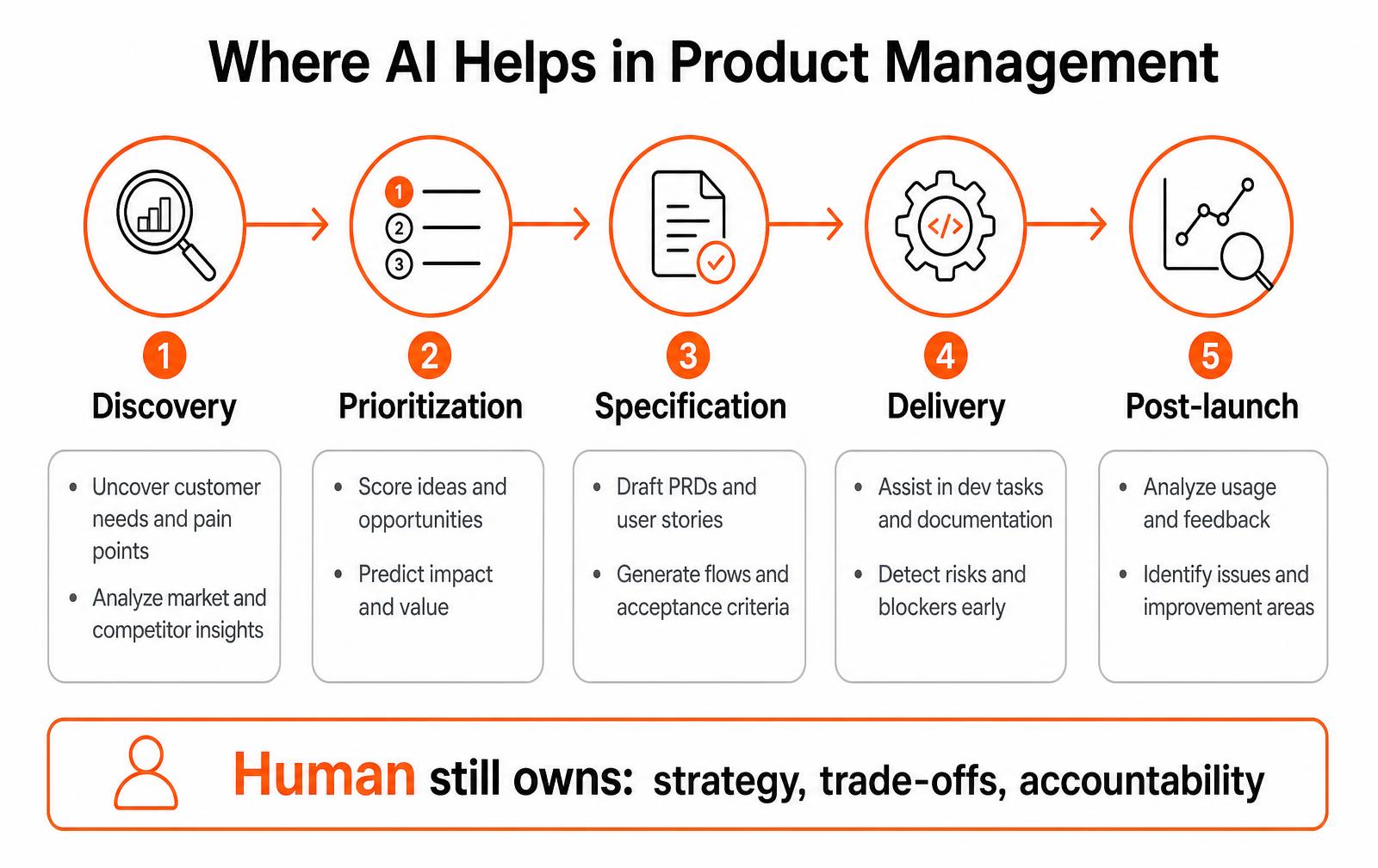
Stage by stage: what AI is good at
Stage | What AI does well | What stays human | Time saved |
|---|---|---|---|
Discovery | Clustering interview notes, tickets and reviews into themes; drafting research questions | Choosing which problem is worth solving | Hours per research round |
Prioritization | Filling scoring frameworks consistently; surfacing dependencies you missed | Setting the weights and defending the cut line | Moderate |
Specification | First-draft PRDs, user stories, acceptance criteria, edge-case checklists | Deciding scope and what good enough means | Large — often 50% of drafting time |
Delivery | Summarizing standups and status, flagging slipping items, drafting release notes | Trade-offs when the date and the scope collide | Moderate |
Post-launch | Sentiment analysis, anomaly detection in usage data, categorizing churn reasons | Deciding what the data means for the roadmap | Large at scale |
Notice the shape of the table. Every genuine win is a reduction in the cost of reading, writing or sorting. None of them is a decision. That is not a temporary limitation of the current models — it is a governance choice. A roadmap is a promise the business makes, and a promise needs an owner who can be held to it.
Where it goes wrong
- Fabricated specifics. Models invent plausible numbers, competitor features and citations. Any figure that reaches a spec needs a source you can open.
- Consensus bias. Summaries flatten the outlier interview — which is often the one that contains the insight — into the average opinion.
- False confidence in small samples. Sentiment analysis over 40 reviews looks as authoritative as analysis over 40,000. It is not.
- Confidential data leakage. Pasting a roadmap, customer list or unfiled invention disclosure into a consumer tool can compromise trade secret status and patent strategy.
- Volume without value. AI makes it cheap to produce documents, so teams produce more of them. Documentation nobody reads is negative work.
The hardware-specific version of the last risk is worse than the software one. A generated spec that says a housing should be 2 mm thick reads exactly like an engineered decision, but nothing behind it accounted for the resin, the tool or the drop test. In physical products, unverified detail becomes tooling, and tooling is expensive to undo — see our note on how tooling decisions drive cost.
A 30-day adoption sequence
- Week 1 — pick one repetitive task. Customer feedback triage is the usual best first candidate: high volume, low risk, obvious quality check.
- Week 2 — write the rules. Which tool, what data may go into it, what must be verified before it leaves the team. One page, agreed with legal if you handle customer data.
- Week 3 — measure against a baseline. Have a human do the same task on the same input once. Without that comparison you are guessing about the benefit.
- Week 4 — expand or stop. Keep what beat the baseline, drop what did not. Most teams find two or three durable uses, not twenty.
What to measure
Metric | Why it matters | Warning sign |
|---|---|---|
Hours reclaimed per week | The direct benefit, and the easiest to verify | Time saved drafting is spent re-editing |
Rework rate on AI-drafted specs | Tells you whether the draft is a head start or a liability | Engineers rewrite more than half of it |
Decision latency | Faster synthesis should produce faster calls | More analysis, same slow decisions |
Escaped errors | Fabricated facts that reached a customer or a supplier | Any nonzero number needs a process change |
One more discipline worth borrowing from engineering: version the prompts and templates the way you version a document. When output quality drops, you want to know what changed — the model, the prompt or the input.
Where AI earns its place in the workflow
The useful applications share a shape: high-volume, low-stakes, verifiable work where a human reviews the output before it matters. Synthesising hundreds of support tickets into themes, drafting a first-pass requirement from a call transcript, or turning a spreadsheet into a readable summary all fit. Prioritisation, pricing and roadmap commitments do not, because the model has no access to the political and commercial context that actually decides them.

Task | Fit | Why |
|---|---|---|
Clustering support tickets and reviews | Strong | Volume work with a checkable result |
Drafting user stories from transcripts | Strong | Human edits before anyone builds |
Competitive teardown summaries | Good | Fast first pass; verify every claim |
Writing test plans and edge-case lists | Good | Broad recall beats a tired author |
Prioritising the roadmap | Weak | Missing commercial and political context |
Estimating engineering effort | Weak | No knowledge of the team or the codebase |
Deciding pricing | Poor | Requires real willingness-to-pay evidence |
Guardrails worth setting up first
- Keep customer data out of general-purpose tools unless your agreement covers it; anonymise transcripts before upload.
- Require a named human owner on any artefact that leaves the team, regardless of who drafted it.
- Ask for sources on factual claims and check them; confident wrong answers are the main failure mode.
- Measure the time actually saved after a month; drop the tools that only feel productive.
- Never let a model author a decision record — it can draft the options, a person signs the choice.
Key takeaways
- Use AI for synthesis and drafting, not for prioritisation, estimation or pricing decisions.
- Every output needs a human owner before it leaves the team.
- Anonymise customer data and confirm the data terms of any tool you adopt.
- Track the hours saved; keep only the workflows that survive that test.
Where AI actually pays back in product management
The measurable wins are narrow and repeatable. Synthesis of customer interviews, support tickets, and warranty claims into themed problem statements saves a product manager roughly four to eight hours a week and improves recall of low-frequency complaints that manual reading misses.
Requirements drafting from a structured template cuts first-draft time by half, provided an engineer still owns acceptance criteria. Competitive teardown summaries and specification comparison tables are safe, high-yield tasks because the source material is public and verifiable.
The losing applications are prioritization scores, roadmap generation, and anything where the model must invent a number. A confidently produced RICE score built on invented reach data is worse than no score, because it launders a guess into a decision artifact.
Put a rule in writing: any AI output that enters a decision document must cite the source rows it came from, and any figure that cannot be traced gets deleted.
Log which workflows use AI and review the log quarterly against cycle-time data, so the team keeps the tools that earn their place and drops the ones that only feel productive.
Frequently asked questions
How is AI used in product management?
Most commonly for synthesis and drafting: clustering customer feedback into themes, drafting PRDs, user stories and acceptance criteria, summarizing usage data and generating release notes. The strategic work — choosing the problem, setting priorities and defending trade-offs — stays with the product manager.
Will AI replace product managers?
No, because the core of the job is accountable judgment under uncertainty and negotiation across teams — neither of which can be delegated to a tool. What changes is the mix: less time spent writing and summarizing, more time spent with customers and on decisions.
Is it safe to put product data into AI tools?
Only under an explicit policy. Use business-tier tools with contractual no-training terms, never paste customer personal data or unfiled invention disclosures, and keep anything that could affect patent or trade secret protection out of consumer tools entirely.
Does AI work for hardware product management?
For research synthesis, documentation and supplier correspondence, yes. For engineering decisions — materials, tolerances, thermal or structural margins — treat any output as a hypothesis to be verified by analysis or test. In hardware, an unverified number becomes tooling, and tooling is expensive to change.
What should a team try first?
Customer feedback triage. It is high volume, low risk, easy to spot-check against the raw tickets, and it produces a visible result in the first week — which makes the second experiment easier to fund.
Building the tool stack, and what it costs
Most teams over-buy AI tooling and under-invest in the workflow around it. Two or three tools used consistently beat eight used occasionally, and the cost that matters is not the license fee but the review time each output consumes. Price a stack per product manager per month, then measure whether it removes hours from the week.
Typical AI stack for a product team
Category | Job it does | Typical cost per seat/month | Review burden |
|---|---|---|---|
General assistant | Drafting, summarizing, analysis | $20-$60 | Medium |
Meeting and call transcription | Customer call notes, themes | $15-$40 | Low |
Research synthesis | Clustering interview and survey data | $30-$100 | High — verify quotes |
Analytics copilot | Query product data in plain language | Bundled or $50+ | High — verify queries |
Roadmap / ticket assistant | Draft specs, acceptance criteria | $10-$30 | Medium |
Judge each tool on one metric: hours returned per week after review time. Anything that needs more checking than it saves belongs in a pilot, not the standard stack. Hardware teams should also confirm where data is stored before any CAD, supplier pricing or unreleased spec goes into a hosted tool.
Rollout rules that keep quality up
- Name an owner per tool who is responsible for prompts, templates and training.
- Ban AI output from customer-facing documents without a named human reviewer.
- Keep confidential specs and supplier pricing out of tools without a data-processing agreement.
- Track hours saved per week for a month before renewing any license.
- Retire tools that overlap; two assistants doing the same job halves adoption of both.
Key takeaways
- Measure AI tools by hours returned after review, not by feature lists.
- A small, well-owned stack outperforms a broad one.
- Set data-handling rules before confidential product data goes into any hosted tool.
Building a product, not just a backlog?
Our discovery team pairs AI-assisted synthesis with engineers who own the decisions and the hardware that follows from them.
From the archive
Work with LA NPDT: if you are moving from here to execution, start with our product development consulting or talk to us about end-to-end product development.
Filed under:EducationUncategorized
Tagged:2025
Services related to this guide
- Product design servicesIndustrial design and CAD taken all the way to manufacturable files.
- Rapid prototypingWorking prototypes in days, from 3D printing to vacuum casting.
- Electronic design servicesSchematic, PCB layout, firmware and bring-up, through to production handoff.
- Product development examplesReal projects we designed, prototyped and shipped.