Design for Manufacturing Services: What to Expect and How to Buy
A buyer guide to industrial design companies: the four things worth evaluating, what each engagement stage delivers, and honest fee ranges before you sign.
October 16, 20248 min read

Written by Konstantin Dolgan, Ph.D., NPDP
Founder & CEO, Product Development Engineer
Published October 16, 2024Updated September 3, 2026
Design for manufacturing services help turn a great idea into a real part. This part can then be made at the planned cost. Many studios show similar past work and charge similar daily rates. However, their results can be very different.
The key difference is when they check the design for manufacturing (DFM). Do they check it during design or after the CAD is finished? This guide explains what each stage should provide.
It also shows what DFM work you are paying for. Finally, it helps you choose a partner before you start.
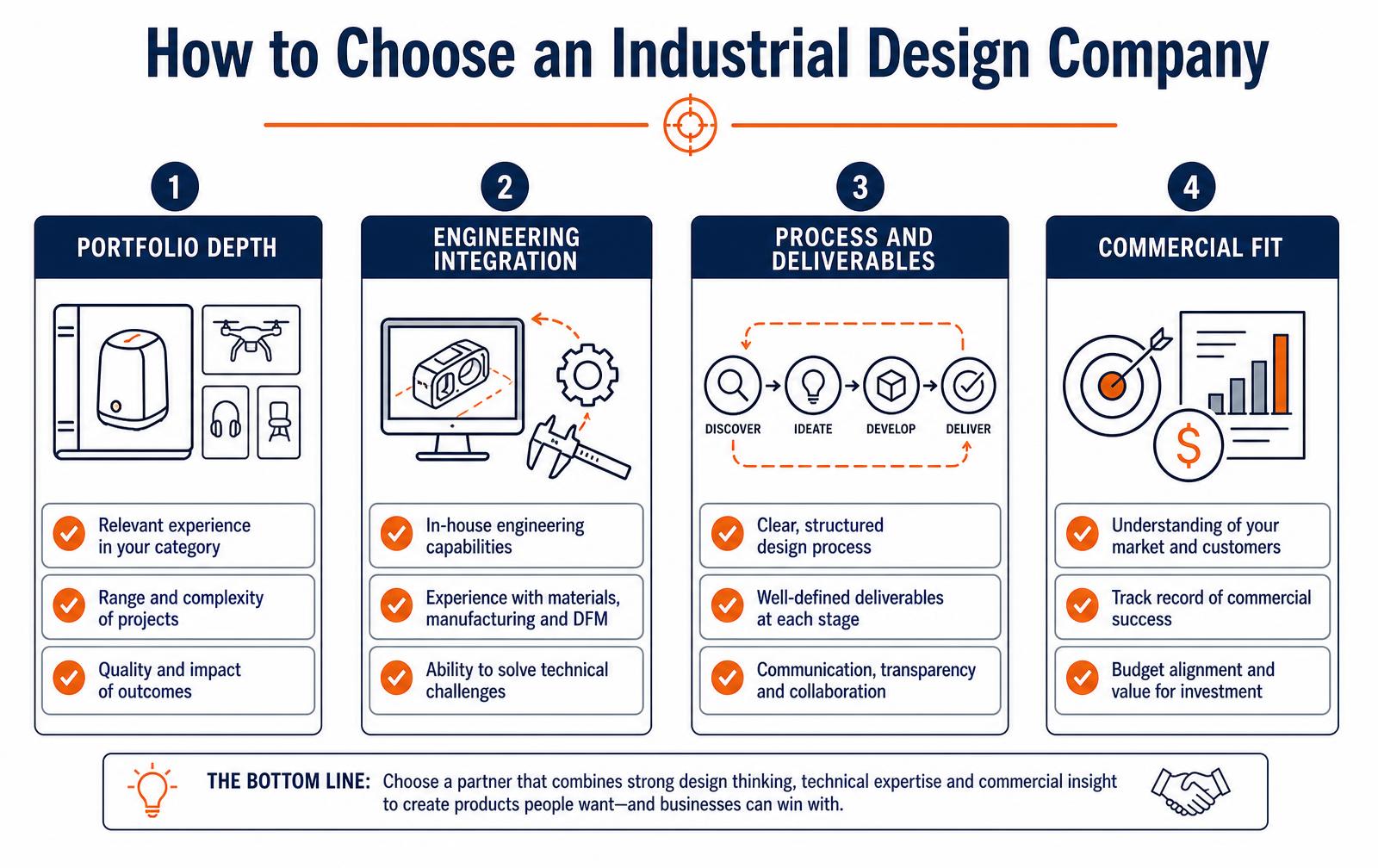
The four things worth evaluating
- Portfolio depth, not breadth. Ask for a product in your category that reached retail, and ask what changed between the render and the shipped part. The answer reveals whether the studio has lived through tooling.
- Engineering integration. A design studio that hands off a surface model leaves you to pay someone else to make it manufacturable. Studios with in-house mechanical engineering catch wall thickness, draft and assembly problems while they are still cheap to fix.
- Process and deliverables. Every stage should end in a named artefact you own: research findings, concept set, CMF direction, Class-A surfaces, engineering CAD, a prototype. Vague phases are where budgets disappear.
- Commercial fit. A studio that never asks about landed cost, target margin or volume is designing without constraints, and you will discover the gap after the first factory quote.
What each stage delivers and costs
Stage | Deliverable | Duration | Typical fee |
|---|---|---|---|
Research and positioning | User findings, competitive teardown, design brief | 2-3 weeks | $8k-$25k |
Concept design | 3-6 directions with sketches and block models | 3-4 weeks | $12k-$35k |
Design refinement and CMF | Chosen direction, colour, material and finish spec | 3-4 weeks | $15k-$40k |
Surfacing and engineering CAD | Production-intent CAD, DFM review | 4-8 weeks | $25k-$90k |
Prototype and validation | Appearance and functional models, test findings | 3-6 weeks | $10k-$60k |
Studio, consultancy or full development partner?
A boutique studio is best if you already have engineering and manufacturing. You would hire them for form, brand, and user experience. A consultancy fits strategy work when product goals are not yet set.
A full development partner is wise when you need one team for everything. This includes tasks from concept to tooling and first production. This way, no one can blame a handoff.
The most costly error is buying great design from a studio that lacks manufacturing knowledge. Then you pay a second firm to redesign it for production.
See our industrial design services and how they connect to product engineering.
What a DFM engagement costs
Scope | Deliverable | Typical fee | Duration |
|---|---|---|---|
DFM review only | Annotated report on an existing CAD set | $2,500-$8,000 | 1-2 weeks |
DFM plus CAD rework | Manufacturable models and drawings | $8,000-$35,000 | 3-6 weeks |
Tooling readiness package | Parting lines, draft, gate strategy, GD&T | $12,000-$45,000 | 4-8 weeks |
Supplier RFQ management | Quote comparison and vendor selection | $5,000-$15,000 | 2-4 weeks |
Pilot build support | On-site or remote first-article support | $6,000-$25,000 | 2-6 weeks |
What to require in the deliverables
- Native CAD, not just STEP. Without the feature tree the next engineer rebuilds the model.
- Fully dimensioned drawings with GD&T and a stated inspection method for each critical feature.
- A tolerance stack-up for every fit that matters. Ask for the worst-case and statistical numbers.
- A documented material and finish spec, including supplier part numbers for purchased components.
- Cost model per part showing tooling, cycle and material assumptions you can challenge.
- Written change log. Every geometry change should be traceable to a reason.
What a DFM review changes in practice
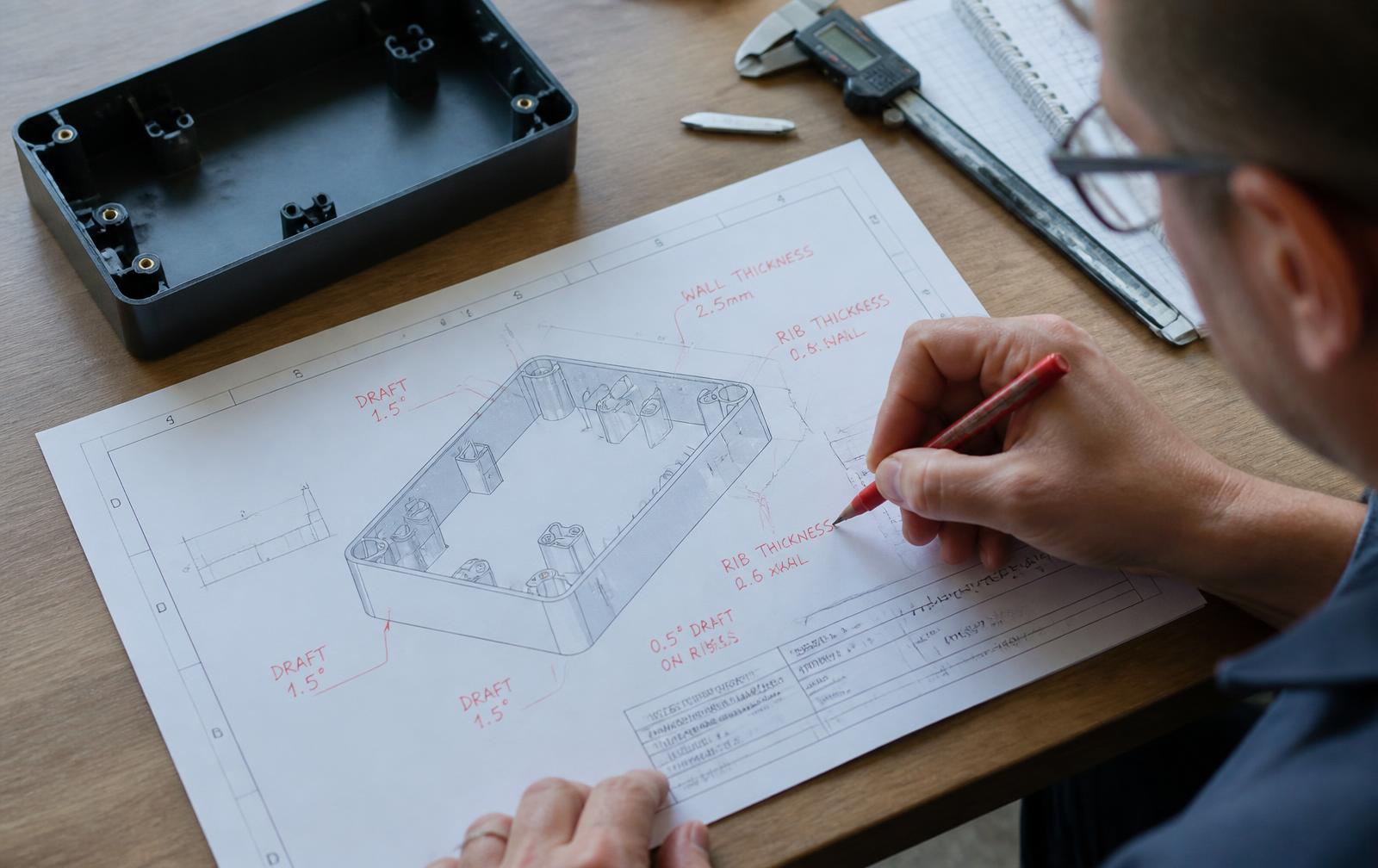
Design for manufacturing is not just a drawing style. Instead, it is a series of choices that decide how much each part will cost forever. For an injection-molded housing, this review checks several things.
It looks at how consistent the wall thickness is. It checks the draft on every straight side. The review also considers the parting line's position compared to visible surfaces.
It examines the gate location and any resulting weld lines. Ejector pin placement is also reviewed. Finally, it checks if any feature requires a side action.
For example, a single undercut could be redesigned as a pass-through. If not, it adds a slide to the tool. This slide costs thousands in tooling.
It also adds a fraction of a second to the cycle time for every part. This extra time lasts for the product's entire life.
For a machined part, the same review asks different questions. Is the tightest tolerance truly needed for function? Can inner corners use a larger cutter radius? How many setups does the part's shape need? Does the material chosen match available stock sizes? Tolerances are where costs often hide. Changing a non-critical dimension from 0.05 mm to 0.2 mm can cut inspection time and waste a lot. And no one later in the process will notice the difference.
A good review does not just list problems. It offers specific changes to the design. Each change shows the cost or risk it removes. This lets you decide which changes to make before the design is finalized.
When to run DFM in the schedule
Most teams run Design for Manufacturability (DFM) just once. This happens right before sending files to a tooling vendor. But this is the most costly time to run it. By then, the industrial design is final. The electronics are already laid out. Each DFM suggestion will conflict with a decision someone has already made. Instead, run DFM three times. Each check will save you more money than the last.
The first check should happen during the concept phase. This is when you choose a manufacturing process. Injection molding, thermoforming, sheet metal, die casting, and additive manufacturing each use a different geometric language.
Choosing the wrong process early on will lead to difficult compromises later. The second check should occur when the detailed design is about 80% complete. At this point, features are solid, but nothing is final.
This is where most cost savings occur. Geometry can still be easily changed. The third check should be done just before releasing tools.
It should only confirm findings and identify minor issues. If this third check finds major problems, then the second check was not done correctly.
Involve the actual manufacturer in the second DFM check whenever possible. A tool shop reviewing your design will provide unique insights. They know their presses, standard mold bases, and past failures. A general checklist cannot give you this level of detail.
- Concept: choose the process and confirm the part can be made that way at your target volume.
- 80 percent design: full geometry review with tolerance stack-ups; this is where the savings are.
- Pre-tooling release: confirmation pass with the tool shop, expecting only minor findings.
- First article: measure against the drawing and close out any deviation in writing before mass production.
We take these steps during our end-to-end product development. This includes CAD and drafting. We provide native models and fully dimensioned drawings. We also offer short-run manufacturing. This lets you test the design. You can do this before investing in final tools.
Tolerance stack-ups, the quiet source of assembly failures
Most assemblies that fail at first article do so because nobody added up the tolerances. Each part is within spec, and the assembly still binds, rattles or leaves a visible gap, because five features in a chain each contributed their share in the same direction.
A worst-case stack-up adds the extremes and tells you whether the assembly can fail at all; a statistical stack-up uses the expected distribution and tells you how often it will.
Do the worst-case first, because it is fast, and only reach for the statistical version when worst-case says you are marginal and tightening tolerances would be expensive.
The practical fix is rarely tighter tolerances. It is a different datum scheme, a compliant feature that absorbs variation, or a design that references both mating faces from the same surface. Adding a rib that locates a part from one wall instead of two removes an entire link from the chain.
A slot instead of a hole removes another. These changes cost nothing in tooling and eliminate the arguments that otherwise happen on the production floor at three in the morning.
Cosmetic gaps deserve the same treatment. A nominal 0.3 mm parting gap that stacks to 0.9 mm on some units looks like a defect even though every part passes inspection. Decide what gap is acceptable, then design the datum scheme that guarantees it rather than hoping the factory holds the middle of every tolerance band.
Frequently asked questions
What do industrial design companies actually do?
Industrial design companies decide how a physical product will look and feel. They also plan how people will use it. Their typical work involves studying users and markets.
They create new ideas. They also focus on ergonomics, which means making things easy to use. They pick colors, materials, and finishes.
They build surface models and physical prototypes. They also help with design through the manufacturing process. Many of these companies also offer mechanical engineering. This ensures the design can be built exactly as planned.
How much do industrial design companies charge?
Individual steps usually cost between $8,000 and $90,000. The price varies based on how complex each step is. A full industrial design project for a consumer product typically costs from $60,000 to $200,000. This price covers all stages. These stages include research, final CAD designs, and prototypes. In the United States, hourly rates are often between $120 and $250 per hour.
Should I hire a design studio or a full development partner?
Hire a studio if your company already handles engineering and manufacturing. You need a full development partner if you want one team to manage everything. This includes tasks from the first idea through tooling and initial production. This approach saves money and time. It stops you from redesigning a concept that could never be made.
How to scope and buy a DFM engagement
Design for manufacturing services are simpler to buy when the main result is a decision, not just a document. A good statement of work lists the parts to be reviewed. It also states the target process and volume. The cost goal per unit must be clear. Finally, it includes the date for tooling release. If these four details are missing, any price you get will be a guess.
Engagement | Typical scope | Deliverable | Best timing |
|---|---|---|---|
DFM audit | 5 to 20 parts, one process family | Annotated review with prioritized changes | Before tooling quotes |
Cost-down study | Existing production part | Cost model with alternate process and material options | After 6 months of production data |
Tooling readiness review | Full assembly | Draft, gate, ejection and parting-line sign-off | Two weeks before mold release |
Supplier qualification support | 2 to 4 candidate vendors | Capability matrix and sample inspection report | During RFQ |
Design transfer package | Complete product | Drawings, tolerance stack, inspection plan, golden samples | At design freeze |
Questions to ask before signing
- Which specific processes has this team released to production in the last two years
- Will the reviewer be the same engineer who signs the tooling package
- Are tolerance stacks included, or quoted separately
- Who owns the CAD after the engagement, and in which native format
- How are change requests priced once tooling is cut
- What happens if first-article inspection fails against the reviewed drawing
The answers separate firms that produce readable reports from firms that carry a product into production. Only the second kind reduces your launch risk.
What a good DFM review changes on the drawing
A design review has failed if it only praises the design. You should expect real improvements. For parts made by injection molding, this often means:
Contract terms that decide how the engagement goes
The business terms in a design and manufacturing services agreement are very important. They are just as important as the team's past work. Topics like who owns the files matter. The number of revisions allowed is also key. How changes are handled can affect the working relationship. These terms help keep the project productive. This is especially true when the project scope changes. Scope changes often happen around week six.
Terms to negotiate before signing
Term | What to insist on | Why |
|---|---|---|
IP ownership | All work product assigned to you on payment | Otherwise you cannot move suppliers |
Native CAD files | Delivered in native and neutral formats | STEP alone blocks future edits |
Revision allowance | A defined number per phase, then hourly | Prevents open-ended billing arguments |
Change control | Written estimates before extra work | Avoids surprise invoices |
Tooling ownership | You own the tools you paid for | Tool hostage situations are common |
Deliverable list | Named documents per phase | Defines what 'done' means |
Confidentiality | Mutual, with defined term | Protects both sides |
Tooling ownership deserves particular attention. If a tool is paid for by you but held by a supplier without a written agreement, moving production later can become a negotiation rather than a logistics exercise.
Vendor selection checklist
- Ask to see a full documentation package from a past program.
- Confirm who specifically will do the work, not just who pitches.
- Check they have shipped in your category and at your volume.
- Agree deliverables per phase in writing before starting.
- Secure IP, CAD and tooling ownership terms up front.
Key takeaways
- Negotiate IP, native CAD and tooling ownership before work begins.
- Define revision allowances and change control to avoid billing disputes.
- Ask who will actually do the work, not just who presents.
Looking for a design and manufacturing partner?
Work with LA NPDT: If you are moving from here to production, start with our product design services. You can also talk to us about concept design services.
Filed under:EducationUncategorized
Tagged:2024
Services related to this guide
- Product design servicesIndustrial design and CAD taken all the way to manufacturable files.
- Best industrial design firmsWhich studios take an idea from form to manufacturable hardware, and what they charge.
- Prototype designLooks-like, works-like or pre-production: what each proves and what it costs.
- Product development examplesReal projects we designed, prototyped and shipped.