Elevating Product Design Through User-Centered Design Principles
UCD is a loop with an exit condition. Here are the research methods by stage, how to convert findings into testable requirements, and what changes when the product is physical.
October 11, 20248 min read

Written by Konstantin Dolgan, Ph.D., NPDP
Founder & CEO, Product Development Engineer
Published October 11, 2024Updated September 2, 2026
User-centered design is not a philosophy about caring more. It is a loop with an exit condition: you stop when the design meets requirements written from real user context.
For physical products the stakes are higher than for software, because every iteration costs tooling time and money. This guide covers the loop, the research methods that fit each stage, how to turn findings into testable requirements, and what UCD looks like in hardware specifically.

The four activities, and what each produces
Activity | Question it answers | Output |
|---|---|---|
Understand context | Who uses this, where, under what constraints? | Context of use description, personas grounded in observation |
Specify requirements | What must be true for this to work for them? | Testable user requirements with pass criteria |
Design solutions | What form and interaction satisfy those requirements? | Concepts, models, prototypes |
Evaluate | Does it meet the requirements with real users? | Findings, defect list, decision to iterate or stop |
Teams usually skip step two. Without written requirements the evaluation step turns into an opinion contest, and the loop never terminates.
Choosing a research method by stage
Stage | Method | Sample | Time |
|---|---|---|---|
Understand context | Contextual inquiry, field observation | 6-12 users | 1-2 weeks |
Understand context | Diary study for infrequent tasks | 8-15 users | 2-4 weeks |
Specify requirements | Task analysis, jobs to be done interviews | 8-15 users | 1-2 weeks |
Design solutions | Participatory design sessions | 5-8 users | Days |
Evaluate early | Looks-like model handling test | 5-8 users | 1 week |
Evaluate function | Task-based usability test on works-like unit | 5-8 per segment | 1-2 weeks |
Evaluate at scale | Beta program with instrumentation | 20-100 users | 4-6 weeks |
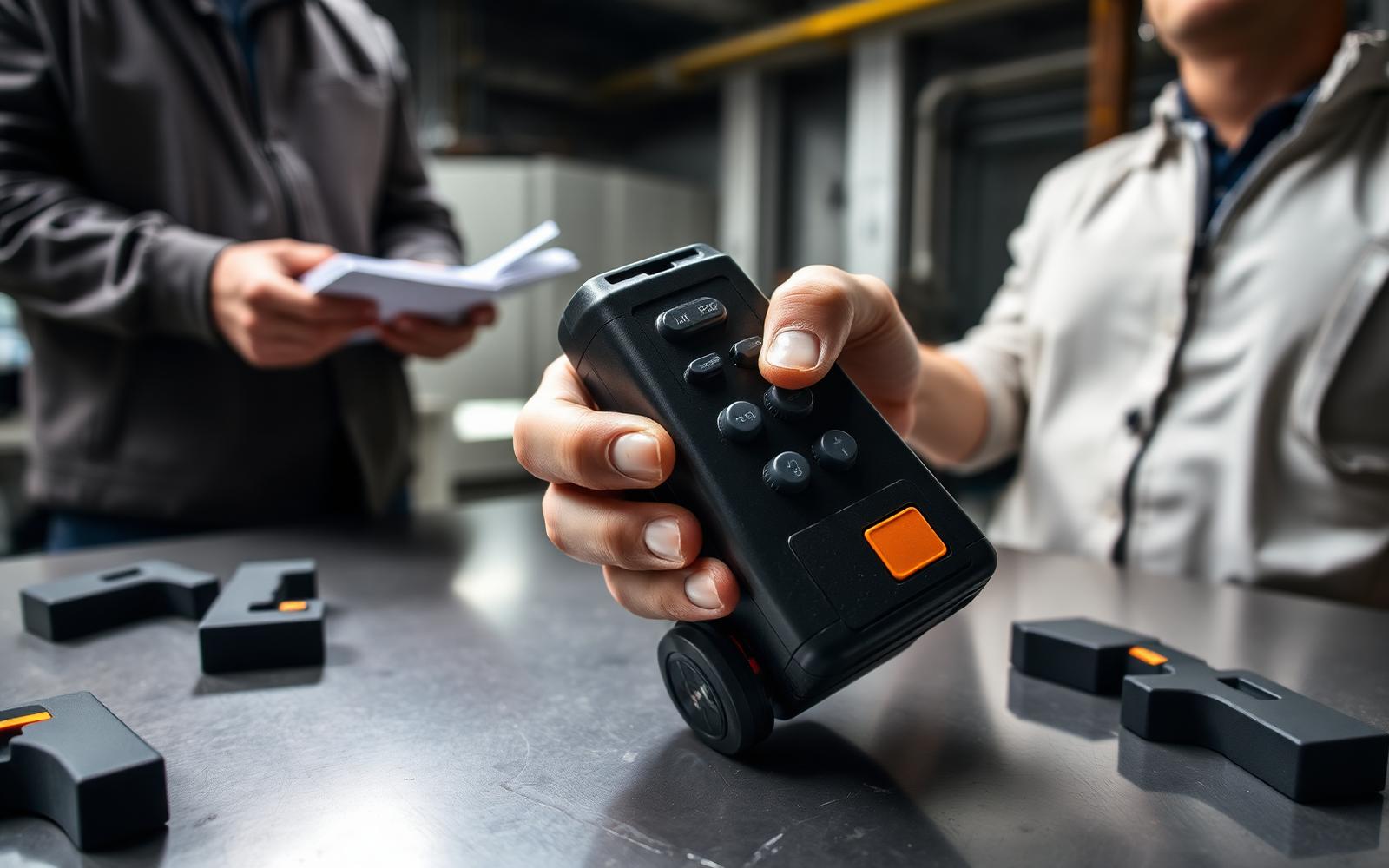
Observation beats interviews for physical products. What people say about how they use something and what they actually do with it in their kitchen, workshop or clinic are routinely different, and only the second one shapes a good design.
Turning findings into requirements you can test
A finding is an observation. A requirement is a commitment with a number attached. Convert every significant finding, or it will be forgotten by the next design review.
Observation | Weak requirement | Testable requirement |
|---|---|---|
Users struggled to open it | Should be easy to open | Opened one-handed by 90% of users in under 5 seconds |
It felt heavy after a while | Should be lightweight | Under 850 g; held for 10 minutes with no reported strain |
People misread the indicator | Clearer indicator | State identified correctly by 95% of users at 2 m in low light |
Setup took too long | Faster setup | First successful use within 4 minutes unaided |
Users wore gloves | Consider gloves | All controls operable with 1.5 mm nitrile gloves |
Accessibility is a design input, not a retrofit
- Grip and force: design for reduced hand strength — target operating forces well below the fifth-percentile capability of your user group.
- Vision: do not carry critical information by colour alone; check contrast and label size at real viewing distance.
- Hearing: pair audible alerts with a visible or haptic signal.
- Reach and anthropometry: validate against percentile data for the actual population, not the design team.
- Cognitive load: one clear primary action per state; make errors recoverable rather than merely preventable.
Designing for the edges of your user range usually improves the product for everyone in the middle. That is not charity; it is where most usability gains come from.
what Makes Hardware Ucd Different
Factor | Software | Physical product |
|---|---|---|
Cost of iteration | Low, continuous | High after tooling |
When feedback must arrive | Any time | Before design freeze |
Fidelity needed to test | Clickable mockup | Physical model, weight and texture matter |
Post-launch fixes | Update pushed | Recall, revision, service |
Key evaluation moments | Continuous | Pre-CAD, pre-tooling, pilot run |
This is why UCD for hardware concentrates its effort early. Once steel is cut, the cheapest available fix is usually a better instruction sheet — which is another way of saying the design defect is now permanent. Test at the prototype stage, where changes still cost days rather than months.
a Realistic Ucd Schedule for a Physical Product
Phase | UCD activity | Gate |
|---|---|---|
Discovery | Field observation, task analysis | Context of use documented |
Concept | Participatory sessions, sketch reactions | Requirements written and agreed |
Industrial design | Looks-like model handling tests | Form and ergonomics validated |
Engineering | Works-like usability tests | Task success thresholds met |
Pre-tooling | Pilot units with target users | No open critical usability defects |
Post-launch | Support ticket and return analysis | Findings feed next revision |
Each gate is a place to stop and check evidence before the next commitment. That structure is how we run discovery and design work, and it is the difference between a product users tolerate and one they recommend.
Running a usability session that produces decisions
A usability session is an experiment, not a demo. The most common failure is the moderator explaining how the product works, which destroys the only data worth collecting. Script the tasks, stay quiet, and record what people do before they tell you what they think.
Step | Time | What the moderator does | What gets recorded |
|---|---|---|---|
Warm-up and context | 5 min | Ask about the last time they did this task for real | Current workaround, frequency, frustrations |
Unassisted first use | 10 min | Hand over the product, say nothing | Time to first success, errors, hesitations |
Task set | 20 min | Read tasks verbatim, no coaching | Completion rate, assists needed, error type |
Force and reach checks | 5 min | Measure grip force, reach, one-handed operation | Numbers against the requirement |
Debrief | 10 min | Ask what was confusing and why, never what they would change | Verbatim quotes, severity rating |

Scoring and prioritizing what you find
Rate each finding on severity and frequency, then fix in that order. Without a rating scheme, teams fix the issue the loudest participant mentioned rather than the one that will generate returns.
Severity | Definition | Response |
|---|---|---|
Critical | Prevents task completion or creates a safety hazard | Fix before the next prototype round, no exceptions |
Major | Task completed but with errors, damage risk or long delay | Fix before design freeze |
Minor | Task completed, user annoyed or slowed | Fix if it does not affect tooling |
Cosmetic | Preference or aesthetic comment | Log, review at CMF stage |
Anthropometrics: designing for the real range of bodies
- Design grip and reach for the 5th percentile female through 95th percentile male unless your user population is genuinely narrower.
- Cap sustained one-handed operating force at about 20 N, and momentary force at roughly 45 N, for general consumer products.
- Keep primary controls at least 19 mm across with 6 mm of separation so gloved and arthritic hands can use them.
- Do not rely on color alone for state indication — roughly 8 percent of men have some form of color vision deficiency.
- Verify legibility at arm's length in the light level where the product is actually used, not at a desk.
- Test with gloves, wet hands or one hand occupied if that is how the product gets used in the field.
If a product only works when the user is fully attentive, two-handed and well lit, it will fail in the kitchen, the truck and the ward.
Key takeaways
- Five to eight participants per segment, tested unassisted, will surface most of the issues that matter.
- Write requirements with numbers attached before evaluation, or testing becomes opinion collection.
- Rate findings by severity and fix critical issues before the next prototype, not after tooling.
- Accessibility constraints — force, size, contrast — usually make the product better for every user, not just the edge cases.
Frequently asked questions
What is user-centered design?
User-centered design is an iterative process with four activities: understand the context of use, specify testable user requirements, design solutions, and evaluate those solutions against the requirements with real users. The loop repeats until the requirements are met, which is what makes it a process rather than an attitude.
How many users do you need for usability testing?
Five to eight participants per distinct user segment uncovers the majority of usability defects in task-based testing. Contextual research needs six to twelve participants, and quantitative validation or beta programs need twenty to a hundred for reliable rates.
How is user-centered design different for physical products?
Iteration is expensive and largely ends at tooling, so evaluation has to happen earlier and at higher fidelity. Weight, texture, grip force and handling cannot be assessed from a screen, which makes looks-like models and works-like prototypes essential rather than optional.
What is the difference between user-centered design and design thinking?
Design thinking is a broader problem-framing approach that encourages empathy and reframing before solutions. User-centered design is a specific iterative process, formalised in ISO 9241-210, that requires written requirements derived from context of use and evaluation against them. They are complementary: design thinking finds the problem, UCD disciplines the solution.
When should user research happen in product development?
Before concepts exist and at every gate afterwards: field observation in discovery, concept reactions before industrial design is locked, handling tests on looks-like models, task tests on works-like prototypes, and pilot units with target users before tooling. Research after tooling informs the next revision, not this one.
Budgeting user research so it actually happens
User centered design principles get abandoned under schedule pressure because research is treated as an optional line item. Budgeting it as a fixed percentage of development cost, with defined touchpoints, keeps it in the plan when the timeline compresses.
Research activities and realistic cost
Activity | Participants | Typical duration | Relative cost |
|---|---|---|---|
Contextual interviews | 8-12 | 2 weeks | Low |
Task analysis and journey mapping | Internal | 1 week | Low |
Early concept feedback | 6-10 | 1 week | Low |
Formative usability on prototypes | 5-8 per round | 1 week per round | Medium |
Anthropometric fit study | 15-25 | 2 weeks | Medium |
Summative validation testing | 15-30 | 3 weeks | High |
Post-launch field study | 10-20 | 4 weeks | Medium |
Small, frequent formative rounds are worth more than one large study at the end. Five participants per round catches most usability issues, and running three rounds across the schedule beats fifteen participants tested once when nothing can change.
Research planning checklist
- Budget research as a fixed share of development, not as a leftover.
- Schedule formative rounds where design can still change.
- Recruit real users, not colleagues or convenient proxies.
- Include accessibility and the full body-size range in fit studies.
- Write findings as testable requirements, not observations.
Key takeaways
- Budget research up front so it survives schedule pressure.
- Three small formative rounds beat one large late study.
- Convert findings into testable requirements to make them stick.
Want user research built into your development schedule?

The Five Principles, Applied to Physical Products
| Principle | What it means on a hardware program | Evidence it is working |
|---|---|---|
| Understand context of use | Observe the real environment: lighting, gloves, noise, posture | Requirements cite observed conditions, not assumptions |
| Involve users throughout | Users touch every prototype generation, not just the last | Design changes traceable to specific sessions |
| Iterate with real artifacts | Physical mockups over slide decks | Two or more geometry revisions before tooling |
| Address the whole experience | Unboxing, setup, maintenance, disposal | Packaging and manuals designed in parallel |
| Multidisciplinary team | Industrial design, engineering, and manufacturing in the same reviews | Fewer late changes at design freeze |
A Lightweight Research Plan You Can Run in Two Weeks
- Day 1-2: Write the task list. Five tasks that represent the highest-frequency and highest-risk uses.
- Day 3-4: Recruit six participants who match the operator profile, not colleagues.
- Day 5-7: Build or print the roughest artifact that can support the tasks.
- Day 8-10: Run sessions, one hour each, recording hands and timing first success.
- Day 11-12: Score every task and cluster failures by cause: geometry, labeling, sequence, or force.
- Day 13-14: Revise the CAD and re-test the two worst tasks.
Six participants surface the large majority of usability defects on a single-purpose device. Spending four weeks recruiting twenty rarely changes the priority list, and it usually pushes the fix past the point where it is cheap.
Common Failure Modes
Three patterns account for most user-centered design programs that produce no measurable improvement. The first is research that arrives after design freeze, when findings can only be filed rather than acted on. The second is testing with internal staff, who know the intended sequence and cannot un-know it.
The third is measuring satisfaction instead of task completion; people routinely rate a product highly and still fail the task, because they blame themselves for the failure. Score behavior, not opinion, and schedule the sessions early enough that the answer can still change the geometry.
User-Centered Design FAQ
What are the core user-centered design principles?
Understand the real context of use, involve users throughout rather than once at the end, iterate using physical artifacts, design the whole experience including setup and maintenance, and staff the effort with a multidisciplinary team. Each of these has an observable signature in how a program runs, which is what makes them auditable rather than aspirational.
How much does user research add to a schedule?
A well-scoped round adds roughly two weeks and typically removes more than that later by preventing a geometry change after tooling. The cost curve is steep: a change that costs hours in CAD costs weeks after a mold is cut.
Can we test with employees?
Only for logistics rehearsal. Employees know the intended sequence, and they cannot un-know it. Every meaningful finding comes from people encountering the product for the first time under realistic conditions.
What should we measure?
Task completion without assistance, time to first success, and the specific point at which a user hesitated. Satisfaction ratings are unreliable, because users routinely blame themselves for a product failure and rate the product highly anyway.
How does this connect to manufacturing?
Directly. Most usability fixes are geometry changes, and geometry changes are tooling changes. Running research early is what keeps the findings actionable and keeps the manufacturing team out of a late change order cycle.
Turning Findings Into Design Decisions
Research only pays back when it changes a drawing. After each round, convert every observed failure into a specific, assignable change: a radius increase, a relocated control, a revised sequence, a different detent force.
Give each change an owner and a target revision, and re-test the two tasks that failed worst before moving on.
Keep a running log that ties each geometry revision to the session that motivated it, because six months later, during a cost-down review, that log is the only thing standing between a hard-won usability fix and a well-meaning engineer who removes it to save eleven cents.
Programs that maintain this traceability ship products that feel obvious in the hand, and they get there with fewer tooling revisions than teams that treat research as a report rather than an input.
Work with LA NPDT: if you are moving from here to execution, start with our product design services or talk to us about industrial design and development.
Filed under:EducationUncategorized
Tagged:2024
Services related to this guide
- Free trademark searchScreen a product name against the live USPTO register in seconds.
- Idea evaluationAn honest read on whether an idea is worth building.
- Product design servicesIndustrial design and CAD taken all the way to manufacturable files.
- Product development examplesReal projects we designed, prototyped and shipped.