Product Development Partner: How to Choose One Without Getting Burned
The wrong product development partner does not announce itself in month one. Here is how to compare the models, read the red flags and structure the contract.
April 11, 20258 min read

Written by Konstantin Dolgan, Ph.D., NPDP
Founder & CEO, Product Development Engineer
Published April 11, 2025Updated September 2, 2026
Choosing a product development partner is the single decision that most often determines whether a hardware idea ships. The wrong pick does not usually announce itself in month one. It shows up in month seven, when the renders look great, the CAD will not tool, and nobody on the team has ever released a product to a factory.
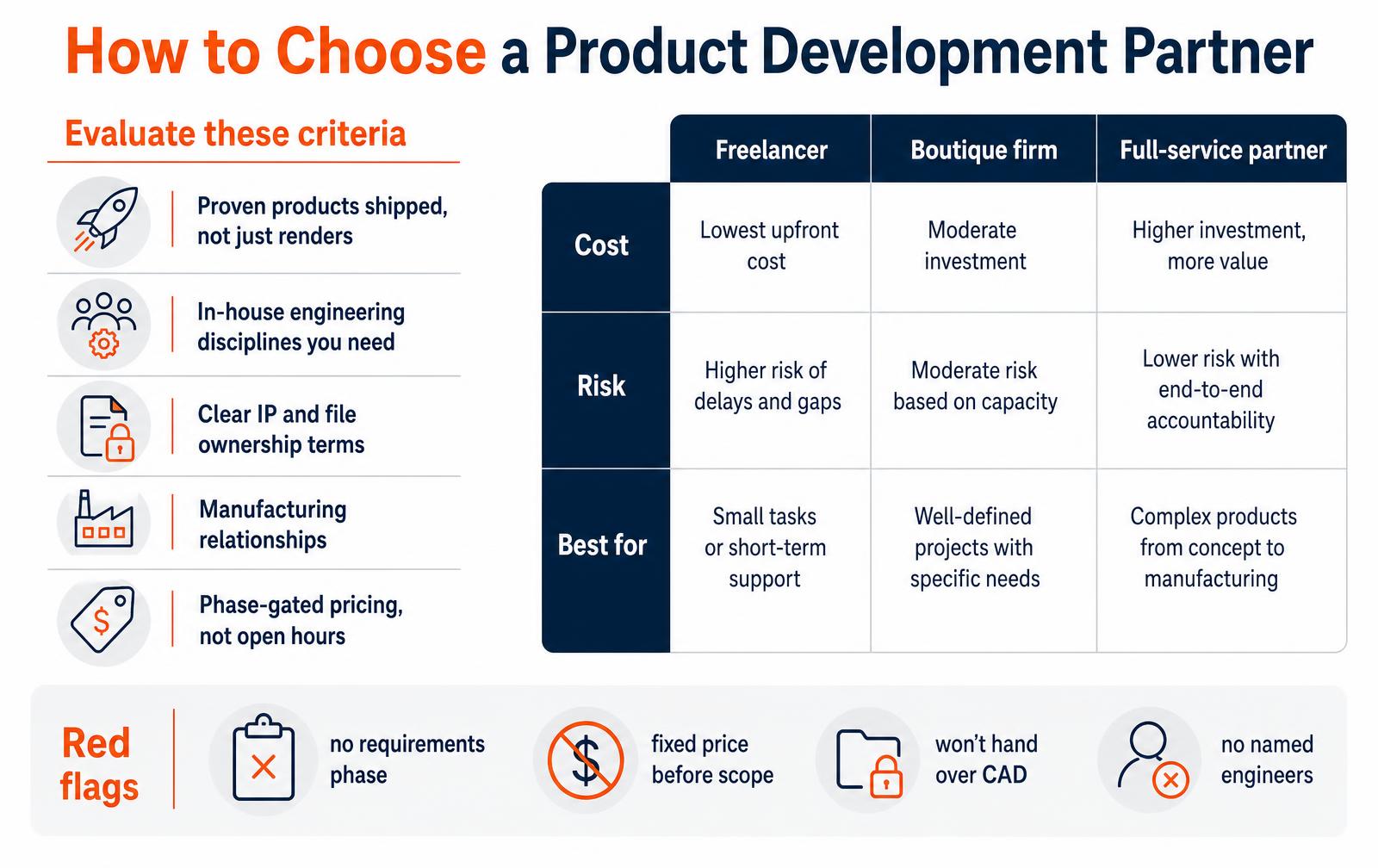
Three kinds of partner, three different failure modes
Option | Typical cost | Where it works | How it fails |
|---|---|---|---|
Individual freelancers | $60-$150/hr | A single discipline: a CAD model, a PCB layout, an enclosure render | Nobody owns the handoffs between mechanical, electrical and firmware |
Boutique design studio | $25k-$100k per project | Industrial design and user experience on a well-defined product | Beautiful concepts that were never checked against tooling or cost |
Full-service development partner | $80k-$400k per program | Concept through DFM, prototypes, testing and factory transfer | Overkill and overpriced if your scope is genuinely one small task |
Offshore engineering shop | $25-$60/hr | Well-specified execution work with an internal lead managing it | Timezone and spec ambiguity turn into silent rework |
Most first-time founders start with the cheapest option, spend nine months and $40,000, and then hire a full-service partner anyway — this time carrying files they cannot use. Matching the model to the scope up front is almost always cheaper than discovering the mismatch later.
What to look for in a product development partner
- Products on shelves, not renders in a portfolio. Ask which of their projects you can buy today, and who manufactured them.
- The disciplines your product actually needs. A connected device needs mechanical, electrical, firmware and app work under one schedule.
- Manufacturing relationships. A partner who has released tooling knows what a factory will reject before you pay for it.
- Clear IP terms. You should own the design, the native CAD, the schematics and the firmware source — in writing, from day one.
- Phase-gated pricing. A fixed fee per phase with defined deliverables beats an open hourly meter and beats a fixed price quoted before requirements exist.
- Named engineers. Find out who does the work, not who runs the sales call.
Red flags worth walking away from
- A firm fixed price quoted before any requirements or discovery phase
- Refusal to hand over native CAD files, only STEP or PDF exports
- No written IP assignment, or IP that transfers only on final payment of an open-ended total
- A portfolio of renders with no manufactured examples and no client references
- No mention of design for manufacturing, tolerances, or a target unit cost
- A promise to go from sketch to production in eight weeks for a physical product
How the engagement should be structured
Start with a paid discovery or feasibility phase — typically $5,000 to $20,000 over two to five weeks. It produces requirements, a technical approach, a risk list and a real budget for the rest of the program. It also lets both sides find out how the other works before six figures are committed.
From there, expect distinct phases for concept, engineering, prototyping, design for manufacturing and production support, each with its own deliverables and exit criteria.
Our product development consulting page shows how we scope those phases.
Contract terms worth reading closely
The proposal sells the work; the contract decides what happens when something goes wrong. Four clauses matter more than the rest, and all four are negotiable before signing and effectively fixed afterwards.
Clause | What you want | What to avoid |
|---|---|---|
IP assignment | Full assignment of all work product to you on payment | License-back terms, or IP that transfers only at project completion |
Deliverable definition | Named file formats and native CAD, listed per phase | 'Design files' with no format specified |
Change control | Written change orders with cost and schedule impact | Open-ended hourly billing with no cap or notification threshold |
Termination | Exit at any phase gate with files delivered to date | Termination fees, or files withheld until final invoice |
Budget: what a first hardware program really costs
Engineering fees are one line among several. A realistic first-product budget covers discovery, design, prototypes, tooling, certification and a revision. Founders who plan only for the engineering quote run out of money at the tooling stage, which is the single most common way a promising product dies.
- Discovery/feasibility: $5,000–$20,000, and the cheapest way to find out the idea needs to change.
- Design and engineering: $30,000–$150,000 for a moderately complex product.
- Prototypes: $3,000–$25,000 across two or three iterations.
- Tooling: $4,000 for a simple single-cavity tool to $60,000+ for production steel.
- Certification: $8,000–$40,000 depending on the marks and the radio content.
- Contingency: 15–20% of the total, because the first prototype always teaches you something.
How to run the partner well once you have chosen
- Give one decision-maker on your side; committees add weeks and cost.
- Answer questions within a day — engineering idles quickly and idle hours still burn schedule.
- Attend design reviews with the actual constraints, including price ceilings you have been quiet about.
- Say no to your own late ideas as firmly as to theirs; scope creep is usually the client's doing.
- Ask for the risk list at every review, and read it before the pretty renders.
The diligence call: questions that separate the shortlist
Every firm sounds capable on a first call, because a first call is a sales call. The way to break the tie is to ask about failure rather than capability.
A partner who has shipped real products can tell you, in specifics, about a tool that had to be re-cut, a certification that came back failed, or a supplier that missed a date — and what it cost, who paid, and what they changed afterwards. A partner who has only run design projects will answer in generalities about process.
- Walk me through the last program you shipped that went badly. What went wrong, and who absorbed the cost?
- Which of the products in your portfolio did you take all the way to tooling, and which stopped at prototype?
- Who specifically will be doing the work, and what else are they staffed on during my schedule?
- How do you handle a tool that needs a change after T1 — what is billable and what is not?
- What certifications have you managed directly, and which lab did you use?
- What does your handoff package contain, and can I take it to a different manufacturer?
Comparing quotes without comparing apples to oranges
Two quotes for the same product routinely differ by three times, and the gap is almost never the hourly rate. It is scope. Normalize the quotes before you compare them: list every deliverable one quote includes, check whether the other includes it, and price the difference.
The cheaper number usually excludes prototype builds, design revisions after testing, manufacturing support during tooling, and certification management — and those are the phases where a first-time hardware program actually spends its money.
Line item | Often included | Often excluded | Typical impact if excluded |
|---|---|---|---|
Prototype builds and materials | Boutique and full-service | Freelance | $3,000–$25,000 |
Design revisions after user or lab testing | Full-service | Freelance and some boutiques | One to three billable cycles |
DFM review with the actual factory | Full-service | Most others | Tool re-cut risk |
Tooling support and T1/T2 sample review | Full-service | Most others | Weeks of schedule |
Certification management | Sometimes | Usually | $5,000–$40,000 plus delay |
Native CAD file handover | Negotiated | Assumed by client | Vendor lock-in |
Warning signs during the first 60 days
Choosing well is only half the job; most partnerships that fail were salvageable at week six and unsalvageable at week twenty. The early signals are procedural rather than technical.
If status updates stop arriving without being chased, if the people on the kickoff call are no longer the people doing the work, or if the first deliverable arrives as a polished presentation with no CAD, test data or open-issues list behind it, address it immediately while the relationship still has goodwill and the budget still has room.
- Deliverables slip a week at a time with no revised schedule.
- Questions about cost or manufacturability get deferred to "later in the process."
- No written record of decisions, so the same debate repeats every month.
- Prototypes are shown but never handed over for you to test yourself.
- The DFM conversation has not involved an actual factory by the time CAD is 80% complete.
A good partner welcomes the intervention, because they would rather reset expectations than deliver into a client who has quietly lost confidence. Ask for a written recovery plan with dates. If the response is reassurance rather than a plan, use the phase gate in your contract — that is precisely what it is for, and the cost of stopping at the end of a phase is always lower than the cost of discovering the problem at tooling.
Frequently asked questions
How much does a product development partner cost?
A paid discovery phase usually runs $5,000-$20,000. A full program from concept through manufacturing-ready files commonly lands between $80,000 and $400,000 depending on electronics, software, regulatory testing and how many prototype rounds the product needs. Simple mechanical products can come in well under that; medical or connected devices routinely exceed it.
Who owns the intellectual property?
You should. A proper agreement assigns all work product to you, delivers native CAD, schematics, gerbers and firmware source, and includes an inventorship clause covering any patentable contributions from the partner team. If a company will not put that in the contract, that is the answer to the question.
Should I hire a partner or build an in-house team?
For a first product, a partner is almost always faster and cheaper: you rent five specialists for the months you need each of them instead of hiring a team you cannot keep busy. In-house makes sense once you have a product line generating revenue and a roadmap that keeps engineers loaded year-round.
How long does a product development program take?
Nine to eighteen months from concept to first production run is normal for a consumer product with electronics. Purely mechanical products can be six to nine. Regulated categories such as medical devices add six to eighteen months for testing and submissions.
Questions that separate a real partner from a good sales call
- Who exactly will do the work? Ask for the names and the weekly hours of the engineers, not the size of the company.
- Show me a program that went badly. A partner who cannot describe a failed tool, a recall, or a blown schedule has not shipped enough.
- What do you hand over at the end? Native CAD, drawings, BOM, firmware source, and test reports - or nothing you can take to another vendor.
- How do you handle a change after tooling release? The answer reveals whether they run a change-control process or improvise.
- Who owns the IP and the tooling? Get it in writing before the first invoice.
- What is your DFM process with the factory? Ask to see a real DFM report from a past program.
- How do you price phase two? Firms that only quote the fun phase tend to disappear at validation.

Engagement models and what each one costs
Model | Best for | Typical range | Main risk |
|---|---|---|---|
Fixed-price phase | Well defined scope, funded milestones | $25k-$150k per phase | Change orders when scope moves |
Time and materials | Exploratory work, moving requirements | $95-$185 per hour | Burn without a clear finish line |
Dedicated team retainer | Multi-year roadmaps | $18k-$60k per month | Paying for idle capacity |
Equity or royalty share | Undercapitalized inventors | Reduced cash plus 3-7% royalty | Misaligned exit expectations |
Turnkey to production | Founders without a supply chain | Phase fees plus per-unit margin | Vendor lock-in on the BOM |
Red flags worth walking away from
Be cautious with a firm that quotes a full production program in a single lump sum after a 30-minute call - the number is either padded or about to be revised.
Be equally cautious with one that will not name the factory, refuses to release native CAD, marks up the BOM without disclosing it, or promises a certification pass date it does not control.
The strongest signal in the other direction is a partner who narrows your scope in the first meeting instead of agreeing to everything.
- Key takeaway 1: Evaluate the individual engineers assigned, not the agency logo wall.
- Key takeaway 2: Contract for native CAD, source code, and tooling ownership up front.
- Key takeaway 3: Match the engagement model to how stable your requirements really are.
- Key takeaway 4: A partner who scopes you down is protecting your budget, not dodging work.
Running a structured partner selection
Choosing a product development partner on rapport alone is how programs end up with a firm that presents well and executes poorly. A short structured process — the same brief to three firms, the same questions, the same scoring — costs a couple of weeks and materially changes the outcome.
Selection scorecard
Criterion | Weight | What good looks like |
|---|---|---|
Relevant shipped products | 25% | Same category and volume, with references |
Named team availability | 20% | The engineers who will do the work, identified |
Manufacturing access | 15% | Real supplier relationships, not a directory |
Documentation quality | 15% | A complete package from a past program |
Commercial terms | 15% | Clear IP, CAD and tooling ownership |
Communication fit | 10% | Direct answers, including bad news |
Call at least two references and ask specifically what went wrong on their program and how the firm handled it. Every program has problems; the answer tells you far more than a portfolio does.
Selection process checklist
- Write one brief and send it unchanged to three firms.
- Ask each for a phased proposal with deliverables per phase.
- Interview the actual engineers, not only the principal.
- Check two references with a question about failure, not success.
- Start with a small paid discovery phase before a full commitment.
Key takeaways
- Send an identical brief to three firms and score them the same way.
- Interview the engineers who will do the work, not just the pitch team.
- Ask references what went wrong; that answer is the useful one.
Evaluating development partners for your program?
Work with LA NPDT: if you are moving from here to execution, start with our our product development process or talk to us about end-to-end product development.
Filed under:Uncategorized
Tagged:2024
Services related to this guide
- Best product development companiesHow the leading US firms compare, and which one fits your stage and budget.
- Best product design companiesDesign studios compared by scope, industry and what they hand off.
- Product engineering companiesEngineering firms for physical products compared by discipline, rigor and budget.
- Consultant vs firm vs freelancerWhat each option costs, what it delivers and where to find them.