Modular Design Examples: Types, Benefits and How to Apply Them
Modular design examples across product categories, the module types behind them, and the interface decisions that make a platform work.
April 18, 20266 min read

Written by Konstantin Dolgan, Ph.D., NPDP
Founder & CEO, Product Development Engineer
Published April 18, 2026Updated September 2, 2026
Modular design breaks a product into standardized, self-contained building blocks joined by defined interfaces, so variants, upgrades and repairs happen at module level instead of through a full redesign. Done well it turns one engineering effort into a family of products. Done reflexively it adds connectors, tolerance stack-up and cost to a product that only ever needed one configuration.
What modular design actually means
A module is a physically or functionally independent block with a stable interface — mechanical, electrical, thermal and data. The interface is the contract. As long as it holds, a module can be redesigned, upgraded, sourced elsewhere or dropped without disturbing anything on the other side of it.
That contract is the entire discipline. Teams that call a product modular because it has removable parts usually have not frozen their interfaces, which means every "module" change still ripples through the assembly. Modularity is an architecture decision made early in product development, not a feature bolted on late.
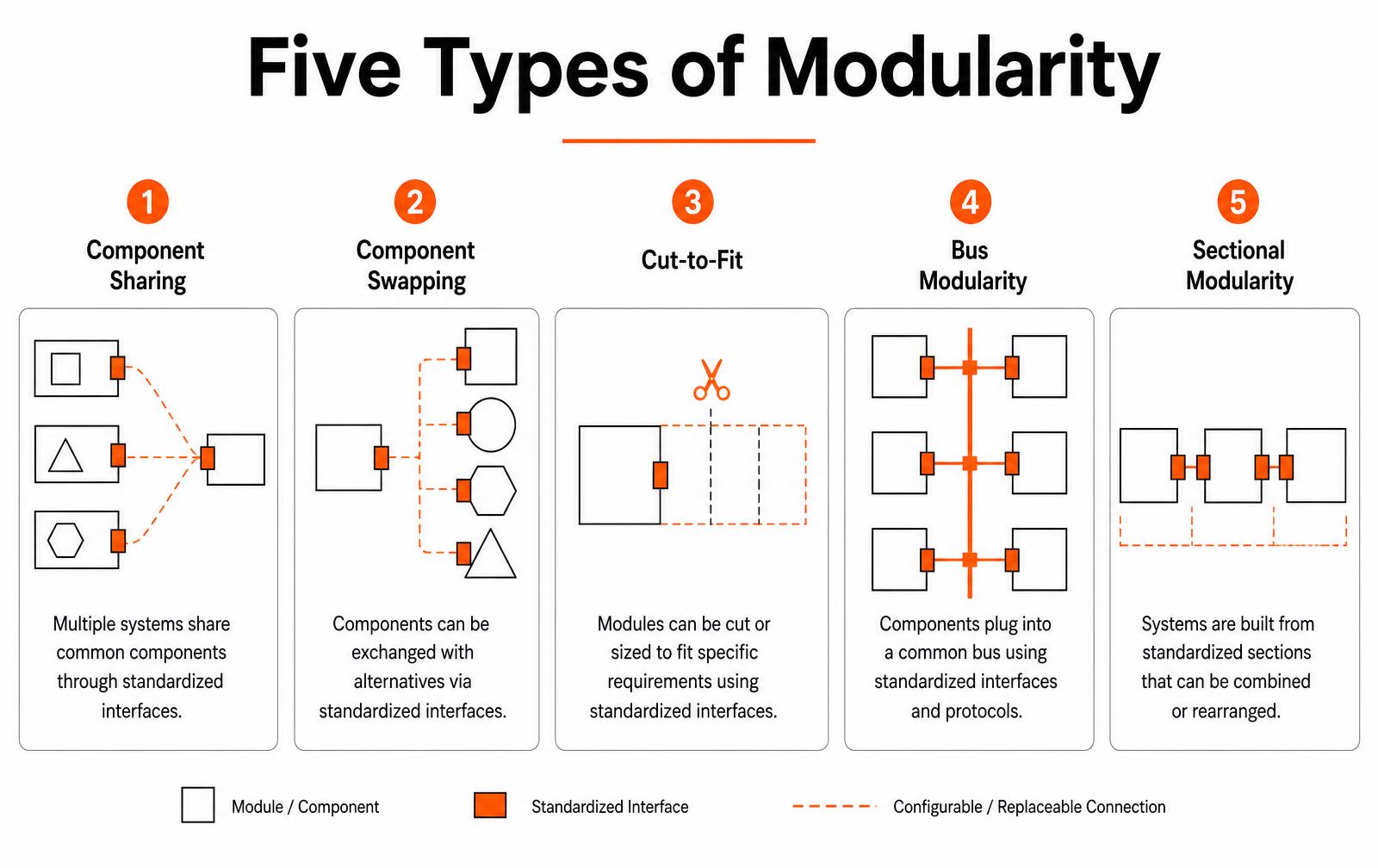
The five types of modularity
Type | How it works | Typical use |
|---|---|---|
Component sharing | One common module is reused across several different products | Shared power supplies, controllers or motor assemblies across a product line |
Component swapping | Different modules attach to the same base product | Tool bodies with interchangeable heads, cameras with interchangeable lenses |
Cut-to-fit | One module is produced in continuously variable dimensions | Cut lengths of extrusion, cable harnesses, conveyor sections |
Bus modularity | Modules plug into a common backbone with a standardized connection | Rack systems, PLC I/O cards, expansion slots |
Sectional | Modules connect to each other in any arrangement with a universal interface | Modular furniture, pipeline sections, configurable enclosures |
Most real products mix two or three. A connected device might share a controller board across the line (component sharing), offer two sensor heads (component swapping) and expose a bus for future add-ons.
What modular design buys you
- Variant coverage without variant engineering. Three interchangeable modules on a common base can yield a dozen sellable configurations from one qualification effort.
- Shorter time to market for follow-on SKUs. The second product in the family reuses validated modules and skips most of the test plan.
- Repairability and serviceability. Field replacement of a module beats returning a whole unit, which lowers warranty cost and shortens downtime.
- Upgrade paths that extend product life. Customers buy the improvement instead of buying a replacement — and right-to-repair and ecodesign rules increasingly expect it.
- Supply resilience. A clean interface means a module can be dual-sourced or redesigned around a shortage without touching the rest of the bill of materials.
- Parallel development. Frozen interfaces let separate teams work on separate modules at the same time.
What it costs
Modularity is not free, and the bill arrives early. Budget for it honestly rather than discovering it at design review.
Cost | Why it appears | Typical impact |
|---|---|---|
Interface hardware | Connectors, fasteners, seals and alignment features at every boundary | Added part cost and assembly time per unit |
Volume and mass | Boundaries need clearance, walls and structure a monolith does not | Larger enclosure, heavier product |
Tolerance stack-up | Each interface adds variation across the assembly | Tighter tolerances or added adjustment features |
Up-front engineering | Interface definition, documentation and change control | Longer architecture phase before the first prototype |
Validation matrix | Configurations must be tested in combination, not just individually | Expanded EMC, thermal, drop and life testing |
The general rule: modularity pays when you expect variants, upgrades, field service or a long product life. It rarely pays on a single-configuration, cost-driven, high-volume consumable where every cent of interface hardware is multiplied by millions of units.
When not to make it modular
- One configuration, no roadmap. If there is genuinely only ever one version, interfaces are pure overhead.
- Extreme cost or size pressure. Sealed, potted or overmolded monolithic designs win on space, weight and unit cost.
- Severe environmental sealing. Every removable boundary is a leak path and an IP-rating risk.
- Immature technology. Freezing interfaces around a subsystem you do not understand yet locks in the wrong architecture.
How to define modules: a practical method
- List the functions the product must perform, independent of any physical part.
- Map the interactions. A Design Structure Matrix (DSM) shows which functions exchange force, heat, signal or material.
- Cluster the tightly coupled functions into candidate modules and cut the architecture where interactions are weakest — a clean cut is one that carries few, simple interfaces.
- Test each candidate against a module driver: planned upgrade, styling variant, service replacement, separate test, supplier capability, or regional compliance difference. A cluster with no driver should not be a module.
- Freeze and document the interfaces — mechanical datums, connector pinouts, protocols, thermal budgets, tolerances — and put them under change control before detailed design starts.
- Prototype the interfaces first. Build the boundary, not the beauty model, and prove that two modules made by two people fit and function together.
Modularity, sustainability and regulation
Modular architecture is now a compliance topic as much as an engineering one. Repairability scoring, spare-part availability requirements and ecodesign rules in the EU and elsewhere reward products whose wearing parts, batteries and electronics can be replaced without destroying the housing. Designing a replaceable battery module and a documented service interface is significantly cheaper than retrofitting one into a product already in tooling.
Modular design in a real program
A typical pattern from our mechanical engineering work: a common chassis and power module carried across three market segments, a swappable sensing head per segment, and a bus connector reserved for a connectivity module planned for release two. The second SKU shipped in roughly a third of the time of the first because only the head required new qualification, and the connectivity module launched later without any change to the certified base unit.
Frequently asked questions
What is modular design?
Modular design is an architecture in which a product is divided into standardized, self-contained modules connected by defined interfaces. Because the interface stays fixed, individual modules can be swapped, upgraded, repaired or re-sourced without redesigning the rest of the product.
What are the types of modularity?
The five commonly cited types are component sharing, component swapping, cut-to-fit, bus modularity and sectional modularity. Most real products combine two or three — for example sharing a common controller across a line while offering swappable heads.
What are the disadvantages of modular design?
Modular design adds interface hardware, volume and mass, tolerance stack-up across boundaries, more up-front engineering, and a larger validation matrix because configurations must be tested in combination. It also creates sealing risk at every removable joint, which matters for products with IP ratings.
When should a product not be modular?
Skip modularity when there is only one configuration and no upgrade roadmap, when unit cost or size pressure is extreme, when environmental sealing is critical, or when the underlying technology is still changing and freezing interfaces would lock in the wrong architecture.
How do you decide where module boundaries go?
Map the functions and their interactions, cluster the tightly coupled ones, and cut the architecture where interactions are weakest so the interface stays simple. Then check each candidate against a driver such as a planned upgrade, a styling variant, a service part or a regional compliance difference. A cluster with no driver should stay part of a larger module.
Does modular design cost more per unit?
Usually yes at the individual unit level, because of connectors, fasteners, seals and extra structure. It pays back through reduced engineering per variant, faster follow-on SKUs, lower warranty and service cost, and longer product life — which is why it fits product families and long-lived equipment better than single-configuration consumables.
Interfaces are the real deliverable of modular design
Modules are easy; stable interfaces are hard. The value of a modular architecture comes entirely from being able to change one module without disturbing the others, and that only holds if the interface between them is specified completely and then frozen. An under-specified interface produces the worst of both worlds: the complexity of modularity with none of the flexibility.
What a complete interface specification covers
Interface type | What must be specified | Failure if omitted |
|---|---|---|
Mechanical | Datums, fastener pattern, tolerances, envelope | Modules that will not fit interchangeably |
Electrical | Connector, pinout, voltage, current budget | Damage or intermittent faults on swap |
Data / protocol | Message format, versioning, error behavior | Silent incompatibility between revisions |
Thermal | Heat rejected into and accepted from neighbors | Overheating when a module is upgraded |
Environmental / sealing | Gasket plane, ingress rating at the joint | Leaks introduced by a module change |
Service | Access, tools required, replacement time | Modularity that nobody can use in the field |
Version the interface explicitly and treat a change to it as a program-level decision, not an engineering change. Once the interface is under revision control, modules can evolve independently — which was the point of the architecture in the first place.
Interface governance checklist
- Write one interface control document per boundary.
- Include a current budget and a thermal budget, not just geometry.
- Assign an owner with authority over interface changes.
- Version the interface and record backward compatibility rules.
- Test module swaps physically, across revisions, before launch.
Key takeaways
- The interface specification, not the module list, is what makes modularity work.
- Cover mechanical, electrical, data, thermal, sealing and service in each interface.
- Version interfaces and govern changes at program level.
Freezing the interface: the document that makes modularity real
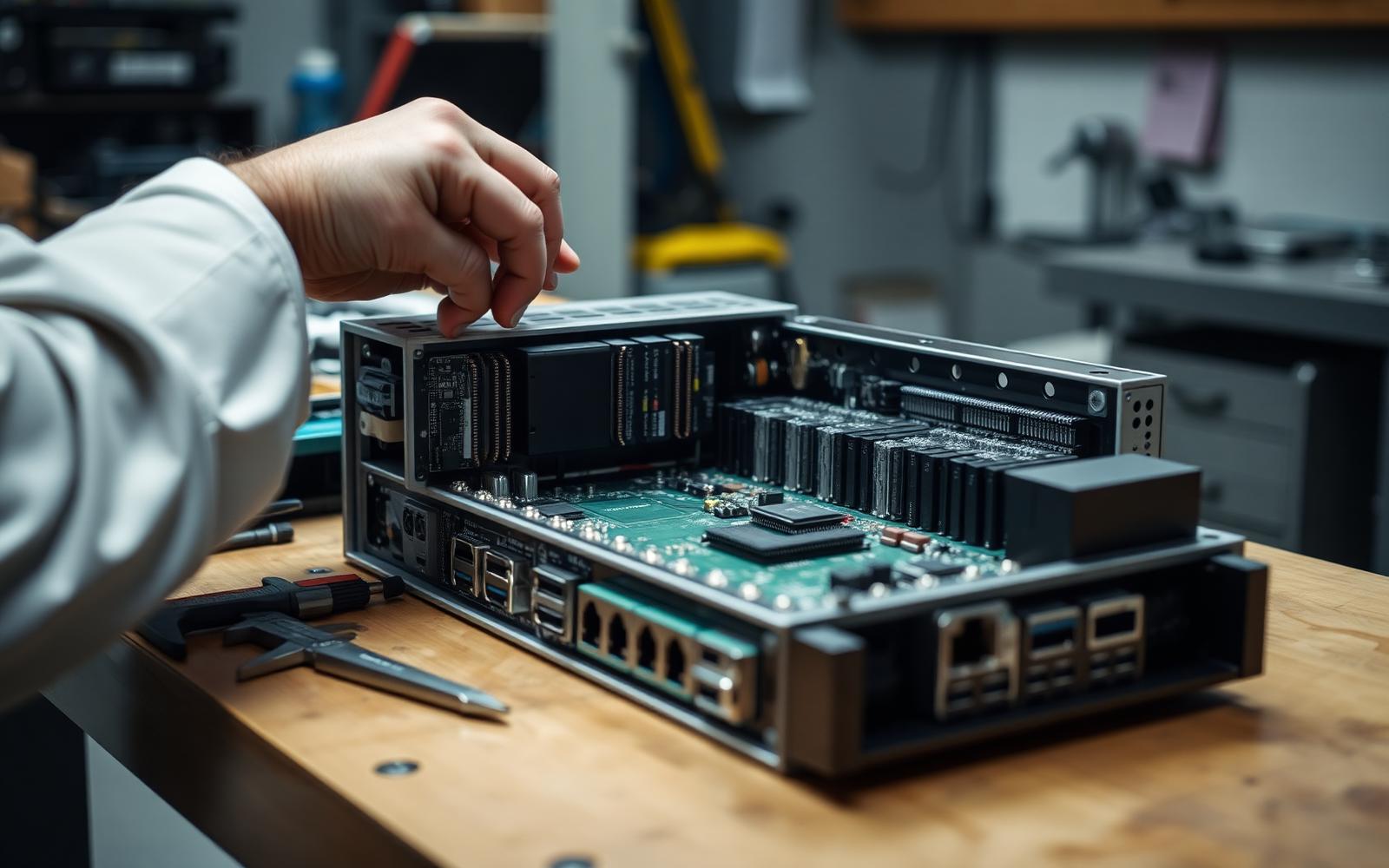
Teams that succeed with modular architecture publish an interface control document (ICD) per boundary and version it like software. Without it, modularity degrades into removability, and every module revision quietly forces a change on the other side of the joint.
Interface domain | What the ICD must fix | Common failure if left open |
|---|---|---|
Mechanical | Datums, bolt pattern, envelope, tolerance stack allocation | Second-source module does not seat squarely |
Electrical | Pinout, voltage rails, current budget, connector part number | Later module browns out the shared supply |
Thermal | Heat rejected into the shared volume, contact area, max case temp | Upgraded module overheats the neighbor |
Data | Protocol, message set, versioning and backward-compatibility rule | Old base unit cannot talk to the new module |
Environmental | Sealing at the joint, ingress rating, gasket compression range | IP rating passes on the monolith, fails on the modular build |
Assign an owner to each ICD and require a change board for any revision. The cost of that overhead is small next to a silent interface drift that invalidates every module already in the field. If you are planning a product family, treat interface freeze as a stage gate in your development plan.
Designing a product family that has to evolve?
Work with LA NPDT: if you are moving from here to execution, start with our product design services or talk to us about industrial design and development.
Filed under:EducationUncategorized
Tagged:2025
Services related to this guide
- Product design servicesIndustrial design and CAD taken all the way to manufacturable files.
- Best industrial design firmsWhich studios take an idea from form to manufacturable hardware, and what they charge.
- Prototype designLooks-like, works-like or pre-production: what each proves and what it costs.
- Product development examplesReal projects we designed, prototyped and shipped.