
Companies That Build Prototypes: How to Find and Vet a Partner
Job shop, development firm or contract manufacturer? How to choose a prototype company, vet it properly and avoid the shops that will cost you months.
November 1, 20228 min read

Written by Konstantin Dolgan, Ph.D., NPDP
Founder & CEO, Product Development Engineer
Published November 1, 2022Updated August 19, 2026
Four kinds of company build prototypes - online print farms, machine shops, prototype houses, and full engineering teams - and they are not interchangeable. The print farm makes exactly what your file says. The engineering team tells you the file is wrong before it makes anything. Which one you need depends on how finished your design already is.
This guide compares the four options, gives you the questions that reveal real capability, explains what a prototype quote should contain, covers domestic versus overseas trade-offs and IP protection, and lists the red flags that reliably predict a disappointing build.
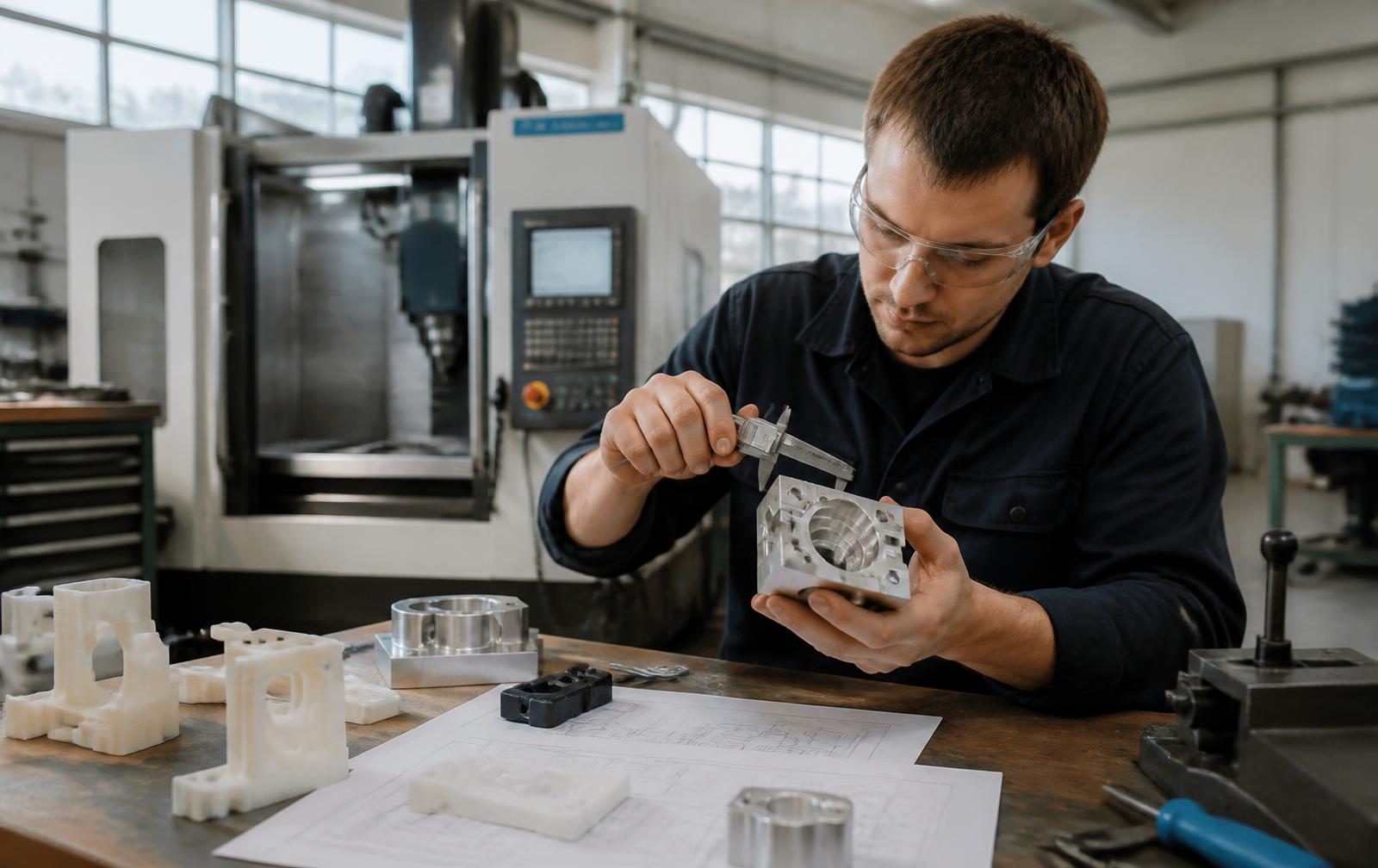
The four kinds of prototype supplier
Supplier type | What they do | Best when | Limitation |
|---|---|---|---|
Online print or CNC service | Instant quotes from an uploaded file, automated production | Your CAD is finished and you need parts fast and cheap | No design feedback; a flawed file becomes a flawed part |
Local machine or print shop | Small job shop, direct contact with the operator | You need iteration, quick turnarounds and someone to talk to | Limited process range; usually one manufacturing family |
Prototype house | Multiple processes, finishing, assembly under one roof | Appearance models, multi-part assemblies, near-final finish | Builds what you specify; engineering usually not included |
Full engineering and prototyping team | Design, DFM, prototyping and manufacturing handoff | The design is unfinished, or the prototype must lead to production | Higher cost than a pure build service for a finished file |
The most common and expensive mistake is sending an unvalidated file to an automated service, receiving parts exactly as drawn, and discovering the design problem only after paying for them. If nobody has reviewed the geometry for the chosen process, you are buying confirmation of your own assumptions.
A print farm prints your mistakes perfectly. An engineering team catches them before the machine starts.
Where to find candidates
- Online manufacturing platforms - fastest quotes, best for finished CAD and simple geometry.
- Local maker and machining directories - useful when you want to visit and iterate in person.
- Industry referrals - other founders in your product category give the most reliable signal.
- Trade shows - manufacturing and design expos let you inspect sample parts in your hand.
- Engineering firms with in-house shops - the right route when the design still needs decisions.
Whatever the source, ask to see a physical sample part in a material and finish close to yours. Photographs hide surface quality, layer lines and parting marks - the things you will actually judge the result by.
Questions that reveal real capability
Ask this | Strong answer | Warning sign |
|---|---|---|
Which machines and processes are in house? | A specific equipment list with build volumes | "We can do anything" with no detail |
What would you change about my part for this process? | Concrete geometry notes - wall thickness, draft, orientation | No comments at all on the file |
What is your realistic turnaround, including finishing? | A date range plus what could delay it | A best case quoted as a promise |
Can I see a sample part in this material and finish? | Yes, sent or shown on a call | Only rendered images |
Who owns my files and how are they stored? | You own them; access is controlled; NDA signed | Vague or reluctant answers |
What happens if a part fails inspection? | A stated remake and cost policy | Case-by-case with no policy |
Can you support the move to production later? | Named path to soft tooling or manufacturing | No answer beyond the single build |
What a prototype quote should contain
- Process and material named explicitly, not just a price per part.
- Finish level described - as-printed, sanded, primed, painted, or cosmetic grade.
- Tolerances the shop commits to, especially on mating features.
- Quantity pricing, so you can see the break points.
- Lead time separated into build and finishing.
- Shipping method and cost, which can be significant on large or fragile parts.
- Policy for remakes, revisions and files that need repair before printing.
If two quotes are far apart, compare finish level and tolerance before comparing price - those two lines explain most of the gap. Our guide to estimating production cost covers the same discipline for volume manufacturing.
Domestic or overseas?
Factor | Domestic shop | Overseas shop |
|---|---|---|
Unit price | Higher | Often 30 to 60 percent lower |
Lead time | Days to two weeks | Two to six weeks including freight |
Iteration speed | Fast; same-day conversations | Slower; time zone and shipping cycles |
Design feedback | Usually available and direct | Variable; often limited to what the file states |
IP protection | Enforceable NDA in your jurisdiction | Enforcement is harder in practice |
Best used for | Early iterations, functional testing, anything confidential | Later builds of a settled design, or higher quantities |
A practical split most teams land on: iterate domestically while the design is changing, then move to a lower-cost supplier once geometry is stable and the risk of rework is low.
Red flags
Red flag | What it usually means |
|---|---|
Refusal to sign an NDA | Your files may be handled loosely, or shared |
No questions about your part at all | The quote is automated and the risk is entirely yours |
A price far below every other quote | A different process, finish or tolerance than you assumed |
Portfolio of renders instead of photographed parts | Limited real production history |
No written tolerance commitment | Fit problems become your problem |
Full payment demanded before any work | No leverage if quality misses |
Cannot explain what happens after prototyping | Dead end when you need production |
How to package an RFQ so quotes come back comparable
Most quoting confusion is self-inflicted. If three shops receive three different amounts of information, their prices are not comparable and the cheapest is usually the one that understood the least. Send every shop the same package and the same questions.
- Native CAD plus a neutral format (STEP for solids, STL only for printed parts) at the released revision.
- A dimensioned drawing marking critical dimensions and their tolerances — if everything is critical, nothing is.
- Material and finish called out by grade, not by adjective: 'PC/ABS, textured MT-11010' rather than 'tough plastic, matte'.
- Quantity and a target date, including whether you want one now or five in three weeks.
- The purpose of the part: appearance model, functional test, or pre-production sample. It changes process selection more than anything else.
- A named point of contact for technical questions, and a request that questions come before quoting rather than after.
Reading the quotes you get back
Line item | What a good quote shows | Warning sign |
|---|---|---|
Setup / programming | Broken out separately | Buried in unit price, so a second run is not cheaper |
Material | Grade, lot traceability if needed | 'Equivalent material' with no grade named |
Tolerances held | Stated capability, per feature if needed | Silence — the shop will interpret at build time |
Finish | Named standard or sample reference | 'As machined' with no roughness value |
Lead time | Business days from PO and from approved drawings | Calendar days with no start trigger |
Inspection | Dimensional report offered | No inspection mentioned at any price |
Building a relationship rather than a transaction
The best outcome from a first prototype order is a shop that answers the phone next time. Pay on time, send clean files, do not rush a job you did not schedule, and give feedback on parts that came back well as well as parts that did not. A shop that knows your product will start flagging design problems before they cut — which is worth more than a ten percent discount from a stranger.
- Visit if you can, even briefly; the shop floor tells you more than a capabilities PDF.
- Start with a small paid job before a critical one, and treat the first order as an audition for both sides.
- Keep a scorecard across vendors: quoted versus actual lead time, dimensional conformance, communication quality.
- Re-quote annually, but do not switch on price alone — requalification costs more than most savings.
Frequently asked questions about prototype companies
What kind of company builds prototypes?
Online 3D printing and CNC services, local job shops, dedicated prototype houses, and full product development firms with in-house prototyping. Automated services suit finished CAD and simple parts; engineering firms suit designs that still need decisions or that must reach production later.
How do I find a reliable prototype manufacturer?
Shortlist three suppliers, send the same brief to each, and ask every one what they would change about your part for their process. The quality of that answer separates a build service from an engineering partner. Request a physical sample in a comparable material before committing to a large build.
How much do prototype companies charge?
A simple printed part runs from about 50 to 500 dollars, a functional prototype from 2,000 to 15,000 dollars, and a finished appearance model from 1,500 to 8,000 dollars. Finish level and tolerance drive the price more than raw size does.
Will a prototype company steal my idea?
Established shops depend on repeat business and confidentiality, and signing a mutual NDA is routine. Reduce residual risk by using domestic suppliers for confidential work, filing a provisional patent application before wide disclosure, and confirming that files are not shared with subcontractors without your approval.
Should I use the same company for prototyping and production?
Not necessarily the same factory, but ideally the same engineering team should carry the design across. Continuity is what prevents the knowledge gathered during prototyping - why a wall is that thick, why a tolerance is tight - from being lost when production drawings are handed to a new supplier.
Build prototypes with an engineering team
We prototype in house with DFM feedback built into every build, and carry the same design through to low-volume manufacturing and full production. See rapid prototyping or send us your files for a quote.
Ready to develop your product?
Talk to an expertWhat each type of prototype supplier costs
Price differences between companies that build prototypes are rarely about greed; they are about what is included. An automated service quotes machine time. A prototype house quotes machine time plus a person who reads your drawing. An engineering firm quotes the part plus the judgement that keeps you from building the wrong one. The table below is the range we see on real quotes for a hand-sized functional part in 2026 dollars.
Supplier | Typical first-part cost | What is included | What is not |
|---|---|---|---|
Online print farm | $50 to $400 | Machine time, standard finish, automatic DFM flags | Drawing interpretation, tolerance negotiation, material substitution advice |
Local machine shop | $300 to $1,500 | Machining, basic finish, a machinist who will call about problems | Design changes, assembly, documentation |
Prototype house | $800 to $5,000 | Multiple processes, finishing, assembly, inspection report | Engineering ownership of the design |
Engineering team with build capability | $2,500 to $20,000 per round | Design revision, build, test, DFM for production | Volume production pricing |
The cheapest quote is only the cheapest outcome if the file is already correct. A $200 print that has to be reordered three times because nobody flagged a 0.4 mm wall costs more than a $900 build that arrives right the first time — and it costs six weeks you cannot buy back.
How to run a first order with a new shop
Treat the first order as an audition with a deliverable. Keep it small enough that a bad result is survivable and complex enough that it actually tests them. One part with a tight tolerance, one cosmetic surface and one threaded feature will tell you more than ten simple brackets.
- Send one representative part, not the whole assembly. You are testing the supplier, not finishing the project.
- Include a drawing with only the dimensions that matter. Over-dimensioned drawings inflate quotes because every callout becomes an inspection point.
- State the purpose of the part. A fit check and a drop test lead to different material and finish recommendations from a shop worth using.
- Ask for a written lead time with a ship date, not a duration. Five days starts whenever they decide it starts.
- Request one photo before shipping. Shops that refuse this are usually hiding a subcontract you were not told about.
Inspecting parts when they arrive
Incoming inspection takes twenty minutes and settles disputes before they become arguments. Do it the day the box lands, while the shop still has the setup on the machine and a re-run is cheap.
Check | Method | Accept or reject signal |
|---|---|---|
Critical dimensions | Calipers or pins against the drawing | Anything outside the stated tolerance band is a reject, even if it fits |
Wall thickness and warp | Calipers plus a flat reference surface | Warp above 0.5 mm across 100 mm usually means the wrong process or orientation |
Threads and inserts | Test-fit the actual fastener | Never accept an assurance without the mating hardware in hand |
Cosmetic surfaces | Raking light at arm length | Judge against the finish level named in the quote, not against production intent |
Material identity | Certificate or supplier statement | No certificate on a load-bearing or regulated part is a hard stop |
Record what you find, even when the parts pass. Three orders of quiet data is what turns a vendor list into a supply chain, and it is the evidence you need if a shop quality drifts once your volumes grow.
When to change suppliers
Switching costs real time — new shops re-learn your tolerances, your finish preferences and your assembly quirks. Switch anyway when the shop misses two committed dates without warning you in advance, when a quality problem gets argued instead of investigated, when they decline to say which work is subcontracted, or when they cannot support the next process you need. Loyalty to a shop that has outgrown your program is a schedule risk, not a virtue.
Key takeaways
- Four supplier types exist and they are priced by how much thinking is bundled with the machine time.
- Audition a new shop with one representative part that has a tolerance, a cosmetic face and a thread.
- Inspect on arrival, while a re-run is still cheap for the supplier.
- Keep the engineering owner constant even when the build vendor changes.
Protecting your design while you shop it around
Sending CAD to five companies that build prototypes means five copies of your design leave your control. The risk is real but it is manageable, and it is smaller than the risk of building in secret for a year and getting the part wrong. Handle it with paperwork and sequencing rather than with silence.
- File a provisional patent application before any disclosure if the design is novel. It costs a fraction of a full filing and buys twelve months of priority.
- Use a mutual NDA — established shops sign them as routine, and refusal is itself the answer to your question.
- Send only what is needed to quote. A single part, without the assembly, the firmware or the business case, is enough for a price.
- Split sensitive work across suppliers when the value sits in one subsystem: nobody outside your team then holds the complete product.
- Mark files and drawings as confidential and keep a record of who received which revision and when.
In practice the greater exposure comes from unmanaged file sharing rather than from deliberate theft: old revisions circulating by email, quotes forwarded to sub-suppliers you never approved. Ask each shop who else will see the files, and write the answer down.
Work with LA NPDT: if you are moving from here to execution, start with our rapid prototyping services or talk to us about prototype design.
Filed under:EducationInspirationWords
Related articles
All articles
Prototype Companies: How to Choose the Right Partner
Prototype companies fall into fabrication shops, engineering-led prototype developers and full product development partners. Here is how to tell them apart, screen a shortlist and read a quote.

Rapid Validation Frameworks: How to Test Market Demand Before You Build
How to Test Market Demand for your Product

The Hidden Cost of Poor Requirements: How to Build a Solid Product Brief
A clear Product Brief prevents costly rework, strengthens requirements, and aligns teams for successful product development. Learn how to build a solid brief.
Services related to this guide
- Rapid prototypingWorking prototypes in days, from 3D printing to vacuum casting.
- Prototype designLooks-like, works-like or pre-production: what each proves and what it costs.
- 3D modeling servicesParametric CAD, renders and print-ready files built for manufacturing.
- Order a prototypeSend a part or an idea and get a build quote back.