
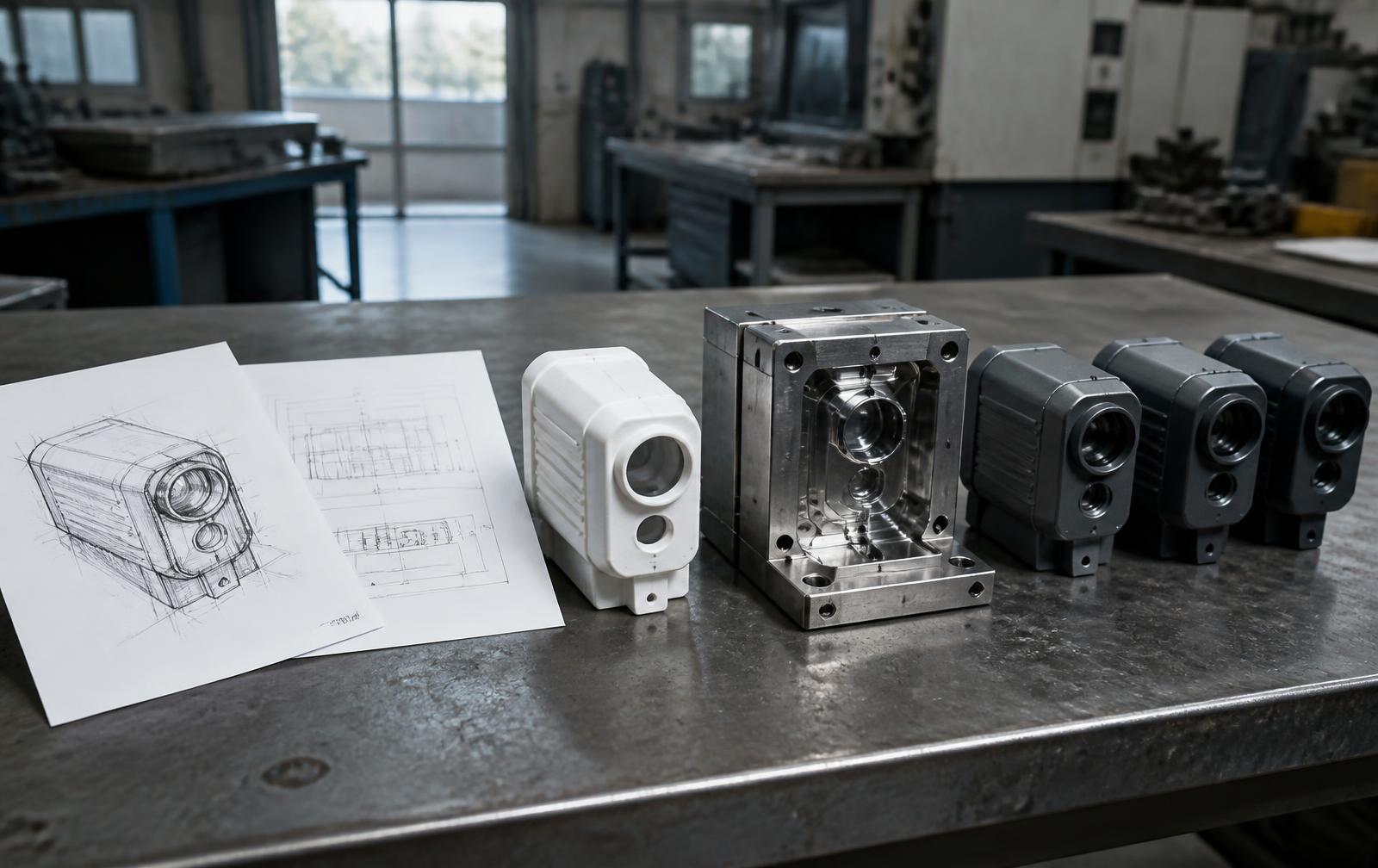
Cost guide
How Much Does Product Development Cost?
What it really takes to go from an idea to a manufacturable product in 2026
Developing a new physical product typically costs $15,000 to $35,000 for a very simple product, $40,000 to $100,000 for a moderate mechanical product, $100,000 to $250,000 for a complex electronic product, and $250,000 or more for a highly regulated or R&D-intensive program. Production tooling and inventory sit on top of those figures.
This page breaks the program into its stages, publishes the ranges we quote for each, and gives you a calculator that brackets your specific product in under two minutes.
- Idea to a manufacturable product
- Stage-by-stage budget split
- Phased funding, not one cheque
Free tool
Estimate your product development cost
Eight questions about the product, where you are starting and how far you want to go. The bracket appears immediately — no email required — and it splits across the development stages a program like yours actually needs.
Question 1 of 8
Where are you starting?
Work already done is the only discount that is always real — we do not price it again.
The sequence
This number covers the whole sequence
Stage 1
Product discovery
Is it worth building? Users, market, feasibility
Priced on this page
See the service →
Stage 2
Concept design
Sketches, directions, the form settled
Priced on this page
See the service →
Stage 3
Engineering & CAD
Parts, materials, drawings, tolerances
Priced on this page
See the service →
Stage 4
Prototype build
Parts made, assembled, wired
Priced on this page
See the service →
Stage 5
Test & iterate
It fails, you learn, version two
Priced on this page
Stage 6
Production
Tooling, suppliers, first run
Priced on this page
See the service →
A development program runs through all six stages. You commit to them one at a time, and each stage produces the information needed to quote the next one properly.
Price a different stage
- Concept design costWhat sketches, directions and a chosen concept cost on their own.
- Product design costDesign and engineering through production-ready CAD, before anything is built.
- Prototype cost calculatorWhat it costs to build the first working unit.
- Industrial design costForm, ergonomics, CMF and surfaced CAD, priced as a service.
What product development costs in 2026
Short answer
Product development in the United States typically costs $15,000 to $35,000 for a very simple product, $25,000 to $60,000 for a simple consumer product, $40,000 to $100,000 for a moderate mechanical product, $60,000 to $150,000 for an electromechanical product, $100,000 to $250,000 for a complex electronic product, $125,000 to $350,000 for a connected or IoT product, $150,000 to $500,000 for a complex industrial system, and $250,000 to $1M or more for highly regulated or R&D-intensive programs. Starting with finished CAD or a working prototype removes 15–35% of that.
Nobody writes one cheque for those numbers. A development program is funded stage by stage — you commit to discovery, then to design, then to prototyping, and each stage produces the information needed to quote the next one properly.
These figures cover engineering services: design, engineering, prototyping, testing and manufacturing preparation. Production tooling, certification fees and first-run inventory are paid to third parties and budgeted separately.
Typical product development budget by complexity (US, 2026)
| Product or project complexity | Typical development budget |
|---|---|
| Very simple product | $15,000 – $35,000 |
| Simple consumer product | $25,000 – $60,000 |
| Moderate mechanical product | $40,000 – $100,000 |
| Electromechanical product | $60,000 – $150,000 |
| Complex electronic product | $100,000 – $250,000 |
| Connected / IoT product | $125,000 – $350,000 |
| Complex industrial system | $150,000 – $500,000+ |
| Highly regulated / R&D intensive | $250,000 – $1M+ |
Very simple product
- Typical development budget
- $15,000 – $35,000
Simple consumer product
- Typical development budget
- $25,000 – $60,000
Moderate mechanical product
- Typical development budget
- $40,000 – $100,000
Electromechanical product
- Typical development budget
- $60,000 – $150,000
Complex electronic product
- Typical development budget
- $100,000 – $250,000
Connected / IoT product
- Typical development budget
- $125,000 – $350,000
Complex industrial system
- Typical development budget
- $150,000 – $500,000+
Highly regulated / R&D intensive
- Typical development budget
- $250,000 – $1M+
Development services only. Production tooling, certification fees, inventory, marketing and distribution are excluded. Certified products add 20–45% of engineering time; medical and regulated programs add 50–90%.
Where the money goes, stage by stage
This is the table the calculator adds up. Your total is the sum of the stages your product actually needs — a mechanical product with no electronics simply skips two rows.
Cost per development stage (US, 2026)
| Stage | Simple | Moderate | Complex |
|---|---|---|---|
| Discovery, requirements and research | $3,000 – $8,000 | $5,000 – $15,000 | $10,000 – $25,000 |
| Concept and industrial design | $5,000 – $15,000 | $10,000 – $25,000 | $20,000 – $50,000 |
| Mechanical engineering and CAD | $5,000 – $15,000 | $15,000 – $35,000 | $30,000 – $75,000 |
| Electronics engineering | $4,000 – $10,000 | $15,000 – $40,000 | $30,000 – $80,000 |
| Firmware and software | $4,000 – $10,000 | $10,000 – $35,000 | $25,000 – $75,000 |
| Prototype fabrication | $1,500 – $5,000 | $5,000 – $20,000 | $15,000 – $50,000 |
| Testing and iteration | $2,000 – $8,000 | $8,000 – $25,000 | $20,000 – $75,000 |
| DFM and manufacturing preparation | $3,000 – $10,000 | $8,000 – $25,000 | $20,000 – $50,000 |
Discovery, requirements and research
- Simple
- $3,000 – $8,000
- Moderate
- $5,000 – $15,000
- Complex
- $10,000 – $25,000
Concept and industrial design
- Simple
- $5,000 – $15,000
- Moderate
- $10,000 – $25,000
- Complex
- $20,000 – $50,000
Mechanical engineering and CAD
- Simple
- $5,000 – $15,000
- Moderate
- $15,000 – $35,000
- Complex
- $30,000 – $75,000
Electronics engineering
- Simple
- $4,000 – $10,000
- Moderate
- $15,000 – $40,000
- Complex
- $30,000 – $80,000
Firmware and software
- Simple
- $4,000 – $10,000
- Moderate
- $10,000 – $35,000
- Complex
- $25,000 – $75,000
Prototype fabrication
- Simple
- $1,500 – $5,000
- Moderate
- $5,000 – $20,000
- Complex
- $15,000 – $50,000
Testing and iteration
- Simple
- $2,000 – $8,000
- Moderate
- $8,000 – $25,000
- Complex
- $20,000 – $75,000
DFM and manufacturing preparation
- Simple
- $3,000 – $10,000
- Moderate
- $8,000 – $25,000
- Complex
- $20,000 – $50,000
Typical durations: 2–4 weeks for discovery, 4–8 weeks for concept and industrial design, 6–14 weeks for engineering, 4–12 weeks for prototyping and 4–12 weeks for testing.
The six things that decide your total
Where you start
Finished CAD removes about 20% of a program. A tested prototype removes about 30%. Work already done is the only discount that is always real.
Launch volume
Under 500 units you can skip hard tooling entirely. Above 50,000 you need hardened multi-cavity tools and a qualified supply chain, and most of the cost lands before the first sale.
Electronics
A custom board with power management, connectivity and firmware roughly doubles a mechanical program and adds a certification path behind it.
Certification
FCC, UL, CE, food contact and children's products add test-lab time and, realistically, one failed test and a redesign round. Budget for that round.
Where it's made
Overseas manufacturing lowers tooling and unit cost and raises what you spend on qualification, samples, travel and oversight. Domestic does the reverse.
Schedule
Cutting a program under six months means committing to tooling before validation finishes. That is a cost risk, not just a schedule one.
How these programs are actually paid for
Almost nobody funds a development program in one go, and nobody should. The right structure is a phased commitment where each stage is quoted from what the previous one produced.
That means your first financial decision is small — usually $3,000 to $15,000 for discovery and concept — and it buys you the information needed to decide whether the rest is worth doing. Founders who lose money on product development almost always lost it by skipping that step and paying for engineering on a product nobody had validated.
- Stage one: discovery and concept. Small, fast, and the cheapest possible way to kill a bad idea.
- Stage two: engineering and a first prototype. This is where the cost of manufacture becomes knowable.
- Stage three: validation and design for manufacture. Fixes found here cost hundreds; found after tooling they cost tens of thousands.
- Stage four: tooling and the first run. Only commit here once the prototype has survived testing.
- The product development processEvery stage explained, in order, with what you get from each.
- Product design costDesign and engineering through production-ready CAD.
- Prototype cost calculatorWhat it costs to build the first working unit.
Development cost versus design and prototype cost
If you only need to price part of the journey, price that part. Each of these pages covers a different scope, and the calculators do not overlap.
| Question | Scope | Typical range |
|---|---|---|
| What does concept design cost? | Research, sketches, a chosen direction | $1,500 – $25,000 |
| What does product design cost? | Concept through production-ready CAD | $5,000 – $150,000+ |
| What does a prototype cost? | Building the first working unit | $1,500 – $150,000 |
| What does product development cost? | Everything, through a manufacturable product | $15,000 – $500,000+ |
What does concept design cost?
- Scope
- Research, sketches, a chosen direction
- Typical range
- $1,500 – $25,000
What does product design cost?
- Scope
- Concept through production-ready CAD
- Typical range
- $5,000 – $150,000+
What does a prototype cost?
- Scope
- Building the first working unit
- Typical range
- $1,500 – $150,000
What does product development cost?
- Scope
- Everything, through a manufacturable product
- Typical range
- $15,000 – $500,000+
- Product design costDesign and engineering through production-ready CAD.
- Prototype cost calculatorWhat it costs to build the first working unit.
- Concept design costWhat the sketching and direction-setting stage costs on its own.
Questions
Frequently asked questions
How much does it cost to develop a new product?
Typically $15,000 to $35,000 for a very simple product, $25,000 to $60,000 for a simple consumer product, $40,000 to $100,000 for a moderate mechanical product, $60,000 to $150,000 for an electromechanical product, $100,000 to $250,000 for a complex electronic product, and $250,000 or more for a highly regulated or R&D-intensive program.
Do I have to pay it all up front?
No. Programs are funded stage by stage. Your first commitment is usually $3,000 to $15,000 for discovery and concept, and each later stage is quoted from what the previous one produced.
Does the estimate include production tooling?
No. The bands cover development services — design, engineering, prototyping, testing and manufacturing preparation. Injection mould tooling, certification fees and first-run inventory are paid to third parties and typically add a third again for a moulded product at moderate volume.
What is the cheapest way to develop a product?
Validate before you engineer, keep the feature list short, use off-the-shelf components wherever the product is not differentiated, and launch with a pilot run rather than production tooling. Those four decisions routinely halve a first-year budget.
How long does product development take?
Six to ten months for a simple mechanical product, nine to fifteen months for a multi-part consumer product, and twelve to twenty-four months for powered and connected devices including certification.
Does this include marketing and packaging?
No. The ranges cover design, engineering, prototyping, testing, tooling and the first production run. Branding, packaging artwork, photography and launch marketing are separate, and typically add 10–20%.
Where to go next
- Product design costDesign and engineering through production-ready CAD.
- Prototype cost calculatorWhat it costs to build the first working unit.
- Concept design costWhat the sketching and direction-setting stage costs on its own.
- The product development processEvery stage explained, in order, with what you get from each.
- Industrial design servicesForm, ergonomics, CMF and surfaced CAD — scope and pricing.