Industrial design
Industrial Design Services for Physical Products
Form, ergonomics, materials and finish — drawn so a factory can build it
Industrial design is the discipline that decides what a product looks like, how it feels in the hand and how its parts go together. We do it as part of a full development team, so the shape that comes out of the studio is one our own engineers have already checked against moulding, assembly and cost.
We have designed and shipped consumer goods, outdoor gear, medical and lab equipment, packaging and industrial machinery — 88 documented projects, most of them for founders and small manufacturers rather than corporate design departments.
- In-house ID, engineering and prototyping
- 88 shipped product projects
- US-based team, national clients
- Files and IP transfer to you
The sequence
Where industrial design sits in the process
Stage 1
Product discovery
Is it worth building? Users, market, feasibility
See the service →
Stage 2
Concept design
Sketches, directions, the form settled
Priced on this page
See the service →
Stage 3
Engineering & CAD
Parts, materials, drawings, tolerances
See the service →
Stage 4
Prototype build
Parts made, assembled, wired
See the service →
Stage 5
Test & iterate
It fails, you learn, version two
Stage 6
Production
Tooling, suppliers, first run
See the service →
Industrial design resolves how the product looks, feels and is used. Mechanical engineering, prototyping and production are separate stages with separate costs.
Price a different stage
- Concept design costWhat sketches, directions and a chosen concept cost on their own.
- Product design costDesign and engineering through production-ready CAD, before anything is built.
- Prototype cost calculatorWhat it costs to build the first working unit.
- Product development costThe whole program — idea through first production run.
What industrial design covers
Short answer
Industrial design is the design of a physical product's form, ergonomics, materials, colour and finish, resolved in 3D CAD so it can be engineered and manufactured. It sits between the product idea and mechanical engineering: the industrial designer decides how the product looks and is used, the engineer makes it work and survive.
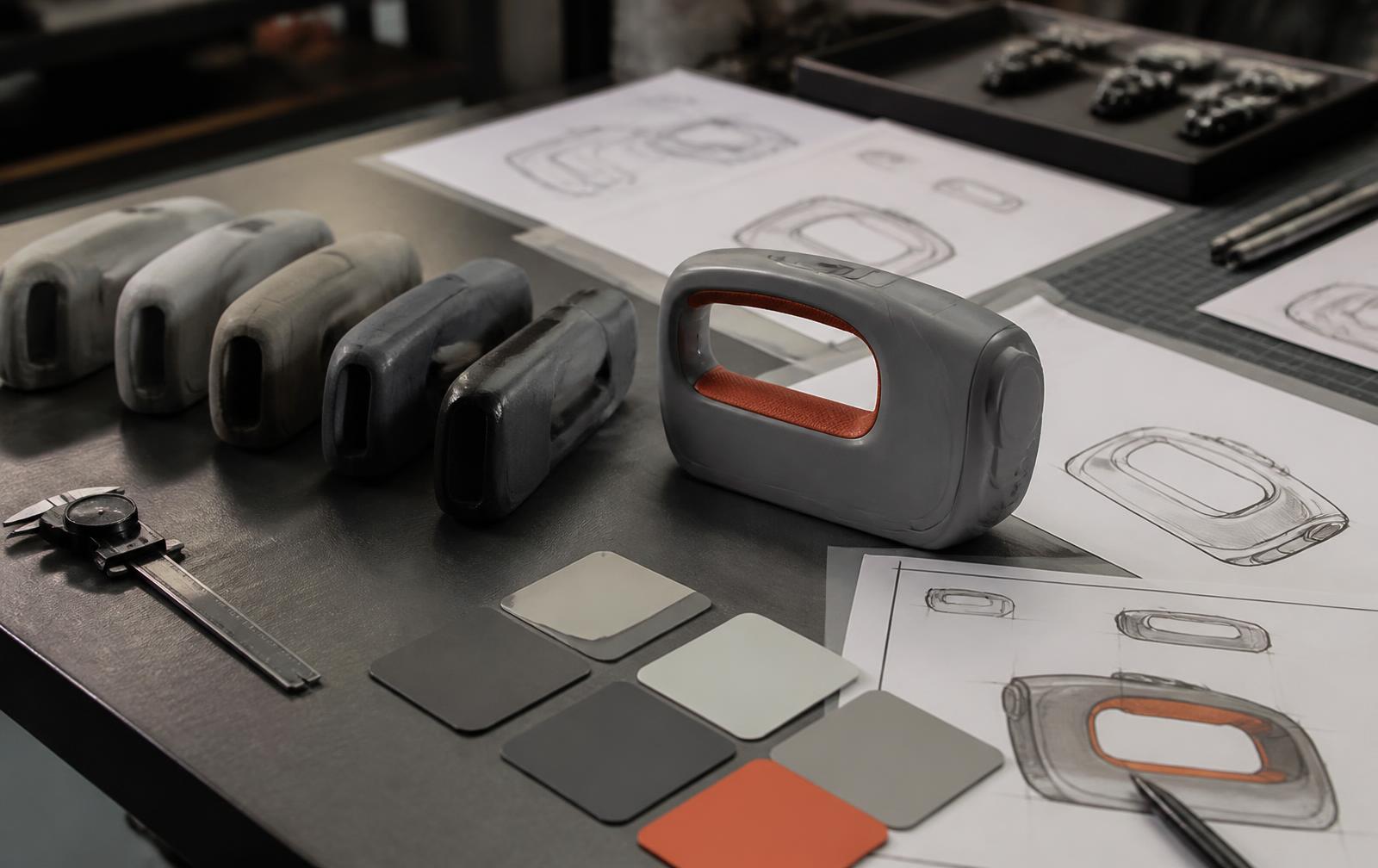
- Form development — sketching and 3D exploration of the shape, proportion and stance of the product.
- Ergonomics and human factors — grip, reach, button placement, weight distribution, one-handed use, glove use.
- CMF — colour, material and finish specification, including texture calls and paint or plating callouts.
- User interface layout — where controls, screens, ports and indicators live, and how the product reads at a glance.
- Design for manufacture — draft, wall thickness, parting lines and part-count reduction built into the shape, not bolted on later.
- Brand expression — making the object look like it came from your company, and applying logos, graphics and packaging consistently.
What you receive
Every industrial design engagement ends with files someone else could build from, not a mood board.
Sketch sheets
Six to twenty explored directions grouped by approach, so the decision is made with real alternatives on the table.
Surfaced 3D CAD
The chosen direction modelled at real dimensions with internal volumes reserved for electronics, battery and fasteners.
Photoreal renders
Studio and in-context images for investors, retail buyers, crowdfunding pages and pre-launch marketing.
CMF specification
Named colours, materials, textures and finishes with supplier-usable callouts, not adjectives.
Appearance model
A physical model of the final form when the product has to be held, photographed or shown at a trade show.
Engineering handoff pack
Sections, a rough bill of materials and a written list of what mechanical engineering has to resolve next.
How an industrial design project runs
Typical five-stage industrial design sequence for a consumer or light industrial product.
| Stage | What happens | Typical duration |
|---|---|---|
| 1. Brief and benchmarking | We fix the user, the job, the target cost and the size envelope, then tear down what already exists in the category. | 3–5 days |
| 2. Sketch exploration | Wide, fast form exploration — deliberately more directions than you will use, reviewed against the brief. | 1–2 weeks |
| 3. Direction selection | Directions scored on cost, manufacturability, user fit and IP risk. Usually two survive into 3D. | 2–4 days |
| 4. Surfacing and CMF | The chosen form is modelled in 3D at real dimensions; colour, material and finish are specified against it. | 2–3 weeks |
| 5. Renders, models and handoff | Photoreal renders, an appearance model where useful, and the pack mechanical engineering picks up from. | 1–2 weeks |
1. Brief and benchmarking
- What happens
- We fix the user, the job, the target cost and the size envelope, then tear down what already exists in the category.
- Typical duration
- 3–5 days
2. Sketch exploration
- What happens
- Wide, fast form exploration — deliberately more directions than you will use, reviewed against the brief.
- Typical duration
- 1–2 weeks
3. Direction selection
- What happens
- Directions scored on cost, manufacturability, user fit and IP risk. Usually two survive into 3D.
- Typical duration
- 2–4 days
4. Surfacing and CMF
- What happens
- The chosen form is modelled in 3D at real dimensions; colour, material and finish are specified against it.
- Typical duration
- 2–3 weeks
5. Renders, models and handoff
- What happens
- Photoreal renders, an appearance model where useful, and the pack mechanical engineering picks up from.
- Typical duration
- 1–2 weeks
Simple single-part accessories compress this to two or three weeks; powered devices with a mechanism and a PCB typically run seven to ten weeks because stages 2–4 iterate against electrical constraints.
Industrial design cost
Short answer
Industrial design for a straightforward consumer product typically runs $4,000–$12,000; a powered device with a mechanism, screen or PCB usually lands between $12,000 and $30,000. Full development including engineering, prototyping and production files runs higher.
Indicative industrial design ranges. Quotes are fixed-scope, not hourly estimates.
| Product type | Industrial design | Typical timeline |
|---|---|---|
| Single-part accessory or housing | $4,000 – $8,000 | 2–3 weeks |
| Multi-part consumer product | $8,000 – $15,000 | 4–6 weeks |
| Powered device with PCB and UI | $15,000 – $30,000 | 7–10 weeks |
| Equipment, cabinet or machine skin | $18,000 – $40,000 | 8–12 weeks |
| Restyle of an existing product | $3,500 – $9,000 | 2–4 weeks |
Single-part accessory or housing
- Industrial design
- $4,000 – $8,000
- Typical timeline
- 2–3 weeks
Multi-part consumer product
- Industrial design
- $8,000 – $15,000
- Typical timeline
- 4–6 weeks
Powered device with PCB and UI
- Industrial design
- $15,000 – $30,000
- Typical timeline
- 7–10 weeks
Equipment, cabinet or machine skin
- Industrial design
- $18,000 – $40,000
- Typical timeline
- 8–12 weeks
Restyle of an existing product
- Industrial design
- $3,500 – $9,000
- Typical timeline
- 2–4 weeks
What pushes a project to the top of a band is almost always part count, regulated use, or a shape that has to survive a drop test — rarely the styling itself.
- Concept design cost and timelineHow the earlier concept stage is priced and what changes the number.
Industrial design vs concept design vs engineering
These three get used interchangeably and they are not the same purchase. This is the practical difference.
Most projects need all three, in that order. Where teams get hurt is buying industrial design alone from a studio with no engineers, then discovering during tooling that the surfaces cannot be moulded at the target cost. We run all three under one roof, so that conversation happens in week two rather than month six.
| Concept design | Industrial design | Mechanical engineering | |
|---|---|---|---|
| Question it answers | Should this product exist, and in what form? | What does it look like and how is it used? | Will it work, survive and go together? |
| Main output | Sketches, concept CAD, a recommendation | Surfaced CAD, CMF spec, renders, appearance model | Detailed CAD, tolerances, drawings, DFM package |
| Who acts on it | You and your investors | Engineering and marketing | The tool maker and the factory |
| Typical spend | $2,500 – $12,000 | $4,000 – $30,000 | $8,000 – $45,000 |
Question it answers
- Concept design
- Should this product exist, and in what form?
- Industrial design
- What does it look like and how is it used?
- Mechanical engineering
- Will it work, survive and go together?
Main output
- Concept design
- Sketches, concept CAD, a recommendation
- Industrial design
- Surfaced CAD, CMF spec, renders, appearance model
- Mechanical engineering
- Detailed CAD, tolerances, drawings, DFM package
Who acts on it
- Concept design
- You and your investors
- Industrial design
- Engineering and marketing
- Mechanical engineering
- The tool maker and the factory
Typical spend
- Concept design
- $2,500 – $12,000
- Industrial design
- $4,000 – $30,000
- Mechanical engineering
- $8,000 – $45,000
- Concept designThe full guide to turning an idea into sketches, CAD and renders.
- All development servicesResearch, design, engineering, prototyping and short-run production.
Industrial design work we have shipped
Six projects where the form, ergonomics and finish were the hard part.
- Product development portfolioProducts we designed, engineered and manufactured.
Why clients pick us over a design-only studio
- Engineers sit in on form reviews, so shapes get a manufacturability check the same week they are drawn.
- We prototype in house — a form study can be printed and held within days rather than shipped out and waited on.
- We are based in Ruston, Louisiana, not a coastal design capital, so rates reflect a lower overhead without offshoring the work.
- One team carries the product from sketch through short-run production, so nothing is redrawn at each handoff.
- Files, CAD and IP transfer to you on final payment, and we sign an NDA before anything is shared.
- Rapid prototypingHow we build working prototypes and what they cost.
- All development servicesResearch, design, engineering, prototyping and short-run production.
- Product development portfolioProducts we designed, engineered and manufactured.
Questions
Frequently asked questions
What do industrial design services include?
Form development, ergonomics and human factors, colour/material/finish specification, control and interface layout, design for manufacture and brand expression — delivered as sketches, surfaced 3D CAD, renders, a CMF spec and an engineering handoff pack.
How much do industrial design services cost?
A single-part accessory typically runs $4,000–$8,000, a multi-part consumer product $8,000–$15,000, and a powered device with a PCB and user interface $15,000–$30,000. We quote fixed scope rather than hourly.
What is the difference between industrial design and product design?
In practice they overlap. Industrial design is the narrower term for the form, ergonomics and finish of a physical object; product design is often used to mean the whole effort including engineering and manufacturing readiness. We deliver both, so the label matters less than the scope you actually need.
Do I need industrial design if my product is purely functional?
Usually yes, but a lighter version. Even a machine skin or a lab instrument has grip points, service access, control layout and part-count decisions that determine cost and usability. What you can skip is extended styling exploration.
How long does an industrial design project take?
Two to three weeks for a simple accessory, four to six weeks for a multi-part consumer product and seven to ten weeks for a powered device. Feedback speed on your side is the biggest variable; projects reviewed within two days of each milestone finish about a third faster.
Do you work with clients outside Louisiana?
Yes. Most of our clients are elsewhere in the United States. The work runs on shared files, weekly reviews and shipped prototypes, and rates are the same wherever you are.
Who owns the design files?
You do. Sketches, CAD, renders and CMF documentation transfer to you on final payment, and an NDA is signed before any material changes hands.